PART 1
"Honestly, if my mom didn’t live with us, this house would breathe differently."
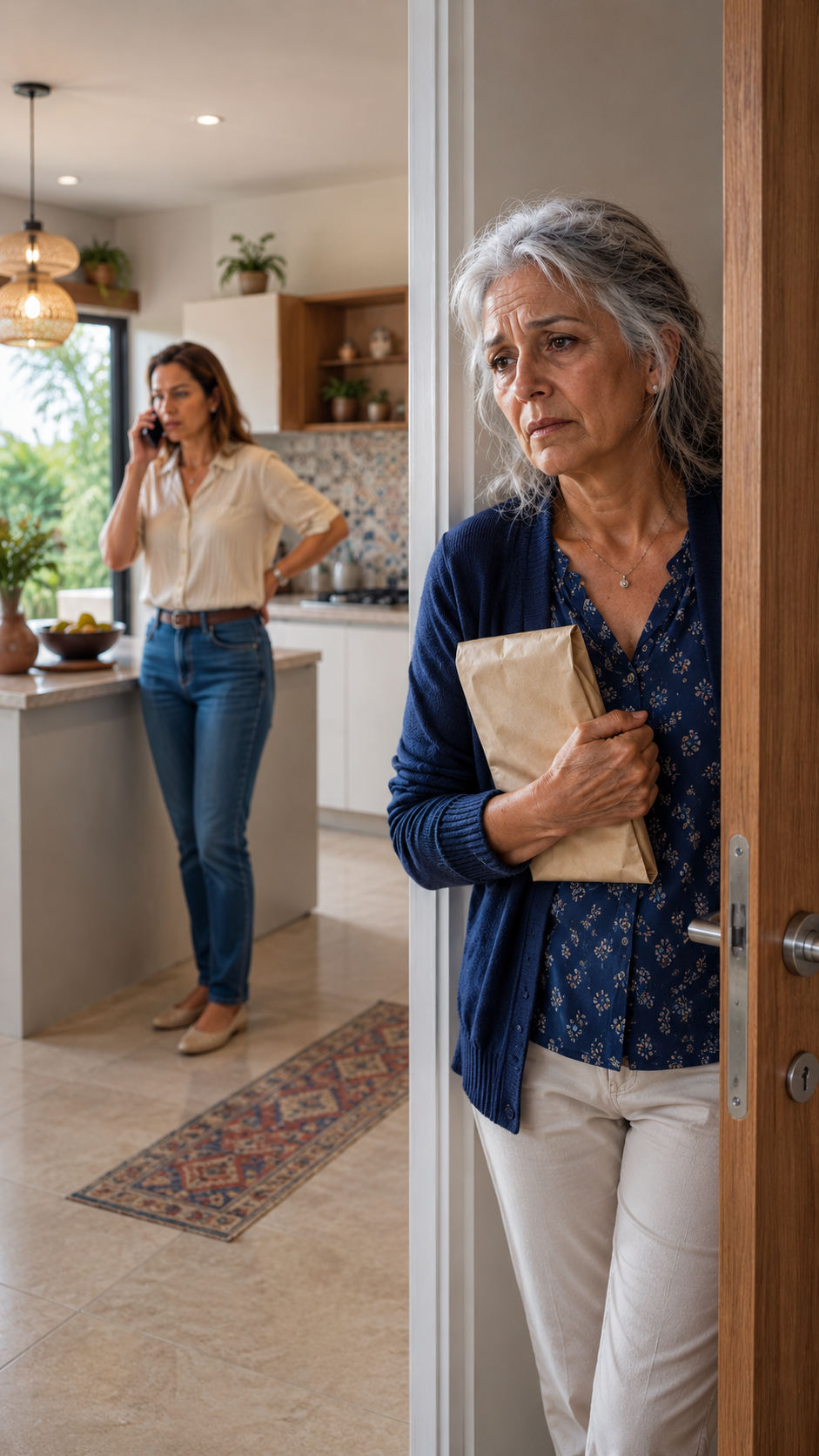
Doña Mercedes Rivas heard that phrase while standing in the hallway, a bag of medicine in one hand and a cardiologist's receipt tucked inside her sweater. She made no noise. She didn’t cough. She didn’t move.
She just stood there, staring at the slightly open kitchen door while her daughter Claudia spoke on the phone as if she were confessing a tragedy.
"I love her, of course I love her," Claudia continued, "but it’s been 3 years, man. 3 years of having her here, of seeing her sitting in the living room, of hearing her complaints, of arranging everything for her. Sometimes I feel like my life is stuck because I’m taking care of her."
Mercedes was 69 years old. She had come to this house in Metepec after her husband, don Aurelio, passed away. Claudia had told her then that she couldn’t stay alone in the town of Tenancingo, that a mother should be close to her own, that her grandchildren needed her.
At first, it was all hugs.
The small room next to the patio, which had once held old bicycles and Christmas boxes, became "Mom’s room." Mercedes accepted it without protest. She had just buried the man she had shared more than 40 years with, and any roof with familiar voices felt like refuge.
But the refuge began to feel like a corner.
First, they stopped inviting her to the movies because "she tired easily." Then they stopped taking her out for Sunday lunches because "it was too much trouble." After that came the silences when she walked into the kitchen.
Still, Mercedes kept getting up at 5:30. She prepared lunches for Emiliano and Renata, ironed uniforms, swept the patio, monitored the mole so it wouldn’t stick, welcomed the gas man, and paid part of the electricity and internet bills with her pension.
No one asked for it, but everyone used it.
Her son-in-law, Mauricio, barely greeted her. The kids cared for her, but between school, their cell phones, and their friends, they had gotten used to seeing her as just part of the house. Like a chair. Like a flower pot. Like something that was always there.
That afternoon, Mercedes had gone to the doctor alone. The cardiologist had advised her to rest, reduce stress, and get new tests. She thought of telling Claudia at dinner. She thought her daughter might worry.
But then she heard the call.
"Besides, Mom has her savings," Claudia said, lowering her voice. "If she agrees to sign the power of attorney, we can settle her in a quiet place and use that money to breathe a little. It’s not stealing, it’s organizing the family."
Mercedes felt the floor drop beneath her.
She didn’t cry. She didn’t scream. She didn’t go in to confront.
She just slowly returned to her room, locked the door for the first time in 3 years, and took out of a metal box the notebook where she kept her accounts.
She had 148,000 pesos. And she had just understood that she was not just a burden.
They were also planning to decide for her.
That night, she had chicken soup for dinner without saying a word. She looked at Claudia, at Mauricio, at Emiliano and Renata as if she were saying goodbye without anyone noticing.
When she turned off the light, Mercedes opened her eyes in the darkness.
No one in that house could imagine what was about to happen when morning came.
PART 2
At 8:10 the next morning, Mercedes left with her shopping bag, her blue shawl, and a calm that felt like exhaustion.
Claudia didn’t even look up from her laptop.
"Mom, if you’re going to the market, bring back tomatoes. And tell the guy from the tortilla shop to put us down for 2 kilos."
Mercedes looked at her from the door.
"I’m not going to the market today, daughter."
"Then where?"
"To sort a few things out."
Claudia made an exasperated gesture, as if the answer were wasting her time.
"Fine, but don’t take too long. I have a meeting at 2 and Renata gets out early."
Mercedes didn’t answer. She softly closed the door.
First, she went to the bank in downtown Toluca. She had been there many times to deposit, pay bills, check her pension. But that day, she walked straight to the window.
"I want to withdraw my 148,000 pesos," she said.
The cashier looked at her carefully.
"All of it, ma’am?"
"All of it."
They offered to let her keep a part, invest another, think about it. Mercedes shook her head. She wasn’t confused. She wasn’t acting out of a tantrum. She was reclaiming the only thing that remained intact: her will.
Next, she went to see Licenciado Ortega, a notary known by don Aurelio. He welcomed her respectfully, offered her coffee, and listened without interrupting.
Mercedes changed her will.
Claudia would still receive a part because a mother doesn’t easily erase blood. But she would no longer be the primary heir. Part of it would go to Emiliano and Renata when they turned 25, as long as they received it without intermediaries. Another part would be for a retirement home for elderly women in Zinacantepec, where she had heard stories sadder than her own.
She also revoked any old authorization Claudia might use over her accounts.
"Are you sure, Doña Mercedes?" the notary asked.
She signed with a firm hand.
"More sure than ever."
As she left, she bought a new notebook, a lock, and a pot of red geraniums. Then she took a taxi to San Mateo Atenco, where her friend Petra had found her a small apartment above a bakery.
The place wasn’t luxurious. It had one bedroom, a narrow kitchen, a window facing the street, and a rooftop that caught the afternoon sun. It smelled of sweet bread and soap.
Mercedes entered, touched the wall slowly, and smiled for the first time in weeks.
"No one is going to keep me like an old broom here," she murmured.
Petra helped her buy a bed, 4 plates, a pot, a wooden table, and cream-colored curtains. She even lent her a truck to move her things when the time came.
But Mercedes didn’t leave that very day.
She returned to Claudia’s house as if nothing had happened. For 10 days, she observed.
She no longer washed others’ clothes. She no longer prepared full dinners. She no longer rushed when Mauricio yelled that he couldn’t find his shirts. She no longer left money on the electricity bill.
The house began to creak.
"Grandma, didn’t you make chilaquiles?" Emiliano asked one Saturday.
"No, sweetheart. I rested today."
The boy frowned, confused. Renata searched for her un-ironed uniform and threw a tantrum. Mauricio complained because the sink was full.
Claudia exploded in the kitchen.
"Mom, seriously, what’s wrong with you? You’ve been acting so strange lately."
Mercedes was washing a cup. She dried it carefully.
"Nothing, daughter. I’m just doing less."
"Less? And who’s going to do the rest?"
Mercedes looked her in the eyes.
"Whoever lives here."
Claudia froze but didn’t ask further. Perhaps because deep down she knew something was broken.
On Friday morning, when everyone had gone, Petra arrived with the truck. Mercedes packed 3 boxes: clothes, photos of don Aurelio, documents, her rosary, 2 woven blankets, and the recipe notebook that Claudia never asked her to learn.
She left the room clean. On the bed, she placed the key to the house.
On the dining table, she left a manila envelope.
Inside were 3 things: a letter, copies of the bills she had paid over the last 3 years, and a simple copy of the document revoking any power over her accounts.
The letter said:
"Claudia: I heard what you said. I also heard what you were planning. You said your life would breathe differently without me. From today, I give you that air. Don’t look for me to ask me to come back, to ask me for money, or to ask me for signatures. I will be fine. I hope one day you understand that a mother helps out of love, not because she’s obligated to disappear so others can live comfortably. Mom."
When Mercedes closed the door, she didn’t look back.
At 7:46 that night, Claudia arrived shouting from the entrance.
"Mom?"
There was no answer.
Renata found the key on the bed. Mauricio opened the envelope. Claudia read the letter standing by the table and turned pale.
"It can’t be," she whispered.
Mauricio took the receipts.
Electricity. Water. Internet. Gas. Groceries. The kids’ uniforms. Medicines. Boiler repair. School contributions. All with small notes from Mercedes, dates, and amounts.
For 3 years, Mercedes hadn’t been a burden.
She had been the silent support of the house.
Claudia began to call her. Once. Twice. Ten times. Mercedes didn’t answer.
That night, there was no dinner. Emiliano had cereal. Renata cried because no one found her physical education shirt. Mauricio had to order food through an app and got angry when he saw the price.
"Your mom left as if we were monsters," he said.
Claudia looked at him with newfound rage.
"And what were we, Mauricio?"
He fell silent.
The hardest blow came 3 days later when Claudia tried to use the shared account card to pay for school. The transaction was rejected. She went to the bank and was told that Mercedes had canceled all authorizations.
"But I’m her daughter," Claudia said.
The executive looked at her seriously.
"And she is the account holder."
That phrase hit her like a slap.
Claudia began to understand too late that she had confused trust with ownership. She thought that just because she was a daughter, she had the right to dispose of her mother’s life. She thought an elderly woman should adapt, stay silent, serve, and be grateful for a roof.
The first week without Mercedes was a disaster.
Mauricio was late 4 days because he couldn’t find clean shirts. Renata failed an assignment because no one checked her poster. Emiliano got into a fight at school and asked to speak to his grandmother, not his mom.
The house, which according to Claudia was going to breathe better, became heavier.
One afternoon, while searching for papers in the empty room, Claudia found a bag with medical studies. There was the cardiologist’s diagnosis, the indication for rest, and a note written by Mercedes:
"Tell Claudia when I have time."
Claudia sat on the empty bed and cried with her face in her hands.
She didn’t know her mother was sick.
She didn’t know because she never asked.
Two months passed before Emiliano discovered where Mercedes lived. He saw her by chance leaving the bakery in San Mateo with a bag of sweet rolls. He followed her from a distance, embarrassed, to the apartment.
When he knocked on the door, Mercedes opened and stood still.
"Grandma," he said, his voice broken. "I’m not here to take you away. I’m here to see you."
Mercedes felt a knot in her throat.
She let him in.
The boy looked at the small table, the geraniums, the photo of don Aurelio next to a candle, the clean curtains.
"It’s nice," he said. "It feels peaceful."
"It is."
Mercedes made him hot chocolate. Emiliano didn’t ask for food, money, or favors. He just talked. He told her that the house felt strange, that his mom cried in the bathroom, that his dad was washing dishes even though he complained, that Renata was keeping a rice pudding recipe like it was a treasure.
"Do you hate me, Grandma?" he suddenly asked.
Mercedes took his hand.
"No, sweetheart. Kids learn what they see. But they can also learn differently."
From then on, Emiliano visited her every Sunday. Sometimes he brought bread. Sometimes he just brought homework. Mercedes helped him, but no longer out of obligation. Now it was because she wanted to.
Claudia found out about the visits and, for the first time, didn’t demand. She didn’t go knock on the door making a scene. She didn’t yell that she was her mother. She didn’t bring Mauricio to pressure.
For 8 months, she wrote letters.
The first said: "Mom, please come back."
Mercedes didn’t respond.
The third said: "I don’t know how to do this without you."
Mercedes didn’t respond either.
The tenth was different.
"Mom: I understand now that you didn’t leave to punish us, you left to save yourself. It hurts me to accept that I used you. It hurts me more to accept that I planned to decide on your money as if your life no longer belonged to you. I have no defense. Only shame. If one day you allow me to see you, I won’t ask you to come back. I’ll ask you for forgiveness."
Mercedes read that letter three times. She cried. Not out of weakness. She cried because love also hurts when it learns late.
The day she turned 70, she received a message from Claudia.
"Can we bring you flowers? Just 1 hour. Without asking for anything."
Mercedes looked around her apartment. Her geraniums were in bloom. The table had a new tablecloth. On the stove, coffee was boiling. She was no longer the woman hidden in the back room.
She was Mercedes Rivas, a widow, a mother, a grandmother, and the owner of her peace.
She replied:
"You can come. 1 hour. If anyone crosses my limits, the visit is over."
They arrived on time.
Claudia brought yellow flowers. Mauricio carried a cake. Renata had a notebook where she had copied the rice pudding recipe. Emiliano smiled nervously.
Claudia didn’t rush to hug her. She stood at the door, her eyes filled with tears.
"Mom… I’m sorry."
Mercedes looked at her long. She saw the girl who once fell asleep on her lap. She saw the woman who had hurt her. She also saw someone who was finally beginning to understand.
"Come in, Claudia."
They sang Las Mañanitas. They ate cake. They talked about simple things: school, plants, the weather, the bakery downstairs. No one mentioned money. No one asked for signatures. No one talked about a return.
When the hour was up, Claudia stood up.
"I don’t want you to come back," she said in a trembling voice. "Well, I do want you to come back, but I understand now that wanting doesn’t give me the right. I just want to learn to be your daughter without taking away your life."
Mercedes took a deep breath.
"Then start by respecting my door."
Claudia nodded.
From that day on, the relationship changed. It didn’t become perfect. The wounds don’t disappear just because someone says sorry. But Claudia called every 15 days. Mauricio learned to take care of his house. Renata visited Mercedes to cook. Emiliano kept coming on Sundays, not out of necessity, but out of affection.
Mercedes never returned to live with them.
And that was the lesson that hurt them the most.
Because sometimes a family only values a mother when she stops being available. When the chair is left empty. When the food no longer appears. When the bills arrive complete. When the silence of a tired woman weighs more than all the complaints.
Mercedes continued to love Claudia.
But she no longer abandoned herself for her.