PART 1
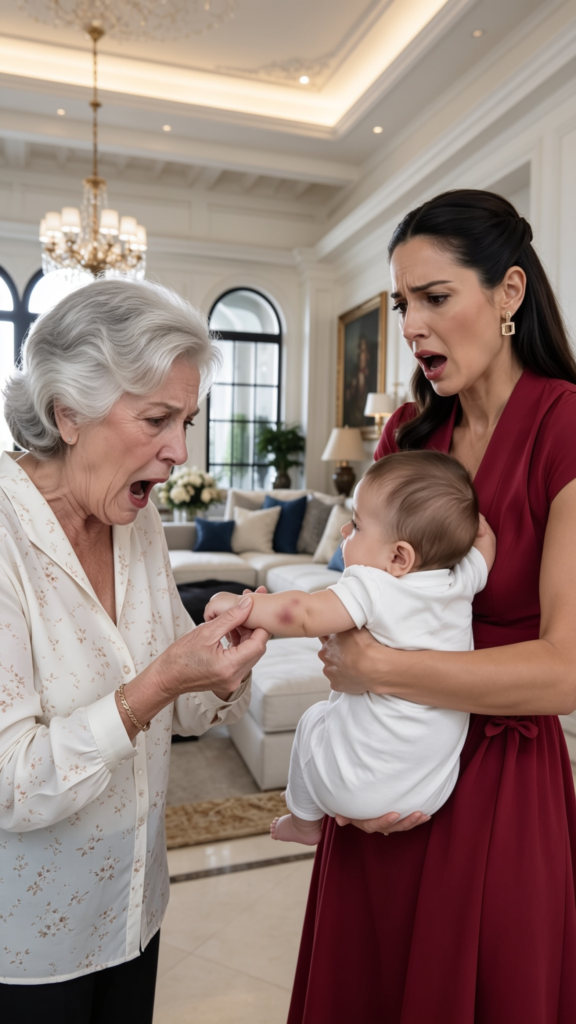
—Don’t return that child to your husband —Doña Aurora said, her voice cracking as she barely touched her grandson’s little hand.
Claudia froze in the middle of the room, with Emiliano pressed against her chest. The boy was one year old, barely babbling incoherent sounds, and everyone always said he was too quiet, too calm.
But that afternoon, as soon as his grandmother brushed his wrist, Emiliano flinched as if expecting a tug.
—Mom, what’s wrong with you? —Claudia protested—. You scared him.
Doña Aurora was not a dramatic woman. She had worked for 28 years as a pediatric nurse at the IMSS in Puebla. She had seen fevers, fractures, negligence, and mothers crying in white hallways. That’s why a horrible chill ran through Claudia when she saw her turn pale.
—Look closely, daughter —Aurora whispered—. But really look.
Claudia lowered her gaze. At first, she only saw the soft skin of her baby, his chubby fingers, his thumb hidden in his palm. Then her mother turned his wrist toward the light from the window.
They appeared.
Fine, almost white marks were circling Emiliano’s skin like tight little rings. They weren’t scrapes. They weren’t toy bruises. They were lines too even, too clean, as if something had held him for long stretches.
Near his thumb, there was also a dark spot, almost closed.
—He must have hurt himself with the walker —Claudia said, though her voice sounded hollow.
Doña Aurora looked at her with a sadness that didn’t need to scream.
—A walker doesn’t leave marks from grabbing. And a baby doesn’t raise his hands to defend himself if he hasn’t learned to do so.
Emiliano buried his face in Claudia’s neck. He wasn’t crying loudly. It was a low, tired whimper, like someone who had cried too much without anyone understanding.
Claudia had taken almost a year to bring him to her mother’s house. Not out of a fight, but out of exhaustion. After giving birth, everything turned into work, diapers, sleepless nights, and bills to pay.
Besides, Iván, her husband, always repeated the same thing:
—Your mom is going to interfere. Better for the child to have a routine at home.
Iván worked from the apartment as a freelance accountant. Claudia returned to the dental clinic when Emiliano turned four months old. The idea seemed perfect: he would take care of the child, and they would save on daycare.
Many told her what a blessing it was to have a husband like that.
For months, Claudia tried to believe it.
—Who takes care of him while you work? —Aurora asked.
—Iván —Claudia replied, feeling her throat constrict—. You know.
Aurora took a deep breath.
—Then let’s go to the hospital. Today.
—Mom, you can’t accuse him over some marks.
—I’m not accusing. I’m observing. And you’re seeing it too, even if it scares you.
Claudia’s phone vibrated.
It was Iván.
“Are you here yet? Don’t be late. Emiliano’s nap is due.”
Claudia read that phrase three times.
Nap.
She remembered the afternoons when she came home to find her son deeply asleep, mouth slightly open, eyes puffy. Iván always said it was normal, that he was growing, that “babies are like that.”
Then the phone vibrated again.
Emiliano raised both hands and covered his face when he heard the sound.
Claudia felt the world shatter.
Her son couldn’t speak, but he had just told her something terrible.
PART 2
Doña Aurora didn’t ask for anyone’s permission. She grabbed her bag, a little blanket for the boy, and the car keys.
Claudia walked behind her as if she were in a thick dream. She wanted to convince herself that it was all an exaggeration, a misunderstanding, one of those stories people share on Facebook to scare first-time moms.
But Emiliano was still stuck to her chest, his little hands hidden.
At the General Hospital of the South, they were taken to pediatric emergency. A bespectacled doctor, Dr. Salinas, examined the child without making gestures, but her silence was worse than any alarm.
She looked at his wrists, his ankles, his back, his ribs. A nurse took photographs with a ruler next to each mark. Then they asked for blood tests and an X-ray.
—We’ll also do a toxicology test —the doctor said.
Claudia blinked, confused.
—Toxicology? He’s a baby.
—Exactly for that reason —the doctor replied—. You mentioned excessive sleepiness.
Doña Aurora closed her eyes in pain.
Claudia remembered the prepared bottle on the table. She recalled Iván saying: “Don’t wake him, he finally calmed down.” She remembered that when Emiliano cried a lot, he would close the bedroom door and say: “Leave him to me, you spoil him too much.”
The phone wouldn’t stop vibrating.
“Where are you?”
“Claudia, answer.”
“Don’t put on your theatrics.”
“Your mom always wanted to separate us.”
A social worker named Maribel saw the messages and spoke carefully.
—You don’t have to answer him right now.
—He’s going to get mad —Claudia murmured without thinking.
The silence that followed hit her harder than her own words.
Iván had never hit her. That’s why she had normalized everything else: him reviewing her expenses, criticizing her friends, saying her mom was nosy, getting upset if Claudia arrived twenty minutes late.
If she doubted, he said she was crazy.
If she cried, he said she was intense.
If Emiliano cried, he said the boy needed “discipline.”
Nearly two hours later, Dr. Salinas returned with a stern face.
—We found traces of a sedating antihistamine at levels not appropriate for a baby of his age.
Claudia shook her head.
—I didn’t give him anything. Nothing. I swear.
—There’s also an old injury on a rib —the doctor added—. It’s healing, but it doesn’t look like a simple fall.
Doña Aurora let out a sob.
Claudia stared at the wall, where a drawing of a sun was taped. She thought of all the times she kissed Emiliano’s sleeping forehead believing he was at peace.
He wasn’t at peace.
He was dimmed.
An officer named Ramírez arrived shortly after. He didn’t enter accusing. He calmly asked who was taking care of the child, who had access to medications, and if Claudia felt safe returning home.
Before she could respond, another message arrived.
“Enough already. Bring my son.”
Claudia looked at those words.
He didn’t say “What’s wrong with Emiliano?”
He didn’t say “Is he okay?”
He said “my son,” as if the child were an object he could claim.
With Claudia’s permission, Maribel read the messages. The officer did too.
—You’re not going back alone —Ramírez said—. And the child isn’t staying with the father until this is clarified.
Doña Aurora touched her daughter’s shoulder.
—Daughter, when Emiliano was born, didn’t Iván want nobody to hold him?
Claudia swallowed.
—He said it was for hygiene.
—And didn’t he gradually distance you from everyone?
The question dropped like a stone.
Yes.
Iván had made visits uncomfortable. He had canceled family meals. He had changed the original pediatrician because, according to him, “that doctor scared for everything.” He chose one who checked quickly, prescribed without hesitation.
When Claudia searched for the pediatrician’s name on her phone, she found something worse: an old photo Iván had sent her months ago.
Emiliano was sleeping in the crib. There was a blue ribbon on his wrist.
Back then, Claudia thought it was a toy ribbon.
The nurse enlarged the image.
Doña Aurora covered her mouth.
Officer Ramírez said:
—We need to check the home. This may have started long before.
Claudia didn’t return to her apartment as a wife. She returned as a mother.
The patrol followed Aurora’s car. Emiliano slept in his seat, but Claudia could no longer look at that sleep without fear.
The apartment was in a quiet private area of Cholula. Pretty facades, potted plants at the entrances, neighbors greeting from afar. Everything looked normal, and that made her angry. Because the worst things also happen where there are clean curtains and family photos on the wall.
Iván opened the door before they knocked.
He was in sweatpants, an expensive t-shirt, and that friendly smile he wore when people were watching.
—Finally —he said—. What drama have you stirred up this time?
Then he saw the officer.
The smile vanished.
—What’s he doing here?
—We need to ask you some questions about your son’s medical findings —Ramírez explained.
Iván let out a dry laugh.
—Findings? Give me a break. Claudia always exaggerates. And her mom is worse; that woman sees abuse in a cough.
Doña Aurora didn’t respond.
Emiliano woke up upon hearing his dad’s voice. He opened his eyes, looked toward the door, and clung to Claudia’s shirt with desperate strength.
Iván noticed.
—Give him to me.
Claudia took a step back.
—No.
Iván blinked. He wasn’t used to that “no” in front of others.
—He’s my son too.
—He’s hurt.
For the first time, Claudia saw fear on his face. Not fear for Emiliano. Fear of being exposed.
The officer asked to check the medications. Iván crossed his arms.
—Without a warrant, you can’t touch anything.
—We can wait for one —Ramírez replied—. In the meantime, the child is not staying here.
Iván looked at Claudia with fury.
—See what you’ve done? Are you going to destroy your family because your mom filled your head?
Claudia trembled, but no longer out of weakness.
—My family is in my arms.
The officer allowed them to go in for the child's basic clothing. Doña Aurora stayed in the living room with Emiliano, while Claudia walked to the room she had decorated with white clouds, a green rug, and animal stories.
Everything seemed sweet.
Everything felt false.
She packed diapers, pajamas, wipes, and a little yellow blanket. When she opened the closet, she saw a plastic box behind an old suitcase.
She didn’t recognize it.
She opened it with frozen hands.
Inside were three fabric strips with Velcro, a dropper, two bottles of children’s antihistamine, and a notebook with written schedules.
“10:30, 5 drops.”
“2:00, if he cries.”
“5:30, put him to sleep before C arrives.”
Claudia felt nauseous.
—Officer!
Iván appeared at the door before anyone else.
—Don’t touch my things.
His voice no longer had a disguise.
Ramírez entered immediately and ordered him to step back. Iván began to speak quickly: that the child was unbearable, that Claudia didn’t understand, that he had work, that these were just “helpful measures” to calm him.
Each excuse sounded more monstrous.
—Why? —Claudia asked, almost out of breath—. Why did you do that to your own son?
Iván looked at her with resentment.
—Because since he was born, you stopped seeing me. It was all Emiliano, Emiliano, Emiliano. I worked, cared, cleaned, endured his screams. No one thought about me.
Doña Aurora appeared in the hallway with Emiliano in her arms.
—A baby didn’t come to compete with you, boy.
Iván clenched his jaw.
—You don’t know what it’s like to be stuck with him all day.
—Yes, we do —Claudia said—. What we didn’t know was that you were treating him like a burden.
Iván attempted to advance toward the box. Ramírez blocked him. There was a brief struggle, a scream, a chair scraping against the floor.
In seconds, Iván ended up handcuffed against the wall, shouting that it was all Claudia’s fault.
The neighbors came out.
A woman murmured from the entrance:
—But he looked like such a good dad.
Claudia turned to her with tears in her eyes.
That was the most dangerous part.
He looked like it.
That night, Claudia and Emiliano didn’t sleep in the apartment. Maribel accompanied them to file the complaint, and Doña Aurora prepared her room for the two of them. She put clean sheets, a low lamp, and a plate of soup that no one could finish.
Emiliano cried every time a door closed. If someone tried to touch his hands, he would hide them. But when Aurora sang him an old song, the boy slowly stopped trembling.
The next day, the calls started.
Claudia’s mother-in-law was the first.
—You’re ruining my son —she said—. Iván was tired. Kids are exhausting, you know.
—One gets desperate and asks for help —Claudia replied—. You don’t sedate or tie up a baby.
The woman fell silent. Then she let out a phrase that changed everything.
—He was always like that. Since he was a child, he couldn’t stand crying. I told him to breathe, but your father-in-law would just lock him up to calm down.
Claudia felt a punch in the stomach.
Always.
It wasn’t an accident. It wasn’t a crisis. It was an old violence no one wanted to name.
The investigation revealed more. On Iván’s computer, they found searches about dosages to sedate babies, deleted messages with a friend where he complained that Emiliano “didn’t let him live,” and a conversation with the pediatrician he had chosen.
The dirtiest twist was that.
The doctor not only knew that Iván was giving sedatives. He had also responded: “As long as you don’t overdo it, it’s all good. Moms exaggerate a lot.”
The phrase was printed in the case file.
They also found that Iván had canceled two medical appointments without telling Claudia. He had lied that the clinic moved them.
The rib injury could have occurred weeks earlier. Claudia remembered a night when Emiliano cried nonstop, and she wanted to take him to the emergency room. Iván told her not to be ridiculous, that it was just a tantrum, that “at that age, they manipulate.”
Her son wasn’t manipulating.
Her son was in pain.
At the family hearing, Iván arrived well-groomed, in a blue shirt, and with a victim’s face. His lawyer spoke of “parental exhaustion,” “judgment errors,” and “a marriage pressured by finances.”
Claudia listened with clenched hands.
Then the judge asked to see the photos.
The silence changed.
No one could keep saying “errors” while looking at the marked wrists of a baby.
Doña Aurora testified in a firm voice.
—I didn’t see an accident. I saw fear in a child who couldn’t yet explain what he was living.
Claudia cried silently.
The protective measures were upheld. Iván lost the right to approach Emiliano while the criminal process advanced. The pediatrician was investigated for omission and concealment. Claudia’s mother-in-law stopped calling when she understood that her excuses could also be documented.
There was no joy in that justice.
There was exhaustion. Guilt. Rage. Sleepless nights.
But there was also something more: Emiliano began to return.
First, he stopped flinching at Aurora’s voice. Then he accepted that Claudia could wash his little hands without crying. Afterwards, in therapy, he reached out for a red ball and laughed for the first time without fear.
That laugh held Claudia up when guilt wanted to drown her.
She also went to therapy. She learned that economic control was violence. That isolating her from her mother wasn’t love. That making her doubt her own eyes had a name. That not all cages have bars; some have phrases like “don’t exaggerate,” “I know better than you,” or “your family is manipulating you.”
A year later, they celebrated Emiliano’s second birthday at Doña Aurora’s house. There was red rice, mole, mosaic gelatin, and a little dinosaur piñata. They didn’t invite anyone who had defended Iván.
Not for revenge.
For peace.
When it was time for cake, Aurora held Emiliano to help him blow out the candle. The boy stuck a finger in the frosting and laughed with his face full of sugar.
Claudia looked at him as if she were witnessing a miracle she almost lost.
—That day —Aurora said softly—, when I touched his hand, I felt God placed it in front of me for me to see it.
Claudia squeezed her fingers.
—And I almost didn’t bring him back.
—But you did, daughter. That counts too.
Claudia looked at Emiliano’s wrists. The marks were gone, but she knew there were wounds that took longer to heal than a scar.
That’s why she never stayed silent again to avoid problems.
Because sometimes danger doesn’t come with shouts or visible blows. Sometimes it sleeps in the same bed, smiles in photos, pays the rent, holds the baby in front of everyone, and then convinces a tired mother that her intuition is pure drama.
And because a child who still can’t speak might be asking for help in many ways.
With a dimmed gaze.
With a sleep too deep.
With a hand that hides.
With a cry that someone calls a tantrum.
The worst blindness isn’t not seeing.
The worst blindness is seeing something strange, feeling your heart constrict, and still staying silent so no one feels uncomfortable.