PART 1
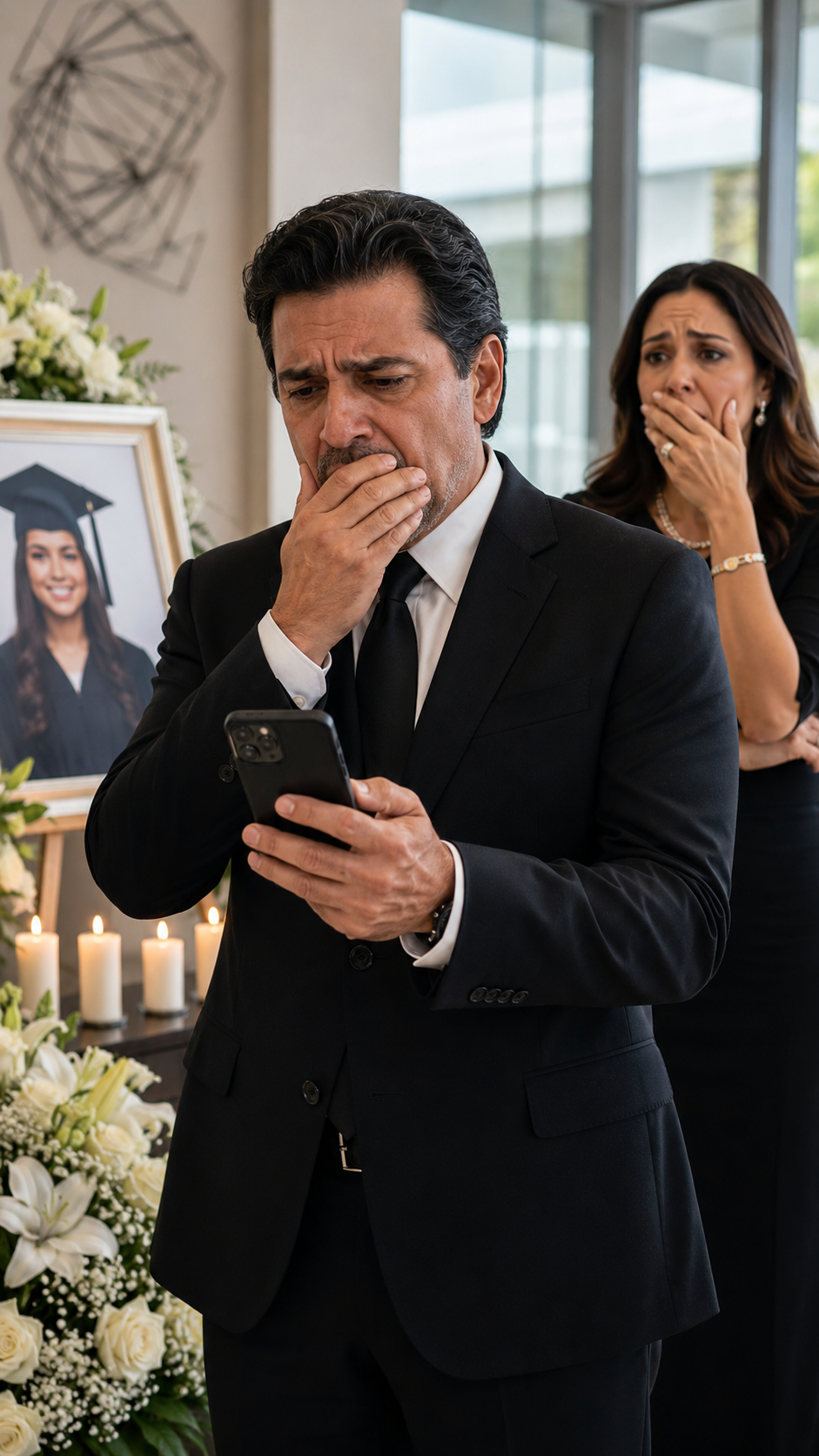
Alejandro Salvatierra sat in the front row of the private chapel in his home in Las Lomas, staring at a massive photo of his daughter Valeria.
It had been two years since the accident on the Mexico-Cuernavaca highway.
Two years since they told him his daughter was dead.
Two years since Beatriz, his second wife, had begged him not to open the coffin because, as she put it, "it was better to remember her beautiful."
The mass was filled with businessmen, society friends, distant relatives who barely knew Valeria, and people crying as if they were in a magazine.
Alejandro did not cry.
He could no longer.
He could only gaze at Valeria's photo: 19 years old, fierce smile, loose hair, and a silver bracelet with a small moon on her left wrist.
Then his cell phone vibrated.
It was a message from a number he had canceled two years ago.
Valeria's number.
Alejandro opened the screen with trembling fingers.
"Dad, if there's still any truth left in your love for me, show up at my graduation tomorrow."
He felt the blood drain from his face.
He read it again.
It couldn't be.
Valeria was dead.
Dead on paper.
Dead in the white flower urn that Beatriz had sent to be changed every week.
Dead in an elegant grave where Alejandro had left expensive bouquets to cover a guilt he couldn’t name.
Beatriz, sitting beside him, noticed his expression.
"What’s wrong, my love?"
Alejandro showed her the phone.
She read the message, and for a split second, the perfect sadness vanished from her face.
Then she regained her mask.
"This is a scam, Alejandro. Someone is playing with your pain."
Rodrigo, Beatriz's son and CFO of Grupo Salvatierra, approached quickly.
"Give me the phone. I’m calling digital security. This reeks of extortion, dude."
Alejandro pressed the phone to his chest.
"Nobody touches this."
Beatriz lowered her voice.
"Valeria is dead. You signed the documents. You were at the wake."
"I stood before a closed coffin," he replied. "I never saw her body."
The words fell like a blow in the chapel.
Rodrigo froze.
Beatriz pressed her lips together.
"The hospital confirmed everything. The lawyers did too. You’re not going to destroy yourself over a cruel message."
Then another notification arrived.
A blurry photo.
A young woman from behind, in a black gown, standing before a university mural. On her left wrist, a silver bracelet with a small moon gleamed.
Alejandro stopped breathing.
"That bracelet was lost in the accident," he murmured.
Beatriz tried to take the phone from him.
Alejandro reacted and grasped her hand.
"No!"
Everyone turned to look.
The soft music continued to play, the guests kept murmuring, but inside Alejandro, something shattered forever.
"Don’t try to take my daughter from me again," he said, pale.
Beatriz glared at him with restrained fury.
"If that girl were Valeria, she would have come back sooner."
That hurt the most.
Because Alejandro remembered their last fight.
Valeria wanted to study law at UNAM. She didn’t want the business, or the family name, or the elegant dinners where everyone pretended to love each other.
He mocked her.
"Law? To defend poor people in filthy courts?"
Valeria cried, but she didn’t look away.
"One day you’re going to be late, Dad. And it won’t matter anymore."
The new message read:
"Don’t be late again."
That night, Alejandro entered Valeria's untouched room. He found books, letters, photos, and a notebook where she had written several times: "Don’t be late."
At midnight, he called Rafael Mendoza, a lawyer who had worked with Elena, Alejandro's first wife and Valeria's mother.
Rafael arrived without asking too many questions.
He saw the message, the photo, and the bracelet.
Then he said:
"Did you see the body?"
Alejandro shook his head.
"Beatriz said it was better not to open the coffin."
Rafael became serious.
"Then we don’t have a death. We have papers saying there was a death."
The next morning, Beatriz found the bed empty.
Alejandro had left.
Rodrigo saw her descend the stairs without makeup, her face twisted.
"Why are you so scared, Mom?"
Beatriz gripped the cell phone between her fingers.
"Because the dead must stay dead when an entire family depends on it."
And Rodrigo understood that this was not a scam.
It was something much worse.
PART 2
Alejandro arrived at Ciudad Universitaria before 6 PM.
The graduation started at 7.
He had no bodyguards.
He wore no expensive suit.
He lacked the arrogant confidence with which he always entered banks, restaurants, and board meetings.
He was filled with fear.
Rafael walked beside him with a folder under his arm. He had confirmed that a law student named Lucía Rojas was graduating that night.
She had entered two semesters after Valeria's accident.
She had no clear academic history.
She had no registered parents.
She had no past.
Just a photo.
And those eyes.
When Alejandro saw her in front of the graduating mural, he nearly buckled.
The young woman had a thinner face, a fine scar next to her right eyebrow, and shorter hair.
But it was her.
It was Valeria.
"She’s my daughter," he said, voice cracking.
Rafael didn’t smile.
"If it is her, someone has hidden her away. And they had two years to erase traces."
In Las Lomas, Beatriz locked herself in her room and pulled an old cell phone from a hidden box.
She called Dr. Álvaro Siqueiros, administrator of Hospital Santa Constanza.
"Alejandro is at the graduation," she said without greeting.
There was silence on the other end.
"Beatriz, after two years you can’t call me like that."
"Don’t talk to me about time. Time was what I bought for everyone."
Rodrigo listened from the hallway.
He didn’t understand everything.
But he understood enough.
His mother didn’t sound like a worried wife.
She sounded like someone covering up a crime.
In the auditorium, families clapped, took photos, and shouted names.
Alejandro felt a wretched envy.
For two years, he had brought flowers to a grave.
When Lucía Rojas was called, the young woman crossed the stage.
She walked firmly, too firmly, like someone who had learned not to fall in front of anyone.
She took the diploma.
Barely turned.
Her eyes met Alejandro's.
She did not smile.
She did not cry.
She did not run to him.
She only looked at him as you look at someone who arrived alive at the funeral you allowed to happen.
Then she kept walking.
Alejandro wanted to approach her after the ceremony.
"Valeria..."
She paused for half a second.
But she didn’t turn.
An older professor placed a hand on her shoulder, protecting her.
Alejandro understood.
For the first time in his life, he realized that not everything could be claimed by blood.
That night, in a discreet hotel near Reforma, Rafael arrived with preliminary documents.
"I found something."
Alejandro stood up.
"Tell me."
"On the night of the accident, two women entered Hospital Santa Constanza. One was in critical condition. The other had severe injuries, facial trauma, and partial memory loss but was stable."
Alejandro felt the ground vanish beneath him.
"Which one was Valeria?"
Rafael took his time to answer.
"During the first 48 hours, the stable patient had no name. After that, she was registered as Lucía Rojas."
"And the other?"
Rafael lowered his gaze.
"The critical patient ended up registered as Valeria Salvatierra."
Alejandro put a hand to his chest.
"What are you saying?"
Rafael placed the folder on the table.
"That the young woman buried under your daughter's name may not have been Valeria."
The next day, Valeria summoned Alejandro to a small chapel in Coyoacán.
He entered alone.
She was sitting in the third pew, wearing a white blouse, dark pants, and the silver bracelet.
"Valeria," he whispered.
She didn’t stand up.
"Don’t use that name as if you hadn’t allowed them to bury it."
Alejandro sat at a distance.
"I didn’t know."
She let out a sad laugh.
"That was always your favorite phrase. You didn’t know Beatriz was humiliating me. You didn’t know Rodrigo called me a useless heiress. You didn’t know I was accepted into UNAM because you never opened the letter. You didn’t know I called you three times the night of the accident."
Alejandro closed his eyes.
"Did you call me?"
"I wanted to come home. I wanted to ask you for forgiveness. Your assistant said you were in a meeting and couldn’t be interrupted."
He remembered that night.
Beatriz had entered the conference room crying and said Valeria was dead.
Alejandro hadn’t checked his calls.
He hadn’t demanded to see the body.
He believed the papers because the papers hurt less than the guilt.
Valeria continued:
"I woke up not knowing who I was. A nurse told me to shut up if I wanted to live. Then new documents appeared. They told me I was Lucía Rojas. That I had no family. That asking could kill me."
Rafael then appeared with a former technician from the hospital named Teresa. The woman trembled as she handed over a yellow envelope.
"I didn’t kill anyone," she said, shaking. "But I stayed silent."
Inside were shifts, incomplete medical notes, and a nearly erased name:
Ana Paula Martínez, 23 years old, with no relatives present.
She was the other young woman.
The one buried without a powerful surname.
The woman buried as Valeria.
Valeria looked at the papers without crying.
"I think of her every day. When I regained part of my memory, I wanted to find you. But I saw on TV the anniversary of my death. Beatriz was crying. You held her hand. Everyone spoke of me as if my absence had made their lives easier."
Alejandro couldn’t defend himself.
"I failed."
"No," she said. "Failing is forgetting a meal. You handed my life over to people who wanted to make me disappear."
That same day, Beatriz called a press conference at a hotel in Polanco.
She arrived dressed in white, with a trembling voice and rehearsed eyes.
"A woman is trying to take advantage of my husband’s pain by pretending to be my dead stepdaughter."
Then the door to the hall opened.
Valeria entered first.
Rafael was beside her.
Alejandro followed.
The place exploded with murmurs.
A reporter shouted:
"Are you Lucía Rojas or Valeria Salvatierra?"
She took a deep breath.
"For two years, I was forced to live as Lucía Rojas because powerful people decided that Valeria Salvatierra was more useful dead."
Beatriz slammed her hand on the table.
"Lies!"
Valeria raised her wrist.
"This bracelet was registered as an object of the stable patient. Then it disappeared. My father gave it to me when I turned 15. Beatriz said it had burned."
Alejandro looked at the cameras.
"I confirm that bracelet belonged to my daughter."
Rafael showed the timeline: two women admitted, administrative identity changes, questionable death, discreet discharge under another name.
Then transfers from Grupo Salvatierra to a medical consultancy without a contract appeared.
Fractioned payments.
Dates.
Intermediaries.
Then Rodrigo entered the hall.
Beatriz turned pale.
"Rodrigo, don’t do this."
He stepped forward, tears in his eyes.
"I spent years believing I had to fight for a place in this family. My mother fed that fear. But I don’t want to inherit a lie."
Beatriz whispered:
"I did everything for you."
"No, Mom. You did everything for yourself, using my name as an excuse."
Rafael projected messages where Beatriz referred to Valeria as "the original heiress" and requested "to close any future claims."
The motive became clear.
Elena, Valeria's mother, had left exclusive shares for her daughter to claim upon turning 21.
Valeria alive was a burden.
Valeria dead left room.
Beatriz lost her mask.
"Are you going to destroy everything for a daughter who hates you?" she screamed at Alejandro.
Valeria answered before he could:
"No. She’s going to destroy the lie that sustained you."
Alejandro took the microphone.
"For two years, I accepted documents because I was a coward. Today, I publicly acknowledge this woman as Valeria Salvatierra Robles, my daughter. I also acknowledge that another woman, Ana Paula Martínez, was buried under her name. My family deserves answers for both."
The conference ended in chaos.
The hospital was investigated.
Dr. Siqueiros was summoned.
Beatriz faced charges for altering records, improper payments, and defamation.
Rodrigo submitted files that also implicated him.
But Valeria did not return to the mansion.
Alejandro asked her once.
"I can give you a safe place."
She crossed her arms.
"Do you still think caring is buying walls?"
He looked down.
"Sometimes I don’t know how else to do it."
"Learn."
And Alejandro learned while waiting.
He waited when Valeria didn’t reply.
He waited when she didn’t want to see him.
He waited when she decided to seek Ana Paula’s family before talking about forgiveness.
Weeks later, they found Juana, Ana Paula’s younger sister, in Puebla.
She had spent two years hearing that the missing adults sometimes leave because they want to.
Valeria went with Alejandro but set a condition:
"You’re going to listen. You won’t talk first."
Juana cried holding the photo of Ana Paula.
Without cameras.
Without expensive flowers.
Without elegant masses.
Alejandro cried too, silently.
That day he understood that his tragedy was news because he was rich.
Ana Paula’s was buried because she was poor.
Months later, Valeria created a fund in Ana Paula’s name to help families searching for missing persons without money or influence.
Alejandro wanted to donate millions and be in the photo.
Valeria stopped him.
"No using other people's pain to cleanse your conscience."
He agreed.
Almost a year later, Valeria presented a paper at UNAM on civil identity and missing persons.
Alejandro arrived twenty minutes early.
Without bodyguards.
Without press.
With two white flowers.
One for Valeria.
Another for Ana Paula.
At the end, she approached him.
"You arrived early."
Alejandro smiled sadly.
"I’m practicing."
Valeria looked at the flowers.
"I still don’t know how to forgive everything."
He replied:
"I still don’t deserve everything."
She looked at him with tears in her eyes.
Then she said softly:
"But you can walk with me to the exit, Dad."
The word came out wounded, imperfect, almost broken.
But it opened a door.
And Alejandro walked by her side without being late, as the evening fell over Ciudad Universitaria, as if the world finally learned to pronounce the correct name of the living… and also of the dead.