PART 1
The train whistle sliced through the twilight like a scream of iron on the outskirts of San Miguel de Allende, Guanajuato.
Miguel Arriaga, a 43-year-old farmer and widower for the past three years, was making his way home along the dirt road that ran beside the old tracks, behind the cornfields.
His boots were caked with dust, his hat tucked under his arm, and his soul felt as weary as it had every day since Teresa, his wife, passed away.
His only joy was Sofía, his 12-year-old daughter, who spent the week studying in León with her maternal grandparents.
But that afternoon, just before reaching the wooden gate, Miguel heard something that was neither the wind nor an animal.
It was a scream.
High-pitched.
Torn apart.
A woman’s scream.
Miguel froze for barely a second. Then he heard another scream, weaker, almost swallowed by the approaching noise of the train.
Without thinking, he ran.
The earth trembled beneath his feet. The cicadas fell silent. The whistle sounded again, louder, closer, as if the whole world was heralding a tragedy.
When he turned by the large mesquite tree, Miguel saw the scene and felt air leave his lungs.
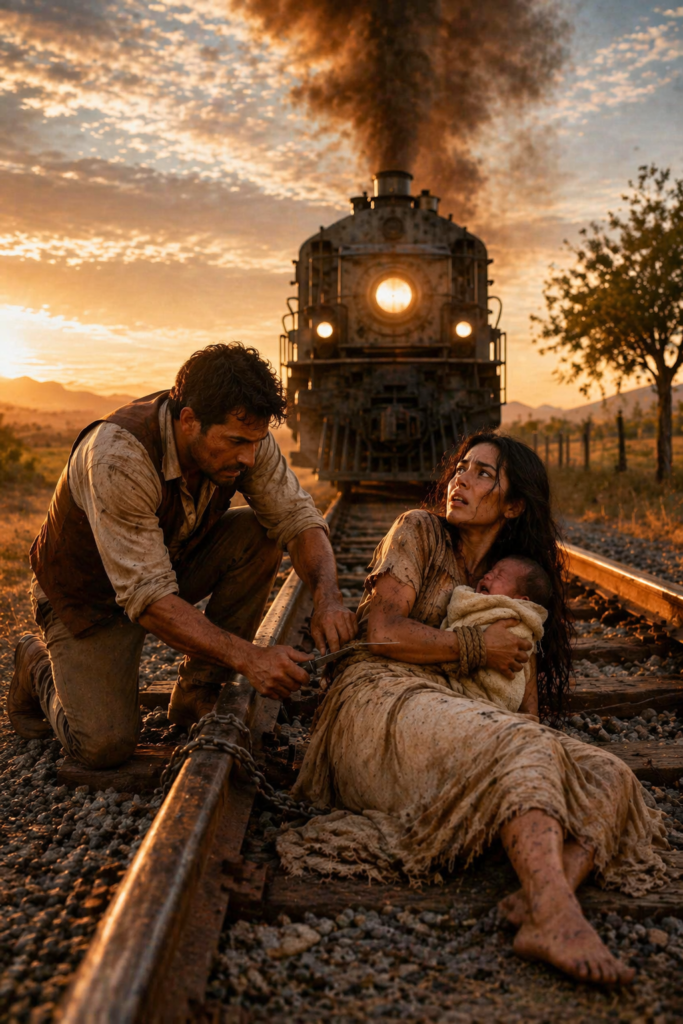
A young woman was tied to the tracks.
Her wrists bound with thick rope, one ankle shackled to the rusted metal, her dress torn and caked with dirt.
But what nearly shattered his heart was seeing her clutching a baby wrapped in a pink blanket, crying softly, already out of strength.
—No, my God! —screamed Miguel.
He threw himself to his knees beside her.
The woman barely opened her eyes. Her face bore bruises, dried blood on her lip, and a gaze so shattered it didn’t look like fear; it looked like farewell.
—My girl… please… save my girl…
Miguel pulled out the knife he carried on his belt to cut sacks and began to slice through the rope.
The train was now visible in the distance.
The tracks were vibrating.
The baby let out a weak wail.
—Hold on, girl! Just hold on a little longer!
The rope gave way.
Miguel tugged at the chain on her ankle, but the padlock was stuck. He struck it with a rock. Once. Again. Again.
The whistle sounded so close that the woman closed her eyes.
Miguel thrust the knife into the rusty lock, twisted with all his strength, and the padlock popped open.
He grabbed the woman and the baby as best he could and hurled them into the gravel.
The train thundered past one second later.
The hot air tossed them amongst stones and dust.
Miguel lay there, breathing as if his chest might split apart.
The woman clung to the baby with a desperation that felt otherworldly.
—Thank you… —she whispered.
Miguel looked into her eyes and understood something horrific.
Someone had not only wanted to kill her.
Someone wanted to erase that baby from existence.
PART 2
Miguel carried them to his adobe house, a humble structure with a tin roof, saints on the wall, and the scent of extinguished firewood.
His neighbor, Doña Carmen, a 70-year-old widow living across the lot, came out upon hearing his shout.
—Virgin of Guadalupe! What happened here?
—I found her on the tracks —said Miguel, his voice trembling—. They left her for the train to crush her.
Doña Carmen crossed herself upon seeing the marks on the young woman’s wrists.
Together, they laid her on the old couch in the living room. Miguel fetched water. Doña Carmen took the baby and cradled her against her chest, as if she were her own granddaughter.
The woman couldn’t have been more than 26.
Though battered, it was evident she had once lived a normal life: well-groomed nails, dark hair cut neatly, a medal of the Virgin around her neck.
But her eyes looked like those of someone who had aged 20 years in one night.
She woke near midnight, startled.
The first thing she did was look for the baby.
—She’s here, dear —said Doña Carmen—. Sleeping. No one will take her from you.
The young woman trembled.
—Where am I?
—In my house —answered Miguel—. Your name is…
She swallowed hard.
—Valeria.
—And the baby?
The girl caressed the pink blanket.
—Emma. She’s one month old.
Miguel felt a knot in his throat. Sofía had also slept like that on Teresa’s chest when she was born.
—Who did this to you, Valeria?
The young woman shook her head.
—I can’t say.
—They tried to kill you.
—That’s exactly why. If I speak, they’ll come back. And this time they won’t miss.
Doña Carmen pressed her lips together.
—My girl, those cowards left you on the tracks with a child. What more can they do to you?
Valeria began to cry silently.
It took her several minutes to muster the courage.
Then she recounted everything.
She lived in León. Worked as a nursing assistant in a private clinic. There she met Rodrigo Santillán, a gas station owner, husband of a socialite, and a candidate for local congressman.
Rodrigo was elegant, educated, one of those men who greets women with a kiss at church and pays for breakfast for the campaign.
He told her he was separated.
He sent her flowers.
He promised a small house, a quiet life, a family.
Valeria believed him.
When she became pregnant, Rodrigo changed.
First, he stopped answering her.
Then he asked her to abort.
When she refused, he offered to pay for her to go to Tijuana and never come back.
Valeria thought about raising her daughter alone. She didn’t want a scandal. She didn’t want to take anything from anyone. She just wanted to be left in peace.
But when Emma was born, everything got worse.
Rodrigo showed up at the clinic with two men.
—That girl doesn’t exist —he told her—. And if you insist, neither will you.
Valeria tried to report it, but at the Public Ministry, they told her she had no proof. One agent even advised her to “work it out” with Rodrigo because getting involved with heavyweights was asking for trouble.
Then the threats began.
They broke the door of her apartment.
They sent her photos of Emma sleeping.
One night, they left a headless doll on the stroller.
—I was being locked away little by little —Valeria whispered—. Until yesterday, they put me in a truck. They beat me. I heard one say: “The boss wants it to look like a train accident. The woman and the baby together. No loose ends.”
Miguel clenched his fists.
He was not a man of fights. He never had been. But at that moment, he felt an old, deep rage, as if Teresa’s death had left a void that was now filling with fire.
—Tomorrow we’re going to the Prosecutor’s Office in León.
Valeria sat up abruptly.
—No, sir. You don’t understand. Rodrigo has police, lawyers, buddies in the government. If you help me, they’ll come for you too.
—They already messed with me the moment they left you in my path.
—It’s not your problem.
Miguel looked at the baby.
—Since I carried her off those tracks, yes, it is.
The next morning, before the sun rose, a black truck stopped in front of the house.
Miguel was giving water to the chickens when three men with pressed shirts, expensive boots, and unfriendly looks got out.
One pulled a photo from his pocket.
It was Valeria.
—We’re looking for this girl. They say she was around here.
Miguel felt his heart in his throat, but he didn’t blink.
—I haven’t seen her.
The man smiled.
—Look, Don Miguel, you have a reputation for being honest. It would be a shame if your field burned down by accident.
Miguel didn’t respond.
The man moved closer.
—Or if your daughter Sofía had a scare over in León. She gets out of school at 2:10, right?
Miguel’s blood ran cold.
Valeria heard everything from inside.
When the truck left, she came out with Emma in her arms, pale.
—I told you. They know about your daughter. Let me go.
Miguel entered the house without answering.
He went straight to the room where he kept Teresa’s things. He opened a wooden box and took out an old cellphone.
Doña Carmen looked on, confused.
—What are you doing?
—Calling someone I didn’t want to ask for anything again.
He dialed a number.
An older man answered on the other end.
—Miguel?
—Don Ernesto, it’s me. I need you to pick up Sofía today. Don’t ask. Take her to your house and don’t let her out.
The girl’s maternal grandfather understood from his tone.
—What trouble are you in?
Miguel glanced at Valeria.
—In one where if I stay silent, they’ll kill a mother and her baby.
Valeria broke down.
Then she did something she hadn’t told.
She reached into the torn seam of her dress and pulled out a USB drive wrapped in plastic.
—Before they took me, I managed to hide this. A nurse friend helped me copy the videos from the clinic.
Miguel plugged the USB into an old computer that Sofía used for homework.
Several files appeared.
The first showed Rodrigo entering Valeria’s room two days after the birth.
His voice was clear.
—Sign this and disappear. You won’t humiliate my wife with a bastard.
Valeria, weak in bed, replied:
—Emma is your daughter. I just want you to acknowledge her.
Rodrigo moved closer to the crib.
—Girls nobody recognizes don’t have to grow up.
Doña Carmen let out a sob.
The second video was worse.
Rodrigo appeared in an office with the same two men from the black truck.
—I don’t want scandals before the campaign —he said—. Make it look like an accident. And make it quick. My father-in-law is putting millions into my candidacy.
There was the twist Valeria didn’t know.
It wasn’t just Rodrigo protecting his marriage.
It was a whole wealthy family protecting a candidacy.
And Rodrigo’s wife, according to the video, wasn’t entirely an innocent victim.
In another recording, her voice could be heard off-camera:
—I don’t want to see that little girl ever. Do whatever you have to do, but don’t ruin my life.
Valeria covered her mouth.
—No… she knew.
Miguel felt nauseous.
Doña Carmen murmured:
—Damn people. They call themselves decent and are worse than animals.
Miguel didn’t go to the municipal police. He didn’t go to acquaintances.
He traveled with Valeria, Emma, and Doña Carmen to León, but they went straight to the Specialized Prosecutor’s Office for Crimes against Women.
There, they asked to see Licenciada Mariana Ríos, a prosecutor known for being tough and not corruptible.
At first, the guards didn’t want to let them through.
Miguel placed the USB on the counter.
—If you send us back, tomorrow you’ll find a woman and her baby dead. And then this Prosecutor’s Office will carry that burden too.
Half an hour later, they were in front of Mariana Ríos.
The prosecutor watched the videos without interruption.
When she finished, she closed the laptop and took a deep breath.
—Who else knows you have this?
—Those who threatened us —said Miguel—. And they may already be coming.
Mariana looked at Valeria.
—I’m going to tell you the truth. This is big. There are businessmen, police, and a political campaign. But I’m also going to tell you something else: with these videos, you’re no longer alone.
That same afternoon, they set up an operation.
They didn’t announce it at the local command. Mariana requested state support and reviewed Valeria’s ignored complaint case.
The agent who had told her to “work it out” with Rodrigo was removed from duty within hours.
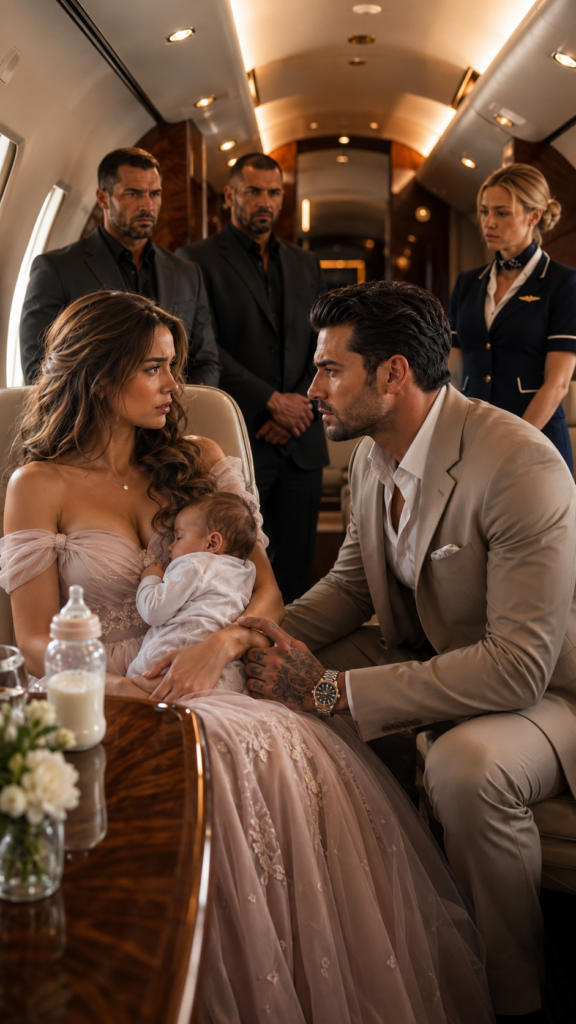
At 8:30 PM, Rodrigo Santillán was at a family dinner in his León residence, toasting to his upcoming candidacy registration.
There were businessmen, his father-in-law, his wife Patricia, local journalists, and even a priest invited.
Rodrigo raised his glass.
—To family, which is the most important thing.
At that moment, the door burst open.
Agents from the Prosecutor’s Office stormed in.
Mariana Ríos walked to the front.
—Rodrigo Santillán, you are under arrest for attempted feminicide, attempted homicide against a minor, threats, and criminal association.
The dining room fell silent.
Patricia dropped her glass.
—This is nonsense. Do you know who my father is?
Mariana looked at her.
—There’s also an order for you, Mrs. Patricia. For concealment and participation in threats.
Rodrigo turned pale.
—You have nothing.
Then Valeria appeared at the entrance, with Emma in her arms.
Miguel stood behind her, hat in hand.
Rodrigo looked at her as if seeing a ghost.
—You… you should…
He didn’t finish the sentence.
Mariana raised an eyebrow.
—Should what, Mr. Santillán? Should you be dead on the tracks?
Guests began recording with their cell phones.
Rodrigo’s father-in-law shouted to call his lawyers.
But when the agents pulled the two men who had threatened Miguel out in handcuffs, the façade crumbled.
One of them spoke first.
He said where they had beaten Valeria.
Who bought the chain.
Who paid for the truck.
And who ordered that the baby also die.
The news exploded in León before midnight.
“Candidate linked to attempted murder of mother and newborn.”
Social media was ablaze.
Some said Valeria had destroyed a family.
Others responded that that family had been rotten long before.
Miguel didn’t say anything to the cameras.
He only accompanied Valeria to testify.
When they returned to San Miguel de Allende, Sofía ran to hug him.
—Grandpa told me you were helping a lady and a baby.
Miguel knelt in front of her.
—Sometimes helping someone is scary, dear.
—But it was the right thing?
Miguel looked toward the house, where Valeria was breastfeeding Emma with Doña Carmen by her side.
—Yes. It was the only decent thing to do.
The following months weren’t easy.
Valeria had to repeat her story many times. In hearings, before expensive lawyers, facing gazes that wanted to make her feel guilty for believing in a married man.
But the evidence was too clear.
The prosecutor’s office found messages, transfers, calls, and the purchase of the padlock at a hardware store near Celaya.
They also found Valeria’s blood in an abandoned warehouse.
Rodrigo lost the candidacy.
Patricia lost the clean surname she boasted about.
The two men agreed to cooperate to reduce their sentences, yet remained imprisoned.
The agent who ignored Valeria’s complaint was investigated for protecting the Santillán family.
The truth came out completely.
And it hurt.
Because it hadn’t been a spur of the moment.
It hadn’t been an accident.
It was a decision made at an elegant table, by people who spoke of honor while calculating how to kill a one-month-old baby.
Valeria found work at a rural clinic near Miguel’s home.
She didn’t stay because she had nowhere to go.
She stayed because for the first time, no one asked her for silence in exchange for shelter.
Emma grew up surrounded by corn, chickens, and arms that wanted to hold her.
Doña Carmen said that girl had been born twice: once in the clinic and once beside the tracks.
Sofía adored her. She made crooked bows, sang songs, and showed her off as “my almost sister.”
Miguel laughed again after years.
One afternoon, while the sun sank orange over the hills, Valeria sat beside him on the porch.
—That night, I thought God had forgotten us.
Miguel looked at the tracks in the distance.
—Sometimes God doesn’t come with wings, Valeria. Sometimes He arrives tired, with dirty boots and an old knife.
She smiled with tears in her eyes.
—You didn’t just save us from the train.
Miguel lowered his gaze.
—You all saved me too.
In the distance, the whistle sounded again.
This time, Emma didn’t cry.
Valeria didn’t tremble.
Miguel didn’t run.
Because there are sounds that one day announce death, and another day recall that life can also return by the same path where someone tried to destroy it.