PART 1
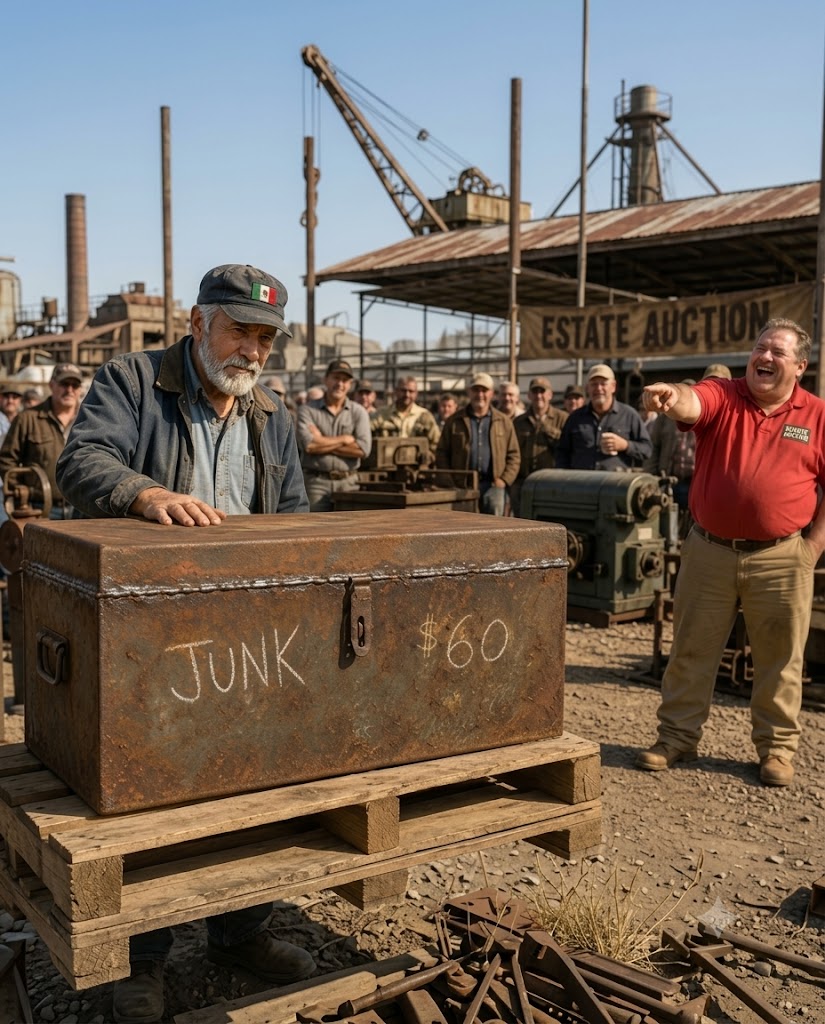
In San Miguel de las Cruces, a dusty town 40 minutes from Puebla, people still gathered on Sundays to watch auctions as if they were theatrical performances.
That day, the spectacle was the old workshop of Don Anselmo Rivas.
Old lathes, wrenches, workbenches, burned-out motors, and boxes filled with scrap iron passed from hand to hand while the auctioneer shouted prices under a blue tarp.
But when that metal box appeared, laughter erupted.
It was a large, rusted toolbox, heavy as old sin. It had no lock. No visible hinges. The lid was completely welded shut, from end to end, as if someone had wanted it never to be opened again.
On the side, with almost erased white paint, it read:
"NOT WORKING."
To everyone else, it was junk.
To Don Julián Arriaga, it was not.
At 74 years old, with a hunched back, white mustache, and scarred hands, he had been a welder for over 50 years, fixing everything from a twisted gate to a well pump when no one else could.
The auctioneer raised his hand.
"Who bids 500 pesos for this thing?"
No one said anything.
Then Julián spoke calmly:
"1200."
Silence lingered for 2 seconds.
Then the laughter exploded.
The loudest was Rogelio Santamaría, owner of the largest junkyard in the area. A 48-year-old man in a tight shirt, gold chain, and an abusive boss's voice.
"Come on, Don Julián!" he shouted. "You paid 1200 for a box that won’t even open? You’d have been better off giving me the money for some carnitas."
The men by the truck roared.
"There goes the old iron man."
"He must think he found gold."
"Let’s see if he ends up with nothing but dust, dude."
Julián didn’t respond.
He simply ran his fingers over the box’s weld.
This was no ordinary seam.
It was even, firm, made by someone who knew how to control their pulse. This was no repair. No whim. It was a seal created with intention.
And Julián recognized that hand.
He had worked with Don Anselmo Rivas when they were both young. Anselmo was reserved, serious, stubborn, but never clumsy. If he had welded that box shut, it was because he wanted to protect something important.
What everyone ignored was that Anselmo had died 3 months prior in the back of the workshop, alone, seated in a wooden chair.
His only daughter, Teresa, lived in Cholula selling homemade meals. After the funeral, a document surfaced supposedly leaving the entire workshop to Evaristo Santamaría, Rogelio’s father and Anselmo’s former business partner.
Teresa swore that signature was a forgery.
No one supported her.
She had no money for lawyers.
And Rogelio, with that smile of the town’s owner, made sure to repeat that the daughter just wanted to benefit.
So the workshop went to auction.
The machines were sold.
The land was disputed.
And the only thing no one wanted was that box, sealed like a tomb.
That afternoon, 2 young men helped Julián load it into his old truck. The box fell into the bed with a dull thud.
Rogelio approached, still laughing.
"Take care of it, Don Julián. Maybe the spirit of the deceased is inside."
Julián tied the box down with 2 ropes and looked at him for the first time.
"Sometimes the dead speak more clearly than the living."
Rogelio’s laughter dimmed a little.
That night, while the whole town continued mocking the old man who bought trash, Julián placed the box in the middle of his workshop.
He didn’t hit it.
He didn’t force it.
He just cleaned the rust slowly, inch by inch, until he found a hidden mark beneath the weld.
There were 3 letters engraved with a punch:
"T.R.A."
Julián froze.
Because those weren’t just any initials.
They were the initials of Teresa Rivas Aranda, the daughter everyone had called a liar.
And when he brought the lamp closer, he discovered something even worse: next to the letters was a date marked, exactly 1 day before Anselmo died.
PART 2
Julián didn’t sleep that night.
He sat in front of the box with a cup of cold coffee in his hands, listening to the buzzing of the lights and the distant barking of dogs.
The date spun in circles in his head.
If Anselmo had sealed that box 1 day before dying, then it hadn’t been a whim of an old man. It had been a final decision. A message encased in steel.
At dawn, Julián went for his gloves, a fire blanket, a bucket of water, and his cutting torch.
He prepared everything as if he were going to operate on someone.
He marked a fine line along the weld seam. He didn’t want to destroy the box. He wanted to open it like one opens an old wound: carefully, because inside could be the truth or a tragedy.
At 7:30, he ignited the flame.
The blue fire illuminated the walls filled with tools. Sparks jumped on the cement floor like furious fireflies.
Julián cut slowly.
His back ached.
His knees trembled a little.
But his hands remained steady. Those hands had learned that metal punishes the impatient.
Almost 2 hours later, the lid gave way.
It didn’t burst open.
It only released a low sound, like a sigh held for years.
Julián turned off the torch and waited for the steel to cool. Then he lifted the lid.
Inside, there were no tools.
No scrap metal.
No scorpions, as Rogelio had said.
There was a folder wrapped in black plastic, a cloth bag with bundles of bills, and a small brown notebook.
On top of everything was an envelope.
It read:
"For those who did not mock the steel."
Julián felt a lump in his throat.
He opened the folder first.
The papers were impeccable. They were deeds, receipts, contracts, and copies of payments. There it proved that the Rivas workshop had never fully belonged to Evaristo Santamaría.
The original agreement stated that Evaristo only had rights to 30% of some machines bought in partnership, not to the land, not to the workshop, not to the accounts, nor to the back house.
Then he found another document.
It was a declaration signed by Anselmo, dated recently, claiming that Evaristo and his son Rogelio were pressuring him to cede properties. It also stated that the supposed signature of total transfer had been taken from an old receipt and mounted on another paper.
Julián gritted his teeth.
Then he opened the notebook.
That’s where the blow came.
Anselmo had recorded every visit from Rogelio, every threat, every attempt to make him sign when he was already sick.
"Rogelio came today. He said Teresa deserves nothing because she’s a woman and left the town."
"Evaristo brought papers. I did not sign."
"If something happens to me, find Teresa. She is the only legitimate heir."
Julián swallowed hard.
The cloth bag had money. Not a fortune from a novel, but enough to hire a lawyer: old bills, new bills, envelopes with dates, savings accumulated from jobs paid in cash.
Finally, he read the letter.
"If someone opens this without breaking it to pieces, then there are still people of trade.
I, Anselmo Rivas, leave here the only thing I can defend. They are robbing me in life and I know that when I die they will say that I wanted to leave everything to the Santamarías.
It’s a lie.
My daughter Teresa has the right to what I built. I distanced myself from her out of pride. That was my sin. I let her believe that I didn’t need her when in reality she was the only clean thing I had left.
I don’t have the strength to fight in court, but I was still able to weld this box.
If you find this, do not let my daughter carry the shame that others manufactured.
Steel doesn’t lie.
Men do."
Julián read the letter 3 times.
Then he removed his glasses and covered his face with one hand.
He knew that type of pain. The kind of parents who regret too late. The kind of children who spend years believing they were unloved.
That same morning he drove to Cholula.
He found Teresa in a small place near the market. She was 52 years old, hair tied back, apron stained with sauce, and tired eyes of one who has fought too long alone.
When Julián entered, she thought he was another customer.
"What can I get for you, chief?"
He took off his cap.
"I come on behalf of your father."
The spoon fell from her hand.
Teresa looked at him as if he had opened a forbidden door.
"My dad didn’t order anything. He died leaving me on the street."
Julián placed the folder on the table.
"That’s what they wanted you to believe."
Teresa didn’t want to touch the papers at first. She was afraid. Afraid to feel hope again only to have it taken away.
But when she saw Anselmo’s handwriting, she sat down slowly.
She read the letter.
Halfway through the second page, she began to cry silently.
Her employees stood still behind the counter.
"I thought he hated me," Teresa whispered. "I thought he preferred those men to me."
Julián shook his head.
"Your father was proud, yes. But he didn’t forget you."
She hugged the letter to her chest.
"So I wasn’t crazy."
"No, daughter. They were leaving you alone."
With the money from the box, they hired Licenciada Valeria Montes, a lawyer from Puebla known for not bending to town bullies.
Valeria reviewed the documents and quickly understood the scheme.
The signature on the supposed will didn’t match. The page had ink from different dates. Furthermore, the notebook contained names, times, and threats. It wasn’t gossip. It was a complete route of abuse.
The news spread in San Miguel de las Cruces like wildfire.
Rogelio arrived at Julián’s workshop on the third day.
He no longer wore a smile.
He was furious.
"Nosy old man," he spat from the entrance. "That box should have stayed closed."
Julián was sitting sharpening a piece.
He didn’t even stand up.
"Then you guys should have bought the junk."
Rogelio took 2 steps inside.
"You don’t know who you’re messing with."
Julián turned off the machine.
The silence fell heavily.
"Look, kid. I’ve worked under trailers, cut beams 20 meters high, and inhaled smoke that sent others to the hospital. You’re not going to scare me with your fancy shirt and your tough-guy voice."
Rogelio turned red.
"My dad has connections."
"And Anselmo had proof."
That phrase stopped him.
For the first time, Rogelio understood that he wasn’t facing a poor old man. He was facing the man who had opened the tomb where his family hid the theft.
The fight didn’t get very far.
When Licenciada Valeria presented the box, the cut weld, the letter, the original documents, the notebook, and the signature analysis, the Santamarías broke down.
Evaristo tried to say it was all made up.
But then came the twist no one expected.
One of the former secretaries of the workshop, Doña Imelda, testified that she had seen Rogelio take a signed sheet from Anselmo from an old folder. She said she had stayed silent out of fear because her son worked in the junkyard.
But seeing Anselmo’s letter, she could no longer hold back.
"I was ashamed," she confessed. "I was ashamed to have let Teresa cry alone."
That statement changed everything.
The Santamarías had to return the land, the main machines, and compensation for the months Teresa was stripped of her rights. Evaristo avoided jail by accepting his guilt and signing a public agreement.
Rogelio, who used to mock at the auctions, stopped going into the downtown diner.
No one laughed with him anymore.
Instead, when Julián walked through the plaza, men took off their hats.
Doña Lupita, the store owner, was the first to say it:
"Here comes Don Julián, the man who made the box speak."
And that phrase stuck.
Months later, Teresa reopened the Rivas workshop.
It wasn’t easy.
Machines were missing.
Money was lacking.
Anselmo was absent, sitting at the entrance, watching without speaking.
But the gate was raised again. The sign was repainted. And the sound of metal returned to the town like a bell of justice.
Teresa placed the rusted box in a simple display case, next to her father’s letter.
Underneath she wrote:
"My father couldn’t defend me in life, but he left me his truth welded."
People came to see it.
Some out of morbid curiosity.
Others out of guilt.
Many to remember that sometimes those who seem stubborn are simply reading something others cannot see.
Julián never accepted money from Teresa.
She insisted many times.
He always responded the same:
"Your father didn’t sell me a box. He left me a responsibility."
But he accepted another thing.
Every Saturday morning, he went to the Rivas workshop to teach welding to the young people of the town. Six came at first. Then nine. Then twelve.
Julián taught them to put on gloves, to control their breathing, to not fear fire, but also to not disrespect it.
"Haste ruins work," he would say. "And life too."
One Saturday, a skinny 16-year-old boy with a downcast look appeared.
It was Mateo, Rogelio’s youngest son.
Teresa froze at the sight of him.
The young man had an old backpack and sweaty hands.
"I want to learn," he said. "I don’t want to be like my dad."
No one spoke.
Julián watched him for a long moment.
Then he handed him some gloves.
"Then start by sweeping. The trade also comes through humility."
Mateo swept the entire workshop.
And he stayed.
In time, Teresa understood that justice doesn’t always mean closing all doors. Sometimes it also means allowing someone to break a chain before repeating it.
A year later, the Rivas workshop was no longer a symbol of theft.
It was a symbol of return.
Teresa was able to pay debts, recover the back house, and stop cooking until dawn to survive.
One afternoon, as she was closing up, she found Julián standing in front of the display case.
The old man was looking at the box with teary eyes.
"Sometimes I think your dad chose you," Teresa said.
Julián smiled faintly.
"No. Your dad chose the steel. I just knew how to listen to it."
Teresa fell silent.
Then she handed him a cup of coffee.
"Do you regret paying 1200 pesos?"
Julián laughed softly.
"I regret not having offered 1500 so they would laugh even harder."
The two laughed.
Outside, the town continued with its usual noise: motorcycles, dogs, vendors, children coming out of school.
Inside, the box remained open.
It no longer looked like trash.
It no longer looked like junk.
It looked like what it always was: a promise.
Because not everything old is empty.
Not everything rusted is useless.
And not everyone who keeps silent is defeated.
Sometimes, the truth doesn’t shout.
Sometimes it waits.
Welded, hidden, patient.
Until someone arrives with steady hands, a righteous heart, and enough dignity to open it.





