PART 1
At 37, Santiago Arriaga had everything that had seemed impossible during his childhood.
He ran a berry export company in Guadalajara, lived in a penthouse in Andares, and drove a truck that cost more than all the houses in the community where he was born.
Yet, he hid a part of his life.
His mother, Doña Elvira, still lived alone in a ranch in the Sierra de Jalisco, in a simple house made of adobe, metal sheets, and years of sacrifice.
She had sold cheese, raised chickens, and washed clothes for others to pay for his education.
But Santiago, surrounded by boastful partners and friends who measured people by their last name, began to feel ashamed of that origin.
Things worsened when he got engaged to Mariana, a 29-year-old nurse who worked in a public hospital in Zapopan.
Mariana was affectionate, straightforward, and unimpressed.
She never asked for trips, jewelry, or fancy restaurants. Still, Raúl, Santiago's partner, kept planting seeds of doubt.
"Seriously, man, a woman like that doesn’t fall for you by chance. She’s after your bank account."
Santiago pretended to laugh, but insecurity crawled under his skin.
Three months before the wedding, he decided to put her to the test.
He called Doña Elvira and asked her not to fix the house, to hide her good dresses, and to wear the oldest shawl.
"I want to know if Mariana truly loves me," he said.
"And you’re going to use my poverty as a stage for that?" his mother replied.
Santiago didn’t answer.
Doña Elvira accepted, but only because she wanted to see just how far her son’s pride had gone.
The following Saturday, Santiago told Mariana they needed to urgently meet his mother.
He invented that his truck was in the shop, so they took two buses, a van, and then walked along a dirt path under the heat.
Mariana didn’t complain.
She bought water for both of them, helped a woman with her bags, and even laughed when the dust turned their shoes the same color.
Upon arrival, Santiago observed every gesture of his fiancée.
The house had leaks, a dirt floor, a sagging door, and an improvised bathroom behind the corral.
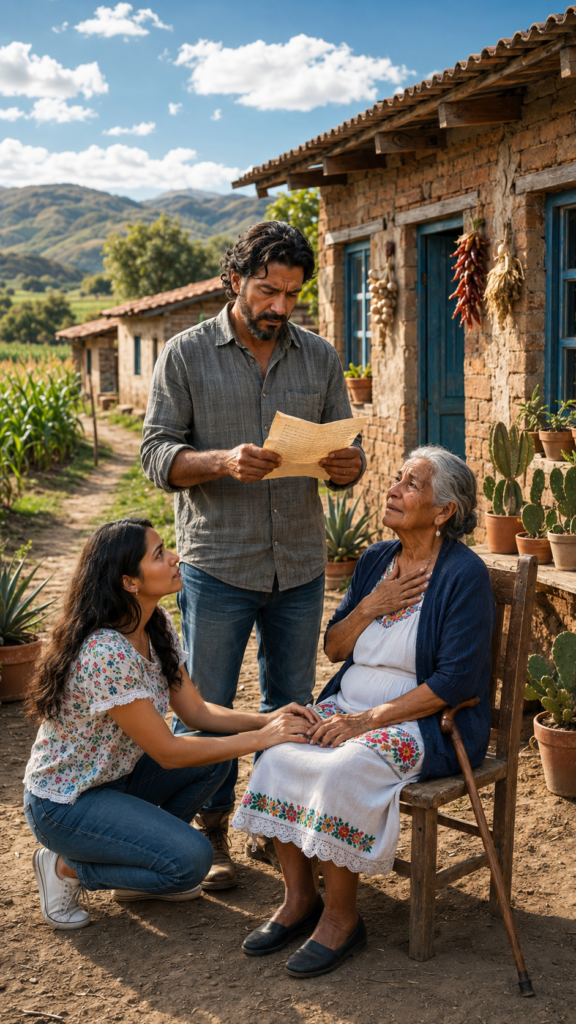
Doña Elvira was sitting outside, hunched over, her cracked hands resting on her lap.
Mariana froze.
Then she opened her bag, took out a folded sheet of paper, and handed it to him.
"Read this before saying anything."
Santiago thought it was the cancellation of the wedding.
But as he opened the paper, his legs began to tremble.
PART 2
At the top of the page, Mariana had written in blue ink:
"Plan for Doña Elvira to live securely, accompanied, and without pain before our wedding."
Santiago blinked several times.
Below was a detailed list with ten points.
Replace the rusted sheets before the rainy season.
Install a solid floor to prevent falls.
Put in a full bathroom inside the house.
Buy an orthopedic bed.
Take Doña Elvira for a medical check-up in Guadalajara.
Allocate 8,000 pesos monthly for groceries and medicines.
Hire a woman from the community to accompany her five days a week.
Install a water heater.
Fix the entrance road.
Visit her every two weeks without excuses.
Santiago lifted his gaze, pale.
Mariana was already kneeling in front of Doña Elvira, caring little that the dirt stained her light pants.
She took the old woman’s hands and examined them with a tenderness that brought both to the brink of tears.
"These hands have worked too hard," Mariana said. "It’s not fair that they still have to carry buckets, wash in cold water, and sleep afraid that the roof will collapse."
Doña Elvira pressed her lips together.
She had promised to maintain her son’s lie, but couldn’t.
A deep sob escaped her.
Mariana embraced her immediately.
"Forgive me for arriving so late, ma'am. Santiago told me you were very independent, but no one should be so alone."
Those words hit Santiago like stones.
He had brought his fiancée to this place expecting to discover ambition, disdain, or discomfort.
Instead, the woman he was testing had seen in mere minutes the abandonment he had justified for years.
Mariana stood up and pointed to the sheet.
"I already spoke with a geriatric doctor at the hospital. I also asked for quotes for the roof and bathroom. I didn’t want to tell you until I met her because I thought she might prefer something else."
Santiago felt his throat tighten.
"Since when have you been planning this?"
"Since you told me that your mom’s knees hurt and that she was still carrying water. I saved part of the money I was going to use for my dress. We can have a simpler wedding."
Doña Elvira slowly turned toward her son.
Her expression was no longer sad.
It was hard.
"Tell him the truth," she ordered.
Mariana looked at Santiago.
"What truth?"
He squeezed the paper between his fingers.
For a moment, he wanted to lie, but Doña Elvira’s face left him no escape.
Santiago fell to his knees.
The dust covered his branded pants and dulled his Italian shoes.
"This was all a test," he confessed. "I asked my mom to leave the house like this and wear old clothes. I wanted to see how you would react."
Mariana didn’t understand at first.
"A test of what?"
"Of whether you loved me… or if you only wanted my money."
The silence became heavy.
Mariana took a step back.
"You made me travel almost 12 hours to scrutinize me?"
Santiago lowered his head.
"My friends said that…"
"Don’t bring your friends into this," she cut him off. "They could say whatever they wanted. You were the one who decided to turn your mother into a backdrop and me into a suspect."
Doña Elvira struggled to stand.
She was small, but her voice made Santiago seem like a child trapped in a lie.
"I gave you an education to help you get ahead, not so you could learn to look down on others," she said. "I played along for you because I wanted to see if there was still something left of the boy who shared a tortilla with me. And what I saw filled me with shame."
Santiago raised his eyes, crying.
"Mom…"
"Don’t call me mom as if that word could fix everything. Mariana saw this house and thought of taking care of me. You saw it and thought of using it to test if someone was worthy of you."
The phrase opened a wound that no money could heal.
Mariana took a deep breath.
Her eyes were filled with tears, but her voice came out strong.
"My dad was a construction worker. My mom sold tamales outside a clinic for twenty years. I know what it’s like to count coins to buy gas. Your ranch never embarrassed me, Santiago."
She wiped a tear with the back of her hand.
"What embarrasses me is discovering that the man I was going to marry needs to humiliate others to feel secure."
Santiago tried to approach.
She raised her hand.
"Don’t touch me."
That gesture hurt more than any insult.
"Mariana, forgive me. I was a fool. Raúl filled my head with nonsense."
"How convenient," she responded with a bitter laugh. "Raúl talked, but you chose to believe him. You decided that I had to pass a test to deserve your last name."
Doña Elvira hugged Mariana.
"Forgive me, dear. I shouldn’t have gone along with this either."
"You’re not to blame," Mariana replied. "A mother’s love sometimes also does painful things."
Then she took her bag.
Santiago stood up abruptly.
"I’ll take you to town. You can’t go alone."
Mariana looked at him one last time.
"I don’t need you to rescue me from the road. I need to get away from a man who never trusted me."
She walked down the path without looking back.
Doña Elvira followed her and accompanied her to a store where they could call a taxi.
Before getting in, Mariana handed the sheet to the old woman.
"This was not part of any act. Even if I don’t marry your son, you deserve for these points to be fulfilled."
Doña Elvira hugged her so tightly that both ended up crying.
Santiago watched the scene from afar.
That night he slept in a chair in the yard and, for the first time, didn’t see the house as a stain on his past, but as a debt.
At dawn, Doña Elvira left him a cup of coffee on the table.
"If you’re going to apologize, don’t start with flowers or jewelry," she said. "Start by stopping being the man who knelt down last night just because he was caught."
Santiago picked up the phone and called Raúl.
His partner answered, laughing.
"What happened, champ? Did the nurse run away when she saw the ranch?"
Santiago clenched his jaw.
"Don’t ever speak of Mariana, my mother, or the people who work to survive."
"Oh, come on, don’t get dramatic."
"Our partnership ends today. The lawyer will send you the documents."
Raúl fell silent.
"Are you going to throw away eight years of business for a woman?"
"No. I’m ending it for having become someone like you."
He hung up before hearing the response.
But that wasn’t the only call.
Santiago contacted an architect, a doctor, and a notary.
He sold two watches and canceled the renovation of his penthouse to repair the house.
He didn’t send Mariana pictures or turn his remorse into a spectacle.
During the first weeks, Doña Elvira hardly spoke to him.
Santiago understood that doing the right thing after years of abandonment didn’t make him a hero, just responsible.
One month later, the roof was finished.
Two months later, they installed the bathroom and the water heater.
Three months later, the house had a solid floor, new windows, and a small ramp for Doña Elvira to walk without hurting herself.
Santiago put the property in his mother’s name and opened an exclusive account for her expenses.
Then an unexpected problem arose.
Raúl, furious over the breakup of the partnership, began telling businessmen in Guadalajara that Mariana had manipulated Santiago to take part of the company.
He even leaked a photograph of her entering the ranch and claimed she was preparing a lawsuit for "emotional damage."
The lie spread quickly.
On social media, they called Mariana a gold digger and said she should be grateful that a millionaire wanted to marry her.
Santiago could have stayed silent.
His PR team advised against it.
"If you respond, you’ll make the scandal bigger," they said.
But this time he chose differently.
He called a meeting with employees, clients, and partners.
In front of everyone, he projected the sheet of ten points.
Then he told the whole truth.
He admitted that he had organized the test, that he had used his mother’s poverty, and that Mariana hadn’t asked him for a single peso.
"The only interested party was me," he said. "Interested in protecting my ego, my reputation, and my fears. Mariana didn’t fail any test. The one who ended up exposed was me."
Raúl tried to sue him for defamation.
However, during the account review, the new auditor found irregular transfers of over 4,600,000 pesos to companies related to Raúl.
The investigation proved that he had been embezzling money for three years.
The man who accused Mariana of being a gold digger was the one who was actually stealing.
Raúl was removed from the company and faced criminal charges.
The news completely changed the public narrative.
But Mariana didn’t return.
The wedding was canceled.
The estate kept the deposit, and several of Santiago’s relatives criticized him.
"Everyone makes mistakes," said an aunt. "Besides, men with that fortune don’t appear every day."
Doña Elvira confronted her during a family meal.
"Women with the dignity of Mariana don’t appear every day either. My son’s money doesn’t buy the right to hurt her."
Santiago began therapy to work on his insecurities, his shame of origin, and the need for approval he hid behind luxuries.
He stopped visiting the ranch as if it were an obligation.
He learned to sit with his mother, listen to her stories, and accompany her to the market.
Doña Elvira told him she had sold her wedding ring to pay for a semester and that many nights she pretended not to be hungry so he could eat.
Every story made him cry in silence.
Four months later, Doña Elvira appeared at Mariana’s hospital with a basket of sweet bread.
Mariana was surprised to see her.
"Are you feeling unwell?"
"Yes," the old woman replied. "It hurts me not to see you."
They had coffee at a nearby diner.
Doña Elvira told her that Santiago had completed the ten points, that the house was already in his name, and that he went to therapy every week.
"I’m not here to convince you to return," she clarified. "I just came to thank you. You saw my abandonment when my own son had learned to hide it."
Mariana cried.
"I still love him. That’s the problem."
"Loving doesn’t obligate you to return," Doña Elvira said. "And forgiving doesn’t mean trusting immediately."
Two more months passed.
One afternoon, Santiago received a message.
"We can talk. I promise nothing."
They met in a park, without drivers, gifts, or exclusive reservations.
Santiago arrived with a folder.
Inside were the deeds to the house, medical receipts, remodeling payments, and the original sheet with the ten points marked.
There was also a letter he had written.
Mariana read it in silence.
"I don’t want you back because I changed a house. I want you to know that I understood why I had to change myself. What I did was not a joke or a small mistake. It was a betrayal of your dignity and my mother’s story."
Mariana closed the folder.
"This doesn’t erase what happened."
"I know."
"I’m not going to be your fiancée again tomorrow."
"I know."
"And if one day you try to test me again, I’m gone for good."
Santiago nodded.
"I don’t want to test you. I want to learn to trust without turning love into an investigation."
They didn’t reconcile that day.
They started with coffees, uncomfortable conversations, and couples therapy. Mariana set clear boundaries, and Santiago accepted them without negotiating.
It took them one year and three months to rebuild something he had destroyed in an afternoon.
When they finally decided to get married, they rejected the fancy estate.
The ceremony took place at the ranch.
The house was painted white, bougainvilleas covered the entrance, and in the yard, there were tables with birria, rice, freshly made tortillas, and aguas frescas.
Doña Elvira wore a dress embroidered with red flowers.
She didn’t look like a poor woman used to evoke pity.
She looked like what she had always been: the root of everything Santiago had.
Before the ceremony, she handed the couple the folded sheet.
Beneath the ten points, she had written a shaky phrase:
"That day my son thought he was testing Mariana. But life was deciding whether he deserved to continue calling himself a man."
Santiago cried in front of everyone.
Not out of public shame.
He cried because he understood that true love is not proven by setting traps.
It is proven by caring for the dignity of the other, even when no one is watching.