PART 1
—My daughter never belonged to the Army. The scars, the medals, and that story of heroism were all fabricated.
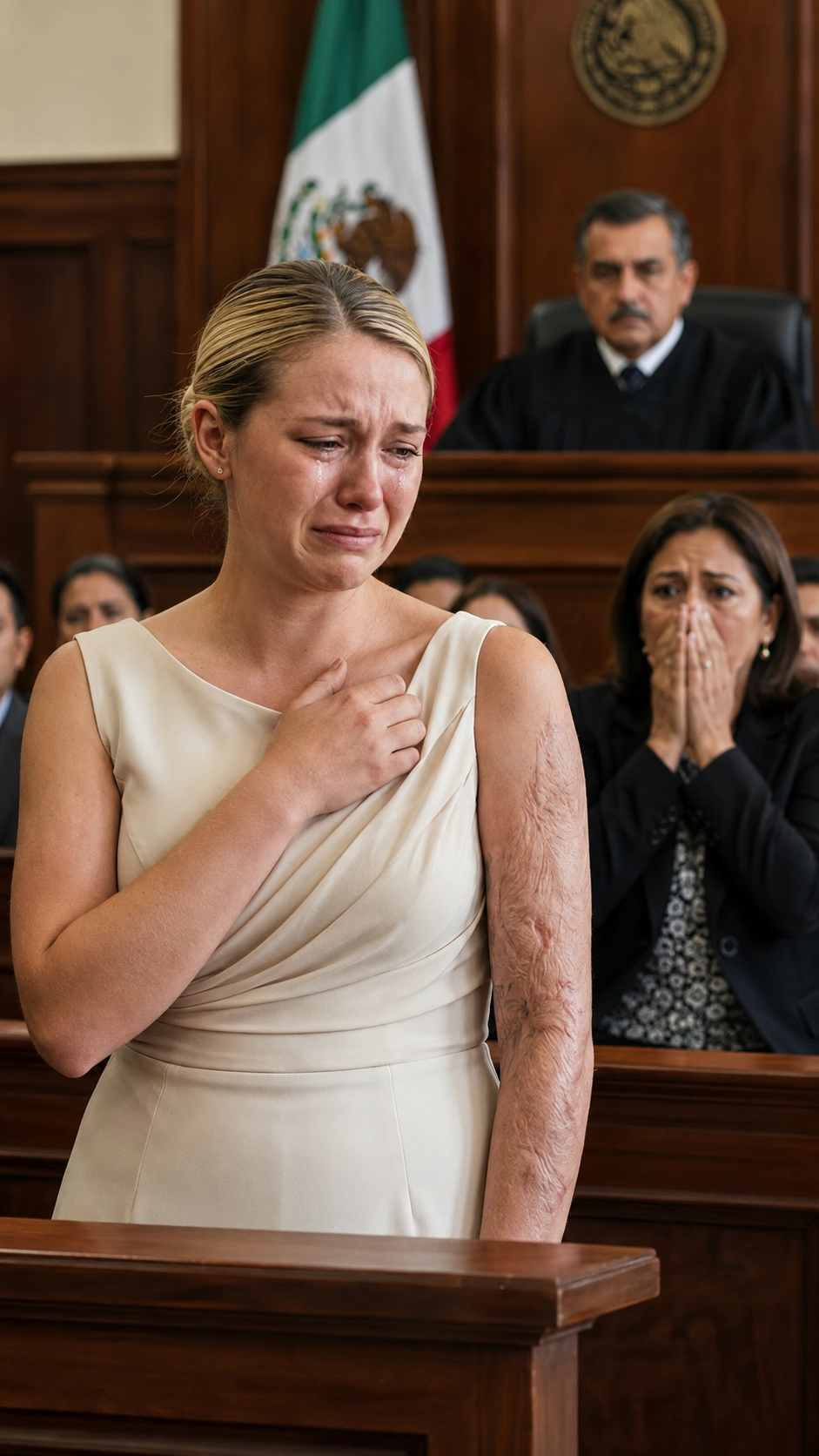
With one hand on the Bible, Elena Robles gazed at the judge with a chilling calmness. She didn’t waver. She didn’t lower her voice. She looked like a shattered mother who, despite the shame, had gathered the courage to accuse her own daughter.
The Monterrey Superior Court was packed. Reporters, former employees, shareholders of the family business, and curious onlookers drawn by the scandal filled the room. When Elena finished speaking, a murmur swept through the benches like an electric current.
Everyone turned to Valeria Robles.
She stood frozen next to her lawyer. Beneath her blouse, the scar that ran across her ribs burned as if the fire from twelve years ago had just reignited.
Across the aisle, her younger brother, Mauricio, feigned concern. However, the corner of his lips betrayed a different emotion: satisfaction.
Everything had begun after the death of their father, Don Arturo Robles, founder of Centinela Tactical Systems, a Nuevo León company that manufactured vests, armored vehicles, and communication equipment for security corporations.
The official will left Valeria with 58% of the shares and named her executor. But three days after the funeral, Mauricio presented another document that handed over absolute control.
When Valeria demanded an expert examination, her family struck back.
They accused her of fraud, forgery of military documents, and misuse of medals. They claimed she had deceived her father for years to seize the company.
The prosecutor lifted a wooden box containing a valor medal, a commendation for service-related injuries, and a scorched patch.
—Do you recognize these items?
Elena curled her lips in disdain.
—She bought them online. She’s always been good at inventing tragedies.
Some jury members looked at Valeria as if she had stolen the identity of a dead soldier.
Her lawyer leaned toward her.
—Don’t react.
—I won’t.
Mauricio knew Valeria’s records were classified due to national security. He had built the entire accusation on her inability to defend herself.
Before he died, Arturo had warned her that Elena and Mauricio were siphoning millions through phantom suppliers. Valeria promised to protect the company without revealing the operation that had left dead, wounded, and still-classified names in its wake.
The family’s lawyer approached Elena.
—Has your daughter ever been in a military unit?
—Never.
—Did she participate in any official operations?
—Never.
Finally, Elena looked at Valeria.
She barely smiled.
It was a private, cruel, and victorious smile.
Valeria placed both hands on the table and glanced at the clock above the stand.
11:47.
At that moment, the courtroom doors swung open.
And when Elena recognized the man who entered using a cane, her face drained of all color.
PART 2
Retired Colonel Julián Cárdenas made his way down the center aisle. He wore a dark suit, a sealed folder tucked under his arm, and a scar running from his temple to his jaw.
For twelve years, Elena had insisted that man was dead.
Mauricio shot up suddenly.
—That witness wasn’t on the list!
The judge slammed the gavel.
—Sit down. You’re not a lawyer.
Julián presented a federal order. Part of Valeria’s file had been declassified that morning because the prosecution had initiated the process with false information.
The judge reviewed the seals. Elena clenched her fingers against her seat, and Mauricio searched for his lawyer, but the man avoided his gaze.
—You may only testify about the authorized facts —the judge indicated.
Julián raised his right hand.
—Valeria Robles was a soldier. She served twelve years in a special military intelligence unit. She participated in operations against arms trafficking and the rescue of kidnapped personnel. Her records were protected because several targets remained active.
A gasp swept through the room.
Julián pointed to the burned patch.
—It belonged to the Centauro 6 team. I was her commander. During an operation in the Sierra de Tamaulipas, our helicopter was attacked. Valeria returned to the burning fuselage to rescue two comrades.
Elena shook her head.
—You’re lying for her.
—I pulled her out of the helicopter after she saved the others. She spent four months hospitalized. You received seventeen official calls and didn’t answer any.
Valeria closed her eyes.
During her recovery, she had called every week. Elena said Arturo was traveling, that Mauricio had exams, and that the family couldn't get involved in “military dramas.”
Julián submitted medical photographs, hospitalization records, and commendation authorizations. Arturo’s signature appeared as the only family member who eventually came to see her.
The judge looked at Elena.
—Do you maintain your statement?
—My husband also doubted her.
—That’s not true either —Julián replied.
He pulled out a letter written by Arturo eight months before his death. The businessman confirmed Valeria’s service and explained that he kept the secret to protect her.
But the letter revealed something else.
Elena and Mauricio were siphoning money from Centinela through six phantom suppliers registered in the names of employees and relatives of Mauricio’s girlfriend.
In three years, they had disappeared 86 million pesos.
Mauricio paled.
—My father was medicated. He didn’t know what he was signing.
Valeria looked at him for the first time.
—That’s why you forged another will.
—I didn’t forge anything!
—Then accept the full appraisal.
Valeria’s lawyer submitted the report. The signature on the document presented by Mauricio was genuine, but it had been stamped on a blank sheet fourteen months before the alleged will was drafted.
The sheet had been stolen from the notary’s office, and the file was printed from Mauricio’s accounting office.
The judge ordered that no one leave the courtroom.
Mauricio leaned toward his mother.
—You said it couldn’t be traced.
The microphone was still on.
Everyone heard.
—Shut up, idiot! —Elena yelled.
Reporters began writing furiously.
Valeria felt no satisfaction. Only an old sadness. Justice could reveal the truth, but it couldn’t bring back the lost years.
Julián explained that after leaving the Army, Valeria discreetly worked at Centinela. Arturo prepared her to lead because he understood the human impact of each product and the responsibility of selling equipment capable of saving or destroying lives.
Mauricio wanted to open markets without controls. He even tried to sell communication systems to intermediaries linked to criminal groups. Arturo canceled two contracts upon discovering it.
That was the true origin of the conflict.
Elena rose.
—Arturo always preferred Valeria! Mauricio just wanted a chance.
—A chance to steal 86 million? —Valeria asked.
—To prove I could run it!
—And sending me to prison was part of proving it too?
Elena lost her mask.
—You left. You abandoned us. Your father spent years waiting for calls that never came.
—My calls went through.
Elena’s silence answered before her words.
Julián showed 43 communications sent by Valeria during her deployments. Many reached Elena’s phone. Some were rejected, and others went straight to voicemail.
Arturo never heard them.
—What did you do with my messages? —Valeria asked.
Mauricio let out a nervous laugh.
—Mom deleted them. She said as long as you were the perfect daughter, Dad would never leave me the company.
The room went cold.
Valeria recalled birthdays without responses, Christmases on a base, and returned letters. For years, she believed her father was ashamed of her.
—You told him I wanted nothing to do with him.
—It was better for everyone —Elena replied.
—For whom?
—For Mauricio. He was here.
—I never asked to be the favorite.
—But you accepted that your father admired you.
Valeria held her gaze.
—I accepted to survive.
The prosecutor admitted that the charges of falsifying military records were no longer sustainable. The judge ordered the charges dropped and an investigation into who fabricated the evidence.
Julián revealed that Mauricio had paid a former administrator expelled from the Ministry of Defense to create false records. The man had been arrested that morning and confessed everything.
—This is a trap —Mauricio stammered.
—No —Valeria said—. The trap was making me believe I was alone.
Then two agents entered with the notary Marcela Villarreal, responsible for the original will. Mauricio had threatened her to force her to declare that Arturo revoked his will.
Marcela handed over a video stored in a vault.
The screen showed a frail, oxygen-dependent Arturo with a voice broken by cancer.
—If you’re watching this, Elena or Mauricio tried to deny my will.
Elena began to cry.
Arturo explained that Valeria would receive control of Centinela because she was the only one who had refused to enrich herself with dubious contracts. Mauricio would retain 20% if he accepted an audit and stepped away from operations for five years.
—I didn’t want to disinherit him —Arturo said—. I wanted to prevent him from ending up in prison.
Mauricio lowered his head.
The father he accused of neglecting him had tried to save him until the end.
—Elena knew I discovered the transfers —Arturo continued—. She asked me to stay silent to protect our son. I agreed because I was sick and still believed things could be corrected. I was wrong.
The video showed accounts, dates, and suppliers. The financial police had already frozen 51 of the 86 million siphoned. The rest had been spent on properties, gambling, travel, and a residence in San Pedro Garza García.
Mauricio looked at his mother.
—You said everything was protected.
Elena slapped him.
—You spent like you owned Mexico!
—Because you promised the company would be mine!
In front of judges and cameras, they began to blame each other. Elena said Mauricio created the companies. He yelled that she forged invoices and bribed the accountant.
In just a few minutes, they destroyed the rehearsed story they had crafted for months.
The judge ordered them detained for false statements, procedural fraud, and document alteration. They would also be investigated for embezzlement and threats.
As the agents approached, Elena looked at Valeria.
—Do something. I’m your mother.
Those words hurt more than the accusations.
—You were my mother when you deleted my calls.
—I did it for your brother.
—You were my mother when you lied under oath.
—I was desperate.
—You were my mother when you tried to send me to prison.
—We can work this out as a family.
Valeria breathed slowly.
—Family is not a hiding place for crimes.
The agents handcuffed Elena. Mauricio struggled and shouted that Valeria had always been the favored one.
Julián looked at him with contempt.
—Your sister entered a burning helicopter for people who didn’t share her blood. You set your family on fire for money.
Mauricio ceased to resist.
As they exited, Elena turned her head, as if looking for Valeria, the little girl she could control with guilt.
That little girl was gone.
The hearing concluded around 5:00 PM. Outside, dozens of reporters waited, but Valeria walked past without looking at the cameras.
Julián caught up with her on the stairs.
—Your father was proud of you.
—I would have liked to hear that from him.
—He tried.
He pulled out a small recorder. Arturo had recorded a message during his last visit to the military hospital, but Elena intercepted the package sent to the house.
Her father’s voice sounded weak.
—Daughter, I don’t know where you are or when you’ll return. I never doubted you. Forgive me for not seeing in time what was happening in our own home.
Valeria listened to the message twice.
On the third, she cried.
Not for the trial, but for the stolen years that no ruling could return.
In the following months, Elena agreed to cooperate with the prosecution to reduce her sentence. Mauricio rejected the agreement and was linked to the process for fraud, threats, and forgery.
The audit recovered much of the money.
Before returning to the company, Valeria entered Arturo’s office alone. Everything remained the same: the walnut desk, a mug with the Centinela logo, and a family photograph taken when Mauricio was ten.
Behind the picture, she found an envelope with her name. Inside were copies of every letter she had sent from military bases. Arturo had saved them from a box Elena intended to destroy.
On several pages were notes from her father. “My daughter keeps fighting.” “I hope she returns soon.” “I don’t know why Elena says she doesn’t want to talk to me.”
Valeria sat in the chair and understood the real dimension of the betrayal. Her mother hadn’t just deleted messages: she had fabricated two versions of the same family, one for Arturo and another for her.
The next day, she gathered the workers. Many had doubted her story for weeks because Mauricio assured them that they would go bankrupt if Valeria won the trial.
She didn’t ask for apologies or applause. She showed them the audit, explained which contracts were contaminated, and promised that no honest employee would pay for the owners’ crimes.
An old technician rose from the back.
—Your father said you would return when the company needed you most.
Valeria took a deep breath.
—Then I arrived too late for him, but I won’t arrive too late for you.
Valeria assumed the leadership of Centinela. She canceled dubious contracts, created an external ethics committee, and allocated profits to the rehabilitation of wounded soldiers and families of fallen personnel.
—This company doesn’t need wall heroes —she told the shareholders—. It needs people who won’t sell their conscience.
Months later, Elena wrote from prison. She asked for no forgiveness. She claimed that a “good daughter” doesn’t abandon the woman who gave her life.
Valeria replied that she would visit her when she acknowledged the damage without blaming Mauricio, Arturo, money, or jealousy.
Elena never answered.
Mauricio did.
He admitted that he always knew Valeria had been a soldier. Years ago, he found a photograph of her in uniform. Elena ordered him to burn it and promised him that one day everything Arturo owned would be his.
Mauricio hadn’t believed a lie.
He had chosen to live inside it because it suited him.
Valeria submitted the letter to the prosecution and then visited her father’s grave. She left the scorched patch from Centauro 6 next to the tombstone.
She didn’t take the medals.
She didn’t need to prove anything.
Julián asked her if she regretted not having protected her mother and brother from the scandal.
—For years, they confused my silence with weakness —she replied—. Then they confused my loyalty with permission. Not anymore.
The story split the country. Some said she should have forgiven them because blood weighs more than any company. Others responded that a mother who fabricates evidence to imprison her daughter stops acting like family long before hearing a verdict.
Valeria never participated in that discussion.
She knew the uniform hadn’t made her brave.
The bravery had been sitting in front of the woman who gave her life, listening to her destroy her name, and refusing to respond with another lie.
Because there are families that protect.
And there are families that demand silence to keep causing harm.
Sometimes, justice doesn’t begin when a judge issues a sentence.
It begins when the victim stops asking what they did to deserve the betrayal and forces the guilty to finally carry the truth.





