PART 1
The day they came to evict him, Don Jacinto didn’t cling to his home for its cracked walls or the tin roof that sounded like a drum when it rained.
He clung to it because there, amidst the smoke of wood fires, hardened tortillas, and patched blankets, he had raised three girls whom no one wanted to touch, not even with pity.
He was 75 years old and lived in San Mateo Yucundá, a lost village nestled between the hills of Oaxaca, where the land was only generous to those who broke their backs for it. His hands looked like dry roots. His nails were always caked with dirt. His palm hat was so old it seemed to have become part of his head.
But Don Jacinto walked slowly with a dignity that made the rich uncomfortable.
His home was humble: two rooms, a kitchen blackened by smoke, a yard with chickens, and a bougainvillea that refused to die. To anyone else, it was just a shack.
To him, it was the place where life had given him family when he thought he was only left to wait for death.
Twenty years ago, a truck carrying farmworkers had overturned on a curve headed to Huajuapan. A young couple died, leaving their three daughters alive: Mariana, 8 years old; Berenice, 6; and Sofía, 4.
During the wake, the whole village mourned.
—What a tragedy.
—Poor little things.
—God keep them safe.
But when the community leader asked who would take responsibility for them, silence fell heavier than wet earth.
No one wanted three more mouths to feed.
No one wanted three uniforms, three pairs of shoes, three girls crying at night.
The closest aunt said she could barely handle her own children. A cousin pretended to be sick. A neighbor suggested sending them to a shelter in Oaxaca City.
—At least they’ll eat there —someone murmured.
—But they’ll be separated —another woman said.
—Well, too bad. We’re not a bank.
Don Jacinto, who had been sitting at the back with his cane, stood up.
—I’ll take them.
Everyone turned to him as if he had just said something insane.
Severiano Montes, the owner of the store, the scale, the loans, and half the village, let out a dry laugh.
—You, Jacinto? You look like you need someone to take care of you.
Don Jacinto looked at the girls huddled by the coffin.
—I don’t have much. But I have a roof. I have corn. And I have a heart.
—You can’t buy milk with a heart, old man.
—Then I’ll sell more firewood.
That night, the three girls entered his house without speaking. Mariana had hard eyes, as if she hated the world. Berenice cried with her face buried in her shawl. Sofía carried a dirty doll missing an eye.
Don Jacinto heated beans, sprinkled salt on a plate, and broke his only piece of bread into four pieces.
—I’m not your dad —he told them—. But if you let me, I can stay close so that fear doesn’t win.
Sofía looked at him with her swollen eyes.
—Will they separate us?
Don Jacinto put his hand to his chest.
—As long as this old man breathes, no, dear.
And he kept his promise.
He worked as if he had three lives. He planted corn, chopped wood, carried sacks, cleared land, and sold greens at the market. He wore the same sandals until the soles looked like paper, but for them, he bought notebooks, ribbons, and school shoes.
When he couldn’t afford meat, he said bean soup was better for the bones.
When they asked him if he had eaten, he smiled.
—I had lunch with your godfather in the field.
It was a lie.
The village watched and criticized.
—That old man is raising ingratitude.
—When those girls grow up, they’ll leave him, and not even give him a glass of water.
—Seriously, why bother with someone else’s problems?
Don Jacinto never responded harshly.
—They’re not problems. They’re girls.
Years passed. Mariana became serious, bright, and good at drawing dresses. Berenice had a head for numbers and sold jello at school to help out. Sofía learned to embroider flowers so beautifully that the ladies fought over her napkins.
With scholarships, raffles, sacrifices, and tears, the three managed to study away from home. Mariana got an opportunity in Madrid. Berenice was accepted at a university in Monterrey and then in Canada. Sofía received support to study fashion merchandising in Italy.
The night before they left, the three knelt in front of the stove.
—We don’t want to leave you, Dad Jacinto —Mariana said.
He steeled himself, even though he was breaking inside.
—I didn’t raise you to take care of leaks. I raised you so the world would know your worth.
—We will come back —Berenice promised.
—And we’ll buy you a house without smoke —Sofía added.
Don Jacinto chuckled softly.
—As long as your souls don’t rot away out there, you’ve already repaid me.
At first, they sent letters. Then calls. After that, short messages. Then nothing.
Five years passed.
Ten years passed.
Twenty years passed since they came into his life.
And that morning, when Severiano showed up with two men, a truck, and a sealed paper, Don Jacinto understood that cruelty does know how to wait.
—I’m here for the house and the land —Severiano said—. You signed. Your debt is due.
Don Jacinto turned pale.
He had borrowed money years ago to pay for the girls' tickets. Severiano had made him put his fingerprint on a contract filled with tiny print.
—Give me a few days —he pleaded.
Severiano smiled.
—You don’t have any time left, old man.
Then, just as they were about to throw his things out into the yard, a line of black trucks appeared, kicking up dust at the end of the road.
PART 2
First, the engines were heard.
Then the whole village stood still.
It was unusual to see armored trucks in San Mateo Yucundá, let alone three together, shining, moving along the dirt road as if the dust didn’t dare to dirty them. Behind them came a white truck with golden letters and a vehicle from the Agrarian Registry.
Children ran after them shouting. Women emerged with their hands full of dough. Men stopped carrying sacks to look.
Severiano frowned.
—What’s this show about?
The first truck stopped in front of the shack. A woman in a beige suit, dark glasses, and tied-back hair got out. She walked over the dirt as though her heels didn’t concern her.
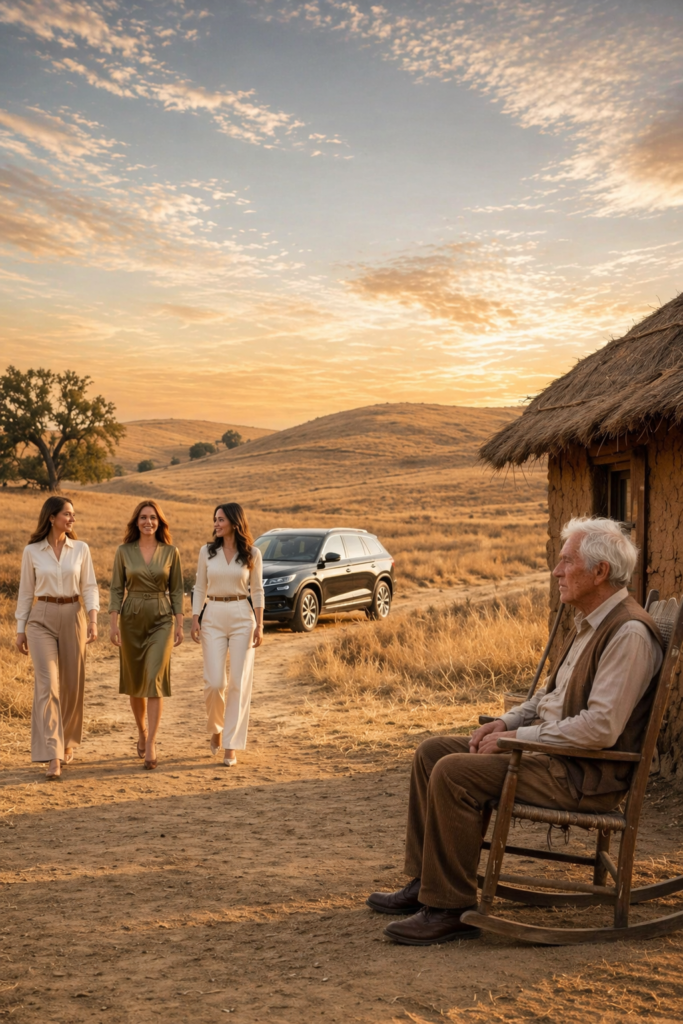
From the second truck, another woman in a navy blue dress, carrying a leather folder and a firm gaze, stepped out. From the third truck, a woman in white pants, an embroidered blouse, and a fine shawl with Oaxacan flowers emerged.
Don Jacinto tightened his grip on his cane.
His lips trembled.
The first woman took off her glasses.
—Dad Jacinto.
The old man exhaled as if he had been holding his breath for twenty years.
—Mariana…
Berenice dropped the folder and ran. So did Sofía. The three knelt in the dirt, disregarding their expensive clothes, oblivious to the whole village watching them.
They hugged him like children.
—Forgive us —Mariana cried—. Forgive us for taking so long.
—We didn’t abandon you —Berenice said, kissing his weathered hands—. Even though it seemed like it.
—Everything we are was born here —Sofía sobbed—. Here with you.
Don Jacinto touched their faces one by one, as if he needed to verify they weren’t ghosts.
—My girls… my three girls…
The neighbors stood in stunned silence. The same people who had said for years that they were ungrateful now lowered their gazes.
Severiano regained his voice first.
—Very touching, yes. But this property no longer belongs to the old man. There are documents.
Berenice stood up slowly.
The girl who once counted coins to buy rice now had a gaze that seemed to open safes.
—We also have documents, Mr. Severiano.
From one of the trucks stepped out two lawyers, a notary public from Oaxaca, two representatives from the Agrarian Registry, and a woman with a badge from the Prosecutor's Office.
Severiano swallowed hard.
—What does this mean?
Mariana opened a folder.
—It means we reviewed the contract you made Don Jacinto sign. You charged illegal interest, altered dates, and used his fingerprint on pages he never read.
—That’s a lie.
Sofía stepped forward.
—The lie was telling the village that our dad was alone.
Severiano spat to the side.
—He’s not your dad. He’s just an old busybody who picked up someone else's trash.
Silence was broken by a murmur of indignation.
Mariana stared at him, unblinking.
—Be careful what you say. That man did more for us than all the blood that turned its back on us.
Don Jacinto began to cry silently.
Not out of fear.
Out of shame for being seen crying, and relief that he hadn’t imagined the love of his daughters.
Berenice handed the papers to the notary.
—The debt was settled eight months ago. We bought the original promissory note, we bought the adjacent lot, and we also bought the abandoned warehouse that you auctioned off with traps. Additionally, 17 families are filing complaints against you for dispossession.
Severiano opened his mouth.
—You bought what?
—Enough —Sofía replied— so you’ll never again force an old man out of his home.
Then the village understood that they hadn’t come to improvise.
They had returned with everything.
For years, while San Mateo judged them, the three sisters had lived a story no one wanted to imagine. Mariana washed dishes in Madrid before anyone bought her designs. Berenice worked as a cashier, waitress, and accounting assistant while studying. Sofía slept in shared rooms in Italy and sold embroidered blouses at fairs where many couldn’t even pronounce Oaxaca.
At first, they failed many times.
They were robbed of designs. They were denied loans. They were shut out for being Mexican, brown, and poor.
But they didn’t give up.
One day, a small boutique bought 30 pieces. Then a store in Milan ordered 200. Next, an international chain wanted a complete collection inspired by Mixtec embroidery, natural dyes, and artisan work.
Thus was born "Hijas del Maíz," a Mexican brand that grew without losing its accent, without hiding its roots, without erasing the name of the man who taught them to share the last tortilla.
—We didn’t call because we were ashamed we couldn’t fulfill our promises —Sofía confessed, kneeling before Don Jacinto—. We wanted to return with something real, not with promises.
Don Jacinto shook his head.
—I just wanted to know if you were okay, girls. That was enough for me.
Mariana covered her mouth to keep from breaking.
—And that’s where we failed. Succeeding didn’t make us less guilty for your silence.
Berenice took out a golden key from her bag.
—But we came to fix what still can be fixed.
Severiano tried to walk toward his truck, but two state police officers blocked his way.
—This is abuse of power —he shouted—. These women think they’re so important because they have money.
The Prosecutor's agent spoke calmly.
—Mr. Severiano Montes, you are under arrest for fraud, usury, forgery, and dispossession. You have the right to remain silent.
The old cacique, who for years had made people tremble with a notebook of debts, was handcuffed in front of everyone.
Some neighbors didn’t clap out of shame. Others did, because they too had lost land, animals, homes, and years of work because of his traps.
Don Jacinto looked at him without hatred.
—Abuse was believing that poverty has no memory.
That phrase hung in the air like a tolling bell.
Then the white truck opened its doors.
Boxes of medicines, food packages, blankets, tools, mattresses, chairs, a new stove, and rolled-up blueprints were unloaded. Doctors, architects, and workers also got out.
The municipal leader came running, his shirt half-tucked.
—What’s happening here?
Berenice turned to him.
—we are filing formal complaints against Severiano. And we also come to announce an investment for the village.
—Investment?
Mariana pointed to the abandoned warehouse.
—There we will set up a textile workshop and training center. It will be called Taller Jacinto.
Sofía looked at the women of the village, many with children clinging to their skirts.
—We will first hire single mothers, widows, artisans, and young people who want to stay. Fair wages, insurance, childcare, and transportation.
A woman placed her hand on her chest.
—Really?
—Really —Sofía said—. But without abusive intermediaries. Your work will be valued for what it’s worth, not for what a scoundrel wants to pay.
The village, which had once seen Don Jacinto as a madman for raising three orphaned girls, now saw that this madness returned transformed into employment, justice, and future.
But the most painful part was yet to come.
Mariana asked for silence.
—There’s something else you should know.
Everyone looked at her.
She pulled out an old, folded photograph, stained with moisture. The image showed the three little girls with Don Jacinto in front of the shack. In the back, almost hidden, was Severiano, looking at the scene with disdain.
—Twenty years ago, when our parents died, Severiano was the first to say we should send them to the shelter. We always thought it was because he was stingy.
Berenice opened another envelope.
—But we found documents. Our parents had a small inherited plot, next to the creek. It wasn’t much, but it was in our mother’s name.
Sofía looked at the already handcuffed Severiano.
—Three months after their death, that plot appeared sold with a forged signature.
The village went cold.
The notary read aloud the name of the buyer.
Severiano Montes.
Don Jacinto closed his eyes.
—No wonder…
Mariana tightened her grip on the photo.
—Not only did he try to take away our future when we were girls. First, he stole the only thing our parents left us. And when Dad Jacinto took care of us, he punished him with a fraudulent debt.
A woman from the village began to cry.
Another shouted:
—He took my land too!
Then another man raised his hand.
—And he did the same to my brother.
Fear began to break.
One by one, the neighbors started to speak. Invented debts. Forged signatures. Impossible interests. Threats. Shame kept buried for years.
Severiano, for the first time, no longer seemed powerful.
He seemed small.
The Prosecutor’s office took statements right there, under the sun, next to the shack where it all began.
That afternoon, there was no eviction.
There was justice.
In the months that followed, San Mateo Yucundá changed in a way no one thought possible. The stolen lands were reviewed legally. Several families regained titles. The abandoned warehouse became a workshop, filled with machines, long tables, colorful threads, and the smell of new fabric.
The three sisters had the old shack carefully dismantled, board by board. They wouldn’t allow it to be thrown away like garbage.
They kept the creaking door, the black griddle, the broken rocking chair, and a wall where their heights were still marked in pencil from when they were little.
—This doesn’t get destroyed —Mariana said—. This is our root.
Next to the same land, they built a new house for Don Jacinto. Spacious, fresh, with a large kitchen, a clean bathroom, a garden, windows facing the road, and a room on the ground floor so he wouldn’t have to climb stairs.
When he entered for the first time, the old man took off his hat.
—This looks like the house of important people.
Berenice adjusted his shirt.
—It is. The most important man in our lives lives here.
Don Jacinto cried like a child.
The day they inaugurated Taller Jacinto, families from nearby ranches came. Women received contracts. Young people stopped talking about the north as the only way out. The daycare opened with hot meals, caring teachers, and new toys.
At the entrance, they placed a plaque:
“For the man who gave a home to three girls when everyone else turned their backs.”
Don Jacinto read it four times.
—It wasn’t necessary.
Sofía hugged him.
—It was necessary. Because good people also deserve their place in life.
That night, they celebrated in the plaza. There was mole negro, tamales, hibiscus water, a band, and lanterns hung among the trees.
Don Jacinto arrived arm in arm with his three daughters.
Those who once mocked stood up. Some applauded with admiration. Others with shame. Others with that strange mix of guilt and hope that comes when one understands too late.
Mariana took the microphone.
—Twenty years ago, this village pitied us, but only one man gave us a home.
Berenice continued:
—He had no money, no education, no influence. He had something harder to find: love without calculation.
Sofía looked at Don Jacinto.
—Today everyone says we returned wealthy. But the truth is different. We are rich because a poor farmer taught us never to abandon anyone.
Don Jacinto covered his face with his hat.
—Enough, girls, you’re going to make me cry in front of everyone.
—Cry, Dad —Mariana said—. This time it’s not out of sadness.
Then they announced a fund for orphaned children and poor students. No sibling would be separated due to lack of money. No girl would leave school for not having shoes. No young person would lose a scholarship for not being able to afford the bus.
Don Jacinto squeezed his daughters’ hands.
—Then it was worth it, every blister.
Berenice kissed his forehead.
—Every blister brought us back.
Years later, when someone entered San Mateo Yucundá, they saw a beautiful house next to a lively workshop. In the corridor, under the shade of the bougainvillea that never died, sat Don Jacinto with his palm hat and a tranquil smile.
He no longer watched the road in waiting.
Now he watched it in peace.
Because he understood that true love sometimes takes time, makes mistakes, and hurts, but when it returns with deep roots, it doesn’t just save a house.
It can uplift an entire village.





