PART 1
On the night of her wedding, Valeria Mendoza still wore her makeup and had her white dress draped over a chair when her mother-in-law placed a black notebook on the bed.
Doña Rebeca Salazar smiled as if she were handing over a sacred inheritance.
—In this house, the daughter-in-law eats when everyone else has finished… if there’s anything left.
Sebastián, her husband, stood pale by the door. Just hours earlier, in front of over 150 guests at a venue in Polanco, he had promised to protect Valeria from everything and everyone.
But there, in front of his mother, he said nothing.
Valeria was 33 years old, the financial director of a food company in Santa Fe, and she was used to detecting hidden losses in massive reports.
She could read numbers, silences, and lies.
That’s why she quickly understood that the notebook was not a tradition.
It was a cage.
Doña Rebeca opened it calmly. Inside were handwritten rules: how to greet elders, where to sit at the table, when to speak, when to stay silent, and even what tone to use with the family aunts.
Sebastián clenched his fists.
—Mom, that’s enough. Valeria didn’t come here to serve you.
Doña Rebeca raised her gaze.
—You shut up, Sebastián. A wife must be taught from day one, because then they think they own the house.
Valeria didn’t shout.
She didn’t cry.
She just looked at the notebook, then at her husband, and then back at her mother-in-law.
—Then I will obey to the letter, Doña Rebeca.
The woman smiled, believing she had won.
The next morning, Valeria woke up at 6, dressed in a navy suit, heels, and her hair perfectly pinned up. Doña Rebeca was already seated in the kitchen, waiting for her coffee.
—Make breakfast —she ordered—. Eggs with chili, warm tortillas, and pot coffee.
Valeria paused at the stairs.
—I can’t.
Doña Rebeca frowned.
—What do you mean you can’t?
—Last night you said the new daughter-in-law should not touch the food of the elders before they finish. If I cook, I would have to taste the salt. If I serve, I would touch your plates. That would be a terrible disrespect.
Sebastián nearly threw a cup.
Doña Rebeca turned red.
—Don’t act all high and mighty, little girl.
—I’m not acting at all —Valeria replied sweetly—. I’m just obeying.
She grabbed her bag and walked toward the door.
—Excuse me. I have a meeting at 8.
That day, Valeria had green chilaquiles for breakfast in her office. Meanwhile, in the Salazar house, Sebastián burned the bread and Doña Rebeca ended up drinking instant coffee, furious.
By the third day, the kitchen looked abandoned.
There was no smell of tortillas, beans, or freshly made salsa. Only a plate of rotting fruit and a hard roll sat on the table.
—Since you arrived, this house feels like a hotel —Doña Rebeca complained—. You come and go, buying food just for yourself.
Valeria lowered her head.
—It wouldn’t be right for me to prepare food for the elders. You said so yourself.
Sebastián looked uncomfortable.
—Come on, please. Just cook something.
She looked him in the eye.
—Do you want me to disobey your mom? Because if I do, then she would be right to say I’m disrespectful.
Sebastián didn’t respond.
That night, Valeria ordered garlic salmon, avocado salad, and artisanal bread. She placed it on a corner of the counter and ate standing, away from the main table.
Doña Rebeca appeared in the kitchen and stared at the plate.
—Fancy food just for you?
—With my salary, yes. And I won’t offer it because it would be food for someone of lesser rank. I wouldn’t want to offend you.
Sebastián lowered his gaze.
For the first time, he didn’t seem angry with Valeria.
He looked embarrassed.
Sunday brought the real blow.
Doña Rebeca summoned her to the living room. She had the black notebook on her lap.
—Saturday will be the anniversary of my husband’s death. The whole family will come. You will prepare the food so everyone can see what kind of daughter-in-law we have.
Valeria understood the trap.
If she cooked, Doña Rebeca would flaunt that she had tamed her.
If she refused, she would be called lazy in front of everyone.
Valeria smiled.
—Of course, Doña Rebeca. I’ll make that day unforgettable.
Throughout the week, she didn’t buy meat, rice, or vegetables.
She only brought white flowers and candles.
The night before, Doña Rebeca opened the refrigerator and found it almost empty.
—Where’s the food?
Valeria replied calmly:
—You’ll understand tomorrow. It will be a perfect demonstration of family respect.
And when the first guests knocked on the door, Doña Rebeca still didn’t know that her own rule was about to strangle her in front of everyone.
PART 2
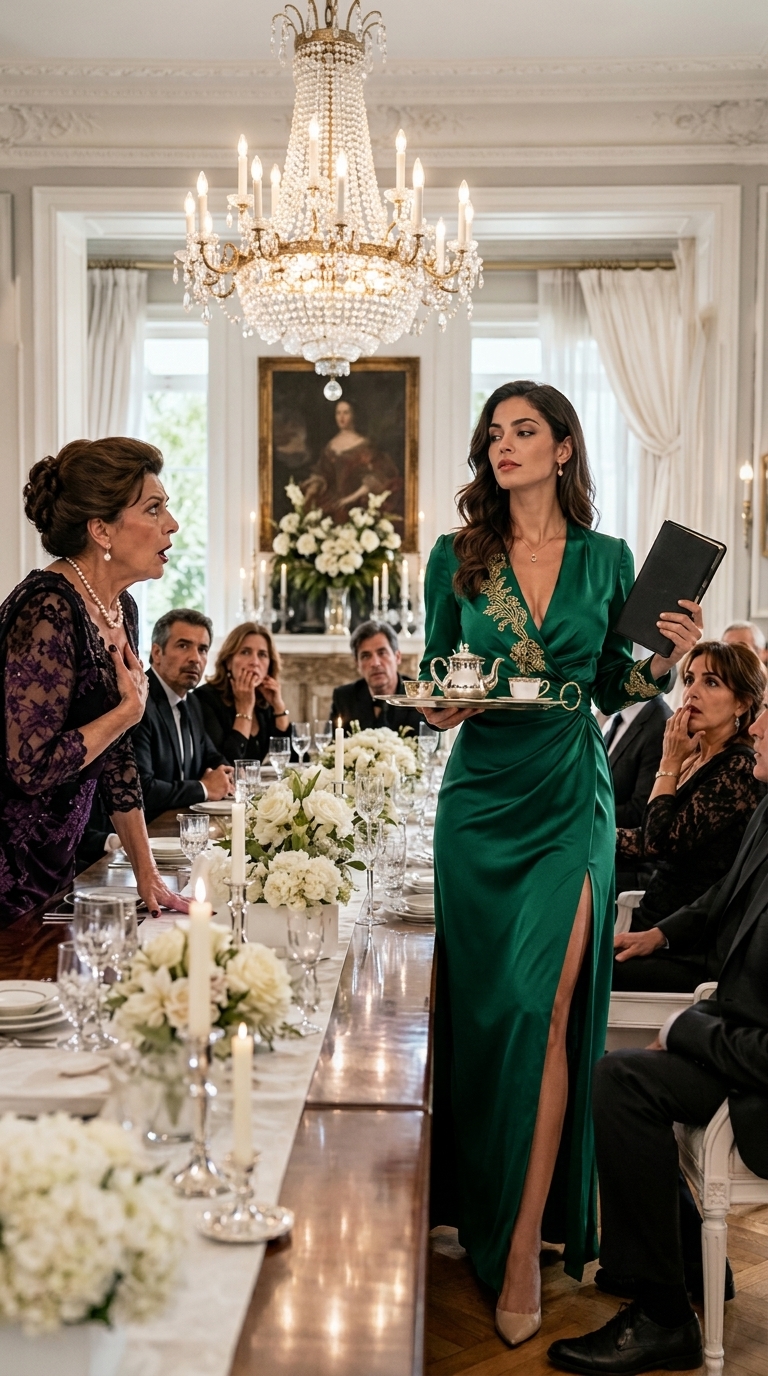
At 8 a.m., the Salazar house was full.
Uncles, cousins, nephews, and close neighbors arrived, all dressed in black to remember Don Arturo, Doña Rebeca’s deceased husband.
In the living room was his portrait with a white ribbon, candles, flowers, and sweet bread.
Doña Rebeca moved among the guests like a queen.
—This year my daughter-in-law took care of everything —she said—. She’s very capable, very refined, but here she’s learning the traditions of a decent family.
The aunts looked Valeria up and down.
Valeria served coffee, offered tea, and smiled.
But no smells wafted from the kitchen.
No mole.
No rice.
No chicken.
No beans.
Nothing.
At 9, Uncle Ernesto, Don Arturo’s older brother, glanced at his watch.
—Rebeca, when will the food be served?
Doña Rebeca swallowed hard and went to the kitchen.
Valeria was washing some cups.
—Where’s the food? —the mother-in-law whispered, furious.
—Waiting for you to start.
—What did you say?
Valeria dried her hands.
—You taught me that the new daughter-in-law should not touch the food of the elders. Today the most respectable members of the family are here. It would be grave for me to cook, taste, or serve before them.
Doña Rebeca opened her mouth but couldn’t speak.
Valeria stepped into the living room and called for attention.
—Dear Salazar family, thank you for coming to honor Don Arturo. As you know, I’ve just joined this house. Doña Rebeca explained to me a very important rule: the new daughter-in-law should not touch the food of the elders until everyone has finished. Therefore, to respect tradition, today she will personally prepare the food with the authority that belongs to her.
The silence was brutal.
Aunt Guadalupe’s eyes widened.
—What do you mean the daughter-in-law eats after everyone?
A cousin murmured:
—Seriously, do you still do those things?
Uncle Ernesto looked at Doña Rebeca seriously.
—If you imposed that rule, Rebeca, then you can’t ask the girl to break it right now. Go cook.
Some aunts stood up, not to help her out of goodwill, but to watch her downfall closely.
—Come on, Rebeca —said a sister-in-law—. You always bragged that no one cooked like you.
Sebastián rushed in.
—What happened?
Doña Rebeca looked at him, expecting defense.
But Sebastián just lowered his head.
He had witnessed for a week how his mother demanded obedience and then complained when she received it.
The kitchen turned into chaos.
There was no order. Sebastián had to run out for chicken, rice, vegetables, tortillas, cream, chiles, and fruit. One cousin chopped onions. Another checked the empty pantry with a mocking expression.
Doña Rebeca, who had been commanding from the armchair for years, tried to cook with trembling hands.
—Faster, Rebeca —said an aunt—. Don’t keep the elders waiting like you make your daughter-in-law wait.
The laughter was quiet but enough to shatter her pride.
The food was served nearly three hours late.
The rice was mushy, the chicken dry, and the sauce too sour. No one said it outright, but everyone noticed.
When they offered Valeria a seat, she humbly declined.
—I can’t sit down. Doña Rebeca taught me that the elders eat first. After I’ll clean up, and if there’s any left, I’ll eat.
The murmurs exploded.
—That’s not tradition, that’s abuse.
—Poor girl.
—And she works too, right?
Uncle Ernesto set his cutlery down on the plate.
—Rebeca, Arturo would never have allowed a woman to be treated like a servant in his memory.
Doña Rebeca didn’t respond.
Her eyes were teary.
But the worst came after the meal.
While Valeria collected cups, the youngest granddaughter, Camila, 17, found the black notebook on a chair.
She opened it out of curiosity.
—Hey… there are names here.
Everyone turned.
Doña Rebeca jumped up.
—Don’t touch that!
But Camila was already reading.
In the first pages were the rules for daughters-in-law.
But later there were dates, quantities, and phrases written with rage.
“Lucía cried on May 12. She went two days without eating at the table.”
“Marta broke down after six months.”
“Claudia asked to leave, but Arturo said that an educated daughter-in-law doesn’t abandon.”
The room froze.
It wasn’t just a notebook of rules.
It was a record of humiliations.
Doña Rebeca had documented for years how each woman in the family had been subdued.
Valeria felt her stomach tighten.
Aunt Guadalupe snatched the notebook and began flipping through it with trembling hands.
Suddenly, she stopped.
—Here’s my name.
Her voice broke.
—It says I “learned” when I was left without dinner on Christmas.
Another older woman covered her mouth.
—They did it to me too.
The truth fell like a stone.
Doña Rebeca hadn’t invented that cruelty.
She had received it, stored it, and then turned it into law.
Sebastián looked at his mother, destroyed.
—Did you know all this?
Doña Rebeca hugged the notebook to her chest.
—That’s how I was raised. That’s how a family stays united.
Valeria stepped forward.
—No, Doña Rebeca. That’s how you keep people scared.
For the first time, no one contradicted her.
Uncle Ernesto spoke in a low voice.
—That notebook should have been burned many years ago.
Doña Rebeca sat down slowly. She no longer looked like a queen. She looked like a tired woman trapped in an old crown no one wanted to inherit.
The guests left with cold hugs.
By Monday, everyone at the corner bakery was already talking about “the daughter-in-law who obeyed too well.”
That night, Doña Rebeca called Sebastián and Valeria to the living room.
The black notebook was on the table.
—You won —she said without looking at Valeria—. You made me look like a tyrant.
Valeria sat across from her.
—I didn’t win anything. I just followed your rules. If they made you look bad, maybe the problem was the rules.
Sebastián took a deep breath.
—Mom, I also failed. I should have defended Valeria from the first night.
Doña Rebeca closed her eyes.
—My mother-in-law did the same to me. She made me eat standing up. She told me that a daughter-in-law learns with hunger. I swore I would never be humiliated again… and I ended up humiliating others.
The living room fell silent.
Valeria pulled a folded sheet from her bag.
—I prepared an agreement. It’s not a threat. It’s respect. If you don’t sign it, Sebastián and I will move out.
Doña Rebeca looked up, scared.
The agreement was clear: everyone would eat together, no one would enter the couple’s room without permission, expenses would be fair, and chores would be divided among everyone.
The last point read:
“No tradition is worth more than a person’s dignity.”
Doña Rebeca read it twice.
—I don’t know how to apologize —she whispered.
Valeria replied:
—You can try.
The woman took the pen.
Her hands trembled.
She signed.
Sebastián exhaled as if he had been trapped for years.
Then he took the black notebook, placed it in front of his mother, and asked:
—What do we do with this?
Doña Rebeca looked at it for a long time.
—Let the women in the family read it. All of them. So that no one ever believes that suffering in silence is an inheritance again.
The next day, for the first time, Valeria woke up to the smell of fresh coffee.
She went down to the kitchen and found Doña Rebeca washing strawberries.
—I thought I’d make pancakes —the mother-in-law said, without looking at her—. Sebastián asked for them as a child.
Valeria approached.
—I’ll prepare the batter. You tell me how you like the fruit.
Doña Rebeca nodded.
Sebastián appeared at the door, surprised to see them together.
—Can I help?
Doña Rebeca looked at him seriously.
—Yes. Set the table. And not as a guest, okay? As part of this family.
The three of them had breakfast at the same table.
Three identical plates.
Three cups of coffee.
Three chairs occupied at the same time.
Doña Rebeca cut a piece of pancake and placed it on Valeria’s plate.
—Eat while it’s hot.
Valeria felt a lump in her throat.
Not all battles are won by shouting. Some are won by obeying an injustice so perfectly that no one can keep pretending it’s normal.
And that morning, in the Salazar house, everyone understood something many families still debate:
a house is not honored by hierarchies, but by a table where no one has to wait standing to be treated like a person.