PART 1
Lucía Ríos was sent to room 12 as if someone were tossing her into a cage to see how long it took before she cried.
She had only been working at the Naval Specialty Hospital south of Mexico City for 18 days. Her sky-blue uniform still looked too new, her shoes bore not a single stain, and she spoke in that soft voice that many mistook for weakness in a place filled with egos.
At the nurse's station, Marisol Delgado dropped the file onto the counter.
—You’re assigned to Iván Salcedo—she said, smiling as if she had just handed out a punishment—. Ex-commando from the Navy. Deaf from an explosion, one leg amputated, a devil of a temper. No one can stand him. Let’s see if your little saintly face does you any good.
Resident Tomás pulled out his cell phone, half-hidden.
—This is going to the group. “This is how you break a new nurse in 3 minutes.”
Some laughed. Others pretended to check papers to avoid involvement. Lucía simply took the file.
Iván Salcedo, 39 years old. Profound bilateral deafness. Left below-knee amputation. Fever 38.3. Saturation 92. Right costal pain. Several notes in red: aggressive, difficult, non-compliant.
Lucía detested that word: difficult.
Because it almost always meant that no one had the patience to understand.
Dr. Arturo Castañeda emerged from his office, immaculate, in a starched white coat with an elegantly annoyed expression.
—Ríos, take his signs and don’t waste my time. That patient has manipulated half the hospital. If he gets agitated, sedate him.
Lucía looked up.
—Does he communicate using Mexican Sign Language?
Castañeda let out a brief laugh.
—He communicates by throwing things. That’s enough.
Laughter chased her down the hall again.
When Lucía arrived at room 12, she saw Iván sitting with his back against the wall, not the pillow. He surveyed every corner: the door, the window, the oxygen outlet, the supply cart.
He didn’t seem crazy.
He seemed like a man who had been waiting for years for someone to come in and hurt him.
There was a broken tablet on the floor and two orderlies beside the bed. One of them had a tense jaw.
Lucía knocked on the doorframe twice.
Iván looked at his hands.
She entered slowly, palms visible.
—You can go—she said.
—Are you sure, boss?
—Yes.
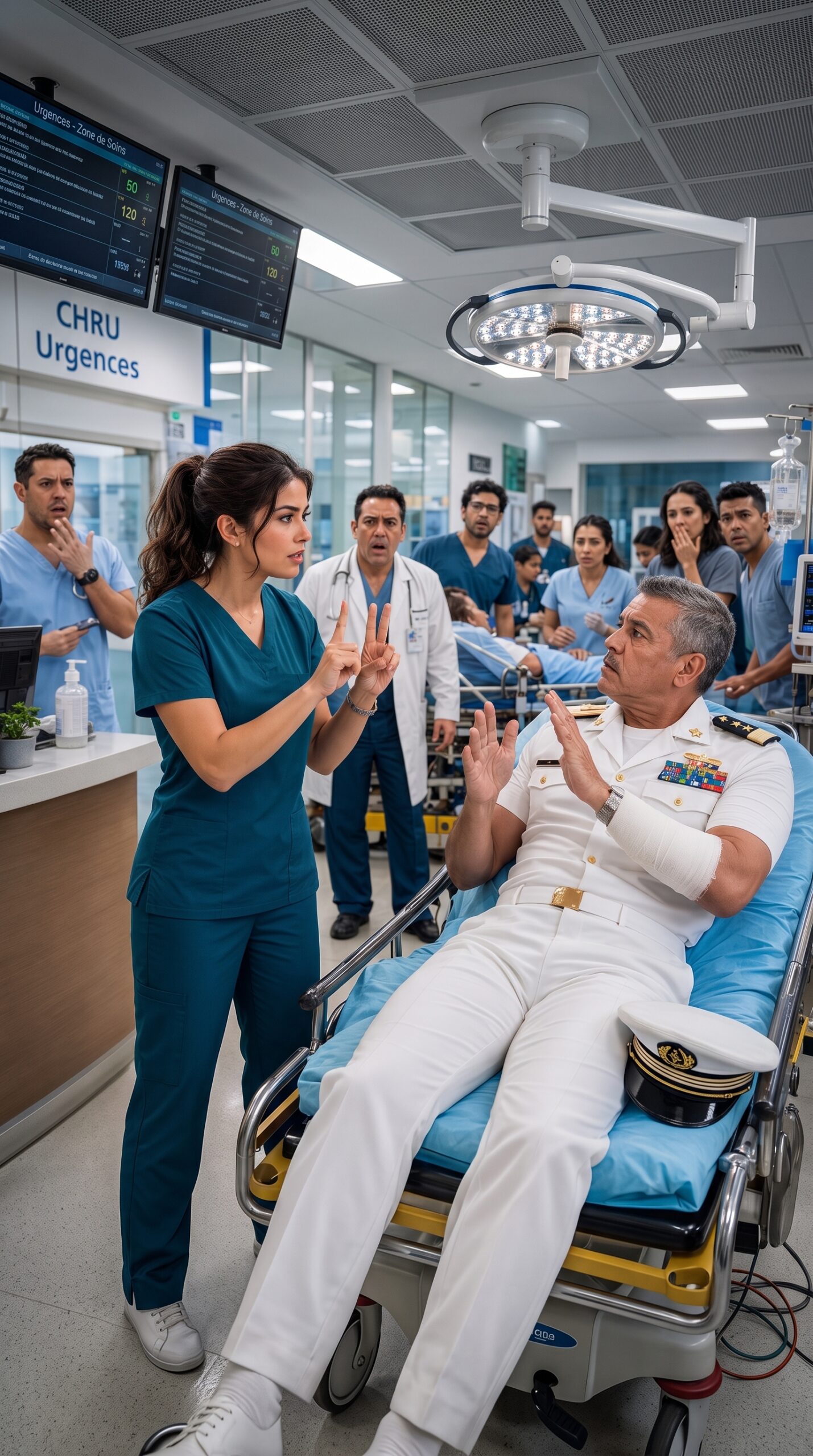
When the door closed, Lucía positioned herself where Iván could see her clearly. Then she raised her hands and began to sign.
—My name is Lucía. I’m a nurse. I won’t touch you without permission.
Iván remained still.
This was no ordinary surprise. It was something deeper, as if he had just heard a buried voice.
He responded quickly.
—Who taught you?
Lucía signed without changing her expression.
—Someone who knew how to listen.
He studied her. Then pointed to the door.
—No residents. No Castañeda. No sedatives.
—Agreed. As long as you’re not in danger.
Lucía wrote on the board: “Main communication: LSM. Do not touch without consent. No students without permission.”
Then she asked to check his signs. Iván consented.
Blood pressure 158/94. Pulse 126. Respiration 29. Fever. Saturation 91. Iván’s right hand pressed against his ribs, as if he were trying to hold something inside.
—Pain there?
—Since this morning.
—Has it worsened since trying the new prosthesis?
Iván fixed his gaze on her.
—Yes. I’m short of breath.
Lucía brought the stethoscope closer, asking for permission with her eyes. He nodded.
The right side sounded low. Too low.
She felt the whole room shrinking.
—You need urgent assessment.
Iván signed:
—Castañeda said anxiety.
—Castañeda is wrong.
For the first time, Iván lowered his guard. Not much. Just a millimeter.
Then he moved his fingers in a different code. Short, sharp, military. It wasn’t LSM.
Pain increases. Air is lacking. Internal threat.
Lucía felt her hands freeze.
That code shouldn’t exist outside a sealed unit. And she shouldn’t recognize it.
Iván saw the change on her face. His eyes dropped to Lucía’s left wrist, where a pale scar peeked out from under her watch.
His breath caught.
Then he signed a single word.
—Sparrow.
Lucía stepped back.
—No.
Iván insisted.
—Sparrow is dead.
She clenched her jaw.
—Then let her stay dead.
The door swung open abruptly. Marisol entered with Tomás behind her. His cell phone glowed against his chest.
—What’s all this mystery?—Marisol said—. Did he bite you?
Tomás smiled.
—Or he’s already taken her hostage. How scary, seriously.
Lucía stepped into the hallway.
—I need Dr. Castañeda now.
When Castañeda arrived, she spoke quickly, firmly.
—Right costal pain, fever, tachypnea, dropping saturation, diminished respiratory sounds. He may be developing a pneumothorax.
The doctor didn’t even approach Iván.
—Anxiety. Nebulization and 2 milligrams of sedative if he gets agitated.
Lucía stared at him without blinking.
—You don’t sedate a patient who can’t breathe.
Castañeda’s face hardened.
—You don’t decide that.
The monitor dropped to 88.
Iván clenched the sheets. His lips began to turn gray.
Lucía pressed the rapid response button.
Castañeda tried to silence the alarm, but Iván gripped his wrist with brutal force. The entire room froze.
Lucía signed:
—Let go.
Iván obeyed instantly.
The silence that fell was louder than any scream.
The team rushed in. The portable X-ray confirmed what Lucía feared: the right lung was collapsing.
Oxygen 80.
Castañeda stood frozen.
—He needs decompression—Lucía said.
—If you touch him, I’ll fire you—he spat.
Iván grabbed Lucía’s sleeve and signed against her palm.
—You.
Lucía took a deep breath.
—Consent granted.
She cleaned the area, located the intercostal space, and inserted the catheter.
For one second, nothing happened.
Then a hiss of trapped air filled the room.
Iván inhaled as if returning from the depths of the sea.
The monitor rose to 86. Then 90. Then 93.
No one laughed.
Iván, still pale, looked at Lucía with an urgency that had nothing to do with pain.
He signed slowly, so only she could understand.
—If they found me, they found you too.
PART 2
The administrative review began 40 minutes later, as if the problem wasn’t that a patient had nearly died, but that a new nurse had been right in front of everyone.
Lucía stood in a cold room, facing the director, Castañeda, Marisol, and Tomás. On the wall hung a poster that read: “Humanity, respect, and service.”
The irony weighed like a stone.
Castañeda accused her of insubordination. Tomás claimed she had “emotionally disturbed” the patient. Marisol remained silent, looking at her hands.
Lucía didn’t defend herself dramatically.
She repeated signs, times, saturations, symptoms, and the patient’s authorization.
The facts sounded louder than any scream.
Then the door opened.
Iván appeared in a wheelchair, pale, with the chest drainage hanging at one side. A nurse tried to stop him.
He raised his hand and demanded Lucía translate.
—You mocked my deafness—he signed—. You wanted to record me, sedate me, and call me crazy because you were too lazy to understand me. She was the only one who listened without hearing.
Lucía translated every word.
Tomás’s face lost color.
Iván pointed at Lucía.
Then, with a rough voice, torn from years of silence, he said:
—Sparrow.
The room fell dead silent.
Castañeda stood up.
—What does that mean?
Lucía didn’t answer.
Iván began to cough. His saturation dropped. She rushed first, held the drainage, ordered oxygen, and returned him to the room with a calmness that left everyone speechless.
But the secret had already slipped out.
Half an hour later, Marisol entered room 12 with a pale face.
—There’s a man in maintenance asking about Iván’s prosthesis. He says he comes on behalf of his brother Ernesto.
Iván closed his eyes.
Lucía understood immediately.
Ernesto Salcedo was a medical contractor, a famous businessman, and Iván’s older brother. In interviews, he spoke of patriotism, family, and support for veterans. His company had donated prostheses to the hospital and appeared in photos with officials.
—What did you have in that prosthesis?—Lucía asked.
Iván hesitated.
Too long.
—Tests—he signed—. Payments. Fake reports. Defective prostheses. Black Tide.
Lucía felt her wrist scar burn.
Black Tide.
The operation where they declared her dead. The night of the explosion. The night Iván lost his hearing and she disappeared from military records under a sealed order.
The night someone sold information from within.
Suddenly, the lights flickered.
In the hallway, Tomás handed an access card to a man in a maintenance coat and too-clean shoes.
Lucía closed the door. She crossed a chair. Grabbed the IV stand as a weapon.
Iván signed with one hand:
—Threat.
—Breathe—she replied—. That’s your job now.
The handle moved.
The man pushed.
Lucía burst open the door and struck his wrist. A syringe fell to the floor. It wasn’t medicine. He hadn’t come to heal.
Iván reached for the call cord and wrapped it around the man’s arm. Security arrived late, confused, but they arrived.
The handcuffed man lifted his face and smiled.
—You should have stayed dead, Sparrow.
The whole hallway heard.
In the back, another guy came out of the elevator with a black case: Iván’s prosthesis.
At that moment, the lights went out completely.
The red emergency light bathed the hospital as if the entire building were breathing blood.
Lucía didn’t run after the case. She first looked at the patients, the oxygen outlets, the exits, the frightened families.
—Marisol, close rooms 10 and 11. Take the families behind the station. If Iván drops below 88, scream.
Marisol trembled.
—I’ll stay with him.
Lucía looked at her.
—This time yes.
Minutes later, Captain Elías Robles arrived with two naval investigators. He stopped upon seeing Lucía.
His stone face cracked just slightly.
—Sparrow.
Castañeda murmured from the hallway:
—It can’t be.
Robles spoke loudly enough for everyone to hear.
—Subofficer Lucía Ríos. Tactical medic of special naval unit. Survivor of Black Tide. Declared deceased under sealed order to protect her.
The entire hospital seemed to hold its breath.
The new nurse, the quiet one, the one in the clean uniform, wasn’t a fragile girl.
She was a hidden woman.
But Lucía didn’t allow the astonishment to distract her.
—The case is a decoy—she said—. Iván wouldn’t keep the only copy there.
Iván, from the bed, pointed to the inner lining of the prosthesis resting next to the chair. Lucía slipped her fingers into an almost invisible seam and pulled out a tiny memory card, sealed against water.
Iván signed:
—Backup.
The handcuffed man shouted from the floor:
—She found it!
From the end of the hallway came three men in hospital jackets. They were waiting for panic.
They found silence.
The veterans in the wing crouched behind stretchers, chairs, and carts. They weren’t young, but they knew how to obey danger.
Robles raised his weapon.
—On the ground!
One of the men aimed toward Iván’s room.
Lucía stepped out of the shadows.
—Are you looking for this?
She raised her closed hand with the memory inside the glove.
The three turned toward her.
The first ran. Lucía threw the IV stand at his knee, entered his space, and twisted his wrist against the counter. The shot went to the ceiling.
Another attempted to surround Marisol. Iván, in brutal pain, threw the prosthesis lining and struck the man’s hand.
Marisol screamed as ordered.
Security entered through the stairs.
It all lasted 9 seconds.
The real violence didn’t feel like a movie. It felt like a door slamming shut.
When they connected the memory to a secure reader, contracts, payments, altered reports, defective prostheses delivered to veterans, and false diagnoses to hide complications appeared.
Ernesto Salcedo figured as the primary intermediary.
Castañeda appeared signing notes of “anxiety” and “aggressive behavior” for patients who were actually reporting medical failures.
The director appeared rejecting complaints.
Tomás appeared in internal messages sharing videos of vulnerable patients.
Iván looked at the screen without surprise.
That hurt more.
—My brother said I was destroying the family—he signed—. But he was selling broken legs to men who had already given theirs for Mexico.
Lucía translated.
Marisol covered her mouth. Tomás began to cry against a wall.
Castañeda tried to justify himself.
—I was just following orders.
Lucía looked at him as one looks at someone too small for the damage they caused.
—No. You followed money. And then you wanted to sedate the truth.
Ernesto was arrested that same night at a house in San Ángel while his mother screamed that Iván was an ungrateful son for “shaming the family.”
Iván didn’t answer.
He only asked to be brought an old photo.
In it, Lucía and Iván were covered in dust, before the explosion, before the silence, before the Navy buried a woman alive in paperwork so that traitors wouldn’t find her.
Three weeks later, the hospital still smelled of reheated coffee and bleach. The hallways were the same. The wheels of the stretchers sounded the same.
But something had changed.
At the entrance of room 12, they placed a new rule:
“No patient will be called difficult until it has been demonstrated that an attempt was made to understand them.”
Courses in Mexican Sign Language opened. Recording patients was prohibited. No student would enter a room as part of a joke again.
Marisol enrolled in the first course.
Tomás was suspended and sent for investigation.
Castañeda lost his license.
The Salcedo name ceased to sound powerful and began to sound like a criminal record.
The day Iván was discharged, he stopped his wheelchair in front of the nurse's station where the joke had begun.
He asked Lucía to translate exactly.
—You thought my silence was weakness. You thought your calm was fear. You thought a blue uniform could hide someone without value. You were wrong three times. Power was never in a lab coat or a last name. It was in the one who decided to listen when everyone wanted to laugh.
Lucía finished translating with a tight throat.
Robles greeted her with military respect.
She responded, but then lowered her hand and adjusted her hospital badge.
It read: Lucía Ríos, nurse.
No medals. No codes. No Sparrow.
That was enough for her.
Months later, many told the story as a legend. That a new nurse faced armed men. That a deaf ex-commando hid the truth in a prosthesis. That a joke uncovered a web of family corruption.
All of it was true.
But it wasn’t the heart of the story.
The heart was simpler and crueller: a group of people saw a quiet nurse and a deaf patient and thought they could use them for laughs.
They expected humiliation.
They found character.
Because sometimes, the one who doesn’t speak loudly is the one who has survived the most.
And sometimes, the person everyone underestimates isn’t hidden out of cowardice, but because the world has already asked too much of them… until someone needs to be saved again.