PART 1
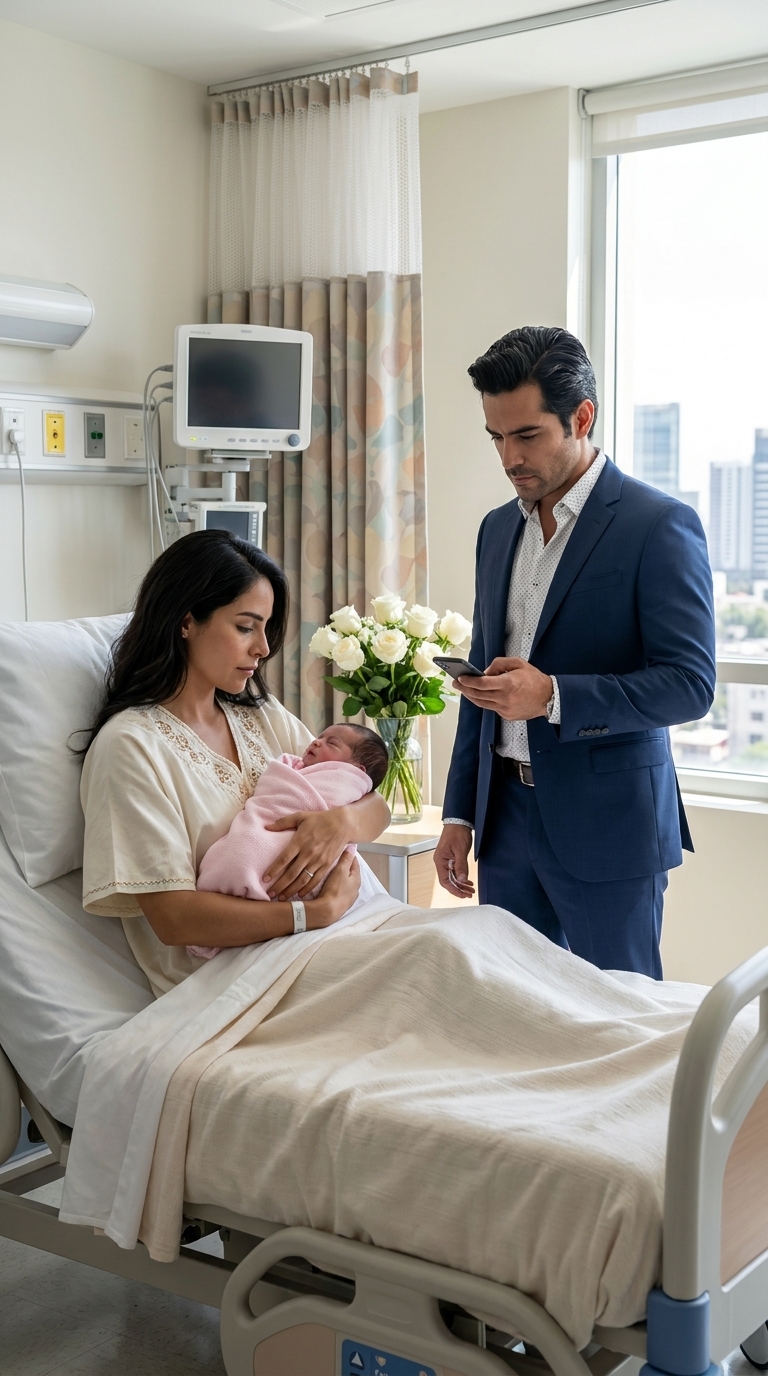
Two hours after giving birth, Mariana Robles could barely keep her eyes open.
Her daughter slept on her chest, wrapped in a pink blanket that her sister had bought at a market in Puebla. The baby breathed softly, mouth slightly open, as if she didn’t know she had just arrived in a family already deciding whether she deserved love or shame.
Emilio Aranda stood by the window of the private hospital room in Santa Fe, dressed in a crisp navy suit, his cellphone clenched in his hand.
He didn’t look like an excited father.
He looked like a man waiting for an awkward meeting to end.
—Emilio—Mariana whispered, exhausted—. Come hold Valentina.
He barely turned.
He looked at the girl as if she were a misdelivered package, something someone had left on his doorstep without asking.
A strange chill settled in Mariana's chest.
For ten hours of labor, Emilio had held her hand, asked for water, pretended to be nervous in front of the nurses. He had even said:
—I can’t wait to meet my princess.
But now he didn’t reach out.
He approached the bed, leaned down, and spoke so softly that only Mariana could hear him.
—I have a child with another woman.
Mariana blinked.
She didn’t scream.
She didn’t cry.
She didn’t even ask if he was joking.
—It’s a boy—he added, with a cruel calm—. My family already knows. I’m not giving my last name to this girl.
The word “girl” came out like a failure.
Mariana looked at Valentina. So tiny. So warm. So innocent.
The child had just been born, and her own father was already rejecting her for not being a boy.
—Did you have a child while I was pregnant?—Mariana asked.
Emilio clenched his jaw.
—Don’t make a scene. This can be handled maturely.
Maturely.
As if maturity meant silently accepting humiliation while a newborn clung to her chest.
—With whom?—she asked.
He hesitated for one second.
—with Daniela.
Mariana recognized that name.
Daniela Fuentes, Emilio’s executive assistant at Grupo Aranda. Always elegant, always serious, always present at family dinners with a smile that seemed rehearsed.
—My dad says the last name needs a male heir—Emilio continued—. And I’m not going to lose my place over a scandal.
Mariana smiled.
A small, tired smile, but firm.
Emilio frowned. He expected tears, pleas, a telenovela scene.
But Mariana just adjusted her daughter against her chest.
—Then remember this moment well—she said—. Because it’s the last one you’ll have of us.
Emilio let out a dry chuckle.
—You’re tired, Mariana. We’ll talk tomorrow.
Then he left the room.
He didn’t come back all night.
What Emilio didn’t know was that Mariana was not a broken woman.
She was a financial auditor.
And before dawn, while everyone was asleep, she called a lawyer who held a secret capable of destroying the entire Aranda family.
PART 2
Mariana Robles was born in Puebla, in a house where money was never plentiful, but dignity was never for sale either.
Her mother sold home-cooked meals near a secondary school. Her father drove a taxi until diabetes robbed him of strength in his legs. Mariana grew up doing calculations on napkins, checking electricity bills, comparing prices at the market.
That’s why she studied accounting and auditing at UNAM.
Not because she dreamed of expensive suits.
But because as a child she understood that numbers don’t cry, but they do tell the truth.
She met Emilio Aranda four years earlier when the firm she worked for was hired to review hotel investments in Los Cabos.
Emilio was the heir to a powerful family from Monterrey. The Arandas owned hotels, shopping malls, luxury buildings, and a foundation that appeared in magazines talking about “family values.”
He pursued her for months.
He brought her coffee without flaunting it. He spoke to her with respect. He said he liked that she was direct, that she wasn’t easily impressed.
Mariana thought he was different.
They married 18 months later in a hacienda near Atlixco. It was an intimate wedding, with lights hung between trees and bolero music in the background.
Emilio told her that night:
—I don’t want a decorative wife. I want a partner.
Mariana believed him.
Doña Irene, Emilio’s mother, always treated her with a false kindness, the kind that smiles while measuring how much your dress costs.
Don Horacio Aranda, her father-in-law, hardly spoke to her. He only watched her as if she were an employee who snuck into the main table.
Over time, Mariana understood something: in that family, no one shouted.
They humiliated softly.
Daniela Fuentes’s name came up for the first time at a Grupo Aranda end-of-year dinner.
Daniela was tall, thin, with perfectly tailored blazers and a calm voice. When she looked at Emilio, she didn’t seem in love.
She seemed tired.
Mariana didn’t want to pay attention.
Then came the trips to Guadalajara that stretched an extra day. The calls on the terrace. The meetings that ended at midnight.
Once she found a restaurant receipt in Querétaro, dated on a night when Emilio was supposedly with his father in Monterrey.
—It was a last-minute meeting—he said—. Don’t make things up, seriously.
Mariana fell silent.
She didn’t want to become a woman rifling through pockets like a cop.
Besides, she was trying to get pregnant.
For almost two years, they went through private clinics, tests, injections, trials, waits, and tears hidden in hospital bathrooms.
Emilio initially accompanied her.
He told her:
—When it happens, it will be perfect.
When they finally found out it was a girl, Emilio smiled, but Mariana noticed something strange in his eyes.
It wasn’t complete happiness.
It was calculation.
Still, she continued preparing Valentina’s room with cream-colored walls, cloud mobiles, and a lamp shaped like a moon.
She never imagined that while she folded zero-size clothes, Daniela had already given birth to a boy named Mateo.
A boy born three months before Valentina.
The morning after the birth, Mariana called her sister Clara.
Clara arrived from Puebla before six in the morning, disheveled, wearing an old sweatshirt, and with eyes full of fury.
Upon entering the room, she saw Mariana pale and the baby sleeping.
—Where is that bastard?—she asked.
—He left—Mariana replied.
Clara clenched her fists.
—Tell me what we do.
Mariana took a deep breath.
—First, we get out of here without him knowing. Then we take off the mask.
Clara didn’t ask further.
She just said:
—Let’s go.
The doctor insisted that Mariana should stay for two more nights. Emilio didn’t show up. Doña Irene sent a huge arrangement of white flowers, without a card.
Don Horacio sent nothing.
That second night, while Valentina slept in a transparent crib, Mariana remembered a message she had been ignoring for weeks.
It was from attorney Teresa Nájera, lawyer for her uncle Ernesto.
Uncle Ernesto had died seven months earlier. He had been a structural engineer, a quiet man who designed buildings for companies that then didn’t even invite him to the inaugurations.
He never had children.
Mariana thought he had left her books, old blueprints, and perhaps a small savings account.
But when she called from the hospital, the lawyer's voice sounded serious.
—Mariana, your uncle didn’t just leave you personal belongings. He left you a stake in an old company.
—What company?
—A firm that was absorbed by Grupo Aranda decades ago.
Mariana froze.
—Grupo Aranda?
—9% of a real estate division. And a voting agreement that is still in effect.
Mariana looked at her daughter.
—What does that mean?
—That you have the right to request a formal review if a director puts the company at financial, ethical, or reputational risk.
The silence became heavy.
Emilio had chosen the worst moment to underestimate her.
A week later, Mariana no longer lived in the Lomas house she shared with him.
Clara helped her take clothes, documents, the crib, and a box of memories she no longer wanted to look at. They settled into a small apartment in Coyoacán, with large windows and neighbors who greeted them without asking too many questions.
Emilio sent her one message.
“I hope you don’t make this harder. Let’s be adults.”
Mariana didn’t respond.
Attorney Teresa submitted the request for review to the Grupo Aranda council.
The reason was clear: Emilio had maintained a relationship with a direct employee, had a child with her, concealed information during banking negotiations, and signed declarations of family and executive stability while living a double life.
This was no longer just infidelity.
It was corporate risk.
The council met on a Thursday in a glass room in Santa Fe.
Mariana was not obliged to attend, but she did.
She carried Valentina asleep in a baby carrier, pressed against her chest.
She wanted Emilio to see exactly who he had denied.
Don Horacio presided over the meeting. He looked older, though he still wore that boss-like gaze that believes everything can be bought.
—Emilio—he said in a dry voice—, is it true that you had a child with your assistant while your wife was pregnant?
Emilio swallowed hard.
—The situation was being handled privately.
Mariana felt nauseous.
Privately.
As if her daughter were an administrative error.
Don Horacio tapped the table with two fingers.
—Does “privately” mean abandoning your newborn daughter and refusing to acknowledge her?
No one spoke.
Emilio looked at Mariana for the first time since the hospital.
He no longer seemed powerful.
He seemed like a man searching for an elegant lie.
Then the door swung open.
Daniela Fuentes entered with a black folder in her hand and a bare face.
Emilio turned pale.
—What are you doing here?—he murmured.
Daniela didn’t look at him.
She sat down in front of the council and placed several documents on the table.
—I was deceived too—she said.
The room turned cold.
Daniela showed printed messages where Emilio promised her he would separate from Mariana “when the baby situation stopped being delicate.”
In other messages, Emilio told a friend that Mateo, Daniela’s son, would serve to “calm the old man,” but that afterward he would try to keep Daniela away from any family decision.
Daniela breathed heavily.
—You promised me a family. To her, you faked one. And you used both children as pawns, dude.
Mariana felt something unexpected.
Compassion.
Daniela wasn’t the main villain.
She was another woman trapped in a different lie.
But the real twist came when Daniela pulled out a final sheet.
—In addition, there’s something everyone should know—she said—. Mateo doesn’t have Aranda blood.
Emilio shot up suddenly.
—Shut up!
Don Horacio turned pale.
Daniela held his gaze.
—Emilio has known for a month. He took a private test because he had doubts. The child is not his.
The silence was brutal.
Mariana felt the air splitting.
The “male heir” for which Emilio had rejected Valentina wasn’t even his biological son.
Daniela cried for the first time.
—I was deceived too before being with him. I told him when I learned the truth, but Emilio chose to hide it because it suited him to flaunt a boy in front of his dad.
Doña Irene, who was sitting in a corner, covered her mouth with her hand.
Don Horacio looked at Emilio as if he had just seen him without a disguise.
—You rejected your legitimate daughter for an heir who isn’t even yours?—he asked.
Emilio didn’t answer.
He couldn’t.
The council suspended Emilio that same day.
It wasn’t a quick or clean victory. Lawyers came, mediations, threats disguised as settlements, calls from relatives saying Mariana was “breaking the family.”
But the family was already broken.
Only now everyone could see it.
Valentina was legally recognized as Emilio’s daughter and heir within the family trust. Mariana obtained full custody, adequate support, asset protection, and total freedom to live away from him.
Daniela received financial support for Mateo, not from Emilio, but from a private fund that Don Horacio created without conditions.
—The child is not to blame for our messes—said the old man.
Emilio lost his executive position, his house, his image as the perfect heir, and everyone’s trust.
But the worst for him was losing control of the narrative.
No one said Mariana was a bitter wife anymore.
Now everyone knew he had denied his own daughter out of machismo, ambition, and fear.
A year later, Don Horacio called Mariana.
—I don’t want lawyers—he said—. I want to ask for permission to meet my granddaughter.
They met in a quiet café in Coyoacán.
Don Horacio arrived without a driver, without bodyguards, without that air of a world owner.
It took him almost a minute to speak.
—I raised my son believing that the last name was worth more than character—he said—. I’ve seen the result.
Mariana didn’t respond.
He lowered his head.
—I don’t ask for your forgiveness. I just ask for the opportunity not to repeat the same mistake with Valentina.
Mariana agreed, but with conditions.
Supervised visits. No speaking ill of anyone. No treating the last name as a prize. No making Valentina feel she had to earn a place that was already hers.
Don Horacio accepted everything.
Doña Irene took longer.
First, she sent a letter saying that “things had been complicated.”
Mariana didn’t reply.
Months later she sent another, shorter.
“I was wrong. Your daughter didn’t have to prove anything to be loved.”
That one she kept.
Emilio showed up almost two years later.
He called at night, his voice no longer commanding.
—Mariana, I want to see her. I want to be part of Valentina’s life.
Mariana looked toward the living room.
Valentina was walking behind a wooden cart, laughing every time she bumped into the sofa.
—You had two hours to choose her when she needed you the most—Mariana said—. And then you had almost two years to show remorse.
—I made a mistake.
—No, Emilio. A mistake is forgetting to pay the electricity bill. What you did was a decision.
He fell silent.
—I’m alone—he whispered.
Mariana closed her eyes.
—Don’t confuse loneliness with love.
And hung up.
She felt no pleasure.
Nor guilt.
Only peace.
Today Valentina is three years old. She runs around the apartment with an energy that leaves anyone breathless. She names everything: the plant is called Lola, her doll is called Lupita, and the patio tree is called Grandpa, because Don Horacio sits under its shade when he visits on Sundays.
Daniela and Mariana talk sometimes.
They are not best friends, but there is a rare respect between them, of women who understood too late that they were never enemies.
Mateo and Valentina met in a park.
There were no speeches or heavy last names.
Just two children sharing cookies and fighting over a red ball.
Sometimes Mariana remembers that hospital room.
Emilio by the window.
Valentina on her chest.
The cold, cruel, absurd phrase:
—I have a child with another woman.
He thought he was destroying her.
He didn’t know he was liberating her.
Because winning doesn’t always mean ruining those who hurt you.
Sometimes winning is leaving with your daughter in your arms from a life where they wanted to make you small and building another where no one has to beg to be chosen.
Every night, before sleeping, Mariana strokes Valentina’s hair and says:
—The people who should love you sometimes fail. But that never means you are worth less.
Valentina almost always falls asleep before hearing it all.
But Mariana repeats it anyway.
Maybe she says it to her daughter.
Maybe she still says it to herself.
And every time she sees Valentina sleeping peacefully, with a tiny hand wrapped around her finger, she understands that Emilio didn’t lose his fortune when he was suspended from the council.
He didn’t lose his future when he signed the divorce.
He lost it two hours after his daughter was born, when he looked at her as if she were worth nothing.
Mariana, on the other hand, looked at her as if she were everything.
And because of that, although many still debate whether she was too harsh or merely did justice, there is one truth no one can deny:
Valentina was never the daughter Emilio lost.
She was the daughter he didn’t deserve.





