PART 1
Teresa stepped out of Santa Martha prison with a black bag, a signed apology, and a check she would never cash.
She had spent six years locked up for the death of a child in Iztapalapa.
When they finally said it had all been a mistake, no one returned her sleepless nights, the hateful glares, or her clean name.
So, she did the only thing she knew how to do.
She rented a small place near the market, painted the walls a light yellow, and hung a hand-painted sign:
"Community Kitchen. No one leaves hungry."
For the first few days, she cooked enormous pots of rice, beans, chicken broth, and noodle soup.
But no one came in.
People walked past on the other side of the street.
The women lowered their voices when they saw her.
Children tugged at their mothers' hands as if the place were cursed.
Everyone knew who Teresa was.
The big woman in the apron.
The one who had been in prison for "killing" a child.
Even though she had been declared innocent, in the neighborhood many still thought the same: "There must be a reason they locked her up."
Teresa endured in silence.
She stood nearly 6'3", had strong arms from carrying pots, and a hardened face that scared people even when she didn’t mean to.
But inside, she carried a void that even the smell of freshly made mole couldn't fill.
Three weeks passed.
The food ended up in trash cans or was given to stray dogs.
Until one midday, a skinny girl appeared, with worn-out sneakers, an oversized hoodie, and eyes steadier than many adults.
She stood at the entrance without fear.
"Are you Mrs. Tere?" she asked.
Teresa looked up from the griddle.
"Depends who’s asking."
"My name is Danna. My mom says you’re good. That I shouldn’t listen to the people. That you never close the door on a child."
Teresa's chest tightened.
She didn’t know what to answer.
She just served her a gigantic plate of broth with rice, warm tortillas, and a glass of cool water.
Danna ate quickly, as if someone would take it away from her.
"Slow down, sweetie," Teresa said. "No one’s rushing you here."
The girl looked down.
"It’s just that I hadn’t eaten hot food in two days."
The next day, she returned with her little brother.
Then their mother came.
Her name was Graciela, but everyone called her Chela.
She was a thin woman with dark circles under her eyes, clinging to an old bag pressed against her chest, and a shame that kept her from crossing the threshold.
"Forgive me," she murmured as soon as she saw Teresa.
"Are you going to eat, or are you going to ask for forgiveness on an empty stomach?"
Chela entered without looking up.
From then on, the kitchen began to fill up.
First, there were five kids.
Then twelve.
Soon came women, construction workers, old folks, and single mothers.
The butcher gave away bones on Fridays.
The baker sent over day-old bread.
A retired teacher washed dishes without charging a dime.
And Chela was the first to arrive.
She peeled potatoes, swept, served plates, and always said thank you too softly.
But there was something strange.
Every time someone mentioned "the Teresa case," Chela would go pale and slip into the kitchen.
One afternoon, Danna hugged Teresa around the waist and said, "You remind me of my brother Beto. He was big too. He’s in heaven now."
Teresa dropped the ladle.
Hours later, a neighbor brought old newspapers to wrap bread.
One had Teresa's photo on the front, from when she was arrested.
Chela saw it.
The plate she was holding shattered on the floor.
Teresa watched her tremble in front of that old photo.
And then she recognized her.
That woman had sat in the courtroom.
That woman testified against her.
That woman had sent her to prison for six years.
PART 2
That night, Teresa didn’t close the kitchen.
She didn’t close her eyes either.
She went up to her room, took out a box hidden in the closet, and placed it on the table as if it were a dead animal.
Inside were the trial papers.
Newspaper clippings.
Copies of testimonies.
The sentence.
The name of the child who had died.
Beto Salazar Hernández.
Chela’s son.
Danna’s brother.
Teresa felt the air leave her.
She read again the testimony she had tried to tear from her memory for years.
"I saw Teresa leave the house, agitated."
"She always looked scary."
"I believe she was capable of harming a child."
At the bottom was the full name of the witness:
Graciela Salazar.
Chela.
The woman who now peeled potatoes in her kitchen.
The same one who sent her children to eat from her hands.
The next day, Chela arrived early, with her apron folded and a bag of cactus.
Teresa didn’t scream.
She didn’t cause a scene.
She waited for Danna to sit with the other kids and took Chela to the back, where the noise of the pots drowned out the words.
She placed the newspaper on the table.
"Explain this to me."
Chela looked at the photo.
She went pale.
"Mrs. Tere…"
"Don’t call me that. You don’t have the right."
Chela lowered her head.
"I know."
"You know what? That you took six years from me? That they spat at me in the prison yard? That my mom died believing her daughter would someday walk free, but didn’t get to see me out?"
Chela pressed her lips together.
She didn’t cry.
That made Teresa even angrier.
"Why me?"
The woman gripped the table.
"Because everyone was already afraid of you."
Teresa felt a stab in her stomach.
"Was that all?"
"No."
Chela lifted her gaze for the first time.
Her eyes were sunken, tired, as if she hadn’t slept in years.
"Beto didn’t die because you did something to him. He died because I left him alone."
Silence fell heavy.
In the kitchen, the only sound was the broth simmering.
"He had a seizure in the tub," Chela said. "He had epilepsy. You knew. You had told me a thousand times to never leave him alone in the water."
Teresa closed her eyes.
She remembered.
Beto was a big kid for his age, clumsy, cheerful, with large hands and a bell-like laugh.
Before Santa Martha, Teresa had a small eatery with three tables next to a tire repair shop.
Beto would come after school, sit by the griddle, and steal hot tortillas.
When he had seizures, Teresa knew how to lay him on his side, remove nearby items, and speak softly until he came back.
"Don’t put him in the bath alone, Chela," she had warned one afternoon. "Not for a minute. If he has a seizure in the water, he’s gone."
Chela hadn’t listened.
That day, she went to the store.
According to her, she was gone for only five minutes.
When she returned, Beto was no longer breathing.
"I got scared," Chela whispered. "I thought of Danna. I thought if I told the truth, they’d take her away from me too. I’d already lost my son. I didn’t want to lose my daughter too."
"So you turned me in."
Chela nodded.
"Yes."
Teresa felt the urge to smash the table.
To grab her by the arm and throw her out into the street.
To scream in front of everyone that the woman pretending to be humble was a liar.
But then Chela coughed.
A dry, deep, ugly cough.
She bent over and covered her mouth with her hand.
When she pulled her fingers away, there was blood.
Teresa froze.
"What’s wrong?"
Chela tried to hide her hand.
"Nothing."
"Don’t give me that, Chela."
The woman wiped her mouth with her sleeve.
"Cancer. In the stomach. It’s advanced."
Teresa said nothing.
The anger was still there, but something broke inside her.
"Is that why you came?"
Chela looked toward the kitchen.
Danna was sitting with a plate of rice, laughing with her mouth full.
"I came for her."
Teresa understood before hearing the rest.
"She has no one," Chela said. "Her dad left years ago. My mom is sick. The neighbors turn their backs on us. And you… you’re the only person in this neighborhood who feeds a child without asking whose child it is."
Teresa let out a bitter laugh.
"What a low blow."
"Yes."
Chela didn’t defend herself.
That hurt more.
"I didn’t come for you to forgive me," she said. "I don’t even dare to ask. I came because I’m going to die, and my daughter needs an open door. Even if that door is the one to the woman I destroyed."
Teresa looked at Danna.
The girl had the same laugh as Beto.
The same way of folding the tortilla backwards.
The same absurd confidence to feel safe in a place where any other child would have felt fear.
For six years, Teresa believed Beto had been taken from her twice.
First by death.
Then by the lie.
But now his sister was there, alive, hungry, innocent, amidst a guilt that didn’t belong to her.
"Get out," Teresa said.
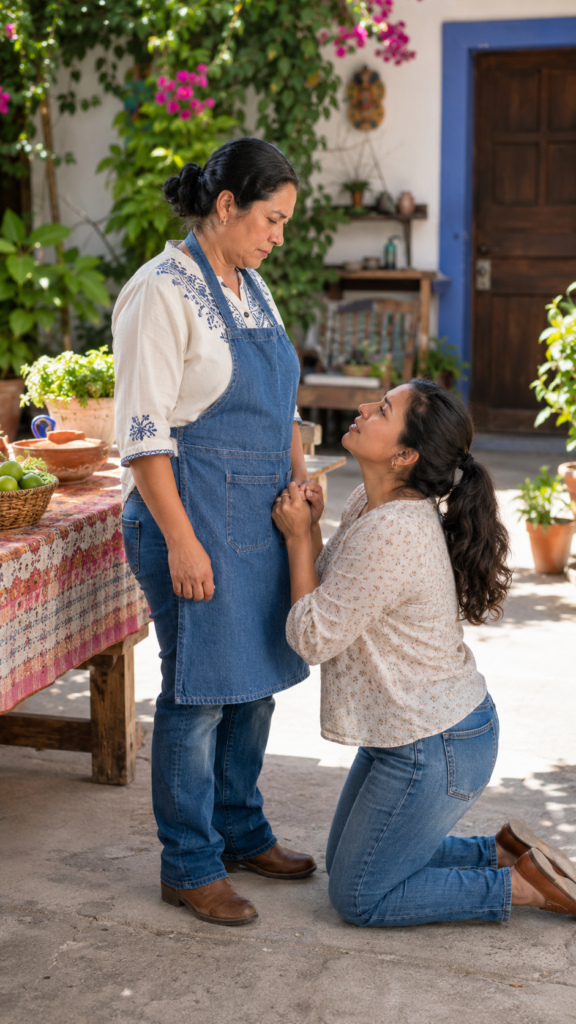
Chela knelt.
"Kick me out. Denounce me. Do whatever you want. But don’t close the door on Danna. I beg you."
Teresa clenched her fists.
The girl entered the kitchen just then.
"Mom?"
Chela quickly stood up, wiping her face.
"Nothing, my love. I dropped something."
Danna looked at Teresa.
"Is Mrs. Tere angry?"
Teresa swallowed hard.
She had the power to destroy Chela in front of her daughter.
She held the truth on her tongue.
But she saw Danna’s worn-out sneakers.
She saw her skinny arms.
She saw Beto in her eyes.
And she kept silent.
That night, Teresa opened the trial box again.
She took out the papers with the idea of burning them.
Not to save Chela.
To save herself.
Because hate had kept her alive in prison, yes, but outside it was already rotting her.
She lit the griddle.
One by one, she began throwing clippings into the fire.
Until she found a thick envelope she had never opened.
It was the one given to her upon her release.
The official apology.
The check.
She had tossed it into the box without looking at it, out of pure anger.
She was about to burn it too.
But something stopped her.
She opened it.
Inside wasn’t just the check.
There were letters.
Dozens of letters.
All written in crooked handwriting, stained, some with spelling mistakes.
They were from Chela.
Letters to the judge.
To the prosecutor’s office.
To human rights.
To public defenders.
To any office that would listen.
The first was dated three months after Teresa entered Santa Martha.
Chela had written:
"I lied. Teresa didn’t kill my son. My son died from a seizure. I left him alone. She is innocent. Please set her free."
Teresa read another.
And another.
And another.
For six years, Chela had confessed over and over.
They ignored her.
They threw her out.
They told her the case was closed.
But she kept writing.
Sometimes on notebook paper.
Sometimes on torn sheets from Danna’s notebooks.
Sometimes in blue ink.
Sometimes in pencil.
Always saying the same thing:
Teresa was innocent.
The guilty one was her.
Teresa sat on the floor.
For the first time since she was freed, she cried without covering her face.
The woman who had sunk her had also been the one who spent six years trying to bring her back.
Not out of perfect bravery.
Not for pure justice.
But out of guilt.
Out of love for Beto.
Out of a truth that burned her throat.
And yet, she had done it.
The following Saturday, Chela died in the IMSS hospital.
Danna was asleep beside her, her little hand clutching her mother’s blanket.
Teresa arrived late.
She didn’t get to tell her she had read the letters.
She didn’t get to tell her she already knew the whole truth.
She didn’t get to tell her she didn’t hate her the way she did before.
And that, in some way, was also a condemnation.
Danna went to live with Teresa a few weeks later.
There were no beautiful speeches.
There were no miracles.
Just a bed made in the upstairs room, two folded changes of clothes, and a backpack with an old photo of Beto.
The neighborhood talked, of course.
Some said Teresa was crazy.
Others said she was a saint.
She was neither.
She was a woman who had six years taken from her, but they couldn’t take away the part of her that still knew how to care.
In the kitchen, Danna always ate first.
Even if there was a line.
Even if the construction workers joked, saying:
"Come on, Mrs. Tere, we know who the favored one is."
Teresa only replied:
"Here, the kids go first, buddy. Line up correctly."
Danna grew up hearing that her mom loved her very much.
That Beto was a cheerful boy.
That the lady from the kitchen always took care of him.
She never knew the whole truth.
Maybe one day she would.
Maybe not.
Teresa stored the letters in a new box, not to hide them, but to remember that people are not always one thing.
Chela was cowardly.
She was unjust.
She was guilty.
But she was also a broken mother who tried to correct what she could no longer undo.
And Teresa, who had more than enough reasons to close that door, left it open.
Since then, the sign for the kitchen changed.
It no longer just said "No one leaves hungry."
Underneath, Danna wrote in red marker:
"Neither with guilt, nor with fear, nor without love."
The phrase was crooked.
But no one dared to correct it.
Because in that neighborhood, everyone understood something that still burned to discuss in hushed tones:
times justice arrives late, forgiveness is incomplete, and the real question isn’t who deserves punishment, but who dares not repeat the same harm.





