PART 1
At 2:00 AM, the Villarreal mansion was so silent that even the squeak of a mop felt like a sin.
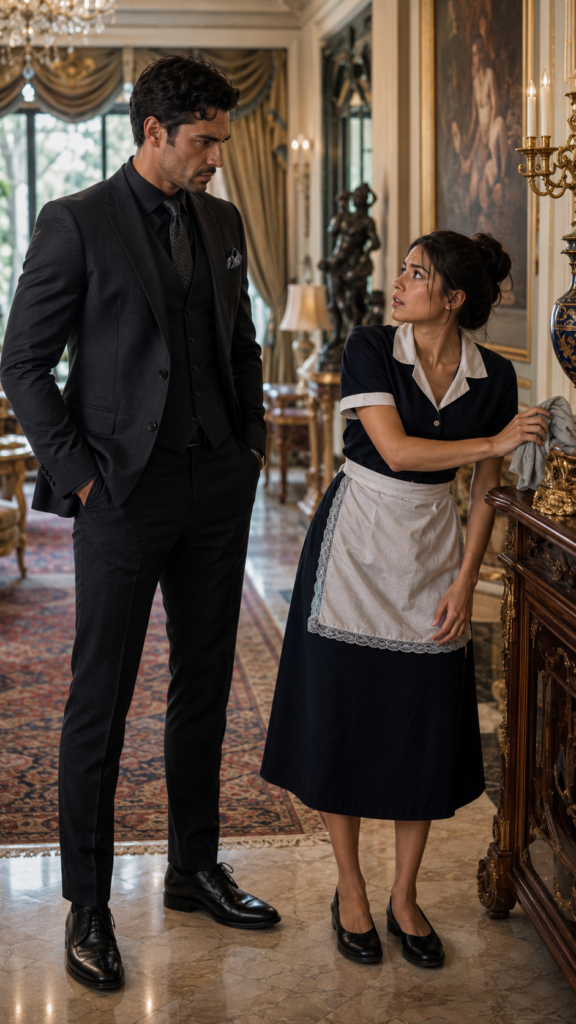
Marina Solís was cleaning the main hallway, one hand on her back and the other holding a damp cloth.
She was seven months pregnant, her feet swollen, and a fatigue that wouldn’t leave her even when she slept.
The gray service uniform hung loosely from her shoulders but clung tightly around her belly.
Every time she stretched to wipe a shelf, the baby moved as if protesting too.
"Hold on a little longer, my love," she murmured softly.
She wasn’t there by choice.
She worked nights because they paid a bit more, because the rent for her little room in the Independencia neighborhood wouldn’t wait, because the father of her baby had vanished like a coward as soon as he heard the news.
Marina raised her arm to clean a gilded frame.
The sleeve slipped.
The purple marks around her wrist were exposed.
She lowered her hand abruptly.
Too late.
At the end of the hallway stood him.
Santiago Villarreal.
The owner of the mansion.
The man that many in Monterrey called “the boss” even if they didn’t work for him.
They said that with a single call he could close deals, destroy reputations, or make anyone tremble.
Marina felt her blood freeze.
She immediately looked down.
Women like her didn’t draw the attention of men like Santiago.
And when they did, it was rarely for anything good.
She grabbed the bucket and tried to slip out through the service door.
But Santiago didn’t move.
He wasn’t looking at the bucket.
He wasn’t looking at the uniform.
He was staring at the small scar above Marina’s left eyebrow.
That fine, almost hidden mark that she had carried since childhood.
Suddenly, the hard face of the businessman shifted slightly.
As if he had seen a ghost.
Seventeen years earlier, in a tenement near the Juárez Market, a skinny girl had fallen from a fence while escaping from some kids who were mocking her.
A boy with fierce eyes had given her his shirt to wipe the blood.
"You’re crying," he said.
"I’m not crying," she replied, stubborn.
"Yes, you are."
"No, I’m not, idiot."
That boy was Santiago.
And that girl was Marina.
But she didn’t know that yet.
The next morning, just before 6:00 AM, Marina was arranging bottles of cleaner in the service kitchen when the head maid, Doña Elvira, froze.
Santiago had just entered.
Everyone went silent.
He looked at no one else.
Only at Marina.
"The woman who cleaned the hallway last night," he said in a calm voice, "the pregnant one."
Doña Elvira swallowed hard.
"It’s Marina Solís, sir."
The name hit Santiago like a stone.
"Marina," he repeated.
She frowned.
She had never heard her name sound like that.
Like a memory.
Like a debt.
Santiago walked toward her.
His eyes fell to the wrist covered by the sleeve.
Then to her scar.
Then to her belly.
"Who did that to you?"
Marina stepped back.
"It’s nothing."
Santiago's jaw tightened.
"Don’t tell me it’s nothing."
She pressed her lips together.
She had learned to survive by being silent.
To not explain bruises.
To not recount betrayals.
To not expect anyone to defend her.
Then Santiago said something that dimmed her world.
"Do you still climb fences, shorty?"
Marina froze.
No one had called her that in seventeen years.
She slowly raised her gaze.
She saw the small scar on his chin.
The same dark eyes.
The same way of looking at her as if the whole world were an enemy.
And she understood.
The boy from the Juárez Market was standing in front of her.
But before she could utter a single word, a male voice exploded from the service entrance.
"So this is where you’re hiding, ungrateful!"
Marina paled.
Santiago turned.
A man soaked with rain, furious, with breath that reeked of alcohol, advanced toward her.
It was Tomás.
The father of the baby.
And he held a crumpled medical order with Marina’s name on it.
"That kid is mine too," he shouted, "and today you’re coming with me, no matter what this rich man says."
PART 2
The silence in the kitchen shattered like glass.
Doña Elvira clutched her chest.
The employees stood frozen.
Marina wrapped her arms around her belly, as if her body could become a wall.
Tomás took two more steps forward.
"Don’t play the victim," he spat. "You provoked me. You left. You abandoned me like a dog."
Marina trembled.
Not out of love.
Not out of doubt.
But out of memory.
Because every word Tomás spoke brought back nights of screams, slammed doors, and broken promises.
Santiago stepped between them.
He didn’t raise his voice.
That made him more dangerous.
"Take one more step and you’ll leave here carried out."
Tomás let out a mocking laugh.
"And who the hell are you, man? Her new owner?"
Santiago’s gaze hardened.
"The one who won’t let you touch her."
Tomás raised the medical order.
"She belongs to me. She’s pregnant with my child."
Marina closed her eyes.
The phrase made her sick.
Santiago barely glanced at her.
"Do you want to go with him?"
Marina shook her head.
She couldn’t speak.
But it didn’t matter.
Santiago gestured.
Two guards appeared instantly and seized Tomás.
He began to thrash around.
"You’ll pay for this, Marina! You know what you’re hiding! You know who you are!"
That last phrase fell differently.
Marina opened her eyes.
Santiago noticed it too.
"What did you say?" he asked.
Tomás grinned with rage.
"Ask the saintly little maid why her mother always feared hospitals."
Marina felt a void in her stomach.
"Shut up, Tomás."
"See?" he shouted. "She knows something."
The guards dragged him out while he kept spewing threats.
The door closed.
But the damage was done.
Marina was pale, sweating cold.
Santiago approached cautiously.
"What did he mean?"
She shook her head.
"I don’t know."
But her voice didn’t sound certain.
Because there were things.
Little things.
Her adoptive mother, Carmen, got nervous every time someone mentioned the hospital where Marina was born.
There were never pictures of her as a newborn.
There was never an original birth certificate, just an old, blurry copy.
And when Marina asked, Carmen replied:
"Some questions only bring misfortune, dear."
That afternoon, Santiago called a doctor to examine Marina.
She protested.
Said she didn’t need charity.
Said she could work.
Said she was fine.
But when she tried to get up, the pain in her back buckled her knees.
Santiago caught her before she fell.
For a moment, Marina was against his chest, listening to a heart that beat too fast for such a cold man.
"You owe me nothing," he whispered.
"Everyone says that before collecting," she replied.
Santiago looked down.
"I don’t."
She wanted to believe him.
And that frightened her.
The following days were chaotic.
Tomás showed up twice outside the mansion.
Once he threw stones at the booth.
Another time he left a note that read:
"What isn’t yours gets returned."
Santiago no longer took it lightly.
He hired a private investigator.
Marina was furious when she found out.
"You had me investigated? Really?"
"I had the man who hit you investigated."
"And in the process, me."
Santiago didn’t deny it.
"Yes."
The honesty disarmed her and infuriated her more.
"You’re not my father, Santiago. Nor my husband. Nor my savior."
He looked down.
"I don’t want to be your savior."
"Then what do you want?"
The question lingered.
Santiago took time to answer.
"I want to fulfill a promise I made when I was 11 years old."
Marina was left speechless.
She remembered that afternoon by the laundry.
The blood on her face.
The skinny boy tying a dirty handkerchief around her forehead.
"If anyone bothers you again, you tell me," he had said. "I’ll look after you."
She had laughed.
"You’re too short to be looking after people."
"Then I’ll grow."
Now he was there.
Grown.
Powerful.
Feared.
And still with guilt in his eyes.
Marina wanted to tell him it was too late.
That no one had looked after her when Carmen died.
That no one showed up when she had to clean houses starting at 15.
That no one defended her when Tomás convinced her to live with him and then broke her soul.
But she couldn’t.
Because a part of her, the most exhausted part, just wanted to sit down and stop fighting.
A week later, Santiago summoned her to his office.
The room smelled of leather, expensive coffee, and storm.
On the desk lay a folder.
Marina saw it and felt something bad was coming.
"What did you find?" she asked.
Santiago didn’t answer immediately.
He looked strange.
Not scared.
Moved.
"Marina, I need you to listen to everything before you react."
"That never announces something good."
He opened the folder.
"The investigator reviewed Tomás’s papers. Turns out he didn’t come to you by chance."
Marina frowned.
"What do you mean?"
"Someone paid him."
The air left her.
"What?"
Santiago placed a photo on the table.
Tomás was seen leaving a restaurant in San Pedro Garza García with an elegant woman, blonde hair, and dark glasses.
Marina didn’t know her.
But the woman had something familiar about the shape of her mouth.
"Her name is Regina Aranda," Santiago said. "The youngest daughter of one of the most powerful families in Nuevo León."
Marina felt a chill.
"And what does that have to do with me?"
Santiago handed her another document.
It was a copy of a birth record.
The date was exact.
The hospital too.
But the mother’s name wasn’t Carmen Solís.
It was Isabel Aranda.
Marina read it three times.
She didn’t understand.
Or didn’t want to understand.
"This is wrong."
"There’s more."
Santiago showed her a sheet from the hospital.
Two babies born the same night.
One nurse fired days later.
One internal report never sent to the authorities.
And a handwritten note:
"The Aranda family requests absolute discretion."
Marina stood up so quickly that the chair almost fell over.
"No. No, no, no. My mother was Carmen."
"Carmen raised you," Santiago said gently, "and that can’t be taken from you."
"She was my mother!"
"Yes."
The word disarmed her.
Because it didn’t contradict her.
It didn’t try to correct her pain.
Marina started to cry without realizing it.
"Are you telling me I was switched at a hospital?"
Santiago swallowed hard.
"I’m telling you it seems that way. And that Regina Aranda probably knew."
Marina looked at the photo again.
"Why would she be looking for me now?"
"Because her father died three months ago."
Santiago pulled out another paper.
"And he left a strange clause in the will. If it was proven that there existed another biological child of Isabel Aranda, that child would inherit 50% of the family shares."
Marina let out a dry, broken laugh.
"So it wasn’t love. It wasn’t guilt. It was money."
"Regina hired Tomás to get close to you, get you pregnant if she could, keep you vulnerable, and control you. When she couldn’t, she started to beat you."
Marina felt nauseous.
The room spun.
The baby kicked hard.
She doubled over with a hand on her belly.
Santiago rushed to her.
"Marina."
"I can’t breathe."
"Look at me."
She looked at him.
His eyes were no longer those of the feared businessman.
They were those of the boy from the market.
"Breathe with me."
Marina tried to do it.
Once.
Again.
Until the air returned.
But the life she knew had shattered.
That same night, Regina Aranda arrived at the Villarreal mansion uninvited.
She entered with heels, expensive perfume, and a viper's smile.
"How dramatic everyone is," she said upon seeing Marina seated in the living room, with Santiago by her side.
Marina stood up.
"Did you pay Tomás?"
Regina slowly took off her glasses.
"Oh, please. That man was cheap. Don’t exaggerate."
Santiago clenched his fists.
Marina felt something breaking inside her.
Not fear.
Not sadness.
Disgust.
"You ruined my life."
Regina let out a laugh.
"Your life? You were cleaning floors, queen. There wasn’t much to ruin."
The phrase ignited everyone.
Doña Elvira, who was at the door, murmured:
"What a piece of work."
Regina ignored her.
She looked at Marina's belly with disdain.
"Besides, you’re too late. Pregnant, uneducated, without a last name. Do you think a family like mine will accept you?"
Marina touched her belly.
For the first time in a long time, she didn’t feel small.
"I don’t need them to accept me."
Regina smiled.
"Then renounce everything."
Santiago spoke, icy.
"It’s already recorded."
Regina blinked.
"What?"
He pointed to a discreet camera in the corner.
"You confessed enough."
Regina’s smile vanished.
"You don’t know who you’re messing with."
"Yes, I do," Santiago replied. "Someone who believed money could buy the silence of a tired woman."
Regina tried to leave, but outside was already waiting a lawyer, two police officers, and the investigator.
Tomás had agreed to testify in exchange for protection.
That was the twist no one expected.
The coward who beat Marina also ended up sinking Regina.
Not out of remorse.
Out of fear.
But the truth came out.
DNA tests confirmed the impossible.
Marina was the biological daughter of Isabel Aranda.
The other baby, the one who had grown up as the heiress, was Regina.
The hospital hadn’t made a simple mistake.
Grandmother Aranda had ordered the switch because Isabel, secretly, had given birth to Marina with a humble man from Santa Catarina, not with the businessman the family wanted to impose on her.
To hide the shame, they handed Marina over to Carmen Solís, a hospital worker who couldn’t have children and agreed to raise her.
Carmen had never stolen a baby.
She had protected her from a family that saw her as a stain.
When Marina read that part, she cried like a child.
Not for the fortune.
Not for the last name.
But for Carmen.
Because she understood that her mother had carried an enormous secret, but also a real love.
Months later, Marina gave birth to a healthy girl.
She named her Carmen.
Santiago was outside the room, pacing like crazy down the hospital hallway.
When the nurse told him both were well, the most feared man in Monterrey sat in a chair and cried in silence.
Regina faced trial.
Tomás too.
The Aranda family tried to negotiate, clean their name, buy forgiveness.
Marina didn’t accept money in exchange for silence.
She accepted what the law entitled her to, but did something that left everyone talking.
She sold part of her shares and created a foundation for unsupported pregnant women, abused domestic workers, and children without clear identity papers.
She named it "Bridges."
Because, as she said, sometimes life breaks a fence, a family, and a complete story, but you can still build a bridge so that someone else doesn’t fall alone.
Santiago never asked her for anything.
Not love.
Not gratitude.
Not promises.
He just stayed.
Changed diapers.
Learned to warm bottles.
Argued with pediatricians as if they were board meetings.
And one afternoon, while Marina watched her daughter sleep under a yellow blanket, he left a handwritten note on the table:
"For the future fence climber."
Marina smiled with tears.
"You’re still so cheesy, you know?"
Santiago shrugged.
"And you still say you don’t cry."
She wiped her face.
"I’m not crying."
"Yes, you are."
"No, I’m not, idiot."
The two laughed softly so as not to wake the baby.
Outside, Monterrey continued to make noise.
People kept opining.
Some said Marina got lucky.
Others said Santiago got involved where he shouldn’t.
Others swore that blood always calls.
But Marina knew something many didn’t want to accept:
Family isn’t always the one who gives you a last name.
Sometimes it’s the one who heals a wound, who believes you when everyone doubts, who stays when you no longer have the strength to ask for help.
And she also knew another thing.
Money can hide a truth for 28 years.
But it can’t erase it.
Because sooner or later, a sleeve slips, a scar appears, and someone remembers the promise they made when they had nothing.
Then everything changes.





