PART 1
"Do you really think, boy, that my daughter was born to live counting coins with you?"
Don Aurelio Robles didn’t raise his voice.
He didn’t need to.
His words fell like a stone in the corridor of the old coffee plantation, high in the mountains of Coatepec, as the rain battered the tiles and the scent of freshly ground coffee wafted from the kitchen.
Santiago Méndez stood before him.
He was 23, his shoes caked in mud, his shirt clean but worn, and his hands marked by endless days of cutting someone else’s coffee.
He had no truck.
He had no money.
He bore none of the last names that could open doors in the town.
He had only one promise.
He wanted to marry Lucía Robles.
Lucía was 20, the only daughter of Don Aurelio, a landowner, a man with warehouses, and an authority no one dared to question.
She was a simple girl, with serene eyes, a black braid, and a smile that made Santiago forget how poor he was.
For two years, they had loved each other almost in secret.
They met after mass.
They left notes in an old notebook.
They found each other near the stream, where she would bring him sweet bread, and he would talk about a tiny house, chickens in the yard, and a life without luxuries, but full of respect.
But for Don Aurelio, that was a disgrace.
"Love doesn’t fill the stomach," the old man said, sitting in his rocking chair. "My daughter is not going to leave with a laborer who smells of sweat and need."
Santiago tightened his hat in his hands.
Behind the door, Lucía listened, her face soaked with tears.
She wanted to go out.
She wanted to defend him.
She wanted to say she preferred a humble life with Santiago over a big house where they even chose how she breathed.
But in that family, when Don Aurelio spoke, everyone fell silent.
"I can work," Santiago replied. "I don’t have much today, but I have my word."
Don Aurelio let out a dry laugh.
"Words don’t buy medicine, or food, or respect. If you really love her, get lost. Come back when you are someone. And if you can’t, don’t even think about returning."
That night, Santiago didn’t sleep.
He packed two shirts, a photo of Lucía, and a change of clothes in a torn backpack.
Before dawn, he set off down the path.
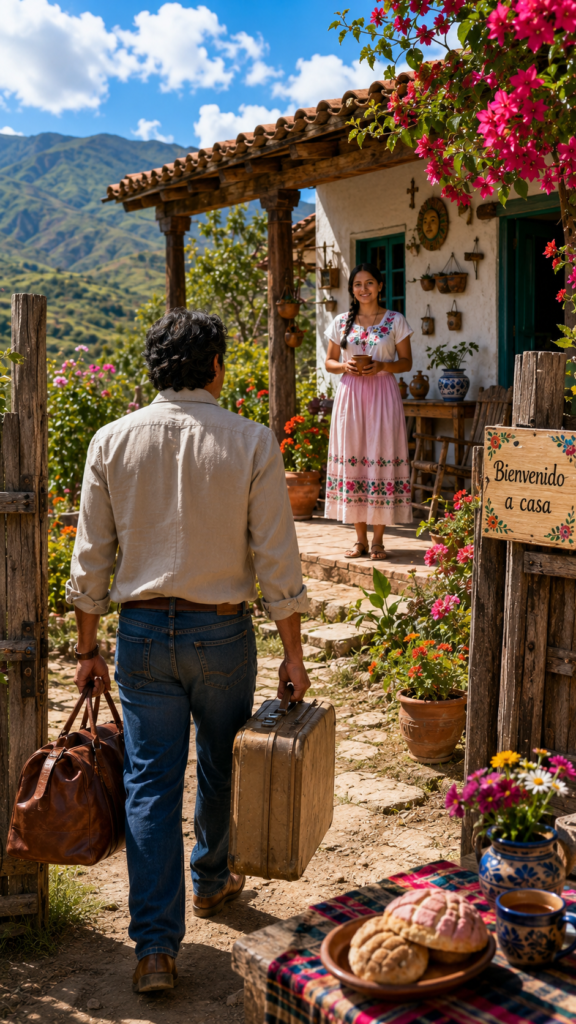
But Lucía was waiting for him in the corridor.
She was barefoot, a rebozo draped over her shoulders, and a cup of hot coffee in her hands.
"You’re leaving," she whispered.
Santiago looked down.
"I will come back. I don’t know when, but I will return with money, with a name, with everything your father says I lack."
Lucía took his hands.
"I never asked you for that."
"But I need to stop feeling less."
She closed her eyes, as if those words had shattered something inside her.
Then she handed him the cup.
"Then go, Santiago. But remember this well: every day I will prepare coffee here. Whether a year goes by, five, or ten. If you return, you will find me in this corridor."
Santiago wanted to hug her.
He couldn’t.
If he embraced her, he’d stay.
He kissed her hands and left down the red path without looking back.
Ten years passed.
And when Santiago Méndez returned to Coatepec, he no longer wore torn shoes.
He arrived in a black truck, dressed in an expensive suit, with a fine watch and two large suitcases in the trunk.
He had made his fortune in Monterrey with a transportation and distribution company.
He owned warehouses, trailers, contracts, and more money than he ever imagined.
But as he entered the dirt road where he had been humiliated, his hands trembled as if he were still that poor boy.
The house was still there.
The corridor too.
And in the rocking chair, with a cup of coffee in her hands, was a woman gazing down the path.
Santiago slammed to a halt.
It was Lucía.
Thinner.
With some gray in her braid.
Her hands marked by the years.
But it was her.
He stepped down slowly, let his suitcases fall, and walked just three steps.
Then he knelt on the wet earth.
"Lucía…"
She stood up without screaming, without running, as if she had been waiting for him forever.
But before Santiago could apologize, he saw something on the table in the corridor.
There were two cups of coffee served.
One was made of clay, old and chipped.
And the other was white, elegant, with a golden rim.
Santiago felt his blood run cold, for after ten years believing she had waited for him alone, those two cups seemed to tell him he had arrived too late.
PART 2
Santiago couldn’t rise.
He stared at the two cups as if a sentence had been placed before him.
For years he had imagined this return in many ways.
Him stepping out of an expensive truck.
Lucía running into his arms.
Don Aurelio swallowing every cruel word.
But there were no applause.
No triumph.
Only a tired woman, an old house, and a second cup that shattered his chest.
Lucía descended the steps and touched his face.
"You took too long for coffee, Santiago," she said softly. "But it’s still hot."
He let out a sob he had kept for years.
"Forgive me."
Lucía didn’t respond right away.
She brushed a bit of dirt off his jacket and said,
"Get up. You didn’t come all the way back to lie there."
They climbed together to the corridor.
Santiago couldn’t stop looking at the white cup.
Lucía noticed.
"It was my father’s."
Santiago froze.
"Don Aurelio is alive?"
She shook her head slowly.
"He died four years ago."
The silence weighed more than the rain.
Santiago had spent ten years carrying that humiliation like a stone in his chest.
He had slept in windowless rooms, driven trucks at dawn, loaded goods until his hands bled, and endured hunger to return as someone.
And now the man he wanted to confront was already beneath the earth.
"Before he died, he asked about you," Lucía said.
Santiago raised his gaze.
"About me?"
"Yes. A stroke left him bedridden for almost two years. I took care of him alone. I fed him, bathed him, changed the sheets, cleaned his wounds. In the end, he hardly spoke, but one afternoon he squeezed my hand and said your name."
Santiago clutched the clay cup.
"What did he say?"
Lucía looked toward the coffee fields.
"That he was wrong. That he confused poverty with lack of courage. That you were more of a man than many rich men who came to sit at this table."
Santiago closed his eyes.
The triumph he had chased for ten years tasted of ashes.
"He also asked me for something," she continued. "He said: 'If Santiago returns, don’t punish him for my pride. Tell him this stubborn old man died regretting.'"
Santiago lowered his head.
"I should have written to you."
Lucía fell silent.
And that silence hurt more than any accusation.
At that moment, Doña Meche, the lifelong neighbor, appeared with her gray rebozo and a bag of sweet bread in her hand.
When she saw Santiago, she stopped.
"So you are the famous Santiago," she said, looking him up and down. "The one who went to get rich while she stayed here growing old."
"Meche, please," Lucía murmured.
"No, mija. It’s time to stop swallowing everything."
The neighbor placed the bag on the table and looked at Santiago with anger.
"Do you know how many men came to ask for her hand? The doctor from Xalapa, a rancher from Huatusco, the owner of the coffee processing plant. All with money, a house, and a name. And she told them all the same: 'I already gave my word.'"
Santiago felt the shame burning his face.
"I didn’t know…"
"Of course you didn’t know, idiot. Because you never sent a single letter."
Lucía looked down.
Doña Meche pointed to the corridor.
"She wouldn’t let them change anything. Not the rocking chair, not the table, not that old cup. She said that if you returned and found everything different, maybe you’d think your place was lost too."
Santiago looked at Lucía.
She remained steadfast.
Hurt, yes.
But not defeated.
Then Doña Meche let out the phrase that shattered him completely:
"While you were accumulating millions to prove your worth, she lost her youth proving that you had always been worth something."
Santiago walked toward the truck.
Lucía thought he would bring money, jewelry, or some expensive gift.
But when he opened one of the suitcases on the table, she clutched her chest.
Inside were no bills.
There were hundreds of yellowing envelopes, tied with ribbons, organized by date.
Santiago picked one up with trembling hands.
"I wrote to you every month, Lucía. For ten years. But I never had the courage to send them."
She opened her lips but said nothing.
He read a letter.
"I’ve been in Monterrey for 31 days. I sleep with five other men in a room where barely any air comes in. Today I carried boxes until my hands bled. I wanted to come back, but I thought of your coffee. If I return, I want to deserve the way you looked at me when I left."
Lucía began to cry.
It wasn’t rage.
It was relief.
For ten years, she had believed that Santiago’s silence meant forgetfulness.
And now she discovered that on the other side, there had also been love, fear, shame, and an equally heavy loneliness.
But the moment broke when a white truck parked in front of the plantation.
Rodrigo Salvatierra, the owner of the most powerful coffee processing plant in the area, stepped out.
He wore a pressed shirt, expensive boots, and a hat too clean for a man who claimed to work in the fields.
He carried a yellow folder and a venomous smile.
"What a lovely family portrait," he said. "The long-lost boyfriend has finally returned."
Santiago stood up.
Lucía hardened her gaze.
"Rodrigo, this is not the time."
"On the contrary. It’s the perfect time."
Rodrigo placed the folder on the table, right next to the letters.
"I’m here to remind you that the deadline is tomorrow."
Santiago looked at Lucía.
"What deadline?"
She didn’t answer.
Doña Meche clenched her jaw.
Rodrigo smiled wider.
"Didn’t she tell you? The Robles estate is neck-deep in debt. Medicines, caregivers, fertilizer, overdue taxes, repairs. Since the young lady refused to sell me a single hectare for years, the debt grew."
Santiago felt his blood boil.
"How much?"
"That’s none of your business."
"I asked how much."
Rodrigo calmly opened the folder.
"Two million six hundred thousand pesos. With interest. Tomorrow she signs over five hectares or we proceed legally."
Lucía stood up.
"I’m not signing anything today."
"Tomorrow you will," Rodrigo replied. "Because this house lives off memories, not money."
Santiago grabbed the papers.
He skimmed through them quickly.
This wasn’t a clean debt.
There were abusive interests, duplicated charges, invented commissions, and clauses designed to take the land from a lone woman.
"This is robbery," he said.
Rodrigo laughed.
"In this region, things are settled with documents, not with screams."
Santiago stared him down.
"Then we’ll talk with documents."
He pulled out his cell phone and called his lawyer in Monterrey.
In less than ten minutes, he had sent photos of contracts, promissory notes, and receipts.
Rodrigo tried to maintain his smile, but he started to sweat.
"You can pay if you want," he said. "But the cession is already ready."
"I’m not going to pay an abuser without reviewing every peso," Santiago replied. "And if these interests are illegal, not only will you not touch Lucía’s land. You will explain to a judge how many estates you’ve taken like this from other families."
Rodrigo’s face changed.
For the first time, Lucía saw something different in Santiago.
He was no longer the wounded young man who had left.
He was not just the wealthy businessman returning with guilt.
He was a man who finally understood what money was for.
To defend.
To repair.
To stay.
Rodrigo angrily collected the folder.
"This isn’t over."
"No," Santiago replied. "For the first time, it won’t be left like that."
When the white truck left, kicking up mud, Lucía sat down slowly.
She looked more tired than ever.
Santiago knelt in front of her.
"Why didn’t you tell me?"
She looked at him sadly.
"Because you didn’t return to carry my problems."
"I came back to stay."
Lucía touched one of the envelopes.
"Then stay for real. Not just with money. Stay with the truth."
Santiago understood.
For years he had believed that being worthy was having millions.
But Lucía had been worthy without flaunting anything.
She cared for her father.
Protected the estate.
Rejected suitors.
Endured gossip.
Prepared coffee every morning for a man who might never return.
That week, Santiago’s lawyers reviewed the debt.
They found irregularities not only in Lucía’s case but in more than twenty contracts with small coffee growers.
Rodrigo had turned other people’s needs into a business.
He lent money for illnesses, bad harvests, or funerals.
Then he inflated the interest and seized the lands through clauses that many didn’t even understand.
Santiago paid Lucía’s legitimate debt.
But took the rest to court.
The case made waves in Xalapa.
Then in Veracruz.
Then across the entire coffee-growing region.
Rodrigo, who for years thought he owned everyone’s fear, ended up facing lawsuits, audits, and the scorn of the same neighbors who had once looked down.
But Santiago didn’t settle just for saving the estate.
He purchased machinery for a cooperative.
Hired agronomists.
Helped producers sell coffee without abusive middlemen.
The town school received paint, new bathrooms, and computers.
The clinic had medicine again.
Saturdays began hosting fairs with tamales, sweet bread, mole, fresh cheese, and coffee from the pot.
And Lucía’s corridor, the same one where Don Aurelio had humiliated Santiago, became the place where people gathered after mass.
There, coffee was served.
Agreements were made.
Advice was sought.
One day a young man named Mateo arrived, holding his hat and looking broken.
He was in love with a girl from a wealthy family and wanted to go to the United States to return with money.
Santiago listened in silence.
Then pointed to Lucía, who was serving coffee and laughing with some girls.
"Look at her well," he said. "I left to prove I was worthy of her. I gathered more money than I can spend in three lives and almost lost the only thing that mattered. If you love her, don’t run away to become important. Stay and build something honest by her side. Time is the only thing that not even the richest man can buy back."
Mateo stayed.
Months later, he married in the town chapel.
Santiago was his godfather.
In time, Santiago and Lucía also married.
They didn’t throw a lavish party.
There was mass, white flowers, sweet bread, coffee from the pot, and the entire mountain range as witnesses.
Santiago cried when he saw her walk towards him.
Not because Lucía looked like the girl from before.
But because she wore on her face the beauty of someone who had endured without becoming bitter.
They lived in the same house.
Santiago could have built a mansion, but he didn’t want to.
He only repaired the corridor.
Changed the rotten boards, reinforced the posts, fixed the roof, and preserved the old rocking chair.
Every morning, Lucía prepared coffee.
Every morning, Santiago opened a letter.
Sometimes they laughed.
Sometimes they cried.
Sometimes they remained silent, gazing at the coffee fields, as if the silence also knew how to ask for forgiveness.
And one afternoon, as the sun fell golden over the mountains, Santiago took Lucía’s hand and understood the lesson that life had cost him too dear:
Poverty never made him less of a man.
Money never made him more worthy.
What truly proved his value was not his millions, but the promise Lucía kept when everyone called her crazy for waiting.
Because there are loves that do not shout.
Do not flaunt.
Do not demand.
They simply remain.
And even if the whole world changes, they are still there, with a cup of hot coffee, waiting in the same corridor.





