PART 1
At 38, Alejandro Santillán owned luxury towers in Santa Fe, million-dollar contracts in Monterrey, and an office in Reforma where no one entered without an appointment.
The newspapers called him "the king of concrete."
But that freezing morning, in Chapultepec Forest, he discovered that his entire life was built on a lie.
His mother, Doña Mercedes, had asked him to walk with her early, near the lake.
Alejandro accepted out of guilt, not joy.
He hadn’t seen her for more than 20 minutes in months. There was always a meeting, a flight, an investor, an urgent call.
Doña Mercedes walked with her arm linked in his, elegant in her gray coat and that expensive perfume everyone in their family recognized.
"Look at the people, son," she said. "They all have something you don’t."
Alejandro let out a dry laugh.
"What thing? Free time?"
"Heart," she replied.
He was about to respond but froze.
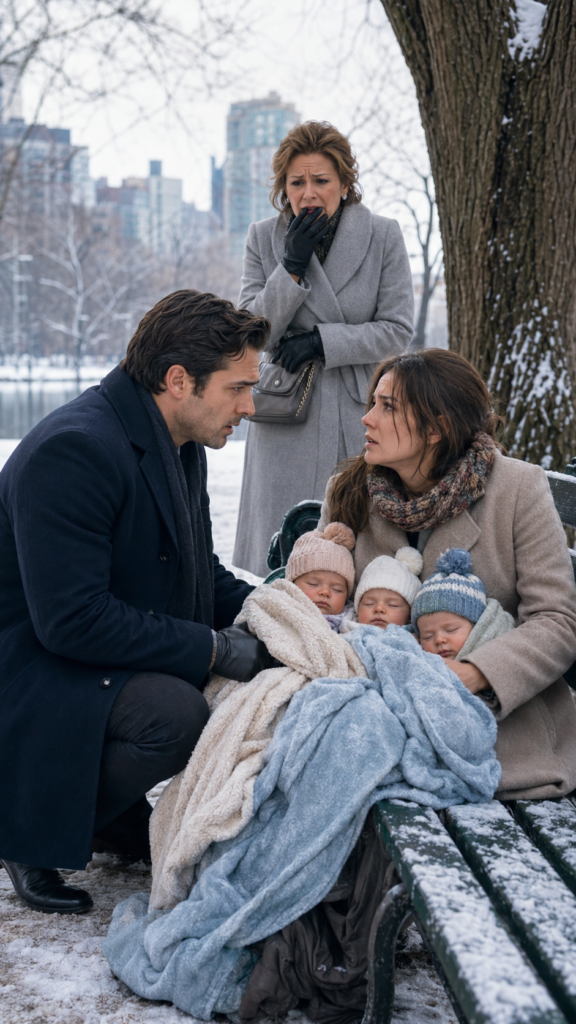
Under an old ahuehuete tree, on a damp bench, a woman was sleeping with three babies pressed against her chest. They were covered with a worn jacket and thin blankets that made him feel anger.
At first, Alejandro felt pity.
Then he saw her face.
It was Julia Aranda.
The woman who had loved him when he had no driver, no office, and no name in business magazines. The woman who ate tacos from a street vendor with him outside a construction site in Iztapalapa, swearing that someday everything would get better.
The woman he had left five years ago because he thought success couldn't bear promises.
Alejandro took a step.
One of the babies moved and pulled a small hand from the blanket. On the knuckle was a tiny indentation identical to the one Alejandro had since he was a child.
The air left his chest.
He looked at the baby.
He looked at Julia.
And then he looked at his mother.
Doña Mercedes no longer looked elegant. She looked scared.
Julia opened her eyes suddenly. Upon seeing him, she hugged the babies as if he were a threat.
"Don’t come near," she whispered with cracked lips.
Alejandro felt his knees give out.
"Julia… what happened?"
She let out a bitter laugh.
"Seriously, you come to ask me that?"
Doña Mercedes looked down.
That gesture said more than any confession.
"Mom," Alejandro said, his voice breaking. "Tell me the truth. Are these kids mine?"
Julia clenched her jaw.
Doña Mercedes closed her eyes.
"Yes," she whispered. "But that’s not the worst of it."
Alejandro fell to his knees in front of the bench, not caring about the mud or his designer suit.
"Julia, I never knew anything. I swear."
She reached into a torn diaper bag and pulled out a crumpled envelope, stained by the rain.
"Of course you didn’t know," she said. "Because someone made sure you didn’t."
Alejandro opened the envelope with trembling hands.
It was a letter dated five years ago. Julia was telling him she was pregnant, that she was scared, that she didn’t want money, just that he knew the truth.
At the bottom was a signature authorizing the return of the envelope.
It wasn’t Julia’s signature.
It was his mother’s signature.
And when Alejandro looked up, Doña Mercedes began to cry as if she had just seen a ghost return.
PART 2
Alejandro didn’t scream at first.
That was what scared Doña Mercedes the most.
He stared at the signature, then the letter, then at the three babies who were breathing laboriously under the damp blankets.
"What did you do?" he asked.
Doña Mercedes clutched her chest.
"Son, I just wanted to protect you."
Julia stood up as best she could. She was weak, pale, her clothes soaked by the morning cold. Still, she held the babies with a strength that seemed inhuman.
"Don’t say you were protecting him," Julia spat. "Tell him the truth. Tell him how you sent me away from the apartment."
Alejandro turned to his mother.
"What?"
Doña Mercedes shook her head.
"She showed up when you were closing the Polanco deal. It was a delicate moment. You couldn’t be distracted."
"Distracted?" Alejandro said. "Were my children a distraction?"
Julia opened the diaper bag and pulled out more papers.
There were copies of messages, medical receipts, rejected requests, a pregnancy test from five years ago, and three birth certificates.
Sofía Santillán Aranda.
Mateo Santillán Aranda.
Emiliano Santillán Aranda.
Alejandro read his last name and felt something break inside him.
"I gave them your last name," Julia said. "Even though everyone told me I was a fool. Even though your mom swore you’d sent me to hell."
"I never said that."
Julia swallowed hard.
"She came with a lawyer. She showed me a document where, according to you, you renounced any responsibility. She told me that if I insisted, she’d sue me for extortion. I was 24, alone, and pregnant with triplets. What did you want me to do?"
Alejandro looked at his mother with a fury he had never felt before.
"Tell me that’s a lie."
Doña Mercedes was crying, but she denied nothing.
"I thought she wanted to take advantage of you."
"She was with me when I had nothing."
"Precisely because of that," his mother replied desperately. "She knew how to touch your heart. She knew how to make you abandon everything."
Julia squeezed Emiliano against her chest.
"I didn’t want your money. I wanted you to know they existed."
One baby started to cough. It was Mateo. His face was red, and his fingers were cold.
Alejandro reacted suddenly.
"We’re going to the hospital."
Julia stepped back.
"No."
"Julia, please. I’m not going to take anything from you. I swear on them."
She looked at him with hatred and exhaustion.
"Your promises come five years too late."
Alejandro took off his coat, wrapped Sofía in it, and called his driver. Then he called his private doctor, but Julia interrupted him.
"I don’t want photos. I don’t want the press. I don’t want you to come out as a hero in your magazines."
He lowered the phone.
"Then we’ll go to the General Hospital. Whatever you want."
That phrase changed something in her.
She didn’t forgive him.
But she stopped retreating.
In the emergency room, the doctors confirmed mild hypothermia, bronchitis in two of the children, and dehydration in Julia.
Alejandro sat in a plastic chair all night, his suit dirty and his face drawn.
Doña Mercedes tried to enter, but Julia asked them not to let her pass.
For the first time in his life, Alejandro didn’t defend his mother.
At dawn, Licenciado Herrera, the Santillán family lawyer, arrived. He came nervous, with a leather briefcase and the look of someone who already knew too much.
Alejandro pulled him into an empty hallway.
"I want the whole truth."
Herrera sweated.
"Mr. Santillán, I only followed your mother’s instructions."
"Speak."
The lawyer pulled out a folder.
Inside was the document Julia had mentioned. A supposed renunciation of paternity with Alejandro’s signature.
But the signature was forged.
There were also transfers made to the name of a non-existent association, payments to a private investigator, and emails where Doña Mercedes ordered surveillance on Julia.
Alejandro felt nauseous.
"Were they following her?"
"Your mother wanted to know if Miss Aranda was trying to approach you."
"And when they were born?"
Herrera lowered his voice.
"Doña Mercedes was informed."
Alejandro closed his eyes.
The worst part hadn’t come yet.
"What did she do?"
The lawyer swallowed.
"She requested that no contact be registered. Then she ordered calls, emails, and any attempt to enter the corporate tower be blocked. She also requested to withdraw the rent support that had been promised."
Alejandro punched the wall.
"What support?"
Herrera opened another sheet.
Julia had desperately accepted temporary help to pay for a room and medical consultations. But the money was cut off after three months, just when the babies were born prematurely.
Doña Mercedes had written in an email: "If she runs out of options, she’ll go far away."
But Julia hadn’t gone far.
She stayed in Mexico City, washing other people’s clothes, selling gelatin outside Metro Tacubaya, and sleeping where she could when the landlord kicked her out for owing two months’ rent.
Alejandro walked back to the emergency room feeling like a coward.
Julia was awake. Sofía was sleeping next to her. Mateo had oxygen. Emiliano held a piece of the blanket with his little hand.
Alejandro didn’t enter immediately.
He stayed at the door.
"I don’t deserve to ask you for anything," he said. "But I want to take responsibility."
Julia looked at him without tears.
That was worse.
"Take responsibility? As if this were a delayed project?"
He looked down.
"No. As a father who arrived late."
"Late? No, Alejandro. Late is when someone is stuck in traffic. You arrived when your children had already learned to sleep hungry."
The phrase destroyed him.
For three days, Alejandro didn’t leave the hospital. He canceled meetings, flights, and interviews. When his assistant told him that the investors were upset, he replied:
"Let them be upset. My children were on the street."
The news leaked anyway.
Not because of him.
A nurse recognized Alejandro and someone published a blurry photo: the magnate from Santa Fe sitting on the floor of the General Hospital, holding a baby with a hospital blanket.
Facebook exploded.
Some said he was a saint.
Others said he was a scoundrel with money trying to clean his guilt.
And the truth was, both hurt him because neither was completely wrong.
But the real scandal came when Alejandro called a press conference.
Doña Mercedes showed up uninvited, wearing sunglasses and with lawyers. She thought her son would protect the Santillán name.
She was mistaken.
Alejandro stood in front of the cameras with Julia beside him, though she didn’t take his hand.
"For five years," he said, "my children were hidden from me by decisions made within my own family. I’m not here to ask for pity. I’m here to acknowledge responsibility."
Reporters shouted questions.
He raised the folder with the evidence.
"Today I filed a complaint for forgery, threats, indirect abandonment, and moral damage against those involved in this, including my mother."
Doña Mercedes removed her glasses.
"Alejandro, don’t be ridiculous. I’m your mother."
He looked at her in front of everyone.
"And they are my children."
The silence was brutal.
Julia closed her eyes. It wasn’t happiness. It was exhaustion. It was justice arriving late, wearing expensive shoes and surrounded by cameras.
The investigation revealed another blow.
Doña Mercedes hadn’t only hidden the letter. She had also pressured Julia’s father to throw her out of the house, telling him that his daughter was "inventing a pregnancy to get money from a rich man."
The father died without speaking to her again.
When Julia heard that, she sat on a bench in the Public Ministry and couldn’t breathe.
Alejandro wanted to hug her.
She wouldn’t let him.
"Don’t hug me because of your guilt," she said. "Do something useful with it."
And that’s what he did.
He sold one of his luxury apartments in Polanco and created a trust in Sofía, Mateo, and Emiliano’s names. He bought a simple house in Coyoacán, near a park and the school Julia chose.
He didn’t put the property in his name.
He put it in the children’s names, with Julia as the legal administrator.
When Doña Mercedes asked to see the babies, Julia agreed to only one supervised visit with a social worker.
The elderly woman arrived with expensive toys and a destroyed face.
Sofía hid behind Julia. Mateo asked if that lady was the one who had left them without a home.
Doña Mercedes broke down in tears.
"I thought I was saving my son."
Julia responded with a calm that hurt.
"No. You were punishing my children for being born."
Alejandro never lived the same again.
He remained rich, yes. But he stopped flaunting towers and began counting lost nights: the first fever he didn’t attend to, the first steps he didn’t see, the birthdays without cake, the times Julia had to choose between diapers or food.
Julia didn’t forgive him quickly.
Nor did she return to him just because he now had money and regret.
She allowed him to see the children, take them to the pediatrician, read stories, change diapers late but with sincere clumsiness.
One day, Emiliano touched his hand and pointed to the indentation on his knuckle.
"Same," he said.
Alejandro broke down.
Julia saw him cry for the first time without rage or pride. Just as a man understanding that blood didn’t make him a father. Presence did.
Months later, in the same Chapultepec Forest, they walked together with three strollers.
The bench was still there.
Alejandro stopped in front of it.
Julia did too.
"This is where it all started for you," she said.
He shook his head slowly.
"No. This is where my lie ended."
Julia didn’t smile, but she didn’t leave either.
And as the children laughed watching the ducks, Alejandro understood the harshest truth: there are mothers who destroy for control, children who obey for comfort, and women who survive without applause.
The question that hung in thousands of comments was the same one no one could easily answer:
Does a father who didn’t know the truth deserve a second chance… or is he also guilty for having stopped searching?





