PART 1
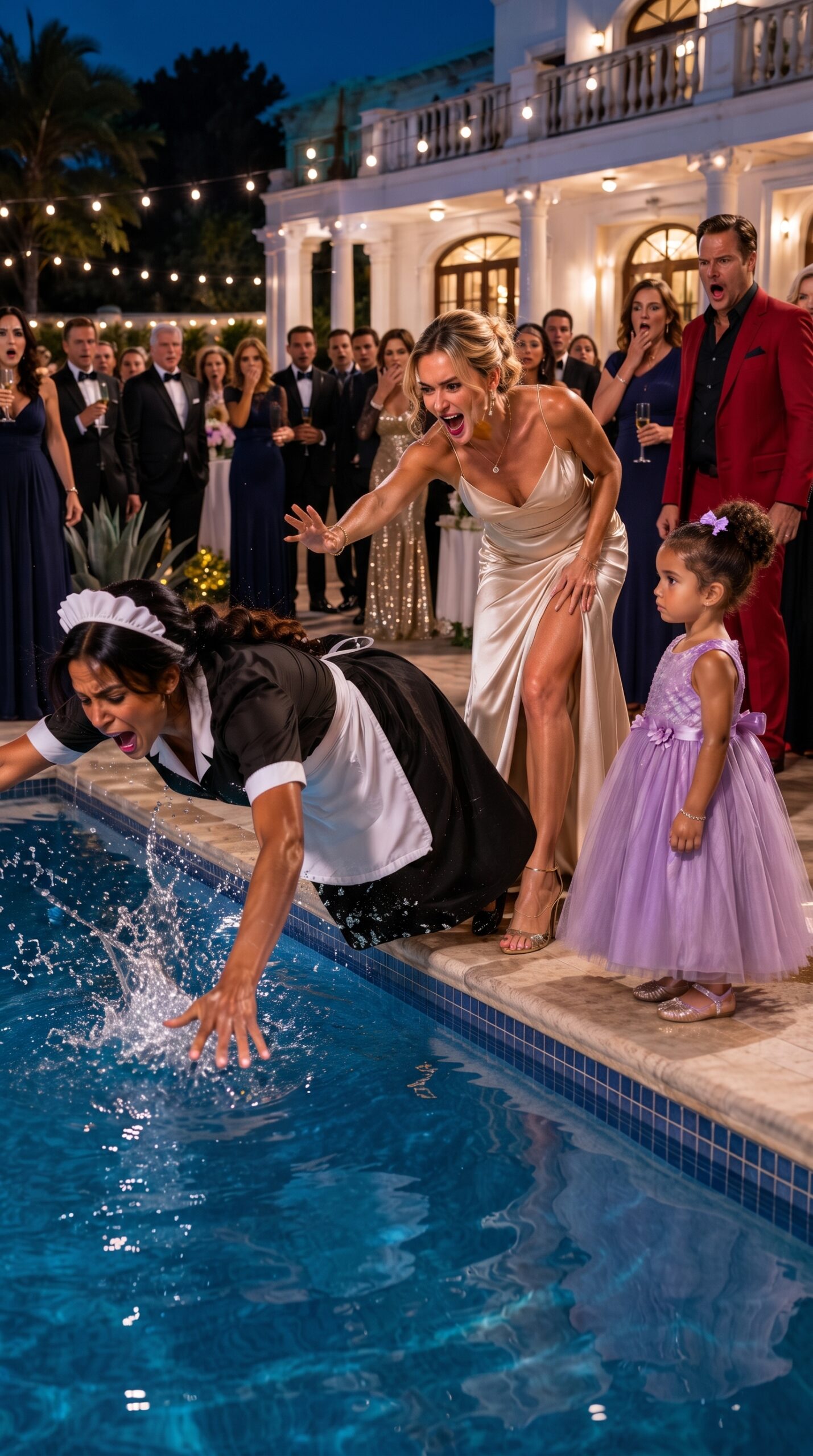
—If you can’t control your daughter, you don’t deserve to work in this house—Valeria spat, her smile icy, just seconds before she shoved Elena straight into the pool.
The splash silenced the music, the laughter, even the elegant murmur of the guests. In the garden of that mansion in Lomas de Chapultepec, there were over 80 people, but for a moment, no one moved.
Elena Morales surfaced gasping, her black uniform clinging to her body, her hair plastered to her face. Shame was the last thing on her mind. She didn’t think of the crowd watching. She only screamed one name:
—Lucía!
Her 3-year-old daughter sat at the edge of the stone pool, hugging a stuffed elephant. She had a scraped knee, her pink dress torn at the hem, and her wide eyes were filled with fear. But she was dry. She was alive.
Elena tried to climb out, but her hands slipped. Two waiters rushed to help her. The other guests, with their expensive glasses and designer suits, remained frozen as if witnessing an injustice was none of their concern.
Valeria Iturbide, fiancée of Alejandro Santillán, stood by the pool, wearing a silver dress, discreet yet expensive jewelry, and the cruel confidence of someone who believed all her life that money could buy silence.
—It was an accident—she said, lifting her chin—. The girl tripped on her own.
Elena wanted to respond but swallowed hard. She knew how that world worked. She was the maid. Valeria was the future wife of the owner of the house. One wrong word could leave her jobless, homeless, with her daughter on the streets.
Elena had lived in a service room at the back of the mansion for nearly two years. She worked cleaning, organizing dinners, attending guests, and enduring humiliations that no one saw or that everyone pretended not to.
Alejandro Santillán wasn’t a bad man. In fact, he always greeted her with respect. But he was busy with flights, meetings, and calls. While he built businesses, Valeria ruled the house like a capricious queen.
She called Elena “girl,” even though she knew her name. She forbade Lucía from entering the garden, saying “poor kids always break something.” More than once, she threatened to fire her if the girl made noise.
That night was Alejandro’s 33rd birthday. The party looked like a magazine cover: discreet mariachi, hanging lights, white flowers, uniformed waiters, and a pool lit like a luxury hotel.
Lucía was supposed to stay in the room with a teenage neighbor watching her. But with all the noise, the little girl wandered out looking for her mom. Elena found her by the water, gazing at the reflected lights.
—I didn’t touch anything, Mommy—said the girl—. I just saw pretty.
Elena picked her up to take her back.
But Valeria saw them.
—I gave you one order—she spat in front of her friends—. You can’t even do that right.
—I’m sorry, ma’am. I’ll take her back.
—No, Elena. That’s enough. I don’t know why Alejandro keeps you here.
Elena tightened her grip on Lucía.
—Please, not in front of the child.
That was what infuriated Valeria the most. She stepped forward, shoved Elena’s shoulder hard, and everything happened in a blink: Lucía fell to the floor, Elena lost her balance, and ended up in the pool.
When Elena emerged, soaked, Lucía stood up. She didn’t cry. She didn’t scream. She walked toward Valeria, clutching her elephant tightly against her chest, lifted her face, and said:
—You hurt my mom.
Five words.
Nothing more.
But those five words sucked the air out of the entire garden.
Valeria opened her mouth, searching for a graceful lie. She couldn’t find one. No one could argue with a 3-year-old girl who had just spoken the truth in front of 80 witnesses.
Then, from the back of the garden, a sound erupted that no one expected.
Alejandro Santillán was crying.
He had seen everything.
And the way he looked at Valeria made her understand, for the first time in her life, what it meant to truly be afraid.
No one could believe what was about to come to light that very night.
PART 2
Alejandro didn’t shout. He didn’t make a scene. He didn’t break a glass or raise his voice. And that’s precisely why Valeria knew things were serious.
He walked up to Lucía, knelt in front of her, and examined her scraped knee.
—Does it hurt, little one?
Lucía shook her head, though her lips trembled.
—My mommy fell in the water.
Alejandro swallowed hard. He carefully touched the ear of the stuffed elephant, as if even that toy deserved more respect than many people at that party.
Then he stood up and looked at Valeria.
—We need to talk.
—Alejandro, please—she said, trying to smile—. You’re not going to ruin your birthday over a maid who can’t even take care of her daughter.
That phrase sunk her deeper than any evidence could.
An aunt of Alejandro placed her hand over her chest. A business partner murmured, “That wasn’t an accident.” Several guests lowered their gazes, uncomfortable, because they had all seen and no one had done anything.
Elena, wrapped in a towel, opened her mouth to apologize. It was her survival instinct. To apologize for being in the way, for breathing, for being poor in a house of the rich.
But Alejandro stopped her.
—Elena, you don’t have to apologize.
She looked at him as if those words were impossible.
—Sir, I…
—No. Not tonight.
The party ended with a false elegance. Alejandro’s assistant announced there was “an urgent family matter.” The guests left in silence, taking with them gossip, shame, and a truth none could erase.
The garden was left scattered with trampled flowers, abandoned glasses, and an oppressive silence.
Elena took Lucía to the back room. A cook cleaned her knee and put a dinosaur band-aid on it. The little girl looked at her very seriously.
—It’s all better now—she said, hugging her stuffed animal.
Elena tried to smile, but her hands trembled. She didn’t know if she would be fired the next day. She didn’t know if Valeria would come up with another story. She didn’t know what would become of them.
Minutes later, someone knocked on the door.
It was Alejandro.
He didn’t enter until Elena gave him permission. He stood in the doorway, looking at the small bed, the paper stars stuck to the wall, Lucía’s tiny shoes, and the used books on a chair.
For the first time, he seemed to understand that this service room was also a home.
—I need to know the truth—he said—. How long has Valeria been treating you like this?
Elena looked down.
—I don’t want to cause trouble.
—The trouble was already here. I was the one who didn’t want to see it.
Then Elena spoke.
She told him about the insults, the threats, the dishes Valeria made her clean twice even when they were already spotless. She told him how Valeria took food out of her hand, saying it was for guests. She told him several maids had quit in tears. She told him Valeria called Lucía “a nuisance.”
Alejandro listened without interrupting. Each word seemed to weigh down on him like a stone.
—Why did you stay?—he asked in the end, even though the answer slept clinging to her elephant.
Elena looked at her daughter.
—Because she needed a roof.
Alejandro closed his eyes.
—I’m sorry.
It wasn’t a pretty apology to make things right. It was a broken, heavy apology, filled with real guilt.
That night, the argument with Valeria was heard from the ground floor. She shouted, cried, accused Elena of wanting to destroy her wedding. She said a “servant” woman couldn’t be worth more than his fiancée.
Then Alejandro said something everyone heard:
—Don’t ever call them that again.
At dawn, Valeria left. Her suitcases were loaded into a black truck. The engagement ring remained on the entryway table. The wedding, which had already appeared in society magazines, was canceled.
Elena thought it would end there.
But that afternoon, Alejandro called her to his office.
On the desk lay an ivory envelope bearing the seal of a law firm from Monterrey. Elena recognized the name and felt the blood drain from her face.
That firm had handled the papers for Miguel Reyes, her deceased husband.
Miguel died four years earlier in a car accident when Lucía was just a baby. Elena believed he had left nothing but memories, a few small debts, and an absence that hurt every day.
Alejandro pushed the envelope toward her.
—This arrived three months ago—he said—. I didn’t know how to tell you.
Elena didn’t touch the paper.
—What is it?
—It has to do with your daughter.
Elena opened the envelope with trembling hands. Inside were certificates, family trees, notarized documents, and a summary of assets. The words hit her one by one: trust, heiress, real estate, legal administration.
—I don’t understand—she whispered—. Miguel had nothing.
Alejandro took a deep breath.
—Miguel may have never known. Five months ago, don Arturo Reyes Salazar, a distant relative of your husband, passed away. He was a powerful businessman in Monterrey. He never had recognized children. His lawyers traced his direct relatives and found Miguel. Since Miguel passed away, the legal heir is Lucía.
Elena felt the chair shift under her legs.
—My daughter?
—Lucía—Alejandro confirmed—. When the process is completed, the estate allocated to her will amount to approximately 24 million pesos. Most will remain in trust until she turns 21, but from now on, there will be resources for housing, education, health, and maintenance.
Elena dropped the papers.
She didn’t cry for the money.
She cried for Miguel.
For that man who fixed cars under the sun, who came home with grease-covered hands and spoke to Elena’s belly, saying, “My girl is going to have a beautiful life, you’ll see.”
She cried for the nights counting coins. For every humiliation she endured to keep a roof over their heads. For every “yes, ma’am” that burned her throat.
—Why didn’t you tell me before?—she asked, in pain.
Alejandro lowered his gaze.
—Because I was a coward. The lawyers were still verifying, yes, but I also hid behind that. And while I waited for the perfect moment, I didn’t see what was happening in my own home.
Elena wiped her tears.
—Lucía only said what she saw.
—Exactly—he replied—. A 3-year-old girl had more courage than all of us.
That same afternoon, Alejandro hired a notary, an independent legal advisor for Elena, and a full severance package with one additional year of salary.
—I’m not asking for charity—she said.
—This isn’t charity. It’s responsibility. You worked here while I allowed, by omission, for you to be treated as if you were invisible.
Two days later, Valeria returned with her mother and brother, a lawyer.
They stormed in furiously, as if the mansion were still theirs.
—Are you going to destroy two families for a maid and her girl?—Valeria’s mother spat.
Elena listened from the kitchen, holding Lucía tightly.
Valeria saw her from the hallway.
—There’s the cause of it all.
Alejandro stepped in front of her.
—Don’t come near them.
Then Valeria glared at Lucía with fury.
—Because of you, I lost my wedding.
Elena felt something inside her, something that had been bowed for years, finally stand up.
—Don’t talk to my daughter—she said.
Everyone turned.
Elena’s voice trembled, but she didn’t back down.
—You lost your wedding because you pushed a mother in front of her child. Because you thought no one would defend us. Because you believed a poor girl had no voice. Don’t put on Lucía a blame that belongs to you.
Valeria fell silent.
Alejandro opened the door.
—You’re leaving now. And if you bother them again, my lawyers will take care of it.
Valeria looked at Alejandro, expecting a hint of doubt.
There was none.
Weeks later, Elena left the mansion with dignity. With legal support, she confirmed Lucía’s trust. She first rented and then bought a small apartment in Narvarte, with two bedrooms, a kitchen with a window, and a tiny patio where Lucía planted pots.
On the first night, the little girl ran around her room.
—Can I stick my stars?
Elena smiled through tears.
—As many as you want.
Over time, Elena studied administration online and started a professional cleaning business. She hired two women who had worked with her and set one rule from the first day:
—Here, no one is invisible.
Alejandro also changed. He reviewed salaries in his company, opened channels to report abuses, and stopped believing that being good was enough if one wasn’t vigilant.
The story never fully appeared in the magazines. There were rumors, of course. Some defended Valeria, saying “everyone makes mistakes.” Others claimed Elena exaggerated.
But the 80 guests knew the truth.
And the truth had the voice of a 3-year-old girl.
Because that night, among powerful last names, expensive dresses, lawyers, and champagne glasses, the bravest person was neither the millionaire nor the silent adults watching.
It was a little girl with a scraped knee, a stuffed elephant, and five words that changed everything:
—You hurt my mom.





