PART 1
In apartment 402 of a quiet neighborhood in Del Valle, no one imagined that a sausage would shatter an entire family.
Regina Álvarez was 31 years old, with a two-year-old daughter named Camila and a husband everyone described as a "good man"—the type who greets the security guard, carries grocery bags, and posts family photos on Sundays.
Her mother-in-law, Doña Hortensia, had been living with them for eight months.
She claimed she was sick.
That she needed care.
That her blood pressure was high.
That public hospitals treated her "like she wasn’t worth anything."
To avoid conflict with her husband, Regina paid for an additional private medical card. She bought her mother-in-law medicine, prepared low-fat meals, and even gave her the brightest room in the apartment.
But nothing was ever enough.
"Nueras used to know how to respect," Doña Hortensia would repeat. "Now they think they’re something special just because they sell online."
Regina ran a fine pastry shop from home. She made cakes, dessert tables, and decorated cookies for events. With that, she covered rent, school, groceries, and even her mother-in-law’s medical expenses.
Yet Doña Hortensia never called it work.
She called it "playing at being a businesswoman."
That Sunday, Diego, Regina’s husband, said he had to travel to Querétaro for an urgent matter for the company. In the apartment remained Regina, Camila, Doña Hortensia, and Tomás, an eight-year-old boy who was supposedly Diego's nephew.
Tomás had come from Michoacán with a sad story.
That his mom couldn’t care for him.
That his dad was missing.
That the family had to support him.
Regina accepted.
She paid for his school supplies.
His sneakers.
His dental check-ups.
His tablet.
And still, Doña Hortensia always put him above Camila.
"He’s a boy, he needs to eat well," she would say, serving him more meat. "The girl can fill up on beans."
Regina endured for Diego.
Endured for peace.
Endured because she had been taught that a good wife doesn’t cause scandals.
Until she heard the slap.
It was dry.
Brutal.
Like a slap against something too small.
Then came Camila’s cries.
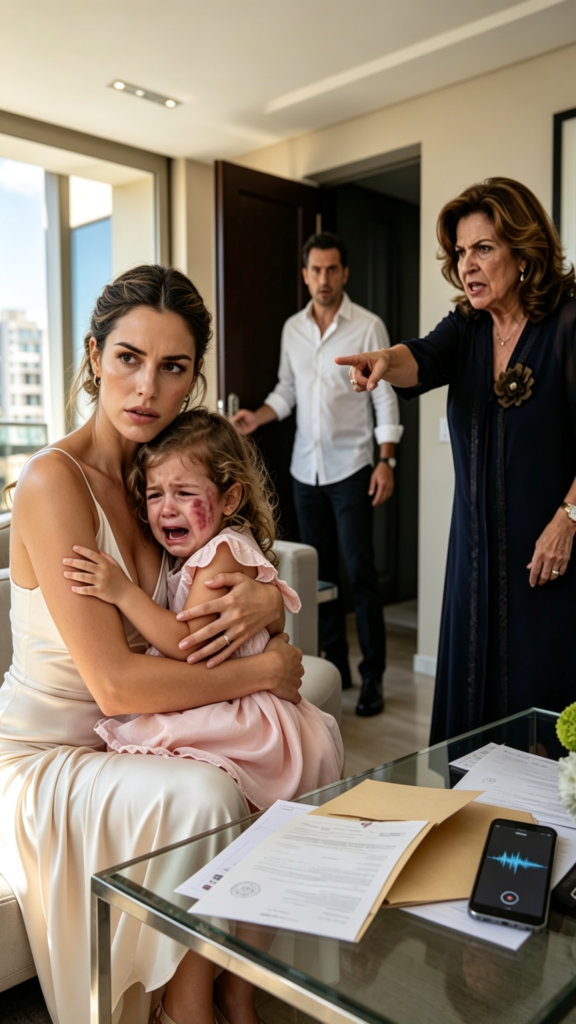
Regina rushed out of the kitchen with her hands covered in flour. She found her daughter on the floor, next to the coffee table, with a bleeding nose and a red mark crossing her cheek.
Doña Hortensia stood before her, hand still tense.
Tomás was on the couch, rigid, with a plate of sausages on his lap.
"What did you do to her?" Regina shouted, lifting Camila.
"I gave her a lesson," the mother-in-law replied.
"She took a sausage that belonged to Tomás."
Regina looked at her daughter.
Camila trembled, hiding her face in her neck.
"She’s two years old."
"Exactly," Doña Hortensia said. "Girls learn this way. If they’re not corrected when they’re little, they grow up spoiled, dependent, and smart-talking like their mother."
Something inside Regina shattered.
It wasn’t just the blood.
It was remembering every plate served late.
Every piece of fruit hidden for Tomás.
Every time Camila asked for a toy and Doña Hortensia said, "That’s for boys, don’t touch it."
Regina wiped her daughter's nose with a damp napkin. She spoke softly, even though everything inside her was burning.
"Mommy’s here, sweetheart. No one’s going to hurt you again."
Doña Hortensia let out a dry laugh.
"When Diego gets here, you’ll see. He knows how to put things in order."
Regina didn’t argue.
Didn’t shout.
Didn’t put on a show.
She took out her cell phone, called the bank, and put it on speaker.
"I need to cancel immediately the medical card in the name of Hortensia Molina. Yes, ending in 8821. It’s blocked from this moment on."
The mother-in-law turned pale.
"You can’t do this to me. I have an appointment with the cardiologist on Tuesday."
"My daughter has blood on her face because of you."
Doña Hortensia called Diego crying.
"Your wife is crazy. She hit me. She took away the hospital. All because of a brat who stole food from Tomás."
Regina locked herself in her bedroom with Camila in her arms.
But she left the door ajar.
And then she heard the phrase.
Doña Hortensia’s voice dropped, nervous, as if she had just made a mistake.
"I told you that woman was going to explode… now you’re going to have to tell her the truth about Tomás before she finds the papers."
Regina stopped breathing.
Because she understood that the slap hadn’t uncovered a fight.
It had uncovered a lie.
And Diego was already on his way to hide it again.
PART 2
Regina left Camila lying on the bed, hugging her stuffed bunny. The little girl continued to cry softly, her breath short, as if she were still waiting for another blow.
Regina set her phone to record.
She didn’t know what was happening.
But she knew that Doña Hortensia and Diego were scared.
And when an abusive person is afraid, they often let truths slip without realizing.
Outside, her mother-in-law paced the living room like a caged animal.
"No, Diego, don’t take long. If he checks the drawer in the entrance, we’re done for. Especially about the boy."
The boy.
Tomás.
The quiet nephew.
The spoiled child.
The boy Camila always had to yield to.
Regina felt nauseous.
The elevator dinged fifteen minutes later.
Diego walked in without a hurry.
He didn’t ask about Camila.
He didn’t rush to see her.
He didn’t say, "Where’s my daughter?"
He simply looked at his mother and said:
"What did you do now?"
Doña Hortensia immediately burst into tears, those tears that come quickly when they’ve been rehearsed many times.
"Your wife has gone mad. She hit me, humiliated me, and canceled the card. All because I corrected the girl for taking food from Tomás."
Diego sighed.
"Mom, I told you not to provoke her if I wasn’t there."
Regina opened the door.
Diego turned. He saw Camila with her swollen cheek and red nose.
His face didn’t show horror.
It showed annoyance.
As if his daughter’s blood was just another formality.
"Regina, this has gotten out of control."
"Yes," she replied. "And I want to know what truth you’re hiding about Tomás."
Doña Hortensia stopped crying.
Diego clenched his jaw.
"Don’t start with your outbursts. You hit my mother, and that could get you into big trouble."
Regina raised her cell phone.
"Everything is recorded from before you walked in."
The silence shifted in weight.
Doña Hortensia’s face crumbled.
Diego took a step toward her.
"Give me the phone."
"Don’t come near me."
Then Tomás appeared in the hallway, barefoot, clutching his tablet to his chest.
His eyes were red.
He looked at Diego and said with a voice that sliced through the air:
"Dad… are you going to tell her?"
Regina felt the floor sink beneath her.
Doña Hortensia closed her eyes.
Diego didn’t correct him.
Didn’t say, "I’m your uncle."
Didn’t say, "The boy is confused."
Said nothing.
And that silence was a complete confession.
"Tomás is not your nephew," Regina said slowly. "He’s your son."
Diego tried to step closer.
"It’s not what you think."
Regina let out a bitter laugh.
"What a cheap phrase for such an expensive lie."
Doña Hortensia interjected.
"That boy isn’t to blame. My son did the right thing by bringing him here."
"By lying?"
"You had money," the mother-in-law spat. "You could support him. Besides, you only gave Diego a daughter. Tomás carries the last name. He is the strong blood."
Regina hugged Camila tighter.
Right then, she understood everything.
It was not love for Tomás.
It was contempt for Camila.
It was that old, rotten idea found in many Mexican households, that a boy is worth more because he "continues the family," while a girl must learn to obey.
"Since when does your son live off my money?" Regina asked.
Diego lowered his gaze.
Tomás answered without understanding the impact of his words:
"My grandma said that when you two had been married for three years, you couldn’t kick me out. And that then Dad would fix things with the house."
The house.
Another bomb.
Regina walked to the entrance cabinet. Doña Hortensia lunged to stop her, but Regina was quicker.
She opened the drawer.
Among recipes, trinkets, and old envelopes, she found a blue folder.
Inside was Tomás’s birth certificate.
Father: Diego Salvatierra Molina.
Mother: Paola Ríos.
There were also receipts for tuition, monthly deposits, and proof of payments made from Regina’s pastry shop account.
Without authorization.
Without permission.
Without shame.
But the worst was another sheet.
A draft of an agreement.
"In the event of separation, priority will be requested for the child Tomás Salvatierra Ríos."
Below was a list.
Regina Álvarez: aggressive, unstable, jealous of the minor, violent with the elderly, emotional risk to children.
Regina felt cold.
This was no longer just a deception.
It was a plan.
They were provoking her to make her look crazy.
They wanted to use her reaction to take away her money, her home, her business, and perhaps even her peace with Camila.
She looked at Diego.
"They hit her to provoke me."
"Don’t say silly things," he replied.
But Doña Hortensia, trembling with rage, made the final mistake.
"I didn’t think the girl would bleed so much."
Diego turned furiously.
Regina felt her body freeze.
It was no longer suspicion.
It was confession.
Tomás started to cry.
"I have the video."
Everyone looked at him.
"What video?" Regina asked.
The boy unlocked the tablet with trembling hands. He searched for a hidden folder and played a file just 42 seconds long.
On the screen, the living room was visible.
Camila walked toward the coffee table. She took a sausage, yes, but not to steal it.
She offered it to Tomás.
The little girl wanted to share.
Then came Doña Hortensia’s voice:
"Leave her, your mom will come soon, and you’ll see how she gets."
Camila looked confused.
Doña Hortensia approached.
She slapped her.
Camila fell to the floor.
And the mother-in-law said, cold as stone:
"Cry louder, so your mother learns who runs things here."
The video ended.
Regina didn’t scream.
Didn’t cry.
Didn’t lash out at anyone.
She simply took a breath and dialed.
First to the pediatrician.
"My two-year-old daughter received a hard blow to the face. I need an examination and injury certification today."
Then to her lawyer, Lucía Cárdenas.
"My mother-in-law hit my daughter. My husband brought his son into my house pretending he was his nephew. I found papers to accuse me of being violent and a video that proves it was a trap."
Lucía didn’t ask for explanations.
"Don’t argue. Don’t hand over the phone. I’m on my way."
Diego tried to take the folder from her.
Regina stepped back.
"Touch me, and you’re recorded too."
For the first time, Diego stopped acting like an offended husband.
Now he seemed like a cornered man.
"You’re going to destroy my family over a sausage."
Regina looked at Camila's stained shirt.
"No, Diego. Your family was destroyed when they thought my daughter was worth less than your lie."
He couldn’t reply.
Because it was true.
That night, Diego and Doña Hortensia left the apartment with a suitcase. The mother-in-law still had the gall to ask for the medical card to be reactivated.
"I have pending tests," she said, crying.
Regina watched her from the door.
"My daughter also had the right to live without fear."
The next day, she changed the locks.
Canceled all additional cards.
Blocked Diego’s access to the business accounts.
Lucía filed complaints for the assault, for the irregular use of funds, and for the planned manipulation against Regina.
Three days later, Paola, Tomás’s mother, appeared.
She wasn’t the irresponsible woman Doña Hortensia had described.
She was a nurse working double shifts in Toluca. Diego had promised to recognize the child and provide stability. He told her that Tomás would stay for a time with "his uncles" while he sorted everything out.
Paola didn’t know Regina was covering her expenses.
Didn’t know he had presented him as a nephew.
Didn’t know her son was being raised to feel superior to a little girl.
When she saw the video of Camila, she covered her mouth and cried.
"I didn’t raise my son to watch how they hurt a baby."
Tomás left with her a week later.
Before departing, he approached Regina.
"I’m sorry for not saying anything."
Regina looked at him with pain but without hatred.
"You’re a child. Adults used you. But learn something: when someone hurts someone smaller, staying silent hurts too."
Months later, Camila still touched her cheek when someone raised their voice.
That was what hurt Regina the most.
Not the divorce.
Not the messages from Diego asking to "talk like family."
Not the people saying she had been too harsh with an elderly sick woman.
What hurt the most was seeing her daughter hide behind her legs in the supermarket when a woman yelled.
There she understood that setting boundaries wasn’t revenge.
It was protection.
With therapy, patience, and nights cuddled together, Camila began to laugh again. She ran through the living room once more. She asked for sausages without fear again.
One day, while Regina decorated cookies for an order, Camila took one and offered it to her.
"For you, Mommy."
Regina cried silently.
Because her daughter still wanted to share, even though someone had tried to punish her for doing so.
That Sunday, Doña Hortensia didn’t just hit a two-year-old girl.
She ripped the mask off an entire marriage.
Revealed the hidden son, the stolen money, the contempt for a girl, and the ambition of a family that called respect to obedience.
And although many opined that a mother-in-law "is still family," Regina learned something she would never forget:
When a family requires a mother to sacrifice her daughter’s safety to maintain peace, that is not family.
It’s a cage.
And no girl should grow up inside one.





