PART 1
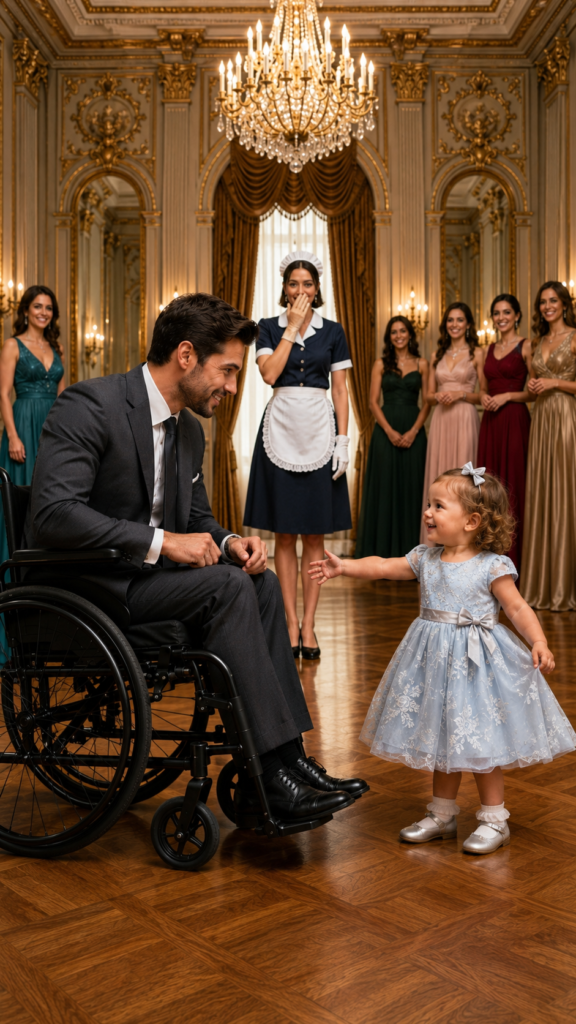
The main hall of the most expensive hotel on Paseo de la Reforma shone as if all of Mexico City had decided to hide its vanity there.
Designer dresses, gold watches, champagne flutes, and smiles so perfect they were frightening.
In the middle of it all was Alejandro Montes de Oca, 42, owner of a chain of private hospitals and founder of an association for children with disabilities.
Everyone wanted his money.
No one wanted to get too close to his wheelchair.
Alejandro had been paralyzed from the waist down after an accident on the Mexico–Toluca highway. Since then, people looked at him with a rare mixture of pity, discomfort, and convenience.
That night was his charity gala.
His name was on every screen, every invitation, every speech.
But he felt like an expensive piece of furniture that no one knew where to place.
First came Renata Villaseñor, an influencer famous for discussing inclusion on her social media.
"Ale, darling, a photo for my followers," she said, leaning in with a huge smile.
Alejandro politely obliged.
But when the photographer raised the camera, Renata glanced at the wheelchair and whispered:
"Oh, maybe not so close. It just looks... strong in the image."
Then she stepped aside as if the chair were a stain on her dress.
Alejandro said nothing.
He was already used to those kinds of silent blows.
Next came a businessman named Bruno Castellanos, who spoke to him slowly and exaggeratedly, as if the paralysis had also robbed him of intelligence.
"Bruno, I can hear you perfectly," Alejandro said, with a calm that hurt.
The man turned red and went straight to the bar.
Minutes later, a young congresswoman spoke to him about a social project without looking him in the eyes even once. She only stared at her watch, her glass, and the cameras.
Alejandro understood he had had enough.
He moved his chair towards the exit.
He preferred to return to his penthouse in Polanco, where at least solitude didn’t pretend to be affectionate.
Then a waltz began.
Couples filled the dance floor. Men extended their hands. Women laughed. Bodies twirled under the chandeliers as if life were easy.
Alejandro remained watching.
There was a time when he danced too.
There was a time when he didn’t need anyone to clear a path for him.
He closed his eyes for a second.
When he opened them, a 5-year-old girl stood in front of him.
She had messy curls, a simple floral dress, and worn-out little shoes. She didn’t seem to belong to this world of jewels, surnames, and cameras.
The girl extended her small hand.
"Do you want to dance with me?"
The hall froze.
Some guests stopped talking. Others turned their heads. A woman covered her mouth as if the girl had committed a sin.
Alejandro couldn’t respond.
No one had offered him something so simple without pity.
Before he could take her hand, a woman in a cleaning uniform rushed in from the service hallway.
"Mr. Montes de Oca, I’m so sorry, please," she said, pale. "I told Sofía to stay in the kitchen. I didn’t want to cause any trouble."
The woman’s name was Mariana Cruz. Her hair was hastily tied up, her eyes tired, and she had that way of apologizing that those who cannot afford to lose a job have.
The girl looked at her mother, confused.
"But Mom… he was all alone."
No one said anything.
The phrase dropped heavier than any insult.
Alejandro looked at Mariana.
"Your daughter caused no trouble."
"Really, sir, it won’t happen again."
"No," he replied, looking at Sofía, "I wish it happened more often."
Mariana didn’t know what to say.
Sofía smiled.
Alejandro carefully took the girl’s hand. The waltz kept playing. He couldn’t stand up, couldn’t spin like the others, but Sofía began to twirl around his chair, moving her arms as if they were in the center of a fairytale.
People murmured.
Some filmed with their phones.
Alejandro didn’t care.
For the first time in years, he didn’t feel observed as a tragedy.
He felt accompanied.
But from the second floor of the hall, an elegant, hard, and cold woman observed the scene with a closed face.
It was Leonor Montes de Oca, Alejandro’s aunt.
And while everyone watched the dance in surprise, she was already thinking about how to remove that woman and that girl from her nephew’s life.
PART 2
Two days later, Mariana received a call from the cleaning company where she worked.
She thought they were going to fire her.
The manager spoke with a strange, almost nervous voice.
"Mariana, Mr. Alejandro Montes de Oca requested that you be permanently assigned to his apartment. Double salary, health insurance, paid days, and fixed hours."
Mariana went mute.
The first thing she felt wasn’t joy.
It was fear.
In her world, when someone powerful did such a huge favor, it almost always came with a hidden debt.
But the rent for her room in Iztapalapa didn’t wait. Sofía’s food didn’t wait either. And life, honestly, had never given her a chance to feel proud.
The next morning, she arrived at Alejandro's building with Sofía’s hand in hers.
The penthouse was in Polanco, in a tower with huge glass, immaculate guards, and elevators that didn’t make noise.
When the door opened, Alejandro was waiting for them.
"Good morning, Mariana. Good morning, Sofía."
The girl raised her hand.
"Are we going to dance today too?"
Mariana closed her eyes, embarrassed.
But Alejandro smiled.
"Maybe after breakfast."
He took them to a huge room with a view of half the city. Mariana was tense, waiting for a complaint, a mockery, or a strange condition.
But Alejandro spoke with a softness that disarmed her.
"I want to offer you a stable job here. Better pay, benefits, and security. And I want Sofía to come with you every day."
Mariana looked at him, not understanding.
"Why would you do that for us?"
Alejandro took a deep breath.
"Because your daughter reminded me that I still exist."
Sofía, who was curiously looking at the wheelchair, asked:
"Can I put stickers on it? It looks very serious."
Alejandro chuckled softly.
Mariana felt something strange in her chest. That man didn’t want to buy her. He didn’t want to humiliate her. He didn’t want to make her a debt.
He just didn’t want to be alone anymore.
In a few weeks, the penthouse stopped looking like a museum.
Crayons appeared on the table, dolls on the couch, drawings stuck to the fridge, and laughter in the afternoon.
Alejandro’s black chair ended up covered in stars, flowers, hearts, and butterflies that Sofía stuck on with absolute seriousness.
"Now it really looks like a happy chair," the girl said.
Alejandro looked at the stickers and felt something inside him crack to heal.
Mariana cleaned, yes, but she also started staying to have coffee with him when Sofía did her homework.
At first, they talked about the weather, the traffic, how expensive life was. Then they spoke of deeper things.
Mariana told him that Sofía's father disappeared when he found out about the pregnancy. That she had worked cleaning offices, houses, clinics, whatever, so that her daughter never went hungry.
Alejandro told her that after the accident, many people stopped visiting him. Some out of discomfort. Others because he was no longer useful to them.
Over time, Sofía began asking him for help with her homework.
Alejandro explained math to her, read her stories, and listened as she invented tales of hero cats, princesses in sneakers, and dragons that lived in the Metro.
One day, Sofía brought home a drawing from school.
On the paper were three people holding hands: Mariana, Sofía, and Alejandro sitting in his flower-covered chair.
Above it said, "My family."
Alejandro locked himself in the bathroom and cried like he hadn’t cried since the accident.
It wasn’t sadness.
It was something more dangerous.
Hope.
But happiness made noise.
And the noise reached Leonor.
One afternoon, the aunt entered the penthouse using her emergency key. She found toys on the carpet, a glass of milk on the table, and Alejandro laughing while Sofía tried to teach him a TikTok song.
"What the hell is this?" Leonor asked.
Mariana immediately stood up.
"Good afternoon, ma’am. I’m Mariana Cruz, I work here."
Leonor looked her up and down.
"I can see that. What I don’t understand is why your daughter is playing at being part of this family."
Alejandro hardened his face.
"Don’t talk to her like that."
Leonor demanded to speak with him alone. As soon as she closed the office door, she let loose what she had been holding back.
"They’re using you, Alejandro. That woman saw money, saw weakness, and brought her daughter in as bait."
"You don’t know anything about them."
"I know too much about people when they smell fortune."
Alejandro slammed the armrest of his chair.
"They treat me like a human being. You treat me like a bank account in danger."
Leonor didn’t listen.
She hired a private investigator. She wanted to find debts, lovers, frauds, anything that proved Mariana was an opportunist.
But the report said the opposite.
Mariana Cruz: single mother, hard worker, with no record, no lawsuits, no scandals. Neighbors described her as honest, reserved, and dedicated to her daughter.
That should have been enough.
But Leonor wasn’t looking for the truth.
She was looking for an excuse.
One afternoon, when Alejandro was in a video call meeting with his foundation, Leonor arrived at the penthouse and found Mariana in the kitchen.
She sent Sofía to play in the television room.
Then she attacked where she knew it hurt.
"You are destroying my nephew."
Mariana put the cloth down on the bar.
"I would never harm him."
"Of course you would. You’re putting a fantasy in his head. Alejandro can’t have a normal life. He can’t play house with a maid and a girl who isn’t even his."
Mariana froze.
"Sofía loves him."
"Kids get attached to anyone. But when you tire of pretending, he will be worse off than before."
"I’m not pretending."
Leonor stepped closer.
"Then leave before you do more damage. Leave while you can still say you had dignity."
That night, Mariana couldn’t sleep.
She looked at Sofía hugging a drawing of Alejandro and felt her heart break.
On the following Monday, they didn’t go to the penthouse.
Not on Tuesday.
Nor Wednesday.
Alejandro called 18 times.
Mariana didn’t answer.
Not because she didn’t want to.
But because every time she saw his name on the screen, she heard Leonor’s voice telling her that she was a burden.
For three days, Alejandro stared at his chair covered in stickers. Each butterfly seemed like a wound.
When Leonor arrived thinking she would find him resigned, he confronted her with a fury she had never seen.
"You did this."
Leonor feigned ignorance.
"I just protected you."
"No. You took away the only thing that made me feel alive."
That phrase hit her harder than any shout.
For the first time, Leonor understood that her protection was not love.
It was a cage with an elegant surname.
That night she couldn’t sleep. She walked through her house in Las Lomas, surrounded by fine furniture, family photos, and expensive silence.
At dawn, she called the cleaning company and got Mariana’s address.
Her driver took her to Iztapalapa, to a street full of stalls, hanging cables, running children, and dogs sleeping under cars.
Leonor climbed three floors up narrow stairs and knocked on a metal door.
Mariana opened with red eyes.
"I didn’t come to threaten you," Leonor said, her voice no longer sounding like an order.
Mariana hesitated but let her in.
The apartment was small, clean, and humble. There was a table with crayons, an old backpack, and two plates drying by the sink.
Leonor looked around.
There was no hidden ambition there.
Only exhaustion, love, and a lot of struggle.
She lowered her head.
"I was cruel to you. I was unjust to your daughter. I thought I was defending Alejandro, but I was only defending my fears."
Mariana pressed her lips together.
"You don’t know what it cost Sofía to leave without saying goodbye."
"I know. And I don’t deserve to be forgiven quickly. But Alejandro doesn’t deserve to lose you both because of my fault."
Then Sofía appeared from the room, hugging a drawing.
On the paper were Mariana, Alejandro, and her holding hands. Leonor also appeared in a corner, serious, but with a red heart above her head.
"Mom," the girl whispered, "is Alejandro sad?"
Mariana closed her eyes.
That question broke the last bit of fear she had left.
An hour later, the three of them got into Leonor’s car.
When the private elevator of the penthouse opened, Alejandro stood in front of the window, motionless, staring at the city as if it no longer belonged to him.
Sofía ran.
"Alejandro!"
He turned his chair sharply.
The girl launched herself to hug him, and Alejandro held her with desperate strength.
"I thought you weren’t coming back," he murmured.
"Mom was scared," Sofía said, "but I didn’t want to stop dancing with you."
Mariana approached slowly.
Alejandro reached out his hand toward her.
"Don’t leave again deciding what pain is okay for me."
Mariana cried.
"I was made to believe I was a burden."
"You are not a burden. You’re the first adult who entered this house without seeing me as a broken man."
Leonor, behind them, wiped her tears.
"Forgive me, Alejandro. I confused love with control."
He looked at her for a long time.
"I forgive you. But never again decide for my heart."
That afternoon, Alejandro told Mariana that he didn’t want her there as an employee anymore.
Mariana turned pale.
"Are you firing me?"
"No," he replied. "I’m asking you to stay as my equal. As the woman I love. As the person who turned this house into a home."
Mariana didn’t respond immediately.
She simply leaned in, hugged him, and kissed him while Sofía clapped excitedly and Leonor cried without hiding.
Five years later, the penthouse no longer echoed.
It had backpacks lying around, muddy shoes, school assignments, the smell of pancakes, and laughter at impossible hours.
Mariana and Alejandro had been married for three years.
Alejandro legally adopted Sofía in a small ceremony where even the judge wiped away a tear when the girl said:
"He was already my dad from the first dance."
Leonor became an intense, indulgent, and somewhat bossy grandmother, but now she asked before deciding.
One night, on the terrace, the city shone under a violet sky.
Sofía was sleeping on a couch with an open book. Mariana rested next to Alejandro. The chair still had some old stickers, now peeling with time.
Alejandro looked at the stickers and remembered that cold hall, the gazes that avoided him, and the small hand that extended toward him without fear.
Then he understood something that many rich people from that gala would never comprehend:
Sometimes life doesn’t change with millions, speeches, or surnames.
Sometimes it changes because a little girl sees a lonely man, crosses a dance floor full of prejudice, and asks him if he wants to dance.





