PART 1
—Tell the doctor you slipped in the bathroom… or when we get home, you won’t wake up again.
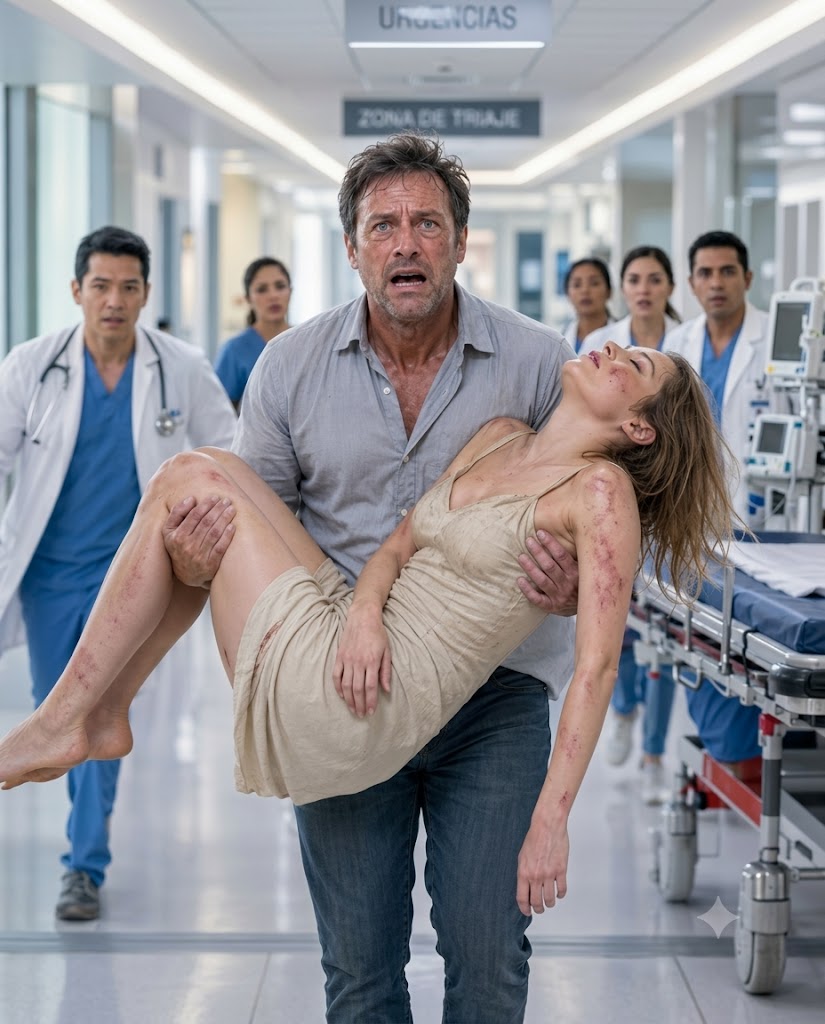
That was the first thing Jimena heard when she opened her eyes under the harsh white lights of the ER.
She was 26, her lip split, her throat burning, and a deep pain in her head, as if someone had stuffed bells inside her skull.
To her right sat Álvaro Mendieta, her stepfather, in a neatly pressed blue shirt, a gold watch, and an expression of concern so perfect it looked rehearsed in front of a mirror.
To her left was her mother, Rosario, clutching a leather bag against her chest.
—It was an accident, doctor —Rosario said before Jimena could move her mouth—. My daughter slipped coming out of the shower. You know how she is, always distracted.
Jimena tried to speak, but Álvaro took her hand.
It wasn’t a gesture of affection.
He pressed his fingers right into an old bruise, hidden beneath the sleeve of her sweater.
—Right, Jimenita? —he whispered, barely smiling—. You fell in the bathroom.
She looked at him.
And said nothing.
Because for years, in that large house in the Providencia neighborhood of Guadalajara, the truth had never meant much.
Álvaro didn’t need a reason to humiliate her. A poorly placed spoon, a shirt not folded, or a glance he interpreted as defiance was enough.
Some nights he came home drunk from his business meals, loosened his belt, and shouted from the living room:
—Jimena, come here. I’m bored.
Rosario always looked down.
She never intervened. Never called anyone. Never stood between her husband and her daughter.
She just repeated in a trembling voice:
—Do as he says, honey. Don’t provoke him.
Jimena had learned to cry in silence. She had learned to cover her arms with sweaters even when it was hot. She had learned that in that house, fear had a schedule, footsteps, the scent of expensive tequila, and keys in the door.
That night, it all started with a blouse.
Álvaro pulled it from a laundry basket and threw it to the floor.
—This is what you call ironing? —he spat—. You’re 26 and still living here like a useless kept woman.
Jimena had gone three days almost without sleeping. She worked from her room for an auditing firm in Mexico City, but Álvaro said that wasn’t “real work.”
—If I’m such a burden, let me go —she said.
Álvaro let out a dry laugh.
—Where are you going, you fool? You have nothing. Everything here exists because I pay for it.
Jimena felt something inside her break.
—No. It exists because you stole it from my father.
Rosario turned pale.
—Jimena, shut up.
But Álvaro had stopped smiling.
He walked toward her with that horrible calm that always signaled the worst.
First, he pushed her against the kitchen counter. Then he grabbed her by the neck, making her lose her breath. Rosario screamed her name, but didn’t come closer. She just stood there, touching her ring, as if the diamond could save her from her own cowardice.
—Apologize —Álvaro ordered.
Rosario cried.
—Apologize, daughter. Please. Don’t make it worse.
Jimena, from the floor, looked up.
—Apologize for what? For not dying when you wanted me to?
Álvaro lost control.
When her head hit the floor, everything went black.
Now, in the hospital, an on-call doctor entered with a file. His badge read: Dr. Santiago Olvera.
He looked at Jimena. Then he looked at the marks on her neck, her wrists, her arms, the recent wounds, and the old ones.
—She says she fell in the bathroom? —he asked.
—Yes, doctor —Rosario replied too quickly—. It was just a scare.
The doctor didn’t take his gaze off Jimena’s neck.
—What a strange fall. Especially since those marks look like fingers.
Álvaro clenched his jaw.
—Doctor, with all due respect, my stepdaughter has emotional problems. Ever since her father died, she makes up things to get attention.
Dr. Santiago picked up the phone on the wall.
—I need police support in emergency. Cubicle 6. Possible domestic violence.
For the first time, Álvaro let his mask slip.
He leaned toward Jimena and whispered:
—Deny this right now.
Jimena swallowed. It hurt to breathe.
But she looked at him without lowering her eyes.
—No.
And when Álvaro realized she was going to speak, his face darkened in a way that made Rosario tremble.
Because Jimena hadn’t just survived.
She had also arrived at the hospital with the evidence that could destroy them forever.
PART 2
The police arrived quietly, but Álvaro made enough noise for everyone.
—This is ridiculous! —he shouted in the middle of the emergency room—. I brought my stepdaughter because I was worried about her. Ask her mother. She was there.
Rosario nodded, tears in her eyes.
—Jimena always exaggerates. She was difficult since she was a child. When her father died, she shut herself away, became… complicated.
Jimena closed her eyes.
There it was again.
The same elegant lie.
They used her father’s death to explain her injuries. They used her sadness to label her insane. They used her silence as if it were a confession.
Dr. Santiago positioned himself between the stretcher and Álvaro.
—As long as she is my patient, no one speaks for her.
—She’s my family —Álvaro said.
—Then you should be worried to see her like this —the doctor replied.
A nurse approached with a transparent bag containing Jimena’s belongings. Inside was her cellphone, the screen cracked at one corner.
Jimena took it with trembling hands. She failed to enter the code twice. On the third try, she unlocked it.
Álvaro stepped forward.
—What are you doing?
She opened a hidden folder named “Recipes.”
There were no recipes.
There were audio recordings, photographs, dated notes, captured messages, medical reports, receipts, and short videos recorded from almost invisible angles.
Six years of silence kept.
One of the police officers connected the cellphone to a small speaker.
The first recording filled the cubicle with Álvaro’s voice:
—If you answer me again, I’m going to leave marks where no one can see.
Then Rosario’s voice followed, softly, almost like a prayer:
—Don’t hit her in the face this week. My sister is coming on Sunday and will ask.
The officer looked up.
Rosario covered her mouth.
—That’s out of context.
Jimena let out a humorless laugh.
—Is it also out of context when you told the neighbor I was a sleepwalker to explain the bruises?
Álvaro tried to approach.
—You lying bitch.
Dr. Santiago raised his voice:
—One more step and you’ll be taken out of the hospital in handcuffs.
But Jimena hadn’t yet shown the worst.
—There’s another folder —she said.
The officer took the cellphone carefully. She dictated a long password to him: her father’s birthday.
Inside appeared scanned documents from Álvaro’s construction company. Fake invoices. Duplicate contracts. Cash deposits. Repeated signatures. Names of workers whose wages had been withheld.
And then something that made Rosario stop crying.
The signature of Arturo Salgado, Jimena’s father, on documents dated two years after his death.
—They used my father’s signature —Jimena said, her voice breaking—. They forged papers to take the house he left in my name.
Álvaro paled.
Until that moment, he thought the problem was a complaint about abuse.
But this was much bigger.
Jimena wasn’t the weak stepdaughter he kept locked in a room. She worked as a compliance analyst for a firm investigating business fraud. While Álvaro thought she was just crying behind the door, Jimena was reviewing his movements, tracking invoices, and comparing old signatures of her father.
She had waited.
Not out of cowardice.
But because she knew that a single complaint could be buried with money, influence, and a mother willing to lie.
She needed everything to come out together.
That same night, the hospital documented every injury. A social worker took statements. The prosecutor’s office was notified. Álvaro was forced to leave while an investigation file was opened.
Before he left, he leaned toward her.
—When you return home, you’ll understand what you did.
Jimena replied without blinking:
—I’m not going back.
Two days later, the Investigation Police raided the house in Providencia.
They found hidden money in the office. Fake notary seals. Copied identifications. Contracts for renovations never completed for elderly people in Zapopan, Tlaquepaque, and Tonalá.
They also found a wall clock with a hidden camera.
Jimena had placed it months earlier.
That camera had recorded the night of the blouse. It had recorded Álvaro grabbing her by the neck. It had recorded Rosario watching everything from the kitchen, without lifting a finger.
Rosario called Jimena’s phone 43 times.
On the 44th call, she left a message crying:
—Daughter, please, don’t destroy this family. You know I’m afraid of him too.
Jimena almost deleted the audio.
But in the background, she heard Álvaro’s voice:
—Tell her that if she opens her mouth, I’ll kill her.
Jimena saved the file.
For the first time in years, she smiled.
Not because she was happy.
But because that threat was no longer going to imprison her.
It was going to finish liberating her.
Three months later, the courtroom was full.
Álvaro arrived in a gray suit, shiny shoes, and the same look of a man used to commanding everywhere. He didn’t look remorseful. He looked offended, as if the crime had been forcing him to sit in front of a judge.
Rosario entered behind him with a white handkerchief in hand. She was crying silently.
Jimena recognized that cry.
It wasn’t pain.
It was habit.
For years, Rosario had cried after every assault, never before. Never enough to stop it. Never enough to choose her daughter.
The Public Ministry opened with a phrase that froze the courtroom:
—This was not a domestic accident. It was a system of violence, cover-up, and theft sustained over years.
Álvaro’s lawyer tried to paint Jimena as a resentful woman.
—You hated your stepfather, didn’t you?
Jimena looked at Álvaro.
—I hated what he did to me. And I hated that my mother allowed it.
—But you recorded for years —the lawyer insisted—. That sounds calculated.
—It was calculated —Jimena replied.
A murmur ran through the courtroom.
The lawyer smiled, believing he had caught her.
—So you admit you planned to destroy him.
Jimena stepped up to the microphone.
—No. I planned to survive long enough for the truth not to be buried again.
Then came the evidence.
Photographs with dates. Medical reports. Audios. Videos. Messages where Rosario asked her to wear long sleeves to avoid “gossip” at family gatherings.
Then came the final blow.
The forensic accountant explained how Álvaro’s construction company laundered money through shell companies and charged for fake renovations to elderly people. He also showed the documents of Jimena’s inheritance.
Her father’s signature had been forged.
And Rosario’s signature appeared as a witness.
Jimena turned to look at her.
Rosario lowered her gaze.
She could no longer say she didn’t know.
Dr. Santiago testified at the end.
—The injuries did not correspond to a fall. There were recent and old marks consistent with repeated assaults. Calling the police was not a personal choice. It was a medical obligation.
Álvaro’s lawyer tried to pressure him.
—Couldn’t you be mistaken?
The doctor looked at him calmly.
—A doctor can be mistaken about many things. Not about finger marks around a neck.
The judge took less than two hours to deliver a ruling.
Álvaro was found guilty of aggravated injuries, threats, fraud, forgery of documents, and abuse against the elderly. He received 21 years in prison.
Rosario received 7 years for cover-up, forgery, and obstruction of justice.
When they handcuffed Álvaro, he completely lost his mask.
—You destroyed this family! —he shouted at Jimena.
She didn’t stand up. Didn’t cry. Didn’t tremble.
She just replied:
—No. I was the only one brave enough to save what little was left of it.
Rosario broke down when they put the handcuffs on her.
—Jimena, I’m your mother. Don’t do this to me.
Jimena looked at her one last time.
—A mother protects her daughter. You protected your lies.
One year later, Jimena bought a small house near Puerto Vallarta with the money recovered from her inheritance.
It wasn’t a mansion. It didn’t have marble or a huge gate. But it had big windows, light walls, and a terrace where the sea could be heard every afternoon.
The first night, she woke up at 3 a.m. with her heart racing.
Not because of a noise.
But because of the absence of noise.
There were no drunken footsteps in the hallway. No plates crashing. No voice calling her from the living room. No mother whispering “don’t provoke him.”
Only the sea was there.
Jimena cried until she fell asleep.
Then she founded a small association to help women document violence safely and legally. It didn’t promise miracles. It didn’t say reporting was easy. It taught how to save audios, back up photos, seek medical attention, and build evidence when no one wanted to believe them.
Álvaro sent her a letter from prison.
Jimena never opened it.
Rosario sent five.
Jimena burned them one calm morning while brewing coffee and the sun spilled into the kitchen.
She didn’t do it in anger.
She did it in peace.
Because for years, Álvaro believed Jimena’s pain was his entertainment. He believed a house could become a cage, that a daughter could be sacrificed, and that a mother could buy silence with jewels.
But in the end, the only audience left for him was a cold prison wall.
And Jimena learned that freedom doesn’t always begin when someone opens a door.
Sometimes it begins when a wounded woman dares to say in front of everyone:
—I didn’t fall. I was harmed. And this time, they’re going to listen to me.





