PART 1
The last car of the Suburban Train was nearly empty, swallowing the night between Buenavista and the northern stations of the city.
Outside, the rain poured down with fury. The drops pounded against the windows as if someone were trying to force their way in, but Diego Márquez heard nothing.
He was 22 years old, wearing a soaked jacket and cradling a folded letter in his pocket.
Back at his apartment in Guerrero, he had left his phone off, his backpack strewn across the floor, and three unanswered messages from his mom. They said the same old things: "Hang in there, son," "Don't let us down," "Your dad wants to know if you've found a job yet."
But his dad didn't ask out of concern. He asked to humiliate him at the family dinner on Sunday.
Diego had lost his scholarship, owed two months' rent, and his girlfriend had left him with a line that still burned: "I can't carry someone who's always sad."
So that night he made a decision.
Two stations remained until he would get off near the old bridge, that cold place where the city seemed to forget about people.
He sat pressed against the window, hands wedged between his legs, trying not to cry.
At the next stop, the doors opened with a metallic screech.
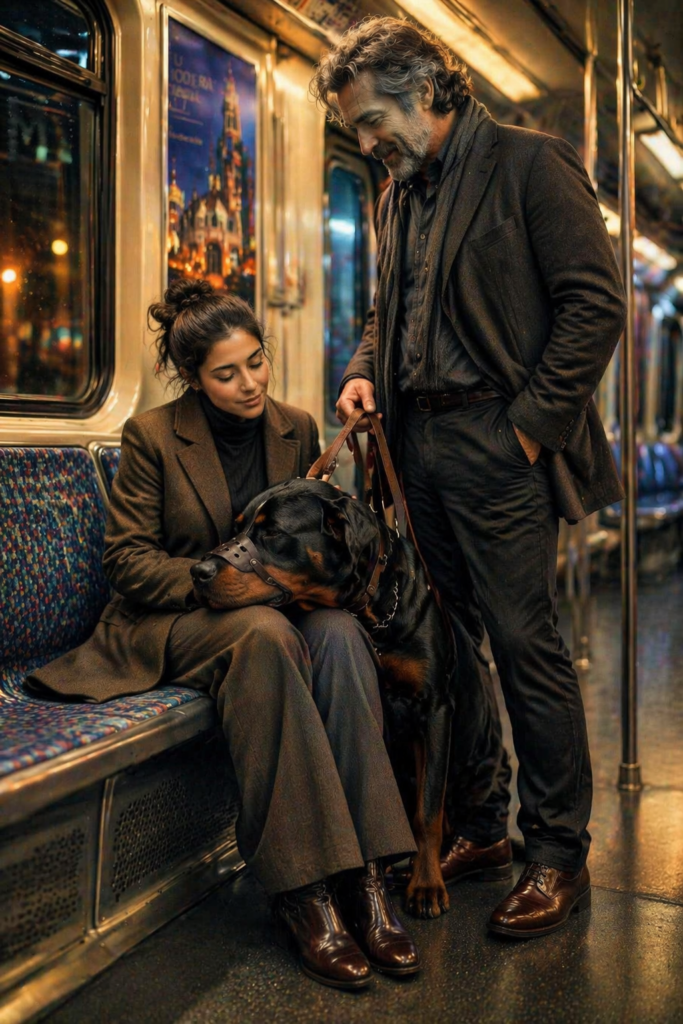
A large man boarded, with graying beard, black boots, and a face that held little warmth. A scar ran across his eyebrow, and a dark raincoat made him look even more intimidating.
Beside him walked a massive Rottweiler.
Black, muscular, with a broad head and a leather muzzle. Several people from the front car quickly swapped seats as soon as they saw him.
Diego pressed himself closer to the glass.
The car had empty seats everywhere, but the dog pulled on the leash.
He didn’t head for the door. He didn’t sniff the floor. He didn’t seek the man.
He walked straight toward Diego.
The young man held his breath.
The Rottweiler stopped right in front of his knees. Then, with an unexpected gentleness for such a large animal, rested his head on Diego’s legs.
Diego froze.
The man looked at him with a strange sadness, as if he had seen this scene before.
“Don’t be afraid, kid,” he said softly. “Dante doesn’t approach just anyone.”
Diego didn’t respond.
The dog lifted his eyes. They were honey-colored, deep, attentive. They didn’t judge. They didn’t demand. They didn’t question why he couldn’t handle his life.
They were just there.
The man sat across from him.
“My name is Alonso,” he said. “And seven years ago my son got off at the station you’re heading to.”
Diego felt the blood drain from his face.
Alonso didn’t raise his voice.
“I didn’t see the signs either. I thought he was tired, I thought it was drama, I thought he’d get over it. And one day, he just didn’t come back.”
The train moved into the darkness.
Dante kept his head on Diego's legs.
Then the speaker announced the next station.
The station where Diego planned to get off.
And when the doors opened, Alonso extended his hand and said:
“Get off with me. There’s a horrible coffee stand, but it’s warm. And today, you really don’t have to be alone.”
Diego looked at the hand, then at the dog, then at the open door.
And just as the train was about to close, he pulled the letter from his pocket, and Alonso saw the name written on the front: “For Mom.”
PART 2
Alonso didn’t snatch the letter away.
He didn’t shout. He didn’t ask what it said. He didn’t make that kind of scene that makes a wounded person retreat further.
He just kept his hand extended.
Dante, as if he understood that everything depended on that second, pressed his head a little harder against Diego's legs.
The young man began to cry.
At first, it was a tremor at his lips. Then a broken gasp. After that, a complete storm that bent his back.
He cried for the lost scholarship, for the rent, for his father calling him useless in front of his uncles, for his mother defending the indefensible with a “that’s just how your dad is.”
He cried for all the times he said, “I’m fine” while inside he couldn’t find a way out.
When the doors started to close, Diego took Alonso’s hand.
They all got off.
The train continued on its way without them, swallowed by the rain.
The stand was outside the station, under a blue tarp tied with ropes. The coffee tasted burnt, and the sweet bread was hard, but Diego later remembered it as if it had been a feast.
Alonso told him about Iván, his son.
He was 19 when he died. He was quiet, good at drawing, terrible at expressing his feelings. Alonso worked double shifts as a guard and thought providing food was enough.
“One thinks giving a roof is giving a home,” he murmured. “But sometimes kids need you to sit down and truly ask: ‘Are you still holding up?’”
Diego looked down.
Alonso also spoke to him about Dante.
He found him in a shelter in Iztapalapa, skinny, beaten, and known for being aggressive. Nobody wanted to adopt him because he seemed dangerous.
“But the dangerous one was me,” Alonso said. “I was filled with rage, guilt, and a desire to disappear too. Dante just sat next to me. That’s how it all began.”
That night, Alonso didn’t take Diego home.
He took him to emotional emergencies at a public hospital, then called his mom. He didn’t share morbid details or shame her. He simply said:
“Your son needs help today. Not tomorrow, not when it passes. Today.”
His mom arrived with a shattered expression.
His dad also showed up, reeking of anger before concern.
“What’s this mess?” he spat as soon as he saw Diego.
Dante stood up.
He didn’t growl. He didn’t bark. He just positioned himself between Diego and that man.
Alonso stared at the father without blinking.
“The mess is that your son was about to not come home. So choose your words carefully, sir.”
For the first time in years, Diego’s father fell silent.
Six months passed.
Diego didn’t fix himself overnight. It wasn’t like in the movies. There was therapy at a community center, pills for a while, relapses, heavy days, and midnight calls.
But there were also small things.
Breakfasts with his mom without pretending. Walks with Alonso. Quiet silences. And Dante, always nearby, serious as if he were the soul’s security chief.
Diego also adopted Pecas, a scruffy street dog, skinny with one drooping ear and a brown spot on his snout.
Pecas looked like an old mop, but he had a huge heart.
Every Saturday, Diego, Alonso, Dante, and Pecas walked through Bicentennial Park. They sat on the same bench, near the coffee kiosk and the bus stop.
One morning, Dante froze.
He didn’t bark.
He just stared toward the bus stop.
Diego followed his gaze and saw a woman in her 50s sitting alone. She wore an oversized brown coat, a black purse pressed against her chest, and yellow papers peeking out from one side.
She wasn’t looking at her phone. She wasn’t waiting for a bus. She wasn’t looking at anyone.
She stared at the ground as if asking for permission to sink.
Diego’s stomach clenched.
He recognized that look.
He had seen it from the train window.
“Alonso,” he whispered.
The old man was already walking over.
Dante moved slowly, head lowered. Pecas stuck close to Diego’s leg, as if he too understood this wasn’t a normal walk.
The woman looked up when the Rottweiler stopped in front of her.
“Don’t be scared,” Alonso said. “His name is Dante. He looks like a collector, but he’s kinder than many Christians.”
The woman let out a tiny, broken laugh.
Dante rested his head on her knees.
Exactly as he had done with Diego.
The woman covered her mouth with one hand.
And broke apart.
It wasn’t a loud cry. It was worse. It was the silent sobbing of someone who had spent months wiping away tears before anyone could see them.
Diego sat a short distance away.
“My name is Diego,” he said softly. “This is Alonso. This big guy is Dante. And this disaster with legs is Pecas.”
Pecas placed his front paws on the bench and wagged his tail with pride.
The woman looked at him.
“I’m Clara,” she murmured.
Alonso sat on the other side.
“Nice to meet you, Clara.”
She caressed Dante with trembling fingers.
“I don’t know why I’m crying with you.”
“Because sometimes we hold too much,” Diego replied. “And then someone arrives who doesn’t ask for explanations.”
Clara closed her eyes.
For a while, only the sounds of buses, birds, and the distant noise of the city waking up could be heard.
Then she spoke.
Her husband had died almost a year ago. Her two children lived in Querétaro and Monterrey, but lately, they called more about the house than about her.
The house was in Azcapotzalco. It was old, two stories, with a balcony full of dried pots.
Her husband always told her she could make even a stone bloom.
But since he died, Clara hadn’t watered anything.
“My kids say it’s too much for me,” she said. “They want me to sell, to move to a smaller room, to stop holding on. My daughter-in-law sent me brochures for a senior living facility. Nice, it is. Expensive too. As if that took away the ugly.”
Diego glanced at the papers in her purse.
Clara noticed and hid them.
“Today I was going to the notary,” she confessed. “My oldest son asked me to sign a power of attorney. He says that way he can sell the house without wearing me down. Says it’s for my own good.”
Alonso clenched his jaw.
“And do you want to sell?”
Clara shook her head.
“No. But they told me I’m being selfish. That an empty house is useless. That my husband is dead, and I’m acting crazy.”
The word hung in the air.
Crazy.
Diego remembered his dad calling him “dramatic,” “weak,” “lazy.”
Sometimes families don’t hit with their hands. They hit with words until one signs things they don’t want, accepts blame that isn’t theirs, and apologizes for continuing to breathe.
Dante didn’t move from Clara’s legs.
Pecas, with ridiculous bravery, jumped onto the bench and leaned his little body against her.
Clara looked at him, surprised.
“He’s so skinny.”
“He was worse,” Diego said. “Now he eats like he’s paying rent in Polanco.”
Clara let out a brief laugh.
It was small but genuine.
Alonso pointed to the kiosk.
“The coffee is kind of bad, but it’s warm. And if you’re going to decide something important, better with sweet bread and not alone on a bench.”
Clara hesitated.
“I don’t want to be a bother.”
Diego felt that phrase like a blow.
“You’re not a bother,” he said. “Just come.”
They walked together to the kiosk.
Clara held the coffee cup with both hands. She spoke more. Said she used to paint pots with flowers, cacti, suns, and names of neighbors. Her balcony was famous on the block.
Now everything was dried up because her kids kept repeating that none of that mattered.
“They told me that if I sign today, they’ll take away a worry,” she whispered.
Alonso took a napkin and wrote down a number.
“This is a trusted lawyer. Don’t sign anything without her reviewing it.”
Clara looked at the paper as if it were a lifeline.
That afternoon, she didn’t go to the notary.
The following week, she returned to the park.
She brought a crooked blue pot with a small plant that seemed to have survived purely out of stubbornness.
“I watered it,” she said.
Alonso took off his cap.
“Well, that calls for a celebration.”
From then on, Clara started coming every Saturday.
Sometimes she arrived sad. Other times she came angry because her kids hung up when she refused to sell. One Saturday she showed messages where her daughter told her: “Mom, don’t throw a tantrum, we’re all going to age.”
Diego read that and felt rage.
But Clara didn’t seem so weighed down anymore.
She had called the lawyer. Discovered that the power of attorney they wanted her to sign allowed them to sell the house, move her savings, and decide where she would live.
The blow was brutal.
“They didn’t want to help me,” Clara said, her voice dry. “They wanted to move me out of the way.”
The truth exploded two Sundays later.
Her children arrived at the house unannounced. One carried a folder. The other had a tone of false patience.
“Mom, enough already,” the oldest said. “This is for your own good.”
Clara wasn’t alone.
Alonso, Diego, Dante, and Pecas had come to bring her some new pots. The lawyer was there too.
When the son saw the Rottweiler at the entrance, he froze.
“What’s this dog doing here?”
Clara, with trembling hands but a firm voice, replied:
“Protecting me better than you ever did.”
The daughter was offended.
“How rude, Mom. After everything we do for you.”
Clara lifted the folder.
“Is this what you do for me? A power of attorney to sell my house and move my money without asking me?”
The oldest turned red.
“You don’t understand; you’re vulnerable.”
“I’m sad,” Clara said. “Not stupid.”
No one spoke.
It was the first time Diego saw someone reclaim their life with a sentence.
Clara didn’t shout. She didn’t insult. She didn’t cry like that morning at the bus stop.
She just said:
“My house isn’t for sale. My pots are staying. And if you want to visit me, it’ll be with respect. If you come to pressure me, that door stays closed.”
The daughter cried out of anger.
The son threatened to sue.
The lawyer barely smiled.
“Try it. We can also talk about property abuse and psychological pressure.”
The silence weighed heavier than any shout.
Dante lay down calmly by the door, as if the matter had already been resolved.
Pecas sniffed the son’s folder and sneezed on it.
Clara laughed.
That laughter shattered the fear completely.
Three more months passed.
Clara painted again. First one yellow pot. Then five. After that, she filled the balcony with colors so vivid that the neighbor across the street began taking pictures.
One Saturday she came to the park with news.
“I went to the shelter,” she said.
Diego and Alonso exchanged glances.
“Just to look,” Clara clarified.
Alonso chuckled.
“Uh-huh. Nobody goes ‘just to look’ at a shelter.”
Clara lowered her gaze, nervous.
“There’s an old dog. White. Blind in one eye. Her name is Lila. Nobody wants her because she’s no longer a puppy.”
Pecas barked as if voting in favor.
Dante wagged his tail twice, solemnly.
“I don’t know if I’m ready,” Clara said.
Alonso replied:
“No one is ready to love again. It’s learned through loving.”
Two weeks later, Clara arrived with Lila.
The little dog walked slowly, with a poorly tied red bow and the dignity of a tired queen. Dante greeted her with respect. Pecas tried to impress her by spinning around and almost fell.
Lila completely ignored him.
Clara laughed so hard she had to sit down.
Diego looked at her under the sun, with her house protected, hands stained with paint, and an old dog glued to her feet.
And he understood something that pierced him.
Dante hadn’t just saved him that night on the train.
He had prepared him to see others.
To not just walk past.
To recognize when someone said, “I don’t want to be a bother,” but was really saying, “Please, don’t leave me alone.”
Months later, Clara invited them to her house.
The balcony was full of pots. Some flowers grew straight. Others were crooked. One plant seemed more will than beauty.
Alonso looked at everything in silence.
“Your husband was right,” he said.
Clara froze.
“About what?”
“About you making even a stone bloom.”
Clara didn’t cry like before.
She smiled.
A tired smile, yes, but alive.
As they left, the evening descended upon Azcapotzalco. Dante walked ahead. Pecas bounced between Diego’s feet. Lila had fallen asleep on the balcony, as if she had finally arrived at her kingdom.
Diego looked at Alonso.
“Sometimes I think if you hadn’t gotten on that train…”
He couldn’t finish.
Alonso wouldn’t let him.
“But we did get on,” he said.
Just that.
But we did get on.
Since then, every Saturday, they leave an empty space on the park bench.
They don’t announce it. They don’t make a drama. They just leave it there.
In case someone arrives with papers they don’t want to sign.
In case someone carries a letter in their pocket.
In case someone smiles too much to hide that they’re breaking.
Dante almost always knows before everyone else.
Pecas is still learning, but he’s giving it his all.
And Diego, who once thought he was invisible, now looks more.
He watches the trembling hands. He observes the silences. He sees those who say, “I’m fine” with dull eyes.
Because he learned that no one saves themselves alone.
And no one should have to.
Sometimes it’s enough for someone to board the train just in time.
For a dog to rest its head on your knees.
For a stranger to invite you for a hot coffee when you can no longer find your way.
And for any ordinary day, for someone to truly look at you and say:
“I’m glad you’re still here.”





