PART 1
Don Ernesto was 64 years old, with a routine that no one in his daughter’s house valued as it deserved: waking up before the sun.
He lived in a modest apartment in Querétaro, with a tight pension, a photo of his late wife in the living room, and a silence that had seeped into his bones ever since she had passed.
That’s why he agreed to help his daughter Mariana when Mateo was born.
Then Leo came along.
And without realizing it, for six years, he stopped being just a grandfather and became a driver, cook, babysitter, locksmith, referee for disputes, homework monitor, and even an emergency psychologist.
Mariana worked at an advertising agency. Her husband, Rodrigo, was a bank manager. They were always rushing, always tired, always caught up in a meeting, a call, or “something urgent.”
At first, it all sounded lovely.
“Dad, nobody takes care of the kids like you do,” Mariana would say.
And Ernesto, who didn’t want to feel like a burden or be stuck talking to the walls, became indispensable.
By 5:40, he was already up.
By 6:30, he was opening the door to Mariana’s house.
He made eggs with beans, checked backpacks, searched for uniforms, signed school notes, filled thermoses, separated lunch boxes, and repeated the same phrases every day:
“First, homework.”
“Brush your teeth.”
“No cell phones at the table.”
“Respect your brother.”
Mateo was 9 and didn’t sleep well. He was a sensitive child, the kind who lies awake thinking about big things before closing his eyes.
Leo was 7 and was pure impulse, affection, and tantrum all at once.
Ernesto loved them.
But each day his knees hurt more and more, and every night he returned to his apartment feeling like he had left pieces of himself in a house where no one asked if he was tired anymore.
Then there was Javier, Rodrigo's dad.
Javier lived in Cancún, came every few months, and appeared with expensive shirts, strong perfume, and a commercial-grade smile.
He didn’t know Mateo’s teacher's name.
He didn’t know Leo was allergic to peanuts.
He didn’t know what day physical education was.
But when he arrived, everyone screamed as if Santa Claus had come.
Saturday was Mateo’s 9th birthday.
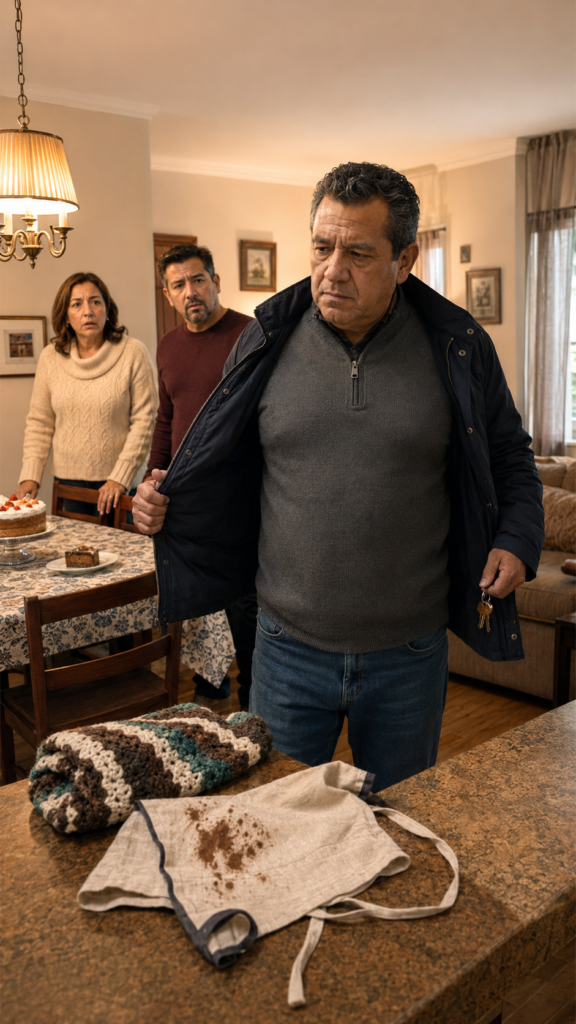
Ernesto had been there since 7 in the morning. He decorated the living room, inflated balloons, arranged plates, prepared gelatin, baked a chocolate cake, and brought a gift he had made with his own hands: a weighted, soft blanket, stitched in blue and green, to help Mateo sleep peacefully.
It wasn’t expensive.
But it was weeks of love poured into it.
At 4:20, the doorbell rang.
Javier entered with sunglasses, a big smile, and two elegant bags.
“Where are my champions?” he shouted.
The kids ran to him, passing by Ernesto as if he were just a piece of furniture.
Javier pulled out two brand new tablets.
Big.
Shiny.
Ridiculously expensive.
“Today, no rules, kiddos,” he said, winking. “Grandpa Javier knows how to spoil you.”
Mateo and Leo screamed.
Mariana smiled.
Rodrigo hugged his dad.
Ernesto stood there with the blanket in his hands, feeling suddenly as heavy as a stone.
He approached Mateo.
“My boy, I have something for you too.”
Mateo didn’t even glance up from the screen.
“Not now, Grandpa. I’m playing.”
Ernesto carefully unfolded the blanket.
“I made it for your nights, for when you have trouble sleeping…”
Mateo made a face.
“Grandpa Ernesto, seriously? A blanket? Javier brought us tablets. You always bring food, homework, and rules.”
The living room froze.
Ernesto looked at Mariana, waiting for a word. A defense. Something.
But Mariana just sighed.
“Dad, don’t take it personally. He’s a kid. Javier is the fun grandpa. You’re the everyday grandpa.”
The everyday grandpa.
Like the dishes.
Like the broom.
Like something that gets used and never thanked.
Then Leo said with his mouth full of candy:
“I wish Grandpa Javier lived here. He’s the good one.”
Ernesto slowly folded the blanket.
He took off the chocolate-stained apron.
Mariana, not noticing his expression, said:
“Dad, will you cut the cake? They’re getting desperate.”
Ernesto raised his gaze.
“No.”
Rodrigo frowned.
“What do you mean, no?”
“I’m not cutting the cake. And I’m not coming back tomorrow.”
Mariana let out a nervous laugh.
“Dad, don’t start. I have a presentation on Monday. Who’s taking the kids?”
Ernesto grabbed his jacket.
“I don’t know. Maybe they’ll sell a tablet and pay someone.”
Javier laughed.
“Don’t be dramatic, Ernesto.”
Ernesto gave him a hard look.
“Stay, fun grandpa. Let’s see if you can wash uniforms, check homework, and calm nightmares too.”
Javier looked down.
Ernesto reached the door.
Mateo finally lifted his eyes.
“Grandpa… will you come back tomorrow?”
Ernesto swallowed hard.
Everything in him wanted to say yes.
But this time, he didn’t.
“No, Mateo. Tomorrow you all will rest from my rules.”
And he left while Mariana shouted behind him, unaware that the worst was yet to come.
PART 2
For two days, Mariana’s house became a disaster.
Not a movie disaster, with flying plates or broken doors.
It was worse.
It was that silent chaos that appears when the person holding everything together stops being present.
On Monday, Mariana woke up late because no one had set the coffee maker or prepared the uniforms.
Mateo couldn’t find his math notebook.
Leo was crying because his sneakers were wet.
Rodrigo, desperate, shouted for everyone to hurry, but he didn’t even know where Ernesto kept the lunch boxes.
Mariana arrived 25 minutes late to her presentation.
Rodrigo took Leo to school without his backpack.
Mateo stood at the entrance of the school, red-eyed, asking if his grandpa was going to be mad forever.
That night, the tablets did nothing.
Mateo couldn’t sleep.
He tossed and turned, asked for water, cried softly, and said his chest felt tight.
Mariana searched for the blanket Ernesto had left in the kitchen the day of the party.
It was gone.
She found it on Mateo’s bed.
Leo had dragged it there without saying a word.
“It’s from Grandpa,” the boy murmured. “Maybe that’s why Mateo won’t cry anymore.”
Mariana stood still in the doorway.
Mateo hugged the blanket like it was a person.
And for the first time, Mariana understood that the gift everyone had dismissed didn’t compete with a tablet.
The tablet entertained.
The blanket cared.
The next day, Javier announced he was leaving.
“I’d love to help, but you know, my back is terrible,” he said while sipping coffee.
Rodrigo looked at him differently.
“Dad, we just asked you to take the kids once.”
Javier raised his hands.
“I come to socialize, not to be a babysitter.”
The phrase landed like a slap.
Mariana and Rodrigo fell silent.
For years, they had treated Ernesto just like that.
As if his love was an obligation.
As if taking care of kids, washing dishes, fixing doors, cooking, and enduring tantrums wasn’t work because it came from family.
That early morning, at 6:02, Mariana rang the doorbell of her father’s apartment.
Ernesto looked through the peephole.
He saw her without makeup, with puffy eyes, and a fabric bag in her hand.
He barely opened the door.
“What do you need?” he asked.
Mariana lowered her head.
“I’m not here to ask you to come back. I’m here to ask you for forgiveness.”
Ernesto didn’t move.
The hallway was cold.
The neighbor from 3B was taking out the trash and pretended not to hear.
Mariana took a deep breath.
“Dad, we turned you into a part of the house. Like you were the stove. Like you would always be there. And when Mateo said that… I should have defended you.”
Ernesto opened the door a bit more.
“Come in.”
The kitchen smelled of freshly brewed coffee and toasted bread.
On the table was a solitary cup, a folded newspaper, and Ernesto’s medicines in a small box.
Mariana looked at those pills with shame.
She had never asked what they were for.
She had never asked if her dad slept well, if his back hurt, if he missed her mom more when he returned home alone.
They sat facing each other.
Mariana pulled out the blanket from the bag.
She placed it on the table as if it were something sacred.
“Mateo slept with it,” she said. “He asked Leo if you had bought it.”
Ernesto stroked a corner of the fabric.
“And what did they say?”
“That you made it.”
Mariana wiped a tear.
“Then he said, ‘Why was I so silly with Grandpa if he made this with his hands?’”
Ernesto closed his eyes.
He didn’t smile.
That pain didn’t get fixed with a sweet phrase.
Mariana continued.
“Dad, I also discovered something that made me very ashamed.”
She pulled out a notebook.
It was a schedule notebook. It had columns, dates, tasks, names.
“I wrote down everything you do in a week.”
Ernesto looked at the page.
Monday: breakfast, school, lunch, homework, soccer.
Tuesday: lunch boxes, pediatrician, wash uniforms.
Wednesday: buy poster board, check reading, take to music.
Thursday: fix bathroom, prepare dinner.
Friday: pick up kids, clean living room, care until 9.
Saturday: market, cake, decoration.
At the bottom, Mariana had written a total.
More than 46 hours a week.
Ernesto exhaled slowly.
Mariana spoke in a broken voice.
“Dad, that wasn’t help. It was a full-time job.”
He lifted his gaze.
“I didn’t want to charge you.”
“I know,” she said. “But we shouldn’t have paid you with demands either.”
There was silence.
Then Mariana pulled out another paper.
“This is what I propose.”
Ernesto took it carefully.
It was a new family agreement.
On Mondays and Wednesdays, a babysitter would pick up the kids.
On Tuesdays, Rodrigo would leave early from the bank.
On Thursdays, Mariana would work from home.
Fridays would be for Ernesto.
Free.
Non-negotiable.
And if Ernesto decided to see his grandkids, it would be as a grandpa, not as an unpaid employee.
“There’s also a rule for the kids,” Mariana said. “When someone does something for them, they should express gratitude. Not out of obligation. Consciously.”
Ernesto looked at the sheet for a long time.
“And Rodrigo?”
Mariana pressed her lips together.
“He’s ashamed.”
“That’s not enough for me.”
“I know. He wants to talk to you.”
Ernesto left the paper on the table.
“Mariana, I love those kids. But loving doesn’t mean disappearing.”
She nodded.
“I understood that too late.”
“Very late.”
Mariana cried silently.
Ernesto didn’t comfort her immediately.
Not out of cruelty.
Because for years he had rushed to cover every discomfort of his daughter, and maybe that’s why she never learned to see the weight others carried for her.
Finally, he placed a napkin in front of her.
Mariana took it.
“There’s something else,” she said.
Ernesto felt a knot in his stomach.
“What?”
Mariana pulled out a folded drawing.
It was from Mateo and Leo.
They had drawn Ernesto with huge hands, a blue and green blanket, and a tablet thrown on the floor with an X over it.
Below it said:
GRANDPA, SORRY. YOUR BLANKET DOES HUG.
Ernesto stared at the paper.
His eyes filled with tears, but he didn’t let them fall.
“Mateo wants to learn to sew with you,” Mariana said. “He said he wants to make a blanket for Leo for when he gets scared.”
In that moment, something changed.
The wound didn’t disappear.
But a window opened.
Ernesto stood up, went to the cupboard, and took out a box of Maria cookies.
He placed it on the table.
Mariana understood the gesture.
It wasn’t a complete forgiveness.
It was a slightly opened door.
“Today I’m going to eat,” Ernesto said.
Mariana lifted her face.
“Really?”
“Yeah. But with conditions.”
“Whatever you want.”
Ernesto spoke slowly.
“If I enter your house, I enter as your father and as a grandfather. Not as service. I’m not going to cut cakes because I’m ordered to. I’m not going to solve emergencies that you created. And if someone treats me like I’m invisible, I’m leaving.”
Mariana nodded.
“I accept.”
“And Rodrigo is going to tell me that to my face.”
“Yes.”
“And Fridays are mine.”
“They’re yours.”
Ernesto took his jacket.
Before leaving, he looked at the photo of his wife.
For a second, Mariana looked at it too.
“I miss Mom,” she whispered.
Ernesto swallowed hard.
“Me too. But she would never have wanted to see me turned into anyone’s emotional mop.”
Mariana let out a sad laugh.
“No. She would have scolded you first for letting yourself go.”
“Definitely,” Ernesto said.
And for the first time in days, the air didn’t feel so heavy.
The dinner at Mariana’s house was different.
When Ernesto entered, nobody asked him to carry bags.
Nobody put an apron on him.
Nobody told him something was missing in the kitchen.
Mateo walked toward him with the blanket in his arms.
He didn’t run.
He didn’t shout.
He approached slowly, like children do when they know they’ve broken something important.
“Grandpa,” he said, in a small voice.
Ernesto knelt down.
Mateo looked at the floor.
“Sorry for saying your gifts didn’t matter.”
Ernesto took a deep breath.
He wanted to say, “It’s okay.”
But it wasn’t.
And kids need to learn that words hurt too.
“It hurt,” Ernesto said. “But saying sorry takes courage.”
Mateo cried.
“Do you still love me?”
Ernesto gently held the back of his neck.
“Always. But loving doesn’t mean letting others hurt me.”
Mateo hugged the blanket.
“Will you teach me to sew?”
“Yes. But first we’re going to learn something else.”
“What?”
“To be grateful.”
Leo appeared behind with a bag of candies.
“I already put the tablet away,” he said quickly. “And I did my homework too, Grandpa. For real.”
Ernesto barely smiled.
“Very good, champ.”
Rodrigo came out of the kitchen.
His hands were wet.
That image surprised Ernesto more than any speech.
Rodrigo was washing dishes.
He approached seriously.
“Mr. Ernesto, I owe you an apology.”
Ernesto didn’t respond.
Rodrigo continued.
“I hid behind work. I let you carry my house, and I even got mad when you got tired. That was wrong.”
Ernesto looked at him intently.
“Yes, it was wrong.”
Rodrigo lowered his head.
“I know. And I don’t want it to happen again.”
Ernesto didn’t hug him.
Not yet.
But he shook his hand.
The meal was simple: soup, rice, chicken in mole bought at the market.
But this time, everyone sat down at the same time.
When dessert came, Mariana put out the cake that had been leftover from the birthday.
The same cake Ernesto hadn’t cut that day.
Mariana placed the knife in the middle of the table.
“Today we’ll cut it together.”
Mateo took a plate.
Leo handed out napkins.
Rodrigo poured water.
Mariana cut the first slice and handed it to Ernesto.
“For you, Dad.”
Ernesto looked at the cake.
Then he looked at his family.
It wasn’t a victory.
It was something more awkward and more valuable: a beginning.
After eating, Mateo wanted to turn on the tablet.
Rodrigo raised an eyebrow.
“What’s the rule?”
Mateo sighed.
“First, clear the table.”
Leo added:
“And ask if anyone needs help.”
Ernesto said nothing.
He just watched.
Because sometimes justice doesn’t come with shouts or punishments.
Sometimes it arrives when others finally do what they had previously taken for granted that you would do.
At 5, Ernesto stood up.
Mariana got nervous.
“Are you leaving already?”
“Yes.”
“But… I thought you’d stay for dinner.”
Ernesto calmly shook his head.
“I came to eat today. Not to cover a shift.”
The phrase landed heavily, but no one argued.
Mateo hugged the blanket to his chest.
“Will you come back tomorrow?”
Ernesto smiled.
“I don’t know about tomorrow. But on Saturday, we can sew for a while, if your parents are home.”
Mateo looked at Mariana.
She nodded.
“We will be.”
At the door, Mariana hugged her father.
Not as someone clinging to a solution.
But as someone finally seeing a person.
“I love you,” she said.
“I love you too,” Ernesto replied. “But now I also love myself.”
He walked down the stairs slowly.
Outside, the air smelled of sweet bread and impending rain.
For the first time in a long time, he wasn’t carrying backpacks, lunch boxes, or guilt.
That afternoon, he went to the community center in the neighborhood.
He saw several men playing dominoes, a woman teaching a dance class, and a group of retirees preparing coffee.
An elderly woman with gray hair smiled at him.
“Are you signing up, sir?”
Ernesto looked at his hands.
The same hands that had sewn a blanket, fixed bicycles, dried tears, and served plates.
Tired hands.
But still his.
“Yes,” he said. “I’m here to learn how to have time.”
That night, upon arriving home, he received a message from Mateo.
Good night, Grandpa. I’m using my hug-blanket.
Ernesto turned off his phone.
He sat on the balcony.
The silence was still there.
But it no longer felt like abandonment.
It felt like space.
And in that space, at last, he fit.