PART 1
—Can I eat what you’re going to throw away?
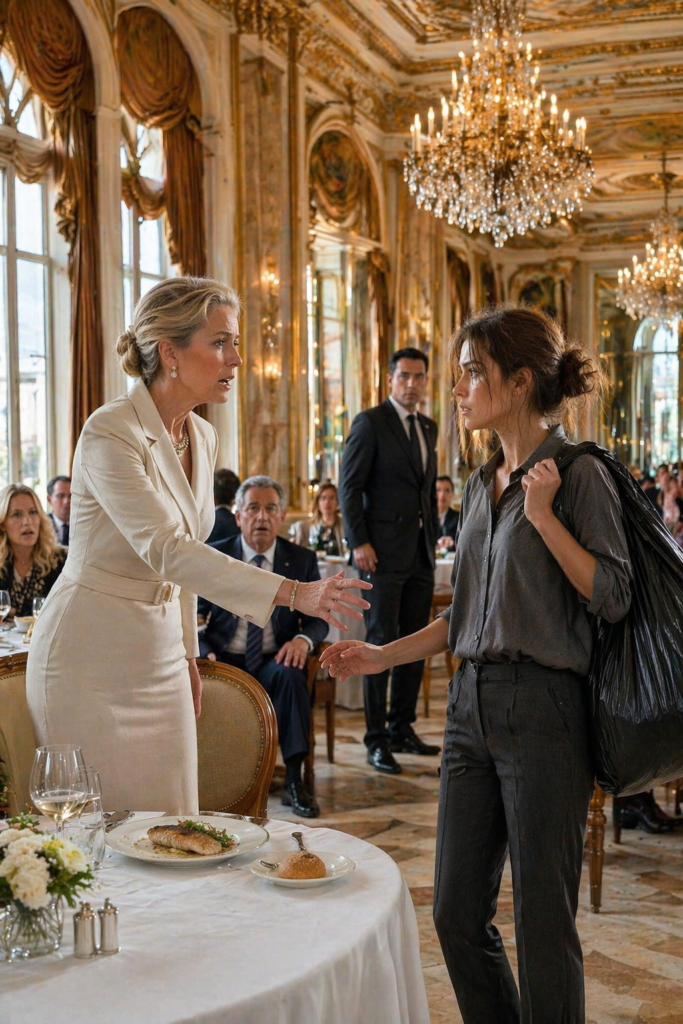
The question was so quiet it nearly got lost in the soft piano music, the crystal glasses, and the elegant conversations of the restaurant El Encanto in Polanco.
But still, everyone heard it.
At a table by the window sat Regina Santillán, one of the richest hotel entrepreneurs in Mexico. Owner of towers, resorts, foundations, and buildings with her name embossed in bronze.
People saw her as a powerful woman.
But no one knew that inside, she remained frozen on the same day 22 years ago, when a private hospital in Santa Fe told her that her baby, Lucía, had died minutes after birth.
Since then, Regina had eaten alone.
She ordered expensive dishes, took three bites, and let the waiter take the rest away. Not out of contempt. Out of habit from a sadness that never left.
That midday, she had ordered seabass, rice with vegetables, and freshly baked bread.
She didn’t get to finish.
Then the girl appeared.
She looked about 22 years old. Thin, too thin. She wore a torn gray sweatshirt, dirty sneakers, and her black hair tied back with an old elastic. In one hand, she clutched a black garbage bag, pressed against her body as if it contained everything she had left in the world.
—Excuse me, ma’am —she said, shamefaced—. I haven’t eaten well in three days. I saw you were going to leave the bread and… I didn’t want to be a bother.
The entire restaurant went cold.
A woman with a pearl necklace grimaced.
A man in a suit murmured:
—How horrible, how did they let her in?
The manager, a man with a fake smile named Licenciado Robles, approached quickly, as if the girl were a stain on the tablecloth.
—Miss, please come with me.
He tried to take her by the arm.
Regina raised her hand.
—Don’t touch her.
A heavy silence fell.
The manager froze.
—Doña Regina, I apologize. I’ll take care of removing this inconvenience.
Regina left the napkin on the table.
—She asked for food, not to be humiliated.
The young woman lowered her head.
—It’s okay, ma’am. I’m leaving. Really. I don’t want to cause any problems.
Regina looked at her intently.
There was something in her eyes.
Not just hunger.
Something familiar.
Something that hit her chest absurdly, as if a buried memory had knocked on the door from within.
—Bring another chair —Regina ordered—. A clean plate, hot soup, fresh bread, and the best you have in the kitchen.
The manager blinked.
—For her?
Regina looked at him coldly.
—For my guest.
The word fell like a slap.
The girl’s eyes widened, confused.
—I don’t belong here.
Regina answered softly:
—Neither did I belong to many places where I was forced to sit.
The girl perched on the edge of the chair, ready to run.
—What’s your name?
—Marisol.
—Marisol what?
She hesitated.
—Marisol Cruz.
The soup arrived. Marisol took the spoon, but her hand trembled so much the metal clanged against the plate.
—Thank you —she whispered—. I don’t understand why you’re doing this.
Regina placed her hand over hers.
—Because no one should have to prove they’re human to receive food.
Marisol began to cry silently.
The manager leaned toward Regina.
—With all due respect, Doña Regina, we have standards. Other customers might feel uncomfortable.
Regina stood up.
—Uncomfortable for what? For her hunger? For her clothes? Or because a girl had to ask for bread in a place where people waste food?
No one answered.
Regina pointed to the door.
—If the atmosphere of this restaurant depends on throwing a hungry young woman out onto the street, then the problem isn’t her.
The manager swallowed hard.
Everyone knew something he couldn't forget: Regina Santillán was not just a customer.
She was the owner of the building.
Marisol ate slowly. Not because she wasn’t hungry, but because her body no longer trusted abundance.
—I wasn’t always like this —she suddenly said—. I worked in a daycare. I wanted to study to be a teacher. But they robbed me of my savings, I lost the room I lived in, and then I lost my address. When you lose your address, people think you also lost your name.
Regina felt a knot in her throat.
—And your family?
Marisol tightened the black bag.
—I grew up in a home for orphans in Iztapalapa. They told me I was left there as a baby. No name. Just a date.
Regina stood still.
—What date?
—October 17.
Regina's face lost color.
Her daughter Lucía had been born on October 17.
Marisol tucked her hair behind her left ear.
And then Regina saw it.
A small brown mark, shaped like a crescent, just below the ear.
The same mark her baby had.
The same one Regina had kissed for less than an hour before a nurse took her away forever.
Regina felt the restaurant spin.
Marisol looked at her, worried.
—Are you okay?
Regina could barely breathe.
Because in front of her sat not a stranger asking for scraps.
But a young woman with the date, the eyes, and the mark of the daughter Regina had buried 22 years ago.
PART 2
Regina wanted to say it right then.
“I think you are my daughter.”
But she didn’t.
She couldn’t give hope to a young woman who had already survived too many lies. She couldn’t break her with an illusion if later the proof said otherwise.
So she took a deep breath.
—Marisol, do you know which hospital you were born in?
The girl frowned.
—I’m not sure. In the home, a worker once told me it was at Santa Esperanza Hospital. Then she told me not to ask so much, that it didn’t change anything.
Regina felt coldness in her back.
Santa Esperanza Hospital.
The same hospital where Lucía was born.
—Would you let me help you tonight? —Regina asked—. A safe room, clean clothes, food, a doctor if you need one. Nothing obligatory. You can leave whenever you want.
Marisol tensed.
—What do you want from me?
The question wasn’t rude.
It was fear.
Regina swallowed tears.
—I want you to sleep safely tonight.
Marisol looked at the black bag. Then the restaurant. Then at Regina.
—Just tonight?
—Just tonight.
That night, Regina hosted her in a simple but beautiful room at one of her hotels in Reforma. Marisol stood at the entrance, staring at the white bed as if it were a trap.
—Can I sleep there?
—Of course.
—In the bed?
Regina’s heart broke.
—In the bed.
Marisol turned away to hide her tears.
Regina didn’t sleep.
From her office, she called her lawyer, a private investigator, a former executive from Santa Esperanza Hospital, and a retired nurse whose name appeared in files from 22 years ago.
By dawn, documents began to arrive.
Incomplete records.
Altered signatures.
A death certificate with a doctor who wasn’t on duty that night.
A burial without the correct identification for the child.
And a note hidden in a dead file:
“Newborn without a name transferred to Casa Hogar San Miguel. Date: October 17.”
Regina read that line seven times.
Lucía hadn’t died.
She had been taken alive from the hospital.
Even so, she waited.
She requested a DNA test with a medical sample that Marisol accepted, believing it was part of a general check-up. Regina hated hiding the truth from her, but she would have hated even more to destroy her without certainty.
For four days, she lived between fear and hope.
Marisol ate with her, but always asked for permission to have seconds. She saved bread in a napkin “just in case.” She apologized for everything. For using too much water. For taking up space. For existing.
On the fifth day, the lawyer arrived with a sealed envelope.
Regina opened it with trembling hands.
Biological coincidence: 99.99%.
Relationship confirmed: mother and daughter.
Regina let out a sound that was neither a scream nor a cry. It was something deeper. As if a buried heart had begun to beat again.
She went up to Marisol’s room.
The young woman opened the door with wet hair and a clean t-shirt.
—Did something happen, ma’am?
Regina stepped in slowly.
—I need to tell you something. And I need you to know I waited until I was sure.
Marisol paled.
—Sure of what?
Regina opened the report.
—Twenty-two years ago, I had a daughter. Her name was Lucía. She was born on October 17 at Santa Esperanza Hospital. They told me she died. They gave me papers. They gave me a coffin. They gave me a grave.
Marisol stepped back.
—No…
—After hearing you talk about the orphanage, about your date, about the hospital, and seeing your mark, I checked everything.
Regina showed her the DNA.
—You are my daughter.
Marisol took the paper with both hands. The sheet trembled.
She read.
Mother and daughter.
For a few seconds, she didn’t cry.
She just stared at the words as if her entire life had just collapsed and rebuilt itself in the same instant.
Then her knees gave out.
Regina caught her.
—You didn’t abandon me? —Marisol whispered.
—Never.
—In the orphanage, they told me no one wanted me.
—I loved you every day of my life.
—They told me no one asked about me.
—I was told you were dead.
Marisol broke into tears.
It wasn’t the cry of an adult woman.
It was the cry of a little girl who had waited on every birthday, at every window, at every closed door, imagining that maybe her mom was still looking for her.
Regina held her tightly.
—Forgive me, my girl. Forgive me for not finding you sooner.
—My name is Marisol —she sobbed.
Regina kissed her forehead.
—Yes. And once you were Lucía.
Marisol lifted her face.
—Can I be both?
Regina cried more.
—You can be everything that helped you survive.
But the happiness didn’t last long.
Someone photographed them leaving the restaurant. The next day, gossip on social media exploded:
“Millionaire rescues young woman from the street.”
“Charity act or setup?”
A man named Bruno Ledesma saw the news from a grimy café in Doctores.
Bruno was the ex-boyfriend who had stolen Marisol’s savings, her phone, and the documents she planned to use to enroll in school. He didn’t feel guilty upon seeing her.
He felt opportunity.
The next day, he showed up in the hotel lobby wearing a clean jacket and a worried expression.
—I’m here to see Marisol Cruz. She’s expecting me.
When they informed the room, Marisol dropped her cup.
—Who is it? —Regina asked.
Marisol went pale.
—The man who took everything from me.
Regina went down to the lobby.
Bruno faked a humble smile.
—Doña Regina, thank God. I love Marisol. I just want to talk to her.
—Don’t use that word in my hotel.
Bruno swallowed hard.
—You don’t know the full story.
—I know enough.
—She and I went hungry together. Yes, I made mistakes, but she also knows how to get by. She’s not that innocent.
Regina looked at him with disgust.
—You came for money.
Bruno smiled slightly.
—I came for justice.
Then he said the phrase that revealed everything:
—Besides, if it’s true that she’s your daughter, it might be better to settle this privately before your family finds out.
Regina froze.
—Who told you that?
Bruno didn’t answer.
That same night, an anonymous video arrived on Regina's phone. It showed a young woman resembling Marisol in the hotel lobby weeks before, saying:
“That old lady is alone. If I play my cards right, I’ll never sleep on the street again.”
Marisol watched it and began to tremble.
—I’m not her. I swear I’m not her.
Regina watched the video three times.
There was a strange cut in the shadow. The voice sounded clear, too clear. The glass reflection didn’t match.
It was fake.
But it was made to sow doubt.
The next day, a woman named Nora Patiño appeared, claiming she had worked at Casa Hogar San Miguel.
—Marisol was always manipulative —she said in a private room of the hotel—. Since she was a child, she said one day she would find a rich family.
Marisol listened from behind the door, pale.
Regina asked:
—What color were the walls in the bedroom?
Nora blinked.
—White.
Regina hardened her gaze.
Marisol had told her the night before: yellow walls, blue beds, a broken window next to the bathroom.
—You never worked there —Regina said.
Nora was left speechless.
The lie fell apart, but the damage was already done.
Marisol ran out to the hallway.
—They’re going to make you hate me.
Regina caught up to her and took her face.
—Look at me.
Marisol could barely manage.
—I lost you once because I believed what they put on paper. I’m not going to lose you again over a lie on a screen.
The investigation moved quickly.
The fake video came from an agency paid by a foundation linked to Esteban Santillán, Regina’s political cousin. For years, Esteban had held positions in the hotels, waiting to inherit power while Regina lived buried in her grief.
And 22 years ago, he had been at the hospital.
A retired nurse, Amparo Treviño, agreed to testify.
—The baby was alive —she said, her voice cracking—. Regina was sedated. The doctor said the girl died, but I saw how they took her out. Then Mr. Esteban arrived and said the family would handle everything privately.
There were transfers.
Forged signatures.
A coffin without real identification.
A trust modification 15 days after Lucía’s supposed death.
The truth was no longer just a feeling.
It was proof.
The confrontation occurred in the boardroom of Grupo Santillán.
Regina entered with Marisol at her side. Not behind. At her side.
Esteban arrived smiling, but the smile faded when he saw the DNA, the hospital note, the nurse’s statement, the payments to Nora, the forensic analysis of the video, and the trust documents.
—You can’t prove intent —he said.
Regina spoke without shouting.
—you stole a newborn, forged her death, sent her to an orphanage, and lived benefiting from that lie for 22 years. Don’t call your crime protection.
Esteban clenched his jaw.
—You were weak. The family did what was necessary.
Marisol looked at him for the first time.
—Did you know where I was?
He remained silent.
—Did you ever go see if I was alive?
Nothing.
—Did you ever wonder if I was hungry?
Esteban looked down.
Marisol took a deep breath.
—You didn’t bury me. You just left me in a place where you thought no one would look for me.
That phrase finished him.
Esteban resigned from all his positions before the week ended. Authorities opened investigations for fraud, forgery, concealment, and document manipulation. Bruno was arrested when he tried to sell a fake interview. Nora confessed she was paid to lie.
Regina didn’t celebrate.
Marisol also didn’t seek revenge.
They asked that the truth be made public, so no one could bury it again.
The following months were not a fairytale.
Marisol sometimes slept on the floor, even though she had a bed. She stored food in drawers without realizing it. She flinched when someone knocked on the door. Regina learned that loving also meant waiting outside with a cup of tea, without intruding.
A year later, together they opened Casa Lucía Marisol, a transition home for young people exiting orphanages, the streets, or violent relationships.
It had real beds, locked doors, food at night, lawyers, therapists, classes, and job support.
No one was called “case.”
No one put their life in black bags.
At the inauguration, Marisol spoke in front of cameras.
—I thought the worst part of living on the street was hunger. It’s not true. The worst part is that people stop seeing you.
The silence was total.
—I went into a restaurant to ask for scraps because I thought that was the only thing I deserved. Regina gave me a chair and dignity before she knew I was her daughter. That matters. Because kindness shouldn’t need a blood test.
Regina cried openly.
Marisol looked at the young women sitting in front.
—I was not abandoned. I was stolen. But even before knowing it, I still deserved food, safety, and a name.
Years later, people would tell the story simply: a girl asked for scraps, a millionaire fed her, and a mark on her neck revealed 22 years of lies.
But the truth was different.
The story didn’t start with DNA.
It started when a room full of people tried to shame a hungry young woman, and a woman stood up to say:
“You’re not going to eat leftovers. You’re not going to be thrown out. You are not less than anyone. Sit with me.”
Because sometimes lost daughters don’t return through a grand door.
Sometimes they come back with a black bag, a trembling question, and a shattered heart.
And they only need someone to look at them before knowing their last name.