PART 1
Alma Salazar was 35 years old and lived in a nice house in Naucalpan, the kind that looked orderly from the outside, but inside, every silence carried an unpaid bill.
For 7 years, she held that house together without boasting about it.
She paid the electricity, water, gas, internet, groceries, repairs, insurance, her husband’s overdue credit cards, and even her mother-in-law’s medications.
Yet in that family, curiously, the only person they called a gold digger was her.
Héctor Rivas, her husband, worked at a car dealership in Satélite. He walked around in a pressed shirt, wearing expensive cologne and a watch he flaunted like a trophy.
Alma washed the shirt.
She bought the cologne on sale.
And she ended up paying for the watch when Héctor’s credit card bounced.
But he felt like the provider of the house.
And Doña Olga, his mother, made sure to remind him of that every chance she got.
—Oh, Alma, how lucky you are. My son breaking his back while you sit here at the computer.
Alma didn’t respond.
Because if she did, she’d be confrontational.
If she explained, she’d be exaggerating.
If she showed receipts, she’d be seen as selfish.
So she kept working from home as an accountant for various companies, earning more than Héctor, solving everything before anyone noticed something was missing.
Sundays were the worst.
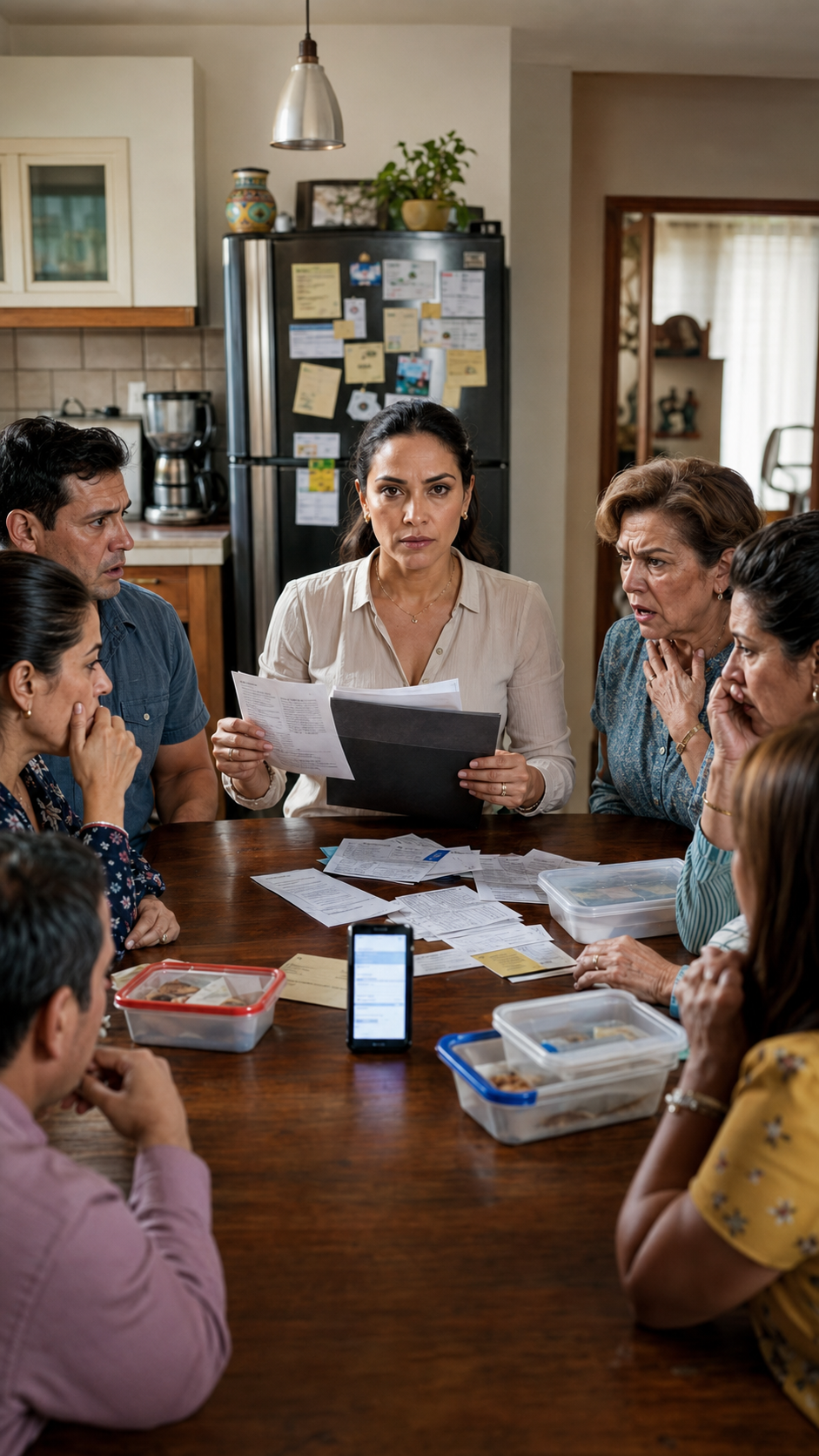
The entire Rivas family would arrive hungry with empty containers: Doña Olga, her 2 daughters, their husbands, 4 nephews, and Uncle Nacho, who only showed up when he smelled free food.
No one asked how much the mole cost.
No one washed a dish.
No one said thank you.
They just ate, and then Doña Olga would drop some venomous remark.
—A good wife serves without keeping score.
Alma clenched her jaw.
Until that Thursday.
She had worked late for a tax closing. She prepared quesadillas, a quick sauce, and lemonade.
Héctor took a bite and let out a mocking laugh.
—Seriously, Alma, you can’t even make a decent dinner. For someone who’s home all day, that’s pretty sad.
Doña Olga burst out laughing.
—Leave her be, son. Gold diggers eventually get tired of doing nothing.
Alma set the glass down on the table.
—Gold digger?
Héctor leaned back in his chair, delighted with his own theater.
—Yeah. That’s enough. Starting tomorrow, we split finances. I’ll pay my own way, and you’ll pay for your little luxuries. Let’s see if that teaches you how much it costs to live.
Doña Olga smiled like a queen.
—That’s right, son. She’ll finally learn not to stretch her hand out.
Alma looked at both of them.
She didn’t cry.
She didn’t yell.
She didn’t ask for respect.
She simply said:
—Perfect. From now on, everyone pays for themselves.
They laughed.
The next morning, Héctor entered the kitchen and found a label stuck to the coffee maker.
“PAID BY ALMA. NOT INCLUDED IN HÉCTOR’S FINANCES.”
In the fridge, there was another.
“PAID BY ALMA. 24 MONTHS.”
On the stove:
“BOUGHT BY ALMA. PAID IN FULL.”
On the modem:
“INTERNET PAID BY ALMA. PASSWORD CHANGED.”
And on Doña Olga’s favorite chair:
“BOUGHT BY ALMA. PLEASE DO NOT USE TO INSULT YOUR OWNER.”
Héctor ripped the modem label off in a rage.
Alma slapped another one on top.
—I have copies, dude.
On the first day, Héctor didn’t have coffee.
On the second, his phone ran out of data because the family plan was in Alma’s name.
On the third, his card bounced at the gas station.
On the fourth, Doña Olga called, furious because the pharmacy refused to give her medication without payment.
—Alma, tell my son to pay!
—Ma’am, we are financially separated. Please speak with the official provider of your comfort.
And she hung up.
Sunday came, and the whole family arrived as if nothing had happened.
Doña Olga entered first, with her big bag for leftovers.
—Where’s the food?
—There isn’t any —Alma replied.
They laughed.
They opened the fridge.
Empty.
They opened the pantry.
Empty.
They tried to light the stove.
No gas.
Héctor turned red.
—Alma, don’t do this in front of my family.
She was sitting at the head of the table, a gray folder in front of her.
—I’m not doing anything. This is what you wanted, right? For me to stop doing everything.
She pulled out the first sheet.
—Groceries for 7 years: 432,900 pesos.
Then another.
—Utilities, internet, gas, and repairs: 218,740 pesos.
Doña Olga crossed her arms.
—Anyone can pay that.
Alma pulled out the third sheet.
—Medications, consultations, tests, and cash given to Doña Olga: 301,600 pesos.
The silence was dry.
Alma showed transfers, audios, prescriptions, signed receipts.
Then she turned her phone toward everyone.
“1,096,480 PESOS PAID BY ALMA SALAZAR TO SUPPORT THE RIVAS FAMILY.”
No one breathed.
Doña Olga screamed:
—A wife doesn’t charge!
Alma stared at her, unblinking.
—I’m not charging, ma’am. I’m counting. And I still have what you hid.
She pulled out a black envelope.
Doña Olga stepped back.
—Alma, don’t open that.
Héctor froze.
Inside was an old invoice from a private clinic in Guadalajara.
The concept read:
“Confidential record of a live-born minor.”
The date was 9 months before Héctor’s official birth.
And in that instant, everyone understood that the empty food wasn’t the real scandal.
PART 2
Héctor took the invoice as if it burned.
He read his mother’s name.
He read the clinic’s name.
Then he looked back at the date.
—This is before I was born.
Doña Olga tried to laugh, but it came out as a broken sound.
—Those are old papers. They don’t mean anything.
—It has your name.
—It could be another Olga.
—My father’s name appears as a reference.
At that moment, Doña Olga stopped searching for exits.
Rebeca, Héctor’s older sister, approached with a pale face.
—Mom, what is this?
Doña Olga grabbed her bag.
—we’re leaving.
No one moved.
—I said we’re leaving!
Mariela, the other daughter, shook her head slowly.
—No. Now we want to know.
Alma opened the gray folder.
—Three months ago, Doña Olga asked me to look through some papers because she said she couldn’t afford her medications. Among her bank statements was this invoice, 2 different birth certificates, a deed, and a sealed letter addressed to Héctor.
Uncle Nacho looked at the floor.
Alma pointed at him.
—And you appear as a witness on one of the certificates.
Nacho swallowed hard.
—I didn’t know everything.
Doña Olga turned to him.
—Shut up!
But fear had already spoken for him.
Héctor took the 2 certificates.
On one, he was registered as the son of Eusebio Rivas and Olga Marín.
On the other, the father’s space was blank.
The dates didn’t match either.
—My certificate says June 1988 —Héctor said, his voice cracking.
Alma pointed to the second document.
—This one says September 14, 1987.
Doña Olga sank into a chair.
Rebeca brought a hand to her mouth.
—Did you lie to us our whole lives?
—I did it to protect you —Olga whispered.
Héctor slammed his hand on the table.
—Don’t use that word. Protect me from what?
Uncle Nacho closed his eyes.
—Eusebio couldn’t have children.
The phrase fell like a stone in the middle of the room.
Mariela let out a brief sob.
—Then what about us?
Doña Olga took a deep breath.
—you were legally adopted after I married Eusebio.
Rebeca stepped back.
—Adopted? And you never thought we had the right to know who we were?
—they were my daughters.
—That doesn’t erase our history.
Héctor couldn’t stop staring at the invoice.
—Who was my father?
Doña Olga shook her head.
—that doesn’t matter anymore.
—It matters to me!
—He’s dead.
—Who was he?
Alma pulled out a copy of a letter.
—Federico Villaseñor Castaño. Owner of the clinic.
Doña Olga glared at her with hatred.
—You don’t know what happened.
—Then explain it before the papers do.
Olga fell silent.
For years, she had dominated everyone with screams, guilt, and the phrases of a sacrificed mother.
But that afternoon, with no food on the table and her secrets laid bare, she no longer had a kingdom.
—I worked at that clinic —she finally said—. I was 20 years old. My mother was sick. Federico helped me with money. Then he started asking me to stay after my shift.
Rebeca clenched her fists.
—Mom, that sounds like abuse.
Olga glared at her, filled with rage and shame.
—I don’t need a label for what I lived through.
Alma spoke softer.
—Maybe you don’t. But Héctor needs to understand.
Olga closed her eyes.
—When I got pregnant, Federico said he couldn’t acknowledge the child. He had a wife, children, a surname, money. He paid for the birth, the hidden registration, and sent me away.
Héctor looked like he was running out of breath.
—Did he know about me?
—Yes.
—Did he meet me?
She took too long to answer.
—Yes.
—What was he to me?
Doña Olga began to cry.
—the doctor who checked your heart.
Héctor stepped back.
As a child, he had a heart murmur. His mother always talked about a generous doctor from Guadalajara who treated him for free.
Now he understood.
That man didn’t help him out of charity.
He looked at him because he was his son.
—Did he touch my chest, listen to my heart, and then send me home without telling me he was my father?
—Don’t say it like that.
—How do you want me to say it?
Doña Olga didn’t respond.
Alma felt no victory.
She felt anger, yes, but also a heavy sadness.
She had prepared that folder to defend herself, to prove that she wasn’t a gold digger, that her work had value.
She never imagined that by opening it, she would also shatter Héctor’s childhood.
But the money didn’t end there.
And that was the part Doña Olga feared the most.
Alma laid 3 bank statements on the table.
—For 16 years, a medical society deposited money in Doña Olga’s name. The payments stopped 6 months after Federico’s death.
Olga jolted her head up.
—that has nothing to do with this.
Héctor looked at her.
—How much money did you receive?
—it wasn’t that much.
—How much?
—it depended on the year.
—Mom.
Alma answered:
—Updated, around 2,500,000 pesos.
The silence became brutal.
Rebeca murmured:
—and yet you asked us for money.
Mariela chimed in:
—and you asked Alma for medications.
Doña Olga clutched her bag to her chest.
—that money was for you.
Héctor pointed at the deed.
—And the house in Tecomán was also for us?
Rebeca raised her head.
—The beach house?
Mariela’s eyes widened.
—Wasn’t it a friend’s?
Alma laid the deed on the table.
—it’s in Doña Olga’s name and a corporation where Uncle Nacho also appears.
Everyone looked at the man.
Nacho was sweating.
—it was a way to safeguard the assets.
—Whose? —Héctor asked.
No one answered.
Alma pulled out the sealed letter.
On the envelope, it read:
“For Héctor, when he’s older.”
Doña Olga stood up.
—Don’t open it.
Héctor looked at her with a calm that was frightening.
—you changed my birth date. You hid my father from me. You took me to him without telling me who he was. You stole my story. Don’t tell me what I can read.
He ripped the envelope open.
He read in silence.
Midway through the letter, his face hardened.
When he finished, he left the paper on the table.
—Federico left a fund for me when I turned 18.
Doña Olga turned pale.
—that man was lying.
—Here’s the bank.
—that account doesn’t exist anymore.
—What happened to that money?
Uncle Nacho covered his face.
Héctor looked at him.
—you know.
Nacho spoke softly.
—it was liquidated when you turned 18.
—Who signed?
No one breathed.
—Your mom.
Héctor knocked the chair over as he stood up.
—I was of legal age!
Olga cried.
—you were immature.
—I was mine!
—you would have spent it.
—How much was it?
Nacho said the figure:
—850,000 pesos.
Héctor lunged at him, grabbing him by the shirt.
—they stole from me!
Alma stood up immediately.
—Héctor, let him go.
He didn’t listen.
—it was my life! It was my right!
—Let him go —Alma repeated—. Don’t give them the chance to turn you into an aggressor.
Héctor breathed heavily.
He released Nacho.
Doña Olga cried like she was the victim of all.
—I was going to pay you back.
—When? —Héctor asked—. After continuing to ask my wife for money?
Olga glared at Alma with hatred.
—She did it to control us.
Héctor turned to his mother.
—No. She did it because I didn’t know what anything cost.
That phrase hit him hard.
Because he finally saw his part.
He hadn’t just been deceived by his mother.
He had also chosen not to look.
It suited him to believe that his salary was what held the house together.
It suited him to call Alma’s salary “help.”
It suited him to eat hot meals and only ask where everything came from when he ran out of coffee.
Alma pulled out another sheet.
—in the last 5 years, Héctor covered 32% of shared expenses. I covered 68%.
Héctor looked down.
—I called you a gold digger.
—Yes.
—I canceled your card.
—a card linked to an account where I deposited more than you.
—I didn’t know.
—you didn’t want to know.
That hurt more than any insult.
Doña Olga tried to stand up.
—I’m not going to stay here to let this woman disrespect me.
Rebeca stopped her.
—No. You filled out those sheets. Alma just opened them.
Mariela cried in silence.
—I want my adoption papers.
—you have no right —Olga said.
—they are my origins.
—I am your mother.
—you’re my mother. You’re not my whole truth.
Doña Olga looked at everyone as if they were betraying her.
Then she took her bag.
—Héctor, let’s go.
He didn’t move.
—Son.
—I need distance.
—Because of her?
—Because of your lies.
Olga pointed at Alma.
—you’re going to be alone. My son is going to open his eyes.
Alma replied without raising her voice:
—I hope so.
Olga left.
Nacho behind her.
None took food.
The empty containers sat on the table like a sad mockery.
When the door closed, Héctor sat there, staring at the labels stuck all over the house.
—Why did you do it in front of everyone?
Alma took her time to respond.
—Because when we’re alone, you minimize. You say I’m exaggerating. That your mom didn’t mean that. That family is like that. I needed everyone to see the same truth at the same time.
—You humiliated me.
—No. The truth caught up with you. It’s not the same.
—in front of my family.
—you called me a gold digger in front of your mother.
Héctor didn’t respond.
He went to the kitchen.
He opened the empty fridge.
—Where’s the food?
—in my sister’s house. I donated some.
—And the gas?
—I took the tank. It’s in my name.
—I didn’t think you’d go this far.
Alma looked at him tired.
—that was always the problem. You never thought about how far I’d go for you to live comfortably.
Héctor sat back down.
—What do you want to do?
Alma opened a blue folder.
—Separate finances for real. A common account proportional to income. Personal accounts. Nothing for your mother without agreement. Therapy. And respect.
—And if I don’t accept?
—Everyone pays for themselves. Everyone cooks for themselves. And we start the divorce.
He wanted to say “I love you.”
But for the first time, he understood that phrase didn’t pay for the damage.
He accepted.
It wasn’t magical.
The first week, he burned rice, washed his shirts badly, and got angry when he saw how much his own internet cost.
The second week, he took Doña Olga to the doctor. She asked for expensive tests. Héctor requested the invoice.
The tests weren’t for her.
They were for a neighbor who owed her a favor.
—I’ll check —he told her.
Doña Olga blocked him for 4 days.
The third week, he asked for money to fix a leak in Tecomán.
—Sell the house —Héctor replied.
She blocked him again.
Héctor started therapy on Thursdays.
At first, he said the therapist asked a lot of silly questions.
Then he talked about Eusebio, the man who raised him.
He cried as he accepted that Eusebio had been his father, even though they didn’t share blood.
He also cried as he realized his mother had turned sacrifice into an eternal debt.
And that he had done the same with Alma.
—I wanted to feel like I was in charge —he confessed one night—. And to be in charge, I needed to believe I paid.
Alma looked at him.
—Then you preferred not to see what I was paying.
—Yes.
—and humiliate me.
—Yes.
It was the first apology without excuses.
It didn’t fix everything.
But it opened a door.
Alma also went to therapy.
She discovered something painful to accept.
She wasn’t guilty of the abuses, but she had participated in hiding her own effort.
She paid silently.
Solved silently.
Saved silently.
Then she filled with resentment because no one appreciated something she never dared to put on the table.
She learned to say:
“This isn’t my responsibility.”
“This expense requires agreement.”
“My time counts too.”
“My rest also matters.”
Months later, Rebeca requested her adoption papers. Mariela did too.
Doña Olga refused until a lawyer intervened.
Rebeca found her biological father.
Mariela decided not to search.
Héctor initiated a process to correct his real birth date, although he was warned it could take years.
He also took a genetic test with a recognized son of Federico Villaseñor.
It came back positive.
The man first accused him of wanting money.
Héctor replied:
“I’m not looking for inheritance. I just wanted to know if we share blood.”
They didn’t become brothers immediately.
Blood doesn’t create trust out of nowhere.
But they talked.
And Héctor understood that Federico hadn’t been a hero either.
He’d been another powerful man hiding what bothered him.
A year later, Doña Olga sold the house in Tecomán.
She returned part of the money to Héctor.
Not because she had suddenly become good.
But because her daughters stopped talking to her, and Uncle Nacho threatened to reveal more papers.
One day, she asked to meet Alma at a café.
She arrived with a folder.
—I’m not doing this for you —she said.
—I never thought you were.
—I’m doing this because I don’t want to lose everyone anymore.
Alma looked at her without hatred, but without false tenderness.
—Then start by not treating your children like property.
Olga pressed her lips together.
—I just wanted to secure what’s mine.
—they weren’t bank accounts.
The mother lowered her gaze.
—I didn’t know how to be any other way.
—that explains. It doesn’t justify.
Almost 2 years passed before Doña Olga entered the house again.
She called ahead.
She brought rice.
She didn’t ask for money.
She didn’t criticize the food.
And when she finished eating, she washed her plate.
Alma didn’t cry.
She didn’t hug her.
But she understood something.
Sometimes change doesn’t come with speeches.
Sometimes it comes when someone finally cleans up what they’ve dirtied.
The house no longer had labels everywhere.
There were 3 accounts: one joint and 2 personal.
Expenses were divided according to income.
Sundays were no longer an obligation.
Whoever came brought something.
Uncle Nacho never returned.
Rebeca and Mariela did.
One Sunday, Doña Olga arrived with an empty container and lifted it before entering.
—This is to take leftovers with me, but only if there’s extra and if I’m invited.
Everyone laughed.
Alma too.
In the end, there was leftover cake.
She herself filled Olga’s container.
The mother accepted it and said:
—Thank you.
Nothing more.
And that “thank you” weighed more than 7 years of meals devoured without recognition.
Three years after that dinner, Alma found an old label inside a drawer.
“PAID BY ALMA.”
Héctor saw it.
—Should we throw it away?
Alma held it for a few seconds.
Then she stuck it on a new folder.
On the cover, it read:
“THINGS THAT COST MORE THAN THEY SEEMED.”
There they stored the label, the first therapy invoice, the signed budget by both, the correction of Héctor’s certificate, and the proof of Olga’s return.
Not because marriage had to be a business.
But because love without clarity had been too easy to exploit.
That night, when Héctor called Alma a gold digger in front of his mother, he thought that by separating finances, he would teach her how much it cost to live.
He was wrong.
Alma already knew.
What needed to be learned were their lessons.
They learned how much oil cost.
The internet.
Medications.
Gas.
The mole for Sundays.
The comfort of not asking.
The arrogance of assuming.
And the exact price of a woman who stops silently holding up a house where everyone swears she contributes nothing.
Since then, when someone said that keeping accounts killed love, Alma replied the same:
Love doesn’t die because it knows how to add.
It dies when one person gives everything, and the other still has the gall to call her a gold digger.





