PART 1
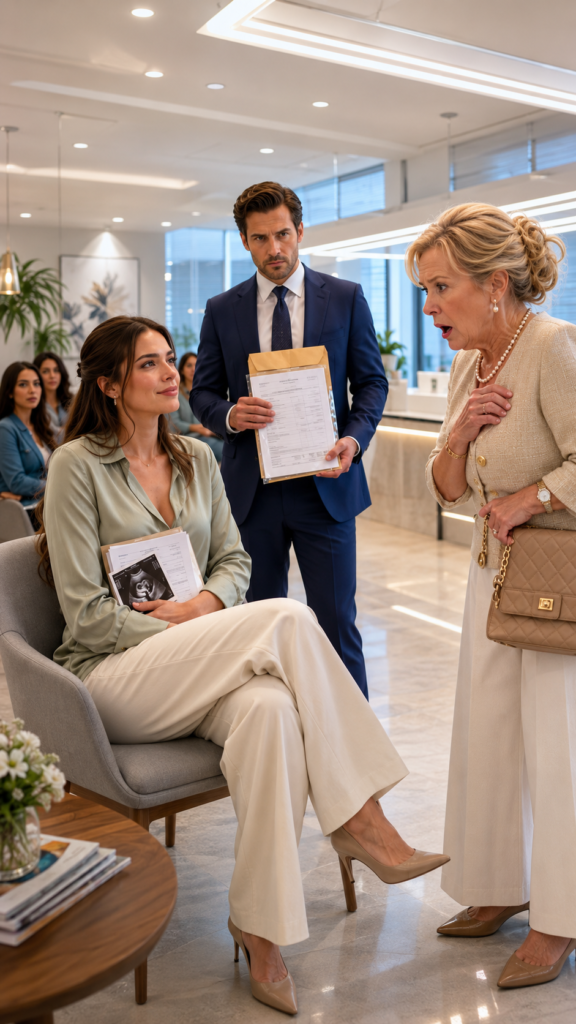
—My son did well to leave you, dear. Now he has a real daughter with a woman who can actually build a family.
Doña Teresa Moncada said it aloud, her elegant, venomous smile making several people in the waiting room turn their heads.
Alma Serrano did not respond immediately.
She simply closed the blue folder she had on her lap slowly.
It had been a year since her divorce from Rodrigo Moncada, but Doña Teresa still looked at her as if Alma were a stain on her family's name.
They were in the Renacer Clinic, a private fertility clinic in the Del Valle neighborhood of Mexico City.
Alma had arrived early for a meeting with the medical director and her lawyer. She hadn't expected to run into the woman who had blamed her for not giving the Moncadas a grandchild for years.
Much less had she expected Doña Teresa to show up dressed in white, with pearls, an expensive handbag, and the face of a woman attending Sunday mass.
—What a coincidence to see you here —the lady continued—. I thought you’d finally understood that some women are born to be mothers… and others are not. Honestly, Alma, what stubbornness on your part.
Alma clenched her fingers over the folder.
For six years, she and Rodrigo had tried to have a baby.
Treatments, injections, sky-high medical bills, endless waits, two losses, and nights when Alma cried in the bathroom so no one would hear her.
At first, Rodrigo held her.
Then he stopped accompanying her.
Later, he began to sleep on his side, as if Alma's pain were contagious.
And in the midst of that hell, Valeria appeared, her best friend since college.
Valeria said she just wanted to help.
She brought food, accompanied her to the hospital, and sent messages to Rodrigo “to check on how she was doing.”
Then came the calls.
The coffees.
The work trips.
And finally, the divorce.
—Rodrigo is happy now —Doña Teresa said, savoring each word—. Valeria gave him a beautiful little girl. Renata is a blessing. At last, we have a granddaughter of Moncada blood. A real family. Something you could never give him.
Alma lifted her gaze.
Months ago, that phrase would have shattered her.
But not anymore.
Because four months after the divorce, Alma received an email by mistake from the clinic.
It was a payment notice.
At first, she thought it was regarding the storage of the frozen embryos that she and Rodrigo had left there.
But then she saw the date.
Embryo transfer.
Two weeks after Rodrigo filed for divorce.
Alma felt the world shatter around her once again.
That embryo wasn’t Valeria’s.
It was Alma’s.
Alma and Rodrigo’s.
A frozen embryo that couldn’t be used without both their signatures.
And Alma had never signed anything.
Doña Teresa leaned toward her.
—That girl is proof that my son made the right choice.
Alma smiled with a calmness that made the lady blink.
—Is that what you believe?
Before Doña Teresa could answer, the automatic door opened.
A tall man in a dark suit entered, a sealed folder tucked under his arm.
He didn’t seem like a doctor.
He didn’t seem like a patient.
He looked like someone coming to dismantle a lie.
Doña Teresa saw him and turned white.
It was Commander Julián Ortega from the Prosecutor's Office.
The same man who had investigated a partner of Rodrigo’s for money laundering years ago.
The commander stopped next to Alma.
—Mrs. Moncada —he said—. It’s good to see you here.
Doña Teresa clutched her purse to her chest.
—I don't know what you're talking about.
The commander lifted the folder.
—I’m talking about the minor Renata Moncada Rivas. Everything indicates she was conceived with an embryo belonging to Mrs. Alma Serrano… and with falsified documents.
The entire room fell silent.
Alma looked at her ex-mother-in-law.
—Do you still think Rodrigo made the right choice?
Doña Teresa wanted to speak but couldn’t.
And when the receptionist called the clinic’s director, everyone understood that the worst was yet to come.
PART 2
Doña Teresa collapsed into a chair as if her heels could no longer support her.
For the first time since Alma had known her, she didn’t have a sharp phrase ready.
There was no smile.
No mockery.
No refined tone from Las Lomas that she used to belittle any woman without her last name.
Commander Ortega placed the folder on the coffee table.
Inside were copies of the medical consent, laboratory records, thawing authorization, payments, internal emails, and a preliminary graphoscopy report.
The signature read:
Alma Serrano.
But Alma had never signed that document.
—The forgery is good —said the commander—. But not perfect.
Alma looked at the document.
The handwriting looked similar.
The strokes did, too.
Whoever did it had seen her signature many times.
But they made a mistake.
At the Renacer Clinic, Alma always signed with her two full last names per the file’s rules:
Alma Serrano Márquez.
The fake paper only said Alma Serrano.
Doña Teresa swallowed hard.
—This is a family matter.
Alma slowly turned toward her.
—No. It stopped being a family matter when they used my embryo without my permission.
The word “my” hit Doña Teresa like a slap.
For a year, that woman had flaunted Renata on Facebook.
Pictures with huge bows.
Embroidered blankets.
Captions like “God rewards good families” and “Finally, the granddaughter we deserved has arrived.”
She called Valeria “the daughter-in-law I always dreamed of.”
And without saying her name, she referred to Alma as “a sad phase my son managed to overcome.”
But Renata wasn’t proof that Valeria had won.
Renata was proof that Rodrigo had stolen from Alma the last thing he couldn’t take from her with the divorce.
The medical director, Dr. Mónica Trejo, emerged from her office with a pale face.
—We need to move to the conference room —she said—. We’ve already suspended the file and notified the clinic’s legal department.
Doña Teresa struggled to stand.
—Alma, listen to me. That girl is Rodrigo’s daughter.
Alma didn’t blink.
—She’s mine too.
At that moment, Doña Teresa understood that asking for forgiveness wouldn’t be enough.
Crying wouldn’t suffice.
Saying it was all “for the love of family” wouldn’t cut it.
This was going to end in court.
Rodrigo Moncada arrived thirty minutes later.
He stormed in, jacket open, cell phone in hand, and the face of a man used to having everyone fix his problems.
Valeria Rivas followed behind.
She carried a pink diaper bag and wore dark glasses inside the building.
She didn’t have the baby with her.
That was the first thing Alma noticed.
The second was that Valeria didn’t ask what was happening.
Valeria already knew.
—What the hell is going on here? —Rodrigo demanded.
Doña Teresa rushed to him and whispered in his ear.
Alma watched as her ex-husband’s face shifted in three seconds.
Anger.
Confusion.
Fear.
Commander Ortega remained still.
—Mr. Moncada, I recommend you listen before you speak.
Rodrigo let out a false laugh.
—This is insane. Alma abandoned those embryos.
Alma’s lawyer, Licenciada Carla Mendoza, appeared on a video call from a large screen.
Her voice was cold.
—She didn’t abandon them. The contract signed by both parties requires written authorization from both parents for any transfer.
Rodrigo looked at Alma with contempt.
—You didn’t want to try again.
Alma felt her hands go cold, but she didn’t lower her voice.
—After losing our second baby, I said I couldn’t go through another pregnancy right away. That didn’t give you the right to give my embryo to my best friend.
Valeria took off her glasses.
Her eyes were red.
—He told me you had accepted.
Alma let out a short, broken laugh.
—you were my friend for 12 years, Valeria. You were with me when I lost my babies. You saw me put clothes I had just bought in a box because there was no one to wear them. You knew what those embryos meant to me.
Valeria lowered her gaze.
—I thought that…
—You didn’t think —Alma interrupted—. You chose to believe the lie that suited you.
The commander opened another folder.
There were entry records, calls between Rodrigo and an administrative assistant, messages from
Then he pulled out a sheet.
It was a screenshot.
A message sent by Doña Teresa to Valeria one night before the transfer.
“Sign as Rodrigo told you. No one will check that closely. Once the girl is born, no one will be able to do anything.”
The silence was brutal.
Valeria covered her mouth.
Rodrigo turned red.
Doña Teresa began to cry, but her tears didn’t seem to be of regret.
They seemed to be of fear.
—I just wanted a granddaughter —she whispered.
Alma looked at her with deep sadness.
—I didn’t want a granddaughter. I wanted to win back my place.
Doña Teresa lifted her face, offended.
But she couldn’t deny anything.
Because that was the truth.
For years, Doña Teresa had turned Alma’s infertility into a competition.
Every negative test was a weapon.
Every loss was a shame.
Every medical appointment was an opportunity to tell Rodrigo that “there was still time to find a healthy woman.”
And when Valeria came into the picture, Doña Teresa didn’t see a betrayal.
She saw an opportunity.
Dr. Trejo spoke with a trembling voice.
—The clinic will cooperate with the Prosecutor’s Office. The assistant who processed the authorization has already been suspended. We have cameras, logs, and system access.
Rodrigo slammed his fist on the table.
—Renata is my daughter!
Alma looked at him without hatred.
That was what hurt Rodrigo the most.
That there was no love anymore, but also no fear.
—I never said she wasn’t. I said she’s mine too.
That phrase shattered the room.
Because the hardest part wasn’t Rodrigo.
It wasn’t Valeria.
It wasn’t Doña Teresa.
It was Renata.
A nine-month-old baby who hadn’t asked to be born from a lie.
An innocent girl who might have Alma’s eyes, the dimple of the Serrano women, or the same way of sleeping she had as a newborn, according to her mother.
Alma didn’t want to rip her from a home as if she were a stolen thing.
She didn’t want to show up suddenly and ruin her life.
But she also couldn’t allow everyone to bury the truth.
That’s why she didn’t go to social media first.
That’s why she didn’t make a scandal on Facebook.
That’s why she gathered evidence, looked for a lawyer, filed a complaint, and requested everything to be done legally.
Licenciada Carla explained the path.
There would be a complaint for forgery and the use of private documents.
A civil lawsuit against Rodrigo, Valeria, and anyone found responsible.
A request for genetic maternity recognition.
And a gradual supervised visitation regime, always prioritizing Renata’s well-being.
—The minor has the right to know her origins —said Carla—. And Mrs. Alma Serrano Márquez has the right to be recognized.
Valeria began to cry.
—I love her. I carried her for nine months. I gave birth to her.
Alma closed her eyes for a moment.
That was the part no one wanted to say out loud.
Valeria had also been used.
She wasn’t innocent.
But she wasn’t the only guilty one.
Rodrigo had sold a lie to each woman.
He stole Alma’s embryo.
He promised Valeria a clean family.
He allowed his mother to manipulate him as if he were still a rich kid hiding behind his privileges.
And he robbed Renata of the right to be born into the truth.
Then came the twist no one expected.
Dr. Trejo asked for permission to show an internal video.
The screen displayed a hallway camera from the clinic, taken two days before the transfer.
Rodrigo was seen arguing with the administrative assistant.
Then Doña Teresa appeared.
But she wasn’t alone.
She was with the family’s trusted notary.
The same one who had handled Rodrigo and Alma’s divorce.
The image had no audio, but the Prosecutor's Office had obtained something more.
The assistant, scared of being implicated, provided a recording she made with her phone.
In the recording, Doña Teresa’s voice was clear:
—My son cannot lose those embryos because of a woman who is no longer useful. If Alma couldn’t give him children, someone else will. Pay whatever needs to be paid.
Alma felt the air leave her.
It wasn’t just Rodrigo.
It wasn’t just Valeria.
It was a plan.
A cold, classist, cruel plan.
A plan where her pain had been used as a mere formality.
Doña Teresa stood up, crying.
—I never meant to hurt anyone! I just wanted to save my family’s blood!
Alma stood up, too.
Her voice came out low but firm.
—Blood isn’t saved by robbing wombs, documents, and other people’s lives.
No one responded.
Weeks later, the case reached a family court.
The news leaked, as it always does in Mexico when money, last names, and scandal are involved.
The Moncadas tried to say that Alma wanted fame.
Then that she wanted money.
Then that she was obsessed.
But the documents, messages, and recording couldn’t be erased.
Rodrigo was linked to the process for forgery and the misuse of genetic material.
Doña Teresa was under investigation as a possible accomplice.
Valeria had to testify how much she knew and when she suspected it.
The clinic faced sanctions, and the administrative assistant lost her license.
But none of that returned what Alma had lost.
It didn’t give her back her pregnancy.
It didn’t give her back the first kick.
It didn’t give her back Renata’s first cry.
It didn’t give her back the sleepless nights that another woman lived with the baby who was also hers.
The hardest day came two months later.
The judge authorized a first supervised visit in a family center in Coyoacán.
Alma arrived without gifts.
She didn’t want to buy affection.
She only brought a folded handkerchief in her bag and an old photo of her mother, in case Renata ever asked where her eyes came from.
Valeria entered with the girl in her arms.
They didn’t greet each other.
There was no easy way to look at the woman who was friend, traitor, and gestational mother all at once.
The social worker placed Renata on a mat with toys.
The baby had round cheeks, dark hair, and a serious expression, as if she were studying everything before trusting.
Alma sat on the floor, at a distance.
She didn’t call her.
She didn’t extend her arms.
She didn’t want to scare her.
She just waited.
Renata crawled toward a fabric cube, bit it, threw it, and then looked at Alma.
She stared at her for several seconds.
Then she moved slowly, awkwardly, curiously, until she was in front of her.
Alma left her hand open on the mat.
The baby touched her palm with two fingers.
Then she closed her little hand around Alma’s index finger.
And Alma cried.
She didn’t scream.
She didn’t accuse.
She didn’t make a scene.
She cried for the years of treatments, for the two losses, for the friend who betrayed her, for the man who confused being a father with being a owner, and for that baby who had been born in the midst of a crime without any guilt.
Months later, the judge recognized Alma’s right to visit Renata while the paternity trial progressed.
Rodrigo stopped appearing in business magazines.
Valeria closed her social media.
Doña Teresa deleted all the photos where she flaunted “the granddaughter we deserved.”
And every Sunday, when she left mass, no one looked at her the same way as before.
Alma didn’t celebrate anyone’s downfall.
Justice didn’t return the life that had been stolen from her.
But it returned something the Moncadas believed they could buy, hide, and manipulate: the truth.
One year after the divorce, Doña Teresa thought she found Alma alone in a clinic.
She thought she could humiliate her again.
She thought a woman without a husband was a defeated woman.
But that day she didn’t confront a broken ex-daughter-in-law.
She confronted a mother who had had her story stolen from her.
And when Commander Ortega walked through that door, the lie had nowhere left to hide.
Rodrigo hadn’t built a new family after leaving Alma.
He had stolen the last piece of the family he himself had destroyed.





