PART 1
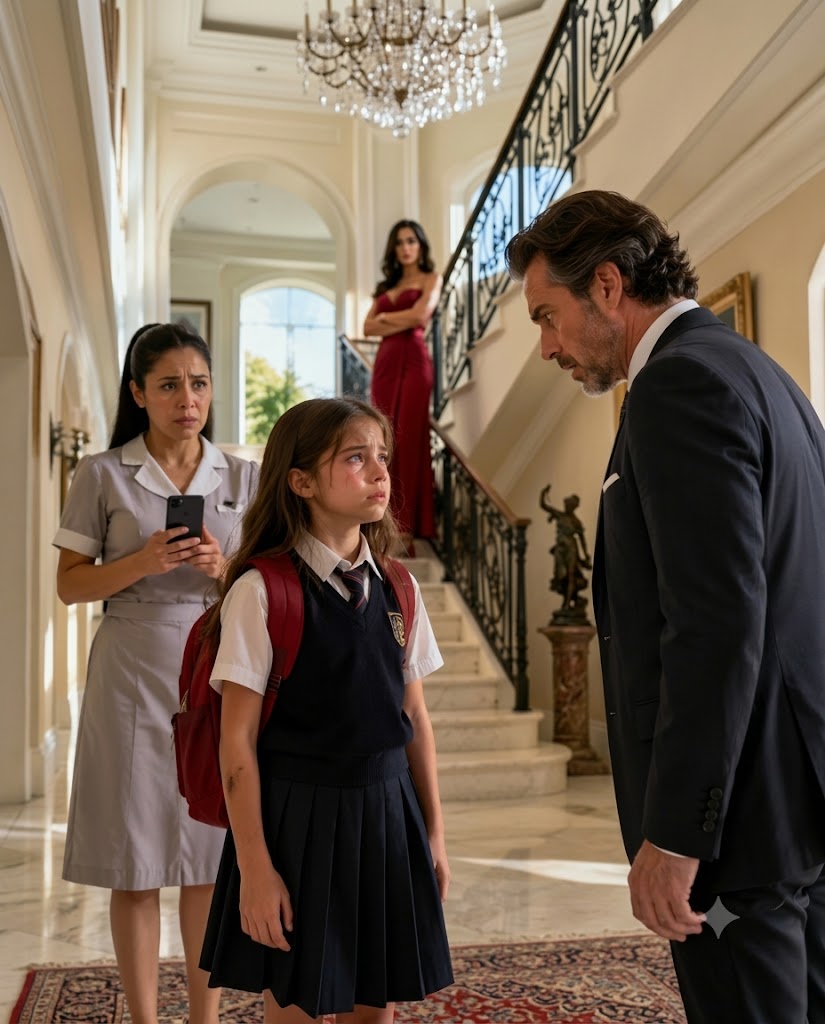
"You promised to pay my mom today. So, why did you leave her crying again?"
The girl’s voice echoed in the main hallway of a mansion in Bosques de las Lomas just as Ricardo Salvatierra descended the stairs, phone in hand and tie loosened after an endless meeting.
No one moved.
Not the cooks.
Not the driver.
Not Clara, the housekeeper standing by the service door, pale, with a wrinkled apron and eyes filled with fear.
The girl was ten, wearing a public school uniform, worn-out sneakers, and a purple backpack that seemed bigger than her. Her name was Lucía, and though her hands trembled, she didn’t look away.
"Lucía, please," Clara whispered. "Don't talk like that."
But the girl could no longer stay silent.
"My mom has worked here since before the sun came up. She cleans bathrooms, changes sheets, irons clothes she doesn’t even wear, picks up plates at parties where everyone throws food away like it’s nothing. And she hasn’t been paid in three months."
Ricardo felt a sharp blow to his chest.
"What do you mean she hasn’t been paid?"
Clara swallowed hard.
"Sir, I didn’t want to bother you. Mr. Óscar told me there were problems with payroll, but it would be resolved today."
"Óscar, the administrator?"
"Yes, sir."
Ricardo glanced toward the corridor where the office was. Óscar didn’t show up.
Lucía stepped forward.
"My mom can’t pay for the room we live in anymore. The landlord told her today is the last day."
As if fate wanted to validate every word, Clara’s phone began to ring. She looked at the screen, and her face broke.
"It’s Mr. Mauro," she murmured.
"Answer it," said Ricardo.
"No, sir, I’m so sorry…"
"Answer, Clara. On speaker."
Clara obeyed, fingers shaking.
"Hello?"
The landlord's voice exploded on the other end.
"Clara, enough already! If you don’t deposit today, I’ll put your things out on the sidewalk tomorrow. I have another family waiting for the room."
"Mr. Mauro, please. I’m at work. They told me I’d be paid today."
"That’s what you told me a week ago. And two weeks ago. I don’t live on promises."
"I have my daughter with me. We have nowhere to go."
"That’s not my problem. Today cash or tomorrow a new lock."
The call ended.
The silence became unbearable.
Lucía looked at Ricardo with tears caught in her throat but with a dignity that made him feel ashamed.
"Did you hear? My mom didn’t want to come, but I told her if she worked, she shouldn’t have to beg."
Ricardo didn’t respond immediately.
In that house, there were imported chandeliers, armored trucks, expensive wines, and paintings worth more than an entire neighborhood. But a woman who cleaned all of that was about to be left on the street.
"Clara, you and your daughter aren’t leaving here," he finally said. "No one is kicking you out today."
At that moment, a cold voice floated down from the staircase.
"Ricardo, don’t make a scene over service staff."
It was Patricia, his wife.
She wore a pristine white suit, dark glasses perched on her head, and a designer bag on her arm. She looked at Clara like she was a stain on the floor.
"Let them wait. They’re just employees."
Lucía clenched her fists.
Ricardo slowly raised his gaze to his wife.
"What did you just say?"
Patricia smiled with annoyance.
"Oh, please. Don’t tell me you’re actually going to believe a spoiled little girl."
Then Óscar appeared from the office, a blue notebook pressed against his chest, sweating as if he had just seen a ghost.
And Ricardo understood that the girl had not only demanded a wage.
She had just opened the door to a truth that no one in that family was ready to face.
PART 2
Ricardo walked toward Óscar without taking his eyes off him.
"Give me that notebook."
Óscar barely stepped back.
"Sir, let me explain first…"
"The notebook, Óscar."
Patricia let out a nervous laugh.
"Ricardo, you don’t have to put on this little show in front of everyone. We’ll look it over later."
"No," he said. "We’ll look it over now."
Clara tried to take Lucía by the hand to pull her aside, but the girl didn’t move. She’d seen her mom cry too many nights, counting coins on the bed, to flee just when someone was finally listening.
Óscar handed over the notebook.
Ricardo opened it.
There were records of staff payments, dates, signatures, canceled advances, and a list of names marked in red ink. Clara appeared twelve times. Next to her name it read: "pending authorization from the lady."
Ricardo looked up.
"The lady?"
Óscar lowered his head.
Patricia crossed her arms.
"I asked to manage some payments because you’re never around. Don’t exaggerate."
"Some payments?" Ricardo flipped through the pages quickly. "Here are gardeners, cooks, drivers, security, cleaning staff. There are people waiting for payments from three months ago."
"No one died."
The phrase landed like a slap.
Clara looked down.
Lucía did not.
"My mom is about to lose her home," the girl said. "Doesn’t that count?"
Patricia looked at her with disdain.
"Nobody asked you, kid."
Ricardo slammed the notebook shut.
"Don’t speak to her like that again."
The mansion went cold.
Patricia opened her eyes, offended.
"You’re defending a little girl from the help?"
"I’m defending a girl who spoke the truth when all of you stayed silent."
Óscar took a deep breath.
"Sir, there’s something else."
Patricia turned toward him.
"Shut up."
But Óscar was already too scared.
"The salaries weren’t the only things that moved. There were also withdrawals from the Salvatierra Foundation."
Ricardo felt the floor sinking beneath him.
The foundation was the only part of his life he boasted about without guilt. Scholarships for children, support for single mothers, temporary housing for evicted families, medicine for the elderly. He had created it in honor of his mother, a woman who cleaned houses in Ecatepec and died without ever having a bank account of her own.
"How much?" Ricardo asked.
Óscar looked at Patricia.
She clutched her bag to her body.
"Don’t answer."
Ricardo slammed his palm on the table.
"How much?"
"Almost 38 million pesos," Óscar said, barely audible.
Clara covered her mouth with one hand.
Lucía looked at her mother, not fully understanding the figure but grasping the horror.
Ricardo didn’t shout. That was worse.
His silence filled the house.
"Where is that money, Patricia?"
She slowly removed her glasses, trying to regain control.
"Invested."
"Don’t lie to me."
"Temporarily moved."
"Into what?"
Patricia took three seconds to respond. And in those three seconds, Ricardo saw something he hadn’t wanted to see in years: fear, not guilt.
"I had some losses," she said. "In some private games."
Óscar closed his eyes.
Ricardo took a step back.
"Did you gamble away the foundation’s money?"
"I was going to recover it."
"Did you gamble away the staff salaries?"
"Don’t be ridiculous. It was liquid money. Nobody at this level distinguishes where each peso comes from."
"Clara does distinguish," Ricardo said. "She distinguishes between paying rent or sleeping on the street. Lucía distinguishes between having dinner or saying she isn’t hungry."
Patricia looked at him with rage.
"You still talk like a poor person, even though you have millions."
Ricardo smiled sadly.
"I hope I never lose that."
He called Julián, his personal accountant, and requested the account statements for the house, the family business, and the foundation for the last six months. Patricia tried to leave, but Ricardo ordered the driver not to move any vehicles.
"I’m not your prisoner," she protested.
"No. But you’re not going to leave to hide documents either."
By 11 PM, the marble dining room resembled an emergency office. There were laptops, folders, receipts, transfers, and printed proofs everywhere.
Julián reviewed everything with an increasingly stern face.
"Ricardo, there are false invoices," he said. "Supposed community events in Puebla, Toluca, and Querétaro. They didn’t happen. The money ended up in accounts linked to private casinos and debt payments."
Patricia sat down, no longer with perfect makeup, no longer with that untouchable lady's confidence.
"I’m not a criminal," she murmured.
"Then explain to me how it’s called to take money intended for poor families to pay for gambling," Ricardo replied.
She cried, but not like Clara had cried from fear. She cried from anger, from wounded pride, from the inability to control the scene.
"You were never there," Patricia said. "You left me alone in a huge house, pretending to smile, attending charity events where everyone thinks they’re saints. I needed to feel something."
Ricardo looked at her with a mix of pain and disgust.
"And you decided to feel something with the salary of a woman who cleans your bathrooms."
Clara wanted to withdraw.
"Sir, I don’t want problems. I just need what’s mine and to be able to pay for my room."
Ricardo turned towards her.
"You didn’t cause any problem. The problem was already here before Lucía spoke."
That same night, all employees received their full pay, overtime, and an additional month as compensation. Ricardo sent an assistant with Clara to her neighborhood in Iztapalapa to pay the landlord six months’ rent in advance.
Mr. Mauro changed his tone as soon as he saw the certified check.
"Oh, well, in that case, Ms. Clara."
Lucía looked at him seriously.
"Don’t say ‘in that case.’ My mom always worked the same. You only respected her when you saw money."
Clara gently pulled her arm.
"Lucía…"
But Ricardo, who had gone personally, didn’t correct her.
"You’re right," he said.
The next day, the scandal exploded within the Salvatierra family.
Patricia’s father arrived furious, with lawyers and a face of a man accustomed to buying silence.
"Ricardo, this needs to be settled at home," said Mr. Raúl. "My daughter made mistakes, but reporting her would destroy us all."
"She destroyed the trust of many people."
"Over a maid?"
Ricardo stood up so fast that the chair screeched.
"Say that again, and this conversation ends here."
Mr. Raúl let out a dry laugh.
"Don’t be naive. In our world, these things get covered up. You pay, sign agreements, fire two employees, and that’s it."
"That’s the problem," Ricardo replied. "That you think everything can be covered up because you’ve never had to beg for a salary."
Patricia, sitting on the couch, cried silently.
Then the second blow came.
Julián entered with a new folder.
"Ricardo, we found something else. Patricia didn’t act alone."
Óscar turned pale.
"What did you say?"
"Óscar authorized several transfers and received personal deposits after each withdrawal. But there’s something more serious: he signed false receipts in the name of the staff."
Clara covered her mouth.
Ricardo opened the folder. There was the supposed signature of Clara on three receipts where it stated she had received her full salary.
"That’s not my signature," she said, trembling.
Lucía approached to see.
"My mom doesn’t write like that. She always makes the ‘C’ rounder."
That childish detail was enough to shatter the last lie.
Óscar collapsed into a chair.
"The lady forced me."
Patricia stood up.
"Liar!"
"You told me if I didn’t sign, you would accuse me of theft. You said nobody would believe the administrator over the lady of the house."
Ricardo closed his eyes.
Corruption had not been an isolated mistake. It was a chain of contempt, fear, and abuse, sustained by a phrase repeated too many times: "They’re employees."
The complaint was filed two days later.
The foundation’s board wanted to avoid it. Several businessmen advised Ricardo to keep quiet, pay back the money, and protect the family name. One even told him that Mexico already had too many scandals to add another.
Ricardo placed the blue notebook on the table.
"This notebook weighs more than my last name."
No one understood until he opened it.
"Here is every day worked by people who were told to wait. Every hour of overtime unpaid. Every false promise. If a poor woman had stolen 38 million pesos, no one would ask for discretion. They would demand prison. So don’t ask me for elegance just because the thief wears diamonds."
The room fell silent.
Patricia was forced to return properties, jewelry, and investments to replenish the money. Óscar was fired and reported for forgery and breach of trust. The foundation was placed under external audit, and Ricardo temporarily resigned from the management to avoid influencing the investigation.
The media tore apart the family.
Some called Ricardo exaggerated.
Others said he had humiliated his wife to look good in front of the poor.
But when Clara appeared in a local interview, without makeup, in her simple uniform, with Lucía by her side, she didn’t attack anyone.
She simply said:
"Working in a big house doesn’t mean you’re worth less."
That phrase went viral.
Thousands of people shared stories of employers delaying payments, of domestic workers treated like furniture, of drivers fired without severance, of nannies caring for others’ children while they couldn’t afford their own children’s schooling.
Months later, Patricia received conditional freedom, hefty fines, and mandatory community service in a program for indebted women and evicted families. She no longer wore diamonds. She no longer entered places like a queen.
One day, during a session, she heard a mother recount how she lost her room because her employer paid her late for two months.
Patricia couldn’t lift her gaze.
That night she sought out Ricardo.
"Today I understood something," she said, her voice broken. "I saw amounts. I never saw people waiting for those amounts."
Ricardo didn’t respond quickly.
"Clara saw them. Lucía did too."
Patricia cried for real, without theater.
"Will you ever forgive me?"
He looked at her wearily.
"I don’t know. Some debts are paid with money. Others with shame. And others with a lifetime of trying not to repeat the damage."
The mansion changed.
Not because the walls were different, but because silence no longer ruled. Employees had clear contracts, timely payments, vacations, insurance, and an anonymous mailbox to report abuse. Clara continued working there for a while, but she no longer walked with her head down.
Lucía received a scholarship from the foundation to study at a private high school. When Ricardo told her, Clara wanted to thank him.
He stopped her.
"Don’t thank me like it’s charity. Your daughter earned it. All we did was stop getting in her way."
Lucía handed him a drawing.
It was a simple house, with three people outside: a woman in an apron, a girl with a backpack, and a man in a suit holding a blue notebook.
Above it, she wrote:
"A decent house isn’t the one with more money, but the one that fulfills what it promises."
Ricardo kept the drawing in his office, next to his mother’s photo.
Because he never forgot again that a fortune can buy marble, trucks, and respectable last names.
But it can’t buy dignity.
And when a girl has to demand her mother’s pay in front of a millionaire, the shame doesn’t belong to the girl.
It belongs to all the adults who learned to look the other way.





