PART 1
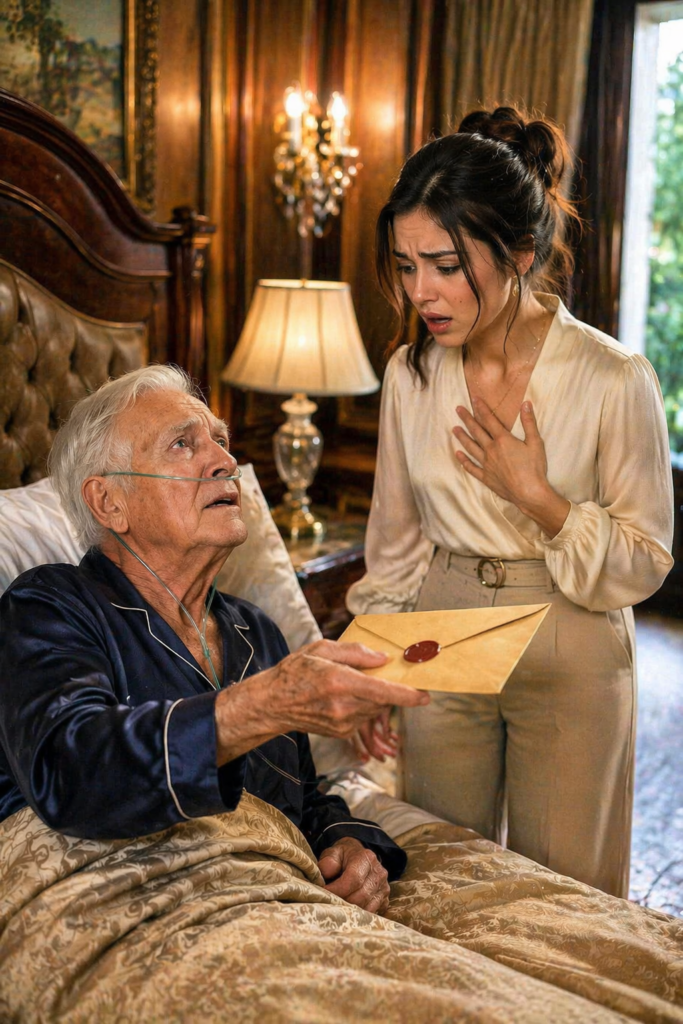
Don Aurelio Santamaría didn't ask Marisol to arrange his medications that night.
He didn’t ask her to warm the atole, to shut the heavy curtains of his bedroom, or to check the oxygen next to his bed.
He looked at her from the white pillows, his pale skin illuminated by the antique lamp, and murmured:
—Marisol… would you stay one night with me?
The tray nearly slipped from her hands.
For three years, Marisol Ríos had worked in the Santamaría mansion, a vast house in Valle de Bravo with windows overlooking the lake, marble floors, black gates, and hallways so cold that even footsteps felt shameful.
Don Aurelio was 81 years old, a fortune built from construction companies, hotels, and lands that half of Mexico envied.
His children feared him.
His lawyers obeyed without breathing.
His employees spoke softly when he was near.
But Marisol was never afraid of him.
Maybe because she had seen him when no one else did.
She had seen him stay awake staring at an old photo of a young woman in a blue dress. She had seen him send birthday gifts to people who never called to thank him. She had seen him feign toughness when his eldest son hung up the phone.
She had also seen him play a silver music box and withdraw his hand as if the memory burned.
Marisol didn’t come from that world.
She had grown up in Nezahualcóyotl, above a laundromat, with a mother who worked double shifts and a father who existed only as an empty space on school papers.
When her mother died, Marisol took the first job that included a room.
That’s how she ended up at the Santamaría house.
That night, upon hearing the request, she took a step back.
—Sir… I think I didn’t understand.
Don Aurelio closed his eyes, embarrassed.
—Not like that, daughter. For God’s sake, not like that.
Marisol stood frozen.
He breathed with difficulty.
—I’m dying. The doctors say I might not last another week. My children are downstairs like vultures in designer clothes, fighting over paintings, stocks, and houses by the beach. None have come up to ask me what I want before I go.
Marisol looked toward the closed door.
Hours earlier, she had heard shouting in the living room.
Ignacio demanded to review the will.
Beatriz wanted an inventory of the jewelry.
Rodrigo was asking about foreign accounts.
None had asked if their father was cold.
—I need someone to stay awake with me —Aurelio whispered—. Someone who will listen. Someone who won’t interrupt. Someone who doesn’t want my money.
Marisol felt pity, but also fear.
—Why me?
The old man’s eyes filled with ancient sorrow.
—Because you resemble her.
—Who?
Don Aurelio looked at the photograph on the nightstand.
The young woman in the blue dress.
—My daughter —he said—. The one nobody in this house is allowed to mention.
Marisol furrowed her brow.
—I thought you only had three children.
—That’s what everyone thinks.
The rain pounded against the windows.
Aurelio swallowed hard, as if each word cost him years.
—Her name was Lucía. She was stubborn, kind, and braver than all my children combined. She fell in love with a young man I considered insignificant. I told her that if she left this house with him, she would never come back.
Tears welled in his eyes.
—And she believed me.
Marisol felt a knot in her throat.
—What happened to her?
—She wrote to me when her husband died. She had a baby. She needed help.
He tightened the sheets.
—I was too proud to reply.
The air grew heavy.
A baby.
A mother working herself to the bone.
An absent father.
A silver music box.
Marisol reached for the necklace hidden beneath her uniform.
A small, silver hummingbird.
The only reminder her mother had left her.
Don Aurelio saw it.
His face changed.
He didn’t look surprised.
He looked like he recognized something he had waited his whole life for.
—Marisol… —he whispered, his voice broken—. What was your mother’s name?
She wanted to lie.
She wanted to run.
But the truth trembled out.
—Lucía Ríos.
Don Aurelio covered his mouth.
Behind the door, footsteps halted.
Someone had been listening.
And then, the richest and most feared man in Valle de Bravo began to cry like a child.
PART 2
For a few seconds, no one said anything.
The rain continued to lash against the windows, and on the other side of the door, there was a clumsy movement, as if someone was quickly backing away.
Don Aurelio tightened Marisol’s hand.
—They know now —he murmured.
—Who?
—My children.
Before she could respond, the door swung open.
Ignacio Santamaría entered first, in a gray suit, perfectly combed hair, and that look of a man used to getting everything solved with money.
Beatriz followed, wrapped in an expensive coat, diamonds around her neck, and anger etched on her face.
Rodrigo came in last, holding his cell phone as if he were already recording evidence.
—What a touching scene —Ignacio said, sizing up Marisol.
Beatriz glanced at the necklace.
Then she looked at her father.
Then back at Marisol.
—You can’t be serious —she spat—. The maid?
Aurelio’s voice, weak but firm, came out.
—Don’t call my granddaughter that.
The word fell like thunder.
Granddaughter.
Marisol felt the ground shift beneath her feet.
Rodrigo let out a dry laugh.
—This is madness. She must have planned this. Are we really going to believe the maid turned out to be family?
—I didn’t plan anything —Marisol said.
Beatriz pointed at her black uniform.
—Of course. You just walked in through the service door, earned his trust, and coincidentally wear Lucía’s necklace.
Don Aurelio tried to reach for the drawer of the nightstand.
His hand trembled too much.
Marisol opened it for him.
Inside was a yellowed envelope, carefully folded.
On the front, it read:
“Dad, please read me.”
Marisol recognized the handwriting.
Not from elegant letters, but from recipes, notes stuck to the fridge, and cheap birthday cards her mother turned into treasures.
Her legs buckled.
—Your mom wrote to me 29 years ago —Aurelio said—. And I kept her letter like a coward keeps his guilt.
Ignacio stepped forward.
—Father, you’re medicated. This isn’t valid.
Aurelio let out a laugh that ended in a cough.
—I’m clearer than ever.
He looked at his three children with a sorrow that no longer asked for permission.
—You waited for my last breath to divide my life into numbers. She brought me tea when my hands couldn’t hold a cup. She covered me with blankets when you wouldn’t even come up to say hello. She spoke to me as if I were still a person.
Beatriz pressed her lips together.
—You can’t change the will over a dying man’s tantrum.
Don Aurelio smiled faintly.
—I changed it six months ago.
The room froze.
Rodrigo lowered his phone.
Ignacio lost color.
—That’s impossible.
—Inconvenient for you, yes. Impossible, no.
Marisol didn’t understand anything.
—Did you know?
Aurelio looked at her with shame.
—I started to suspect the day I saw your necklace. The same hummingbird I gave Lucía when she turned 18. I had a quiet investigation done. I needed to be sure before putting you in danger.
—In danger from whom?
The old man didn’t reply.
He only looked at his children.
Then he pointed to the silver music box.
—Marisol, behind the music box.
She lifted it carefully.
Behind it was a small black device, hidden against the wall.
Beatriz gasped.
—What is that?
—The truth —Aurelio said.
Ignacio took a step toward Marisol, but the old man’s voice stopped him.
—If you touch it, every news outlet will receive a copy by morning.
Marisol pressed play.
First, there was static.
Then Rodrigo’s voice appeared.
—The old man is taking too long to die.
Then Beatriz:
—If anything changes, we’ll say the maid manipulated him.
Ignacio spoke coldly:
—The girl is a problem. He trusts her.
Rodrigo scoffed.
—Then fire her.
Ignacio replied:
—Not yet. Let her keep him calm. When he dies, we give her a severance, confidentiality agreement, and make her disappear.
The recording ended.
Marisol felt her heart pounding in her ears.
Don Aurelio looked at his children.
There was no fury left on his face.
Only disappointment.
—I gave you everything —he said—. Last names, schools, businesses, houses, contacts. And still, there wasn’t a speck of humanity left in you.
Ignacio tried to compose himself.
—People say things under pressure.
—Yes —Aurelio replied—. And they also show who they are when they think no important person is listening.
Beatriz looked at Marisol with contempt.
—Don’t turn her into a saint.
—She’s not a saint —Aurelio said—. She’s my granddaughter. And that’s enough.
Marisol opened the envelope with trembling hands.
The first line nearly broke her.
“Dad, I know you said not to come back, so I won’t.”
Her mother’s voice seemed to fill the room.
Lucía wrote that her husband Daniel had died, that Marisol was only three months old, that she worked night shifts and asked for no money for herself.
She asked for a chance for her daughter.
“If you still remember that I was your daughter before disappointing you, help me give Marisol a life safer than the one I can provide alone.”
Tears fell onto the paper from Marisol.
—Did he reply? —she asked, her voice barely audible.
Aurelio closed his eyes.
—I wrote a cruel reply. I told her she had chosen her life. I sealed it. But that night I reread her letter and saw your name. You were three months old.
He swallowed.
—I tore up my reply.
Marisol looked at him.
—And what did he send her?
The silence felt worse than any insult.
—Nothing.
Nothing.
That word hurt more than a closed door.
Because a cruel letter at least arrives.
Nothing leaves a woman checking the mailbox for weeks. Nothing forces a mother to swallow her pride while carrying her baby. Nothing makes a girl grow believing family is something others are entitled to.
—My mom never hated you —Marisol said.
Aurelio opened his eyes in surprise.
—No?
—She kept your photo. She kept the necklace. She said her dad was a complicated man who had forgotten how to say sorry.
The old man cried silently.
At that moment, there was a knock at the door.
Licenciada Patricia Cárdenas, Don Aurelio’s personal lawyer, entered with a leather portfolio and the face of a woman who knew exactly what fire she was walking into.
—Don Aurelio —she said—, I came as soon as you called.
Ignacio exploded.
—Did you call your lawyer?
—Before dinner —the old man replied.
Patricia closed the door.
—To be clear, the updated succession documents were signed six months ago, with two independent doctors certifying full mental capacity. Everything is notarized.
Beatriz turned pale.
—This is a trap.
—No —Patricia said—. It’s foresight.
She pulled out a folder.
—Marisol Ríos is recognized as the biological granddaughter of Aurelio Santamaría, daughter of Lucía Santamaría Ríos. The confirmation was made with personal samples, medical files, and items kept by the gentleman.
Marisol felt the air leave her.
—They tested me.
Aurelio lowered his gaze.
—I had to know before revealing something that could destroy you.
Patricia handed her another envelope.
—This is for you.
Marisol didn’t open it yet.
Everything had changed too quickly.
She was still dressed in the same uniform she had worn to clean the dining room that morning, when her biggest concern was that Beatriz would complain about a stain on the tablecloths.
Beatriz let out a bitter laugh.
—So you come in with a sad story and take it all.
Don Aurelio slowly turned towards her.
—No. She came with kindness when she thought she would receive nothing.
—You’re punishing us for Lucía.
—No —he said—. I’m confronting you with what you are. None of you learned to love something you couldn’t possess.
Ignacio gritted his teeth.
—You’re going to destroy the Santamaría legacy for a woman who cleaned your floors.
Marisol lifted her gaze.
For the first time that night, she smiled.
Not because it amused her.
But because she understood something her mother had repeated her whole life: people who adore status always expose themselves when they are afraid.
—Yes —Don Aurelio said—. She cleaned my floors. And yet she stands taller than all of you.
Ignacio looked as if he had been slapped.
Patricia opened the main folder.
—There’s an important condition. The personal inheritance can be passed to Marisol. But the majority part of the businesses and trusts must be decided between two paths: private management or the definitive creation of Fundación Casa Lucía.
Marisol furrowed her brow.
—Casa Lucía?
Aurelio’s voice cracked.
—A shelter for young women with children, without family, without money, and without a safe place.
Marisol understood immediately.
—The help my mom asked for.
—Yes —he whispered—. I can’t respond to Lucía in time. But maybe I can respond to others.
Beatriz murmured:
—How convenient. Giving away our heritage to strangers.
Marisol looked at her sharply.
—Your sister wasn’t a stranger.
Beatriz opened her mouth.
Nothing came out.
For the first time, her face showed something akin to shame.
Maybe a memory.
Maybe contained rage.
Maybe both.
Patricia spoke calmly.
—You don’t have to decide tonight.
But Marisol already knew.
Not the legal details.
Not the signatures.
But the sense.
Her mother wouldn’t have wanted a revenge dressed as justice. She wouldn’t have wanted her daughter to become just another rich person, locked behind gates, forgetting the sound of a woman quietly crying so as not to wake her baby.
—I want the foundation —Marisol said.
Ignacio straightened up.
—All of it?
—Not all of it.
For a second, his eyes shone with hope.
Marisol continued:
—The house will be in my name until deciding how to open it. My mom should have come back here, and no one let her. I won’t allow them to erase her again.
Aurelio nodded with tears in his eyes.
—And the business? —Patricia asked.
—Let it finance the foundation. But it will be run by honest professionals, not heirs who see it as a prize.
Ignacio let out a laugh.
—You know nothing about business.
—That’s true —Marisol replied—. Which is why I need honest people around. That’s very different from needing you.
Don Aurelio let out a soft laugh, almost of relief.
Rodrigo sank into a chair.
Beatriz looked at the floor.
Ignacio pulled out his cell phone and stormed out, talking to his lawyers before crossing the hallway.
For the next hour, the house changed.
Patricia made calls. The children whispered heatedly to each other. Doña Chela, the cook, brought up coffee with tear-filled eyes and squeezed Marisol’s shoulder without saying a word.
Don Aurelio and Marisol held hands.
He told her about Lucía as a child.
How she would sneak off to the village market because she hated elegant events. How she released 12 expensive fish into the lake because she said no creature should live locked up for decoration. How she hated piano lessons, but played beautifully when no one was listening.
Marisol cried and laughed at the same time.
—She really was her.
He told her that her mother burned tortillas every Sunday, sang while washing clothes, and kept a blue dress in a plastic bag, saying it belonged to another life.
Aurelio closed his eyes.
—She should never have been another life.
Near dawn, the rain stopped.
The mansion fell silent.
Not empty.
Awaiting.
Don Aurelio asked to have the curtains opened.
Marisol walked to the window and let the light in over the lake.
The water shimmered peacefully after the storm.
—Lucía loved the mornings here —he said.
—She would have loved this one —Marisol replied.
He looked at her with childlike desperation.
—Do you think she knew I loved her?
That question hurt more than anything.
Because love that remains silent can seem like abandonment.
Marisol squeezed his hand.
—I think she hoped you did.
Aurelio cried.
—Hope is more generous than I deserve.
—Maybe —she said—. But it’s what she left me.
At 6:12 in the morning, Don Aurelio Santamaría died in silence, not surrounded by lawyers or heirs, but by the granddaughter he had almost lost forever.
The news exploded before noon.
“MEXICAN MILLIONAIRE LEAVES FORTUNE TO UNKNOWN GRANDDAUGHTER AND FOUNDATION FOR SINGLE MOTHERS.”
Reporters flooded the entrance.
Ignacio sued.
He lost.
Rodrigo tried to sell stories.
No one believed him for a long time.
Beatriz disappeared from public life for months.
Three days after the burial, Marisol took her mother’s ashes to the family cemetery, fulfilling Aurelio’s last instruction.
The white tombstone read:
LUCÍA SANTAMARÍA RÍOS
BELOVED DAUGHTER
BELOVED MOTHER
FINALLY HOME
Marisol stood in front of that stone for a long time.
Money didn’t fix the past.
It didn’t return nights of hunger, empty mailboxes, or birthdays without grandparents.
But the truth, even if it arrived late, was still better than a lie buried forever.
Six months later, the Santamaría mansion opened its east wing as Casa Lucía.
The dining room where political dinners were once served became a community dining area.
The library turned into legal advice.
The music room filled with cribs, backpacks, toys, and drawings taped up.
The first night, a 22-year-old woman arrived with a sleeping child in her arms and a black bag with all her clothes.
Seeing the marble floors, she stopped at the entrance.
—I don’t belong here —she whispered.
Marisol remembered her first day in that house.
She remembered Beatriz calling her “the maid.”
She remembered her mother writing a letter that no one answered.
Then she took the young woman’s bag and smiled.
—You do belong. That’s precisely the point.
Later on, Beatriz appeared with three boxes of Lucía’s things.
—I should have brought them earlier —she said.
—Yes —Marisol replied.
Beatriz lowered her head.
—I know.
It wasn’t an apology.
Not yet.
But it was a beginning.
And sometimes, in broken families, an honest beginning is worth more than a hundred pretty speeches.
On the second anniversary of Aurelio’s death, Marisol opened the silver music box in front of the lake.
The melody played as children ran through the garden and young mothers filled out job, school, and life applications.
The house no longer looked like a museum of old mistakes.
It looked like an answer.
Later, Marisol left a letter under her mother’s tombstone.
“We were not rescued by money. We were rescued by the truth. He loved you late, poorly, and in silence. But in the end, he opened the door he closed on his own daughter. And now that door will not close for anyone again.”
As she returned to the entrance, a four-year-old boy ran toward her with a paper hummingbird.
—Look, Miss Marisol! It flies!
He threw it into the air.
The paper rose for a second and fell onto the grass.
The boy clapped anyway.
Marisol picked it up and handed it back to him.
—Try again.
And while the boy ran off laughing, she understood the true reason Don Aurelio had asked her to spend one night with him.
He didn’t want company only.
He wanted a witness.
Someone to hear the truth before the money buried it.
Someone to carry his regret to a place better than a grave.
Someone to open the door he had closed on his own daughter.
People later said Marisol was lucky.
That she went from maid to heiress.
That she won a mansion overnight.
But that wasn’t the real story.
The real story was a mother who wrote a letter.
A daughter who kept a necklace.
An old man who almost waited too long to ask for forgiveness.
And a huge house that, at last, learned to welcome those who should never have been kept outside.





