PART 1
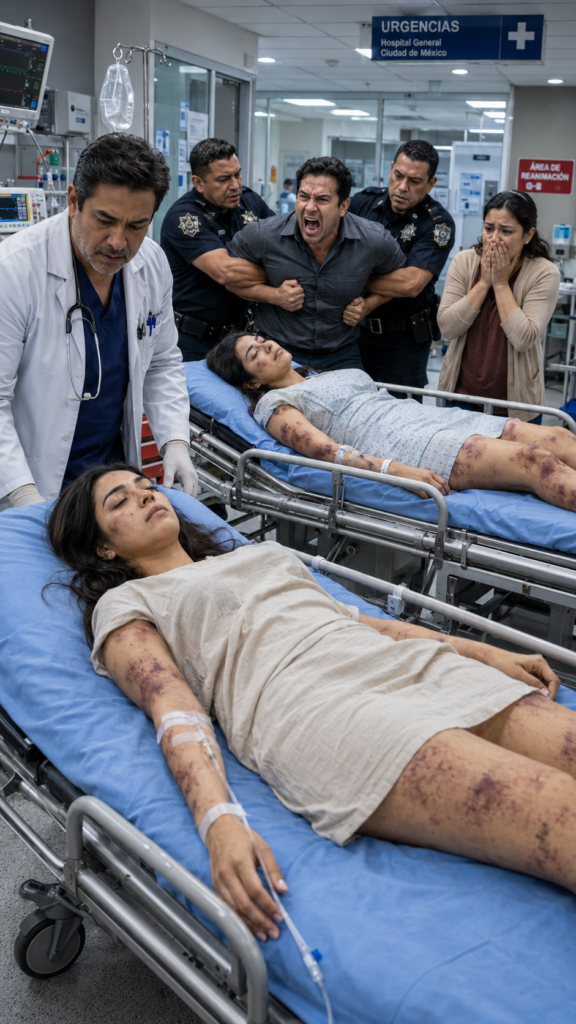
On the night Mariana and Lucía Mendoza arrived at the Civil Hospital of Guadalajara, no one in the emergency room imagined that two stretchers would bring down a lie built over six years.
They were 17 years old.
Identical twins.
Same height, same dark hair, same large eyes.
But that morning, they also had the same bruises on their arms, the same marks on their necks, and the same fear lodged in their throats.
Their stepfather, Esteban Navarro, walked in behind them, calm and collected.
He didn’t look like a worried man.
He looked like a shop owner inspecting damaged goods.
He adjusted the cuffs of his shirt, glanced at the on-duty doctor, and said in a firm voice:
—They fell down the stairs.
Claudia Reyes, the girls' mother, stood by the door.
Her makeup was smudged, but not from crying too much.
More like from sweating fear.
When Doctor Gabriel Salazar looked at her, she repeated almost in a whisper:
—Yes… it was an accident.
Mariana could barely open her eyes.
Lucía was unconscious on the stretcher next to her.
The harsh white lights of the hospital burned Mariana’s vision, but even so, she managed to see something that froze her blood.
Esteban was smiling.
Not much.
Just enough to remind her that he still believed he was untouchable.
For years, that smile had been the last thing Mariana saw before she closed her eyes from pain.
Esteban didn't hit them out of anger.
That was the worst part.
He planned it.
He waited for the neighbors to turn off their lights.
He closed the curtains.
He removed the fake cameras from the living room to pretend nothing was being recorded.
He turned the television up to full volume.
Then he took off his wedding ring and set it on the table, as if he were shedding any obligation to be human.
—Alright, girls —he would say—. Who’s going to learn first?
Lucía always begged.
Mariana always stayed silent.
And that silence drove him mad.
In the private neighborhood of Zapopan, everyone knew Esteban as a respectable businessman.
He donated toys at Christmas.
He paid the community fees.
He greeted the guard with 500 peso bills.
And when someone asked about the twins, he would respond:
—They’re difficult teenagers. You know, just drama.
Claudia never contradicted him.
On the contrary.
She helped paint the cage.
She said her daughters were problematic.
That they fought with each other.
That they made things up.
That they exaggerated.
Little by little, Mariana and Lucía lost neighbors, teachers, friends, and family.
They only had fear.
And a secret.
Three months earlier, Mariana had found an old cell phone belonging to their father, Ricardo Mendoza, hidden in a box of Christmas decorations.
The screen was cracked, but the microphone worked.
Ricardo had been a financial auditor.
Before dying in an alleged accident on his way to Tepatitlán, he left a trust fund for his daughters.
That money would be theirs when they turned 18.
Esteban knew.
Or thought he did.
He believed Claudia could control everything.
And Claudia, whether out of fear or convenience, never told him the truth.
Since she found the phone, Mariana had hidden it every night under a loose floorboard, next to the vent.
The device recorded audio.
And those audios uploaded automatically to a private cloud created by Ricardo years before.
Mariana didn’t know if they would ever serve a purpose.
She just knew that if they died, someone needed to hear the truth.
That morning, Doctor Gabriel examined Mariana.
Then he checked Lucía.
He stared at the identical marks.
He took a deep breath.
—Did both of them fall in exactly the same way?
Esteban crossed his arms.
—Doctor, just treat them. My wife confirmed what happened.
Gabriel looked at Claudia.
—Ma'am, is that true?
Claudia lowered her gaze.
She didn’t respond.
The doctor left the room.
He closed the door from the outside.
He approached the guard in the hallway and said:
—Call 911. Now.
Inside the room, Esteban let out a dry laugh.
—That doctor doesn’t know who he’s messing with.
Then Lucía slowly opened her eyes.
She took Mariana's hand and whispered:
—No, Esteban… you don’t know what we recorded.
PART 2
For the first time in six years, Esteban Navarro stopped smiling.
It was just one second.
But Mariana saw it.
And that second gave her more strength than any promise.
The man who had locked them away, humiliated them, and beaten them for years had just heard a word he never expected:
recorded.
—What did you say? —Esteban asked.
Lucía was breathing heavily.
Her lips were cracked, and a bandage was wrapped around her forehead, but her eyes were wide open.
Wider than ever.
—I said we’re not going to stay silent anymore.
Claudia took a step towards the stretcher.
—Lucía, please...
Lucía turned her face towards her.
—Don’t ask me that again, Mom.
The phrase fell like a stone.
Mariana felt something break inside her chest.
Because for years, Claudia had not been blind.
She had seen the bruises.
She had washed clothes stained with blood.
She had hidden medical excuses.
She had made breakfasts after horrible nights as if nothing had happened.
And she always said the same thing:
—Don’t provoke him.
As if they were guilty of existing.
The sirens arrived before Esteban could invent another story.
Two patrol cars parked in front of the emergency room.
Municipal police officers, a social worker from the DIF, and the hospital's head of security entered.
Esteban raised his hands in false calm.
—Officers, this is a misunderstanding. My stepdaughters have emotional issues. My wife can confirm that.
An officer named Verónica Aguilar looked at Claudia.
—Ma'am, I need you to clearly tell me if your daughters fell down the stairs.
Claudia trembled.
Her fingers clutched tightly around her purse.
Esteban shot her a sidelong glance.
He didn't need to speak.
His threat was complete in his eyes.
—Yes —Claudia said—. They fell.
Lucía let out a small sound, as if something had been ripped away from her.
Mariana closed her eyes.
She had been expecting that betrayal.
Even so, it hurt.
Doctor Gabriel intervened.
—I won’t let them leave here without protection. The injuries are inconsistent with a fall. There are signs of repeated violence, old fractures, and untreated wounds.
Esteban laughed.
—So now you’re a detective?
—No —Gabriel replied—. I’m a doctor. And I can tell the difference between a fall and a beating.
The word beating made Claudia start to cry.
But once again, her tears weren’t for her daughters.
They were for herself.
For her home.
For her marriage.
For the comfortable life she was about to lose.
Officer Verónica approached Mariana.
—Can you talk?
Mariana nodded.
Her hand trembled as she lifted the old cell phone.
—There are audios.
Esteban changed color.
—That phone isn’t yours.
Mariana looked him straight in the eye.
—It belonged to my dad.
Claudia stifled a scream.
The officer took the phone carefully.
Mariana provided the passcode.
The folder was named: “For when someone wants to listen.”
Inside were 194 files.
They weren’t photos.
They weren’t messages.
They were entire nights turned into evidence.
The first audio began with Esteban’s voice:
—Today it’s Mariana’s turn. Lucía, if you move, it’s you next.
Then a thud was heard.
Then a scream.
Then Claudia’s voice from afar:
—Turn it down, the neighbors will hear.
She didn’t say “stop.”
She didn’t say “leave them alone.”
She said the neighbors could hear.
Officer Verónica clenched her jaw.
Doctor Gabriel stood still.
The social worker covered her mouth.
Esteban tried to move forward, but two guards stopped him.
—That’s edited —he shouted—. They’re manipulative girls.
The officer played another file.
Esteban’s voice rang clear:
—When they turn 18, that trust fund is going to be mine. Their father thought he was clever, but no one protects money from the grave.
Mariana saw Claudia close her eyes.
That gesture confirmed something terrible to her.
Her mother knew more.
Much more.
—What did you mean by that? —the officer asked.
Esteban gritted his teeth.
—Nothing.
Lucía spoke weakly:
—My dad died before he married my mom.
—It was an accident —Claudia said too quickly.
Mariana looked at her.
—No one asked you that.
The silence that followed was brutal.
Claudia started to breathe poorly.
Her purse fell to the floor.
Inside were some pills, a rosary, old receipts, and a key with a yellowed tag.
Mariana recognized Ricardo's handwriting.
The tag read: “Tonalá Warehouse.”
Lucía saw it too.
—Mom… what is that?
Claudia bent down to pick it up, but the officer was quicker.
—Don’t touch anything.
Esteban let out a nervous laugh.
—Look at this. They’ve turned it into a novel.
But his voice no longer sounded sure.
Officer Verónica approached Claudia.
—Ma'am, what’s in that warehouse?
Claudia shook her head.
—I don’t know.
Mariana felt a cold rage.
—You always say you don’t know. You didn’t know why we had bruises. You didn’t know why we cried. You didn’t know why Dad died. How convenient, right?
Claudia broke down.
—I was scared!
Lucía replied almost weakly:
—We were 11 years old when it all started.
That phrase was worse than a scream.
Even Esteban looked down.
Just for an instant.
Then he attacked again.
—Your mother isn’t a victim. Tell her to recount what happened at the workshop.
Claudia covered her ears.
—Shut up.
—Tell them —Esteban insisted—. Tell them what you found after Ricardo’s accident.
Mariana felt the world move beneath her feet.
Ricardo Mendoza had died six years ago.
They were told it was a mechanical failure.
A wet road.
A car that lost control.
A tragedy.
But Ricardo checked his car every month.
He didn’t drive tired.
He didn’t drink.
He wasn’t careless.
—What workshop? —Mariana asked.
Claudia cried with a painful, desperate sorrow.
—Ricardo discovered Esteban’s debts.
Esteban glared at her with hatred.
—Don’t continue.
But it was too late.
Claudia had spent years silent.
And that night, finally, the silence began to rot in her own mouth.
—Your dad discovered that Esteban was gambling. That he owed money. That he approached me out of interest. That he inquired about your trust fund.
Lucía could barely breathe.
—Did you already know him before Dad died?
Claudia couldn’t look at her.
—Yes.
Mariana understood before she said it.
She felt disgust.
She felt secondhand shame.
She felt the image of her mother turning to dust.
—Did you cheat on Dad with him?
Claudia cried louder.
No answer was needed.
—Ricardo was going to report him —Claudia continued—. He was also going to change documents to protect your money. They argued. Esteban threatened him. And three days later… the accident happened.
Officer Verónica asked:
—Did you suspect it wasn’t an accident?
Claudia looked at the key.
—I found a receipt.
Mariana felt her throat tighten.
—What receipt?
—A cash payment to a workshop in Tonalá. It said “brake adjustment.” The date was one day before Ricardo’s death.
The entire room fell silent.
Even the sounds of the hospital seemed to fade.
Lucía began to cry silently.
Mariana couldn’t.
There were moments when the pain was so great that it no longer came out as tears.
It came out as ice.
—And you hid it? —Mariana asked.
Claudia covered her face.
—Esteban said that if I spoke, you would disappear with me. I was terrified.
—You left us with him —Lucía said—. You let us sleep under the same roof as the man who could have killed Dad.
Claudia fell to her knees.
—Forgive me.
Mariana looked at her as if she were a stranger.
—Don’t ask for forgiveness here. Ask it from Dad.
The officer ordered Esteban to be arrested.
When the police put handcuffs on him, he resisted.
—She knew too! I’m not going alone!
—That will be determined by the Prosecutor’s Office —Verónica replied.
—She helped me cover it up!
Claudia didn’t deny it.
And that was the second death of Mariana and Lucía in one night.
The first was understanding that perhaps their father didn’t die by accident.
The second was accepting that their mother chose to save herself before saving them.
Hours later, personnel from the Jalisco Prosecutor's Office arrived.
They secured the audios.
They took statements.
They requested to inspect the Tonalá warehouse.
And they sought to locate the only relative Ricardo had left as legal contact for the trust: Javier Mendoza, his brother.
Javier lived in Houston.
For years he had sent letters, gifts, messages, and money for the twins.
Nothing arrived.
Claudia blocked calls.
Esteban returned packages.
He told the girls their uncle had forgotten them.
When Mariana heard his name, she asked to call him.
The phone rang twice.
—Hello?
Mariana tried to speak, but her voice broke.
—Uncle Javier… it’s Mariana.
There was silence.
Then a sob.
—Mariana? My girl? Where are you? Are you alive?
Lucía began to cry.
For the first time in years, she wasn’t crying from fear.
She was crying because someone had looked for them all this time.
—We’re in the hospital —Mariana said—. We need help.
Javier took a flight that same night.
He arrived the next day with an old folder, deep dark circles under his eyes, and a fury that didn’t need shouting.
He hugged his nieces carefully, as if they were made of glass.
Then he spoke with the Prosecutor’s Office.
He never believed the accident story.
He had hired a private expert.
He had checked bank transactions.
He had found strange payments made from Claudia’s account.
But without witnesses, without access to the girls, and with Claudia defending Esteban, no one wanted to reopen the case.
The Tonalá warehouse changed everything.
Inside a metal filing cabinet was what Ricardo had hidden before he died:
copies of emails,
bank statements,
the workshop receipt,
photos of the car,
a USB drive,
and a letter for his daughters.
The letter had only six paragraphs.
But each word felt like it was written with an open heart.
“Mariana and Lucía, if you ever read this, I want you to know that my entire life had meaning because you existed. If anything happens to me, don’t believe anyone who asks you to keep silent for love. True love never needs a girl to be quiet to survive.”
Lucía fell apart.
Mariana hugged the letter to her chest.
It wasn’t justice yet.
But it was their dad coming back for them from the past.
With that evidence, Esteban was charged with aggravated domestic violence, injuries, illegal deprivation of liberty, attempted homicide, and probable participation in the death of Ricardo Mendoza.
Claudia was also investigated for concealment, omission of care, and domestic violence.
When she requested to see her daughters, Javier didn’t decide for them.
The social worker didn’t either.
The judge didn’t either.
For the first time, someone asked them what they wanted.
Lucía took time to respond.
Mariana didn’t.
—We don’t want to see her.
Claudia heard the answer from the hallway.
She collapsed against the wall.
She said she loved them.
That she was sorry.
That fear had turned her into a coward.
But Mariana only remembered the nights when her mother turned the volume of the television up to drown out their screams.
Months later, the twins turned 18.
The trust was protected in their name.
Javier moved temporarily to Guadalajara to support them.
Lucía started therapy and returned to school.
Mariana decided to enter criminalistics.
Not because she wanted to cling to pain.
But because she understood something no one should learn so young:
sometimes the truth doesn’t appear on its own.
Sometimes you have to hide a cell phone under a floorboard, survive one more night, and wait for someone to finally listen.





