PART 1
Mariana returned to Ecatepec on a Sunday afternoon, dragging an old suitcase, two bags of clothes, and hands raw from the bleach used in the hotels of Cancún.
For five years, she had sent money every two weeks to "save" her mother's house.
That’s what doña Raquel told her over the phone.
—Mija, the bank is going to leave us on the street. Don’t abandon us.
And Mariana never abandoned.
She worked cleaning bathrooms, making beds, washing other people's sheets, and eating cold tortas at the bus stop. While her colleagues went out to the boardwalk, she stood in line at the bank to deposit every last peso.
So when she opened the door to the house and smelled the pozole boiling in the kitchen, she thought she was finally going to rest.
But no one ran to hug her.
Her mom didn’t look her in the eye.
Her dad, don Efraín, hid some keys under the tablecloth.
And her sister Sandra, with long burgundy nails and new bracelets, smiled as if Mariana were an uncomfortable guest.
—Sit there, Mari —Sandra said, pointing to a plastic chair by the door.
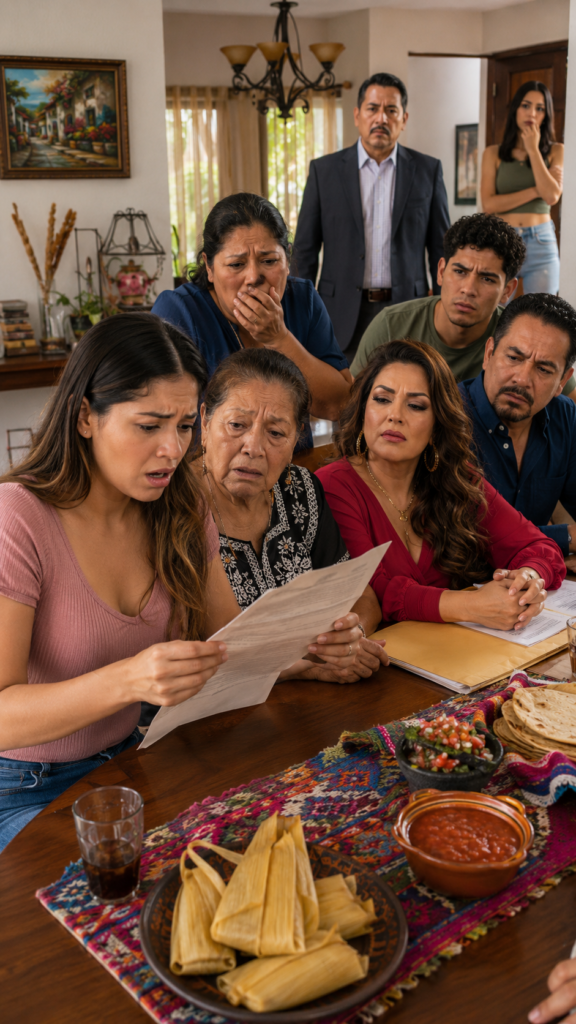
The big table was occupied by everyone: her brother Iván, her niece Renata, her dad, her mom, and even a man in a cheap suit she didn’t know.
—And my place? —Mariana asked.
Sandra let out a giggle.
—Oh, don’t start. We come in peace today.
In peace.
With Mariana’s money they bought the huge screen for the living room.
With her money they paid for Renata’s 15th birthday party.
With her money they fixed the roof, put down new flooring, and bought a used truck for Iván.
But that Sunday, they all looked at her as if she had come to beg.
—We need to talk —doña Raquel said, not lifting her gaze from her plate.
Sandra pulled out a blue folder and placed it on the plastic tablecloth, next to the limes and tortillas.
—Sign here. It’s just to make it clear that you won’t claim anything.
Mariana opened the folder.
It wasn’t a simple sheet.
It was a waiver of rights over the house, the quesadilla shop that had belonged to her grandmother, the truck, and an account where she had deposited money for five years.
Her name appeared at the bottom.
And a signature already prepared.
Mariana felt the ground slip away from under her.
—Who did this?
Iván shrugged.
—Don’t make a scene, dude. No one forced you to send money.
Mariana looked at her mom.
—Is that what you think?
Doña Raquel pressed her lips together.
—You left. Sandra stayed.
—I left to support you.
Sandra stood up slowly.
—The house is in my name because I have a family. You are alone.
The phrase landed like a slap.
At that moment, Renata came down the stairs with her cell phone in hand.
—Mom, the lawyer is here.
The man in the cheap suit opened his briefcase.
—Miss Mariana, just sign. After that, everything will be quiet.
But before she could touch the pen, someone knocked on the door.
It was doña Meche, the lifelong neighbor, wearing an apron, tears in her eyes, and a grocery bag tied with raffia.
Doña Raquel turned pale.
—You didn’t have to come.
Doña Meche entered without asking for permission and grabbed Mariana by the arm.
—Mijita, don’t sign anything. Your grandmother left you something before she died.
Sandra shouted:
—Shut up, nosy old woman!
But doña Meche had already pulled out some photos, old receipts, a medal of the Virgin of Guadalupe, and a birth certificate folded in four.
Mariana opened it.
She read her name.
Then she read her mother’s name.
And it wasn’t doña Raquel’s.
PART 2
The pozole kept boiling in the kitchen, but no one in the living room was breathing.
Mariana looked at the paper again, thinking she had read it wrong.
Mother's name: Teresa Aguilar Mendoza.
It didn’t say Raquel Méndez.
It didn’t say the woman who had scolded her, used her, and called her “daughter” only when she needed money.
—Who is Teresa? —Mariana asked, her voice breaking.
Doña Raquel closed her eyes.
She didn’t seem sad.
She seemed tired of carrying an old lie.
Sandra tried to snatch the certificate away.
—Give that to me, Mariana. It has nothing to do with the house.
Mariana held it to her chest.
—It has my name. Of course it has to do with it.
Doña Meche stood by her side.
—Teresa was your real mom, mijita.
The silence was worse than a scream.
Don Efraín lowered his head.
Iván stopped laughing.
Sandra gritted her teeth.
—My mom raised her. That’s what matters.
Doña Meche looked at her with disdain.
—Raising her wasn’t the same as charging her life.
The fake lawyer cleared his throat.
—Ladies, this is a family matter. The young lady just needs to sign a simple waiver.
Mariana turned to him.
—Do you have a professional ID?
The man froze.
—That’s not relevant.
—Of course it is —said a voice from the door.
A woman in a gray suit entered, holding a black folder under her arm. Behind her were two municipal police officers and a man with an ID badge from the Public Registry.
—I am lawyer Valeria Montes —she said—. Attorney for the succession of Teresa Aguilar and Mrs. Carmen Mendoza, Mariana’s grandmother.
Doña Raquel jumped up.
—Carmen was crazy!
The lawyer placed a certified copy on the table.
—Not so crazy as to forget to register documents.
Mariana felt a knot in her throat.
Doña Meche opened a yellow notebook. It belonged to grandmother Carmen. The handwriting trembled, but it was clear.
“Mariana must not sign anything. The house in Ecatepec is in the name of Teresa Aguilar. The shop too. Teresa left her daughter Mariana as the sole heir. Raquel and Efraín were only supposed to care for her until she turned 18. If Mariana went far away, it was not out of selfishness. They pushed her to keep living off her.”
Mariana raised her gaze.
—So the house never had a debt?
No one answered.
Only the pot bubbling in the kitchen could be heard.
Lawyer Valeria opened another folder.
—There is a certificate of freedom from encumbrance. There is no active mortgage. There is also no notice of seizure. For five years, Mariana deposited money into an account managed by Raquel Méndez. That money was used for event payments, furniture, credit card bills, and transfers to Iván.
Renata, the 15-year-old niece, stepped down a stair.
—Did my party come from there?
Sandra shot her a glare.
—Go back to your room.
—Did my party come from my aunt’s money? —the girl repeated.
No one answered.
Renata began to cry silently.
Mariana hurt to see her like that.
Not because Sandra deserved compassion, but because the girl had stolen nothing. She had merely danced a waltz over someone else’s money without knowing where the music came from.
The lawyer took the blue folder Sandra wanted to have signed.
—This is not just a waiver. Here they also attempt to cede the shop, the truck, and a savings account. Moreover, Mariana’s signature already appears printed. Who forged this?
The fake lawyer sweated.
—I was given the documents.
—Who?
Iván looked at Sandra.
Sandra looked at doña Raquel.
Doña Raquel looked at don Efraín.
And don Efraín looked at the keys hidden under the tablecloth.
There was the entire family.
Not as a family.
As accomplices waiting for one to fall first.
Doña Meche pulled out a small recorder.
—Now we need to hear what Mrs. Carmen said.
Doña Raquel shouted:
—No!
One of the police officers stepped forward.
—Sit down, ma’am.
Doña Meche pressed the button.
Grandmother Carmen’s voice filled the living room.
“Mariana, my girl. I’m sorry for not telling you the truth before. Your mom Teresa died thinking you would be protected. She left the house, the shop, and an account for you. Raquel promised to raise you as a daughter, but soon I understood she had taken you as debt.”
Mariana covered her mouth with a hand.
The voice continued:
“If one day you find yourself treated as a guest in your own house, don’t sign. If they serve you food to soften the betrayal, don’t eat. That food is not love. It’s bait.”
Mariana walked into the kitchen.
Doña Raquel followed her with her gaze.
—What are you doing?
Mariana turned off the flame.
The pozole stopped boiling.
—I’m not going to swallow anything from you anymore.
The police asked for identifications.
The fake lawyer tried to escape through the patio, but they stopped him next to the garbage bins. In his briefcase, they found copies of Mariana’s ID, signed blank papers, and a contract prepared to sell the shop to a lender of Iván’s.
Don Efraín stood up trembling.
He pulled out the keys from under the table and offered them.
—Mariana… daughter…
She didn’t take them.
—Give them to the lawyer. I want an inventory.
He broke down.
Maybe he expected screams.
Maybe he expected tears.
Maybe he expected Mariana to still be that girl who asked for permission to sit in a house that had always belonged to her.
But that girl was gone.
Lawyer Valeria requested measures to prevent them from selling, renting, or mortgaging the house and the shop. She also initiated a complaint for forgery, property fraud, breach of trust, and identity theft.
Doña Raquel clung to the chair.
—You don’t know how to maintain a house!
Mariana looked directly at her.
—I don’t know how to maintain parasites.
And then she called her by her name.
—Raquel.
Not “mom.”
Everyone felt it.
As if someone had closed a door forever.
The following months turned into a war of paperwork.
Public Registry.
Bank.
CONDUSEF.
Public Ministry.
Family Court.
In every office, there was a missing copy, a seal, an appointment, or a patience Mariana no longer had.
She learned to carry a folder with dividers: transfers from Cancún, receipts from the hotel where she worked, account statements, birth certificate, deed, certificate of freedom from encumbrance, photos of the shop, and audios of her grandmother.
She also learned to say without trembling:
—I don’t recognize that signature.
Sandra tried to stay in the house using Renata as a pretext.
Mariana didn’t throw her out overnight. The law did what the family never did: set a date, limit, and consequence.
Iván ended up summoned for credits opened in Mariana’s name. The fake lawyer turned out to be an agent without an ID, famous for "fixing" houses in neighborhoods where people trusted their buddy more than a notary.
Don Efraín spoke at the end.
He handed over a box hidden for years in the empty water tank on the rooftop.
Inside was a letter from Teresa.
Mariana’s true mother.
It read:
“If my daughter grows up without me, tell her that her house is not debt. It’s roots. Tell her that no one has the right to make her feel like a guest in what belongs to her.”
Mariana cried with that letter in her hands.
Not like she cried in Cancún, locked in the staff bathroom so no one would see her broken.
She cried like someone who finally understands where her pain comes from.
Three months later, she opened the shop.
She painted it light yellow, set up simple tables, and put up a new sign:
“Antojitos Teresa y Mariana.”
She sold quesadillas, sopes, pambazos, pot coffee, and pozole on Thursdays.
Doña Meche was the first customer.
She ordered a bean sope with red sauce and left the medal of the Virgin next to the cash register.
—Your mom would be proud, mijita.
It still cost her to imagine Teresa as a mom.
But that phrase warmed her chest.
One afternoon, Renata arrived in her high school uniform.
—Aunt, can I work here? I want to pay you back for my party.
Mariana looked at her for a long time.
She wanted to hate her.
She couldn’t.
She gave her a blue apron.
—Here, we work with honesty. We’ll see about the rest later.
Sandra appeared furious.
—You’re not going to turn my daughter against me!
Mariana wiped the counter with a cloth.
—No, Sandra. You turned her against the truth.
Sandra insulted her on the sidewalk. She said blood calls, that family forgives, that Mariana was ungrateful.
Then she made a mistake.
She pulled a key from her bag.
—I have a copy. This shop is mine too.
Mariana looked at the camera installed above the door.
—Thank you.
Sandra blinked.
—Why?
A patrol rounded the corner.
Behind it came lawyer Valeria with her black folder.
Sandra dropped the key as if it burned.
But it was already recorded.
She was summoned for attempting to access a protected property. Iván, cornered, declared that Raquel had ordered the forgery of Mariana’s signature long before she returned from Cancún.
Raquel didn’t show up that afternoon.
She arrived months later.
The house was already recognized in Mariana’s name. They had changed locks, painted the living room, and removed the huge screen bought with her deposits. On one wall, Mariana hung photos of Teresa and her grandmother Carmen.
Raquel knocked on the door near midnight.
The camera showed her tired face, a grocery bag, and another blue folder stained with pozole.
—Mari, let me in. I’m your mom.
Mariana stood still.
The girl inside her wanted to open.
The woman who cleaned bathrooms in Cancún wanted to ask if she had eaten.
But the owner of the house didn’t move.
—My mom’s name was Teresa.
Raquel tightened the bag.
—I raised you.
—You charged me.
Raquel’s face changed.
—You’re going to be alone.
Mariana looked behind her.
The deed on the table.
The keys to the shop.
The letter from Teresa framed.
The medal of the Virgin.
Renata’s blue apron hanging by the door.
—No. I’m going to keep what’s mine.
Then Raquel opened the folder.
—You can still sign. We can still fix this.
But the document she showed wasn’t a waiver.
It was worse.
It was a request to collect a life insurance policy Teresa had left in Mariana’s name, accompanied by a forged birth certificate trying to pass her off as dead for years.
Mariana felt ice in her spine.
They hadn’t just tried to take her house.
They had tried to bury her in paperwork.
She opened the door just a crack, enough for the camera to record.
—Thank you, Raquel.
—Why? —she asked.
Red and blue lights illuminated the street.
Lawyer Valeria appeared behind the police officers.
—Because you brought the missing document —Mariana said.
Raquel screamed that she was her mother, that she did everything for the family, that a daughter doesn’t call the cops.
Mariana closed the door.
She went to the kitchen.
The pot coffee was still hot.
She poured herself a cup.
Outside, Raquel repeated her name as if she still belonged to her.
But inside, under the portrait of Teresa, Mariana understood the full truth.
She hadn’t come back to reclaim walls.
She had returned to stop paying rent on a lie.
And that night, for the first time, the plastic chair remained empty.
Because the visitor was no longer her.