PART 1
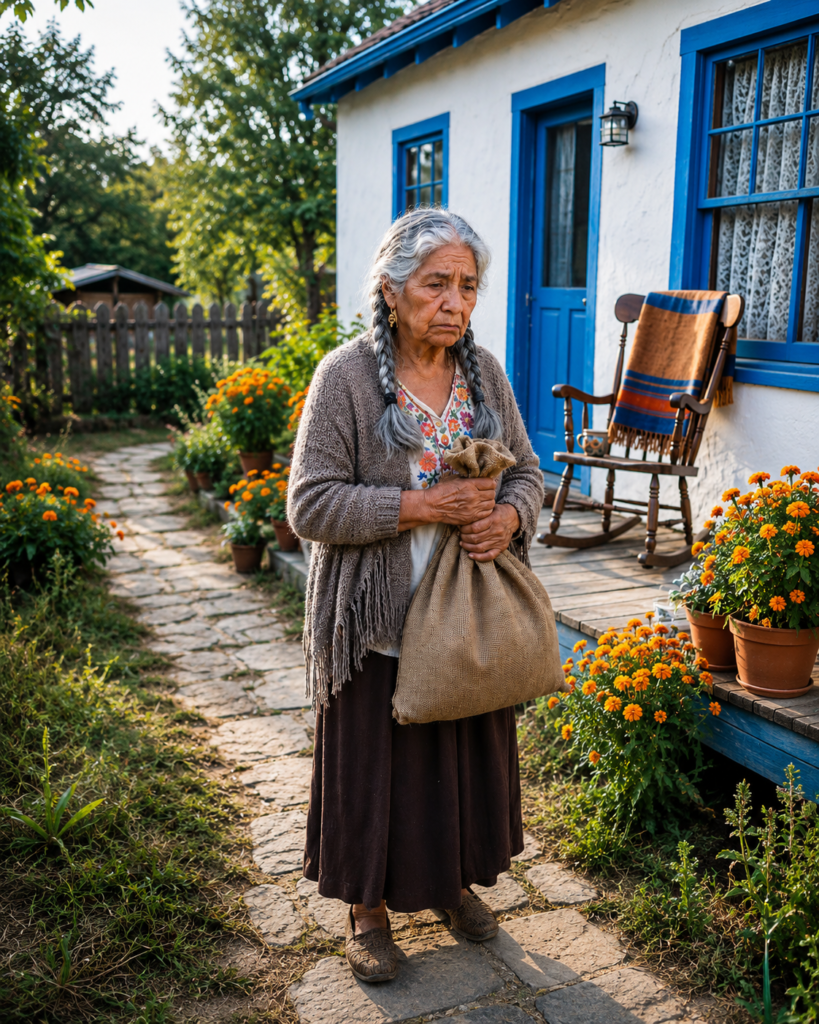
Carmen Villaseñor stepped out of the Puente Grande prison on a gray Thursday, 68 years old, a grocery bag in hand, her eyes betraying a woman who had learned never to ask anything of anyone.
She had spent 30 years incarcerated for a crime she swore, until her voice ran dry, she did not commit.
In San Pedro Tlaquepaque, everyone remembered her name, but nobody spoke it with respect. To the town, Carmen was "the woman who killed her husband," the fierce one, the jealous one, the one who never knew how to stay quiet.
Her husband, Mateo Robles, had turned up dead one rainy night inside their home, near the San Martín de las Flores neighborhood. He was found sprawled next to the washbasin, his shirt soaked in blood, and the little medal of San Judas Tadeo ripped from his neck.
That medal never showed up again.
Carmen insisted from the very first interrogation:
—I didn’t kill Mateo.
But the people wanted a culprit, and a poor, strong, outspoken woman fit the bill perfectly.
The main witness was Don Hilario Méndez, a neighbor who claimed to have seen her running out of the house with blood on her hands. Then a knife appeared hidden among her flower pots. Everything seemed so clear, so convenient, so well orchestrated.
The judge didn’t hesitate.
The town didn’t either.
For 30 years, Carmen learned to walk close to the wall, to eat quickly, to sleep without taking off her shoes. She grew old behind bars, but never let them tear away a phrase:
—Mateo knows it wasn’t me.
When they finally reviewed the case and freed her, a young woman with swollen eyes awaited her outside the prison.
—Doña Carmen… I’m Lucía, Hilario’s daughter.
Carmen stopped as if she’d seen a ghost.
—Your father buried me alive.
Lucía lowered her head.
—I know. He died two weeks ago. Before he passed, he asked me to come for you.
Carmen wanted to spit her rage in her face, but the girl pulled out an old wooden box, tied with twine.
—He left you this. He said it was yours.
Inside were letters.
Many.
All addressed to Carmen. Some dated 25 years ago, others 18, others 9. None had been sent.
Carmen opened one with her rough hands.
The first line read: "Forgive me, for I lied."
The second line contained a name that froze her blood:
Rafael Castañeda.
Rafael, Mateo’s compadre.
The man who had carried the coffin.
The one who cried in front of everyone.
The one who said at the trial that Carmen had always had a "dangerous character."
Lucía drove her back to the town. Along the way, she kept glancing at the car mirrors, as if someone were following them.
Carmen’s house still stood.
Older, yes, but clean. The bougainvilleas still climbed the wall. The door had been freshly painted. On the windowsill was a pot of basil, just like when Mateo was alive.
Carmen entered slowly.
The smell of Zote soap, cinnamon, and damp earth pierced her chest. She touched the table where Mateo used to leave the hot tortillas on Sundays. Then she saw his photo on the wall, dust-free, with a burnt candle beneath it.
—Who took care of my house? —she asked, without turning around.
Lucía swallowed hard.
—My dad. He never let them sell it.
Carmen opened another letter.
Hilario confessed that night he didn’t see Carmen run. He saw Rafael enter through the back door. He saw Mateo argue with him. He saw too much… and was afraid.
Then someone banged on the gate.
Carmen peeked out.
Rafael stood outside, wearing a fine hat, clean boots, and a black truck parked on the street.
Beside him, a young man held an old medal between his fingers.
It was Mateo’s medal.
And Rafael smiled as if he had come to collect a debt.
PART 2
—Open up, Carmencita —Rafael called from the street—. After 30 years, you don’t greet family like this.
Carmen felt her heart pounding against her ribs.
This wasn’t a similar medal. It was that one. The same one. It had a scratch on the bottom because Mateo had once scraped it against the griddle while playing with it to make her laugh.
Carmen remembered that sound.
Lucía abruptly closed the curtain.
—We have to go out the back.
—I’m not going to flee my house again.
—My dad said you’d say that.
Carmen turned slowly.
—What else did your father say?
Lucía opened the box in desperation. She pulled out a blue handkerchief and, inside, a USB drive.
—He said Rafael would come as soon as he knew you returned. He said he wouldn’t let you speak. And he said there was something in here that he had been searching for years and never found.
Outside, the banging on the gate returned.
Once.
Twice.
Three times.
—Don’t hide from me, Carmen —Rafael insisted—. I just want to talk. Don’t make a scene; you’ve made enough already.
That calm voice terrified her more than any scream.
Lucía pulled Carmen toward the kitchen. She moved an old wardrobe next to the washbasin and opened a hidden little door leading to Doña Chayo’s yard, the neighbor from all their lives.
Doña Chayo was waiting for them, wearing a shawl and mismatched sandals.
—Come on, comadre. Don’t act dignified now. Just walk fast, even if it’s out of pure anger.
Carmen looked at her house.
The table.
The photo.
The bougainvilleas.
She had waited 30 years to return, and once again, she had to sneak out like a criminal.
But she hadn’t survived prison to surrender to the man who had stolen her life.
They crossed the yard just as they heard glass shattering.
Rafael had entered.
The house that Carmen had dreamed of for 30 years was being invaded once again.
Lucía drove to an old parish in Tonalá. She didn’t speak until they reached a narrow street filled with corn, sweet bread, and candles.
Then she released the truth:
—My dad didn’t lie for money.
Carmen looked out the window.
—Then why?
Lucía tightened her grip on the wheel.
—Rafael threatened me with him. I was six months old. He showed him a photo of me sleeping in my crib and told him that if he spoke, they would find me in a ditch.
Carmen closed her eyes.
For 30 years, she had hated Hilario. She imagined him cowardly, sold out, miserable. And yes, maybe he was. But imagining a baby used as a threat stirred her anger in a different way.
—He could have spoken later —Carmen said.
—Yes.
—He could have sent me a letter.
—Yes.
—He could have gone to another judge.
Lucía began to cry.
—Yes, Doña Carmen. And he died knowing that.
The parish smelled of wax, dampness, and wilted flowers. Father Tomás received them pale, as if he had seen a dead person return.
—Carmen…
—Don’t talk to me like we’re acquaintances. Everyone knew me when it was convenient for them.
The priest lowered his head.
He took them to an office behind the sacristy. He locked the door, opened a metal drawer, and pulled out an old recorder, several yellow folders, and a photograph.
In the photo, Mateo smiled next to Rafael.
The medal gleamed on Mateo’s chest.
—Hilario left this before he died —Father Tomás said—. He asked me to give it to you when you were released.
Carmen looked at him with a calm that was frightening.
—And why didn’t you give it to me earlier?
The priest took off his glasses.
—Because Rafael controls businesses, police, land, notaries. Because I was afraid. Because I’m guilty too.
Carmen let out a dry laugh.
—How lovely. Everyone was afraid, and the only one who paid was me.
Lucía connected the USB drive to an old laptop.
Hilario’s voice sounded weak, raspy, full of guilt.
"Doña Carmen, if you’re listening to this, I don’t ask for forgiveness because my life isn’t long enough. I lied. You didn’t run out that night. You were unconscious when they arrived. I saw Rafael enter through the back. Mateo was still alive."
Carmen gripped the desk.
The voice continued:
"They were arguing about the land by the stream. Mateo discovered Rafael was forging signatures of ejidatarios to sell land that wasn’t his. Mateo said he was going to report him in Guadalajara. Rafael pulled out a gun. I was behind the fence. I heard the shot."
Lucía covered her mouth.
Carmen didn’t cry.
What came from her throat was an old groan, as if a part of her had been buried with Mateo all those years.
The recording went on:
"Rafael saw me. He told me that if I spoke, my daughter would pay. Then he took Mateo’s medal. He said it was his insurance. That if anyone opened their mouth, that medal would appear wherever he wanted to plant another blame."
Carmen understood.
Rafael didn’t keep the medal for memory.
He kept it as a trophy.
As a threat.
As a mockery.
At that moment, Father Tomás’s cell phone rang. He answered, listened for a few seconds, and turned pale.
—Rafael is saying in the town that you returned to steal your own house. He’s already called the municipal police.
Carmen smiled without joy.
—Thirty years as a murderer. Now a thief. What a lack of imagination, really.
Lucía took her hand.
—Let’s go to the Prosecutor’s Office.
—That’s not enough —the father said—. With old evidence, Rafael will use his influence. They need you to speak now. To out yourself in front of witnesses.
Carmen looked toward the courtyard. Several women were arranging chairs for a rosary. A child was selling tamales outside. Life continued as usual, just as it had when they locked her up.
Then Carmen said:
—Let him come to flaunt his truth.
Lucía shook her head.
—No, Doña Carmen. It’s dangerous.
Carmen looked at her firmly.
—Mija, I spent 30 years surrounded by women screaming in their dreams. Danger doesn’t scare me anymore. What scares me is dying without Mateo hearing my name clear.
The plan was born over reheated coffee, hard sweet bread, and a shame that finally decided to walk.
The father would call Rafael. He’d tell him that Carmen was tired, confused, and willing to sell the house if they gave her money to move to Guadalajara. The meeting would be in the courtyard, where the parish had new cameras.
Lucía would record from behind a column.
Doña Chayo would alert a local journalist investigating cases of innocent prisoners.
Father Tomás, for the first time in 30 years, would not hide.
Rafael arrived at dusk.
He wore a white shirt, an expensive hat, and that smile of a man who thinks the town belongs to him. Two men accompanied him. One carried a black folder. The other held Mateo’s medal tangled between his fingers, as if it were just any keychain.
Carmen sat on a bench, her grocery bag at her feet.
She looked like a tired old woman.
That’s what she wanted them to see.
—Carmencita —Rafael said—, it’s a pleasure to see you free.
—Don’t call me Carmencita.
He sighed, pretending to feel sorry.
—You’re still just as resentful.
—Thirty years help.
Rafael sat beside her.
—Look, I’m not here to fight. I’m here to help you. Your house no longer suits you. Sign the sale, and I’ll get you a decent little room. You’ll leave quietly, and no one will bother you.
Carmen looked at her hands.
Wrinkled.
Stained.
Free.
—And what if I don’t sign?
Rafael stopped smiling.
—Then the town will remember what you are.
—A murderer?
—That’s what a judge said.
—A judge also swallows lies when they’re served with a suit, hat, and money.
Rafael leaned toward her.
—It doesn’t suit you to speak that way.
—Like it didn’t suit Mateo?
Carmen felt the air stop.
Not with surprise.
But with confirmation.
—Where didn’t it suit him?
Rafael looked around, annoyed. Men like him keep secrets for years, until someone makes them feel small.
—In my business. In the land deals. Your husband thought he could be righteous and wanted to report me.
—So you killed him.
Rafael clenched his jaw.
—I didn’t want to. He came at me. It was an accident.
Carmen inhaled deeply.
Mateo.
Finally.
The truth had a voice outside her head.
—And you blamed me.
Rafael let out a low laugh.
—You were easy. A poor woman, without children, fierce, outspoken. Everyone wanted to believe it.
That phrase hurt more than a bullet.
Because it was true.
They didn’t convict her just for false evidence. They convicted her because it was comfortable for the town to believe that a strong woman was dangerous.
Then a voice rang out from the entrance.
—And now everyone has heard it too.
The journalist was recording with his phone held high. Behind him, two state agents entered. Not municipal. Not Rafael’s friends.
Rafael shot up abruptly.
—This is worthless.
Lucía stepped out from behind the column.
—We also have my dad’s confession.
Father Tomás raised the USB drive.
—And I will testify.
Rafael looked at the priest with hatred.
—Coward old man.
The priest lowered his head.
—Yes. But not anymore.
The man holding the medal tried to run. An agent stopped him at the stairs. The medal fell to the ground and bounced off the stone.
Carmen walked toward it.
Her knees hurt.
Her back ached.
The 30 years hurt.
But she bent down, picked it up, and pressed it against her chest.
She didn’t cry in front of Rafael.
As they cuffed him, he spat at her with rage:
—You won’t recover what you lost.
Carmen looked at him fixedly.
—No. But you’re going to lose what you stole.
The news spread before midnight.
The murderer was no longer a murderer.
The respectable man was no longer respectable.
Neighbors who once closed their windows now wanted to embrace her. Some cried. Others asked for forgiveness. Carmen didn’t let everyone approach. She wasn’t obligated to receive regrets as if they were flowers.
Doña Chayo brought her birria, hot tortillas, and coffee.
—Eat, comadre.
—I’m not hungry.
—Freedom on an empty stomach makes one dizzy.
Carmen accepted a tortilla.
Lucía sat across from her, with red eyes.
—I know it’s not enough.
—No.
—I know my dad should have spoken sooner.
—Yes.
—I know this house wasn’t ours to take care of.
Carmen looked around.
The clean curtains.
The lively pots.
Mateo’s dust-free photo.
For 30 years, she thought the world had erased her. But someone, even if out of guilt, had watered her flowers.
—Did you change the bougainvilleas? —she asked.
Lucía nodded.
—Every Friday. My dad said you liked them.
Carmen looked at the medal on the table.
—I don’t know what I like anymore.
Lucía broke down in tears.
—I’ll leave tomorrow if you want.
Carmen sighed.
—Don’t go. This house has had too many ghosts. A living one doesn’t get in the way.
The following months weren’t pretty.
They were hearings, lawyers, reporters, hypocritical neighbors, and nights when Carmen woke up searching for bars. Sometimes she hid bread under the pillow. Sometimes she ate quickly, as if someone would take her plate away.
Freedom also scares when one learns to breathe confined.
Rafael was prosecuted. His lawyers tried to argue that the recording was old, that Carmen wanted money, that it was all a setup. But there were too many pieces: the medal, the land documents, Hilario’s letters, the confession from the courtyard, and the witnesses who finally found the courage to speak.
The day a judge officially recognized her innocence, Carmen didn’t scream.
She didn’t raise her arms.
She simply took Mateo’s medal, placed it on the table, and murmured:
—You heard, old man. Late, but you heard.
Later, she bought a lemon snow cone with salt in the center of Guadalajara. The first in 30 years.
It tasted like rage.
Like childhood.
Like life.
A year later, her house stopped being "the house of crime." Lucía set up a small sewing workshop in the living room. Women from the neighborhood came to mend clothes but also silences.
Carmen sat in the rocking chair with the medal around her neck.
When someone stopped at the gate and said:
—Doña Carmen, I’m sorry for having believed.
She always replied the same:
—Don’t ask me for forgiveness with your mouth. Believe the next woman before burying her alive.
On the Day of the Dead, Lucía accompanied her to the cemetery. They cleaned Mateo’s grave, placed cempasúchil, candles, and a jar of coffee.
Carmen touched the tombstone.
—I didn’t kill you, old man. And now everyone knows it.
There was no miracle.
No voice from the sky.
But the wind moved the flowers as if someone, at last, breathed in peace.
That night, Carmen returned to her house. She looked at the door where 30 years before she had walked out shackled, the town treating her like she was dead.
Now she returned old, tired, broken in ways no one could see.
But standing.
Lucía opened the door.
—Are you coming in, Doña Carmen?
She clutched Mateo’s medal and gazed at the lively house.
—Yes —she said—. It’s time to enter as the owner.





