PART 1
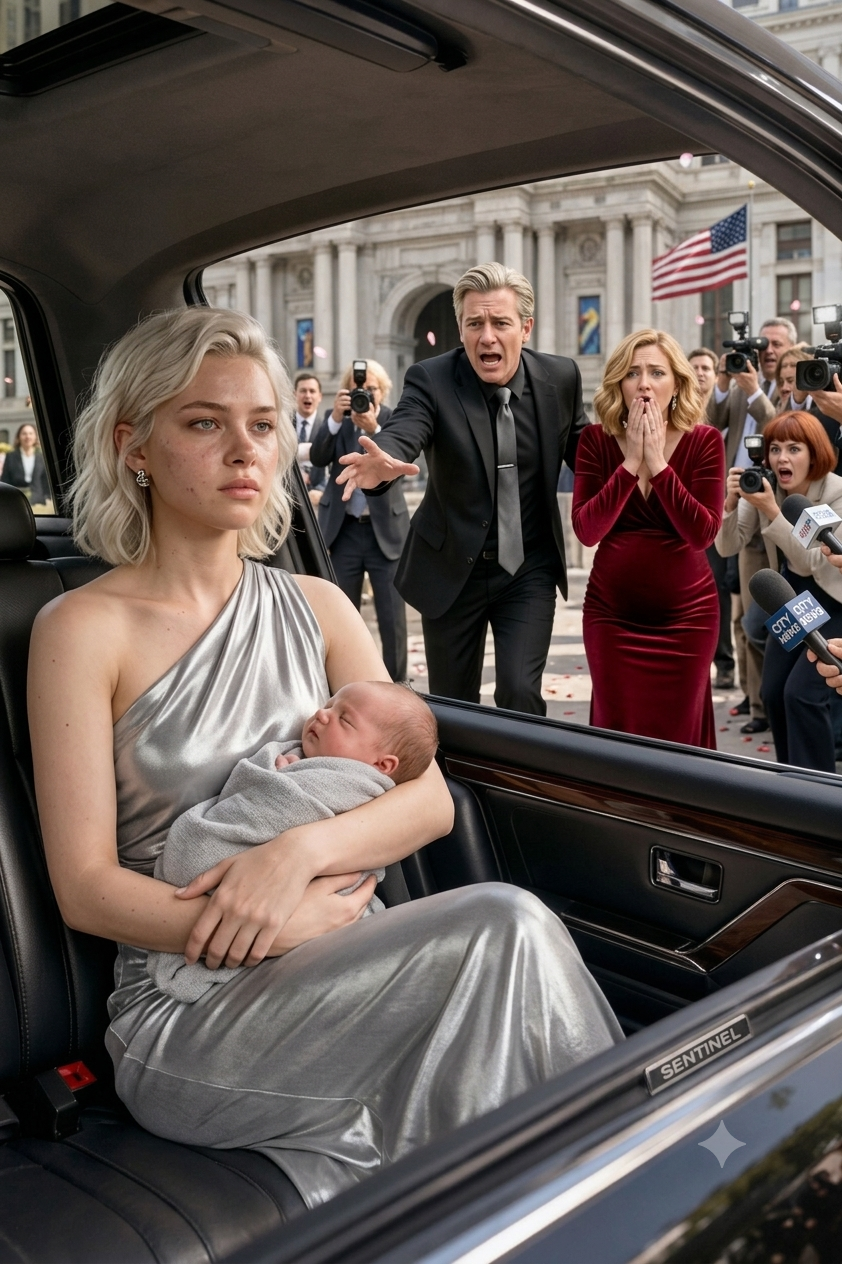
Mariana Salazar stood outside the house in Las Lomas that she had called home for 11 years, a suitcase at her feet and the keys resting atop a white envelope.
Inside the envelope lay the divorce papers.
Inside the house, her husband, Rodrigo Montemayor, laughed while sitting on the beige armchair she had chosen with such hope when she still believed love could hold everything together.
Beside him was Vanessa Duarte.
Young, polished, immaculate.
With a glass of wine in hand as if that house already belonged to her.
And standing next to them was Doña Rebeca Montemayor, her mother-in-law, wearing the same pearl necklace she donned each time she wanted to humiliate someone with elegance.
—Don’t make a scene, Mariana—Doña Rebeca said—. Rodrigo deserves a woman who can give him a family.
Mariana felt those words cut open an old wound.
For 11 years, she had endured tests, treatments, injections, surgeries, prayers, teas from nosy ladies, comments at family meals, and pitying glances.
“A woman without children is incomplete,” Doña Rebeca would say.
“Poor Rodrigo, such a good man without an heir,” the aunts repeated.
Rodrigo never defended her.
At first, he would squeeze her hand under the table.
Then he stopped.
And in the end, he simply fell silent.
What they didn’t know was that 7 weeks earlier, a specialist in Guadalajara had discovered the truth: Mariana had severe endometriosis, mistreated for years. She was not sterile. She had never been.
That morning, Mariana had taken 3 tests.
All 3 were positive.
She was pregnant.
For the first time in 11 years, she was going to be a mom.
She had driven back with tears of happiness, imagining how she would tell Rodrigo. Maybe with some little shoes. Maybe with an ultrasound card. Maybe he would cry, hug her, and apologize for all the years of distance.
But upon arrival, she found her suitcase packed.
Vanessa in her living room.
And Rodrigo unable to look her in the eye.
—Aren’t you going to say anything?—Mariana asked, her voice breaking.
Rodrigo got up slowly.
—I can’t keep doing this. Vanessa and I want to start a family. You and I tried too much.
Mariana almost brought a hand to her belly.
Almost said: “I’m pregnant.”
Almost gifted them the news she had waited a lifetime to share.
But then she saw Vanessa’s smile, Rebeca’s venomous satisfaction, and Rodrigo’s cowardice.
And she understood something.
They didn’t deserve to know.
Not yet.
She picked up her suitcase and left without a single word.
She walked down the cobblestone street with her heart shattered, while behind her, no one called. No one ran. No one regretted.
Half a block away, next to a jacaranda tree, a black truck slowly rolled down its window.
An older man, elegant, with silver hair and a gray suit, looked at her as if he had seen a ghost.
—Excuse me, miss—he said with a trembling voice—. Why are you crying?
Mariana frowned.
—Do I know you?
The man swallowed hard, pulled an old photograph from his jacket, and showed it to her.
Mariana felt the world shift beneath her feet.
The woman in the photo was identical to her.
Not similar.
Identical.
—That can’t be—she whispered.
The man’s eyes were filled with tears.
—My name is Don Julián Valdés—he said—. And that woman was my daughter, Elena.
Mariana tightened her grip on the suitcase.
—Why do I look like her?
Don Julián took a deep breath, as if he had waited 30 years to say it.
—Because I believe you are her daughter.
The noise of the city faded away.
Mariana looked at the house where Rodrigo had just destroyed her life and then at the stranger holding an impossible truth in his hands.
—My daughter Elena disappeared pregnant 30 years ago—Don Julián said—. And I swear to God I never stopped searching for her baby.
Mariana couldn’t respond.
She only felt an invisible hand squeezing her chest.
And just then, Don Julián said the phrase that would change not only her past but also the day Rodrigo Montemayor would end up kneeling before hundreds of guests.
—Mariana, there are powerful people who did everything to ensure you were never found.
PART 2
Don Julián didn’t take her to a hotel.
He took her to a discreet estate in Valle de Bravo, surrounded by bougainvillea, pine trees, and silence. There a woman named Alma welcomed her with a bowl of hot soup and a gaze that didn’t ask any unnecessary questions.
Mariana cried that night as she hadn’t cried in years.
She cried for her marriage.
For the girl who had been adopted without answers.
For the unknown mother in the photograph.
And for the 3 positive dots she carried hidden in her bag, as if they were the only piece of future no one could take from her.
The next day, Don Julián told her what little he knew.
His daughter Elena Valdés had disappeared in Mexico City at 22 years old. She was pregnant, scared, and had called only once, saying she had trusted the wrong people. After that, nothing.
Only confusing records were found in a private hospital, a document with the name misspelled, and an adoption arranged too quickly.
Mariana had always known she was adopted. Her parents, Hernán and Lucía Salazar, loved her with all their hearts, but every time she asked about her origins, her mother would turn pale.
“There are truths that hurt more when exposed,” she would say.
Now she understood why.
They did a DNA test.
For 2 weeks, Mariana lived in the estate like someone walking among ruins and miracles. Her lawyer, Licenciada Priya Santos, reviewed the divorce papers and discovered that Rodrigo wanted to close everything quickly.
—When someone rushes, Mariana, they’re almost always hiding shame, money, or both—she said.
Mariana didn’t fight for the house.
But she didn’t sign as a victim either.
She received what was fair.
Not for revenge, but because for the first time, someone reminded her that peace didn’t mean giving away her dignity.
When the DNA results arrived, Don Julián opened the envelope with trembling hands.
He didn’t need to read it aloud.
His face broke first.
—You are my granddaughter—he whispered—. You are Elena’s daughter.
Mariana felt joy and pain at the same time. She had gained a grandfather, but she had also just lost a mother she could never embrace.
That night, she told him about the pregnancy.
Don Julián froze.
Then he covered his mouth with a hand.
—So I didn’t just find my granddaughter—he said in a hoarse voice—. I also found my great-grandson.
—Maybe—Mariana replied—. It’s too early.
—Then we will wait slowly—he said—. But we will wait with faith.
At 12 weeks, in an office in Santa Fe, the doctor moved the ultrasound and fell silent.
Mariana felt her soul drop.
—What’s wrong?
The doctor smiled.
—There’s not 1 heartbeat, Mariana.
Don Julián gripped the back of the chair.
—There are 3.
Mariana let out a laugh through her tears.
After 11 years of hearing she was incomplete, her body held 3 lives.
They were born prematurely, on a rainy morning in April.
2 girls and 1 boy.
She named them Clara, Elisa, and Mateo.
Clara cried loudly, as if she had come to claim her place. Elisa was calm, observant, with huge eyes. Mateo was the smallest, but from the very first day, he gripped Mariana’s finger as if promising never to let go.
Weeks passed in the incubator.
Mariana learned to celebrate gained grams, removed tubes, and stable breaths.
Rodrigo never knew.
Not because Mariana wanted to erase him, but because life became diapers, milk, sleepless nights, and 3 reasons not to give up.
Over the years, the children grew up among trees, books, hot chocolate, and the stories that Don Julián told about Elena.
They had Rodrigo’s dark hair.
The family dimple.
The serious Montemayor brow.
That sometimes hurt.
But Mariana never spoke ill of their father.
When they asked, she would say:
—Your dad and I were married. Things ended before he knew how much joy was coming.
—Does he know we exist?—Clara asked when she turned 7.
Mariana folded a blanket slowly.
—Not yet.
—And if he doesn’t want us?—Mateo murmured.
Mariana hugged all 3 of them.
—Someone else’s reaction never decides how much you’re worth. You were loved before he knew your names.
The opportunity came in a cream-colored envelope.
The invitation read: Rodrigo Montemayor and Vanessa Duarte have the honor of inviting you to the celebration of their marriage.
Mariana stared at the golden letters.
The wedding would take place at the Gran Hotel Valdés, a property Rodrigo didn’t know belonged to Don Julián’s company.
Priya thought the invitation was cruel or careless.
Mariana thought it was a sign.
Before going, she wrote Rodrigo a brief letter:
“There’s something important you didn’t know before the divorce. I would prefer to discuss it privately before your wedding. Please contact my lawyer before Friday.”
Friday passed.
Rodrigo’s lawyer responded that Mr. Montemayor did not wish to have any contact with his ex-wife and considered any approach an attempt to ruin his wedding.
Mariana kept the letter.
—He had his chance—Priya said.
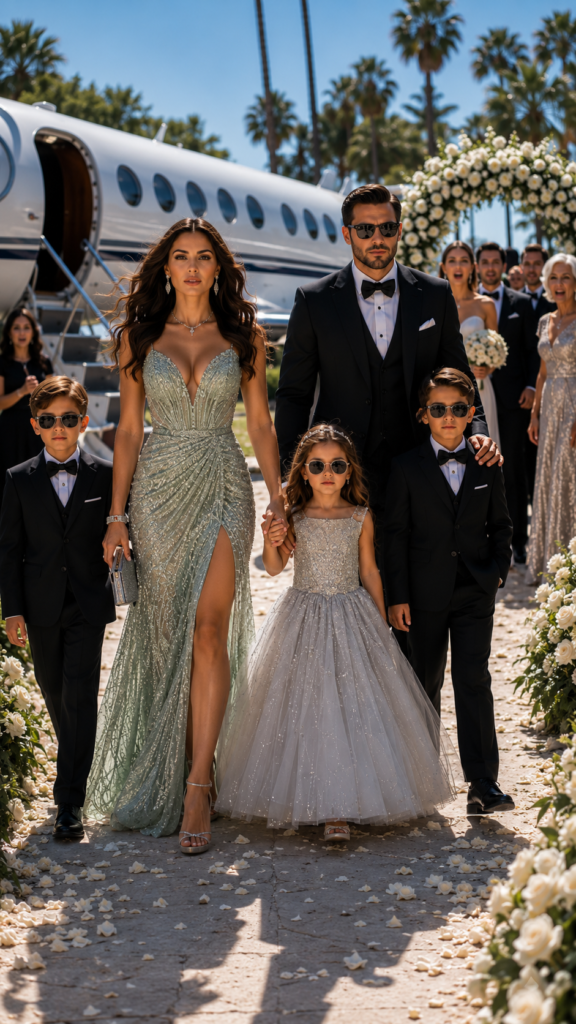
On the wedding day, Mariana arrived in a navy blue dress. Clara wore a light blue dress, Elisa one in soft green, and Mateo a gray suit with a crooked tie because he insisted on putting it on himself.
—Are we going to ruin the wedding?—Elisa asked in the car.
—No—Mariana replied—. We’re going to tell the truth in private if possible. And if not, we’ll leave with our heads held high.
Don Julián accompanied them.
—Not as bodyguards—he said—. As family.
In the hotel, white flowers filled the lobby. Guests laughed, glasses clinked, and a quartet played near the main hall.
For a moment, Mariana felt like she was back on that sidewalk in Las Lomas, with a suitcase at her feet.
Then Mateo took her hand.
—I’m here, Mom.
She breathed.
—Me too.
Priya had organized a private meeting in a room next to the hall. Rodrigo was called under the pretense of an urgent legal matter before the ceremony.
He entered annoyed, dressed in a tuxedo.
—Mariana, this is completely inappropriate...
He fell silent.
His eyes shifted from Mariana to the 3 children.
Clara stopped walking.
Elisa held her breath.
Mateo hid a little behind his mother.
Rodrigo paled.
—What is this?
Mariana stood up.
—This is what I tried to tell you before the divorce. What I offered to share last week.
Rodrigo looked at Mateo, then at Clara, then at Elisa.
His mouth opened, but nothing came out.
—They are 7 years old—Mariana said—. Their names are Clara, Elisa, and Mateo.
—Are they… mine?—he whispered.
—They are your biological children—she replied—. But they are not a spectacle, Rodrigo. They are kids. So choose your words carefully.
Before he could respond, the door swung open.
Doña Rebeca stormed in, furious.
—Rodrigo, Vanessa is waiting. What could be so…?
She saw Mariana.
Then she saw the children.
And her face drained of color.
Clara took a tentative step.
—Are you our grandmother?
Rebeca didn’t answer.
Rodrigo turned to his mother.
—Did you know?
—Know what?—she replied too quickly.
Don Julián stood up.
—Perhaps she knows more than she lets on.
He pulled out a sealed folder.
—Yesterday, a retired nurse from Hospital Santa Inés contacted me. She saw the announcement of this wedding in a social magazine and recognized the name Rebeca Montemayor.
Rebeca recoiled.
—That’s absurd.
Don Julián opened the folder.
He placed an old photo on the table.
It showed a young Rebeca at the hospital counter.
And beside her, pale, weak, in a wheelchair, was Elena Valdés.
Mariana's mother.
Rodrigo took the photo with trembling hands.
—Mom… what is this?
Rebeca pressed her lips together.
Don Julián pulled out a handwritten note.
—According to this nurse, Rebeca was present the night Elena gave birth. Not as a friend. Not as a visitor. But as the person who signed false documents to hand over the baby for adoption and disappear Elena.
Mariana felt the air leave her.
—Why?—she asked.
Rebeca looked towards the door, where the music announced the ceremony was about to begin.
But there was no escape now.
—Elena was going to marry my brother—she finally said, her voice dry—. She was going to inherit part of the family group. If she showed up with a daughter, everything would change.
Don Julián closed his eyes.
—What did they do to my daughter?
Rebeca didn’t answer.
That silence was a confession.
Rodrigo stepped back as if his own blood disgusted him.
—You destroyed Mariana before I even met her.
—I protected my family—Rebeca spat.
Mariana, for the first time, didn’t cry.
She took her children’s hands and looked at the woman who had called her incomplete for 11 years.
—No, Rebeca. You were afraid of a baby. And 30 years later, that baby came back with 3 children who carry your last name in their blood but not your cruelty in their hearts.
The door opened again.
Vanessa appeared in her wedding dress, followed by several curious guests.
—Rodrigo? What’s happening?
Rodrigo looked at his children.
Then at Mariana.
Then at his mother.
And he collapsed.
He fell to his knees before Clara, Elisa, and Mateo.
—Forgive me—he said, crying—. I didn’t know.
Mateo looked at Mariana before responding.
—My mom knew how to love us.
The blow was stronger than any scream.
The wedding was canceled.
Rebeca was escorted out of the hotel and weeks later faced an investigation for forgery, disappearance of documents, illegal adoption, and cover-up. The case of Elena Valdés reopened a wound that finally stopped hiding under elegant last names.
Rodrigo asked to see the children.
Mariana didn’t refuse, but set conditions: therapy, legal process, respect, and time.
Because blood could explain an origin, but it didn’t replace 7 years of absence.
Don Julián had a plaque placed at the foundation he opened in Elena’s name:
“For every child separated by a lie. For every mother erased by ambition. For every truth that returns even if they try to bury it.”
Years later, some still said Mariana had ruined a wedding.
Others said she had saved it from a lie.
But those who saw 3 children enter hand in hand that day never forgot Rodrigo’s face.
Because sometimes life doesn’t return to take revenge.
It returns with the truth.
And the truth, when it walks through the front door, doesn’t knock.