PART 1
—God knew exactly what kind of mother those children had.
Beatriz Rivas's words landed in the funeral home like a slap.
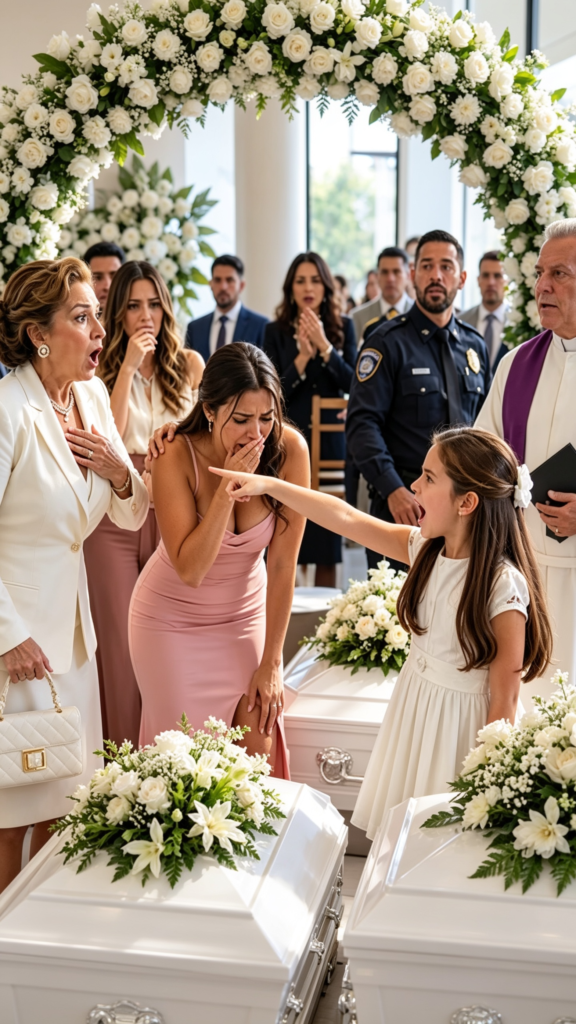
In front of two white coffins, Mariana Torres felt the air vanish. Inside lay Emiliano and Matías, her three-month-old twins, the babies she had longed for through five years of treatments, needles, losses, and prayers.
The funeral home was in Zapopan. Outside, the city continued as if nothing had shattered.
Beatriz, her mother-in-law, stood by the coffins in an immaculate black dress, a rosary between her fingers, her eyes completely dry.
—I tried to help her—she continued, raising her voice—. But there are proud women who think that taking care of three children is easy. God sees what a mother hides.
Some of Alejandro's aunts, Mariana's husband, lowered their gazes.
Others began to murmur.
—She always looked exhausted.
—Maybe she stopped watching them.
—Poor little angels.
Mariana wanted to scream that her children hadn’t died from neglect. She wanted to tell them she slept in 20-minute intervals, that she measured every ounce of milk, and that she woke up in the middle of the night just to check they were breathing.
But she couldn't.
Next to her, Alejandro stared at the floor.
He wore his navy blue pharmaceutical representative suit and cowardice stuck to his tongue.
He didn’t defend his wife.
Not even when Beatriz pointed at the coffins.
—The Lord sometimes takes the innocent to spare them from a worse life.
Don Ernesto, Mariana’s father, stepped forward, but his wife held him back. They didn’t want to turn their grandchildren's funeral into a fight.
Then a small hand squeezed Mariana's fingers three times.
It was Lucía, her seven-year-old daughter.
She wore a black dress and looked at her grandmother with fear but also with determination.
—Mom—she whispered.
Mariana leaned down, but Beatriz spoke again.
—I went every Tuesday and Thursday because that house was a disaster. If it weren't for me, those babies would have suffered much more.
Lucía released her mother's hand.
She walked to the lectern where Father Joel waited. Everyone fell silent.
The girl tugged at the priest's sleeve.
—Father, does God punish children for what adults do?
The man swallowed hard.
—No, daughter. Children are not to blame for anything.
Lucía nodded. Then she opened the little black bag she wore across her chest.
Beatriz paled.
—Lucía, come here—she ordered.
The girl stepped back and pulled out an old cell phone, its screen cracked.
—So my mom wasn’t to blame—she said—. Because I saw my grandmother put something in my little brothers' bottles.
No one breathed.
Alejandro raised his head for the first time.
—What are you saying?
Lucía turned on the phone.
On the screen appeared a blurry photo of Beatriz leaning over two bottles. Beside her was Alejandro's open black bag.
And between her fingers was a medicine bottle.
Beatriz lunged for the girl.
—Give me that right now!
But Don Ernesto stepped in.
Lucía, trembling, swiped her finger to the next image.
This time, the white powder was clearly seen falling into the milk.
Mariana looked at her mother-in-law, then at her husband, and finally at the two coffins.
And she understood that the death of her babies hadn’t been an inexplicable tragedy.
Someone in that family knew exactly what had happened.
PART 2
—That girl is confused—Beatriz said—. Surely her mother filled her head with lies.
Lucía hugged the cell phone to her chest.
—No, grandma. I also recorded your voice.
Beatriz's face changed.
She no longer looked offended, but trapped.
Father Joel asked to close the entrance of the funeral home and called the police. Meanwhile, Mariana knelt in front of her daughter.
—My love, tell me everything you saw.
Lucía began to cry.
Three weeks before, Lucía had pretended to have a stomach ache to stay home.
That Thursday, Lucía went to the kitchen for juice.
Beatriz had her back turned, by the sink. On the table were two open bottles and a medical sample bag that Alejandro usually left at home when he traveled.
The girl saw her grandmother take some pills, crush them with a spoon, and empty the powder into the formula.
—What is that?—she asked.
Beatriz jumped, but then smiled.
—Vitamins to help them sleep better. Good babies don’t wake everyone with their cries.
That day Emiliano and Matías slept nearly eight hours straight. Mariana tried to wake them to feed them, but they barely reacted.
Beatriz accused her of exaggerating.
—They finally got on schedule, and now you want to make drama. Seriously, you don’t know how to enjoy anything.
Lucía felt something was wrong.
Her teacher had told them they should share secrets that made them feel scared. But Beatriz was her grandmother, and everyone obeyed her.
That's why Lucía decided to gather evidence.
She used the old cell phone her mother lent her to play. She took photos from the hallway and began writing dates in a purple notebook.
Tuesday the 7th: powder in the bottles.
Thursday the 9th: the babies didn’t wake up to eat.
Tuesday the 14th: grandma said mom was useless.
Thursday the 16th: she put in more because Matías wouldn’t stop crying.
The night before the death, Beatriz arrived unannounced.
Alejandro was in León. Mariana had been running a fever for two days but had taken care of the children and finished her work.
—Go to sleep—Beatriz ordered—. I’ll take care of it.
Mariana hesitated.
However, Alejandro called her just then.
—Listen to my mom—he said from the hotel—. You always complain about being tired, and when someone helps, you get upset, too.
Those words finally defeated her.
Mariana went upstairs to lie down.
Lucía remained on the stairs.
From there, she saw Beatriz take the bottle out of the bag again. This time, she didn’t crush one pill.
She crushed three.
The girl activated the cell phone recorder.
Beatriz's voice echoed through the funeral home:
—Now they’re going to sleep all night. Tomorrow Alejandro will see that they behave like angels with me. When Mariana loses her mind, he’ll understand that the children would be better under my care.
A murmur of horror swept through the room.
But the recording continued.
Nadia, Alejandro’s sister, appeared in the kitchen.
—Mom, that’s too much—she was heard saying.
Mariana turned to her sister-in-law.
Nadia began to tremble.
—I didn’t know what it was—she stammered—. I thought they were natural drops.
In the audio, Beatriz replied:
—Don’t be stupid. It’s just to put them to sleep. Plus, I need Mariana to seem incapable. I’ve already talked to a lawyer. If Alejandro separates, we can ask for custody of all three.
That was the twist that shattered everyone.
Beatriz hadn’t just wanted to “calm” the babies.
She had been building a story to take Mariana's children away.
She had photographed the mess and sent messages saying that Mariana suffered from “attacks” and could harm the kids.
—You knew—Mariana said to Nadia.
—I only knew Mom wanted to help Alejandro with custody—she replied in tears—. I swear I didn’t know about the pills.
—You saw her by the bottles.
—She told me it was concentrated chamomile.
—And you decided to believe her because it was more comfortable.
Nadia lowered her head.
Alejandro looked like he was about to collapse.
—Mom… did you take that medication from my bag?
Beatriz looked at him as if he were the traitor.
—You left the samples there. I only used what was necessary.
—It was a controlled sedative.
—Don’t dramatize. You said yourself that Mariana couldn’t handle everything.
Alejandro opened his mouth, but no sound came out.
Mariana watched him.
She remembered how many times she had asked him to change the lock and warned him that the babies slept too heavily after those visits.
Alejandro always replied the same:
“My mom just wants to help.”
At 4:52 AM the morning after the recording, Mariana woke up to silence.
She first found Emiliano.
He was cold.
Then she touched Matías.
He was also cold.
The ambulance arrived in nine minutes, but there was nothing to be done.
The initial report spoke of a possible double sudden death. Beatriz seized the moment to insinuate that Mariana had prepared the formula wrong.
And Alejandro, destroyed and cowardly, allowed the doubt to grow.
Until that moment.
When the officers arrived, a detective secured the cell phone, the notebook, and the bag. Another officer blocked the exit.
—This is a misunderstanding—she screamed—. I was saving that family!
Mariana walked until she stood in front of her mother-in-law.
—you killed my children to prove I didn’t deserve to be a mother.
—You killed them—Beatriz spat—. If you had been an organized woman, I wouldn’t have had to intervene.
Alejandro stepped toward his mother.
—Don’t ever speak to her like that again.
Beatriz let out a bitter laugh.
—Now you defend her? How convenient, son.
That sentence hit him harder than any blow.
Because it was true.
He defended her when there were two coffins between them.
The prosecution reopened the investigation that very afternoon. Toxicology tests confirmed lethal levels of a sedative that should never have been administered to infants.
At Beatriz’s home, they found searches about dosages and custody loss, as well as photos and messages taken out of context.
The plan was clear.
Beatriz wanted to present her daughter-in-law as an unstable mother, provoke the separation, and take control of the children.
She claimed she never wanted to kill the twins.
She said she only intended to make them sleep and show that she could care for them better.
But the experts found something worse: for several weeks, she had increased the dosages. She knew the babies would go without food and breathe with difficulty. Still, she continued.
Nadia acknowledged that she helped store photos and messages, although she insisted she was unaware of the sedative.
The family that had murmured against Mariana at the funeral began to call her to apologize.
She didn’t answer.
The late remorse didn’t bring Emiliano or Matías back.
Alejandro spent days sitting in front of the empty cribs. One afternoon, he took one of the blankets and broke down in tears.
—I gave her the key—I repeated—I left the bag. I made you doubt yourself.
Mariana stood by the door.
—Your mother put the poison—she said—. But you opened the door every time I asked you to close it.
—I know.
—At the funeral, you heard how she blamed me.
—I know.
—and you looked down.
Alejandro didn’t apologize.
He understood that no words would suffice.
Months later, Beatriz arrived at the trial with a rosary. Her lawyer presented her as a grandmother who made a mistake.
Then Lucía took the stand.
Before sitting down, she squeezed Mariana's hand three times.
“I love you.”
The girl showed her photos, read the purple notebook, and explained why she had kept silent.
—Everyone believed my grandmother because she spoke loudly—she said—. Nobody believed my mom because she cried.
The room fell still.
Beatriz was found guilty of the twins' deaths. When the sentence was heard, she didn’t cry for them.
She screamed that Mariana had destroyed the family.
Weeks later, Alejandro signed the divorce. He didn’t fight for the house. He accepted therapy and supervised visits with Lucía.
—I don’t expect you to forgive me—he told Mariana.
She looked at him without hatred.
—Don’t seek forgiveness. Learn what it costs to remain silent to avoid upsetting the wrong person.
Mariana and Lucía moved to Mazatlán, near their maternal grandparents.
Lucía began therapy.
One night she asked:
—Mom, do my little brothers know I tried to save them?
Mariana hugged her tightly.
—they know you loved them. But you were a child. Protecting them was the adults' responsibility.
A year later, they visited Emiliano and Matías’s grave.
Lucía left a letter next to the flowers.
“Dear Emi and Mati: I’m already in third grade. Grandma can’t hurt anyone anymore. I told the truth. I love you. Your sister Lucía, the one who did see.”
Mariana cried as she read it.
Her children would not return. They would never take their first steps or fill the house with laughter.
But the truth had ripped the mask off a woman who used the word “family” to justify control, exposing all those who preferred to remain silent.
Because danger doesn’t always enter by breaking a door.
Sometimes it comes with a copy of the key, a rosary in hand, and the phrase: “I just want to help.”
And sometimes the only person capable of stopping it is the one the adults never took the time to listen to.





