PART 1
The first sound that rattled Damián Salcedo wasn’t a gunshot.
It was a beep.
A quick, clean, insistent beep echoing from a monitor in the emergency room of Santa Lucía Hospital in Mexico City.
Outside, the hallway smelled of bleach, fear, and old coffee.
No one said Damián's name aloud.
In Tepito, Polanco, and even in offices where everyone wore suits, his last name was spoken in hushed tones. Not because he was famous. Because he was dangerous.
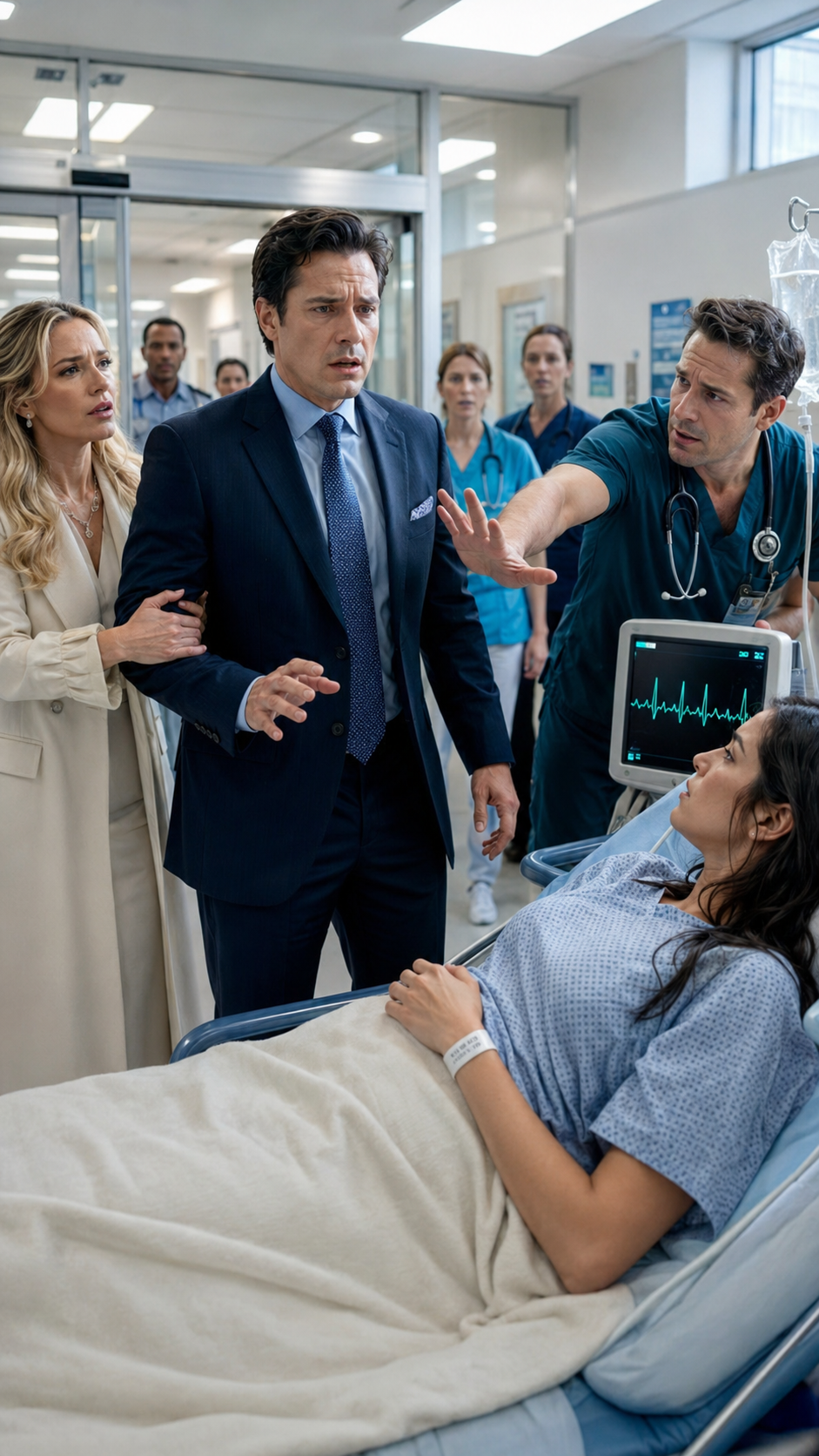
Damián entered the hospital with Renata Fuentes on his arm.
She wore an ivory coat, perfectly manicured nails, and a smile that looked expensive but not warm.
As they approached, a guard stepped aside.
A nurse lowered her gaze.
A man waiting for news about his wife stopped praying for a few seconds.
—Damián—Renata whispered, almost amused—, you’re scaring them.
He didn’t even glance back.
—I didn’t come to win their favor.
He had come for blood.
One of his men had taken three bullets outside a warehouse in Iztapalapa. Damián wanted names, license plates, schedules, and the snitch before dawn.
He hadn’t come for love.
He hadn’t come out of guilt.
He hadn’t come for any woman.
But when the automatic doors of the emergency room opened, the world lodged in his throat.
There she was.
Mariana Ríos.
Pale, sweaty, her black hair plastered to her forehead, and a blue gown stained with blood on one side.
The woman he had erased from his life eight months earlier.
The woman whose calls he had blocked.
The woman whose letters he burned unopened.
The only one who ever looked at him like a man, not a monster.
Damián stood frozen.
Renata tightened her grip on his arm.
—No—she said quickly—. Let’s go. This has nothing to do with you.
That “quickly” made him turn.
Because good lies walk slowly.
Bad ones trip over themselves.
Inside the room, a doctor was urgently examining Mariana. A nurse adjusted tubes. Another stared at the monitor with a tense face.
Then came the phrase that split the night in two:
—She’s 32 weeks pregnant. The baby still has a strong heartbeat, but the mother is slipping away.
32 weeks.
8 months.
Damián didn’t need a calculator.
The last night with Mariana.
The last morning she made him coffee.
The last time he kissed her before believing she had turned him in to the police.
Renata tugged at his arm.
—Damián, seriously, don’t do this here.
He didn’t move.
Mariana barely opened her eyes.
She didn’t look at the doctor.
She didn’t look at the nurses.
She looked at him.
Her cracked lips tried to say something, but no sound came out.
The fetal monitor emitted a sharp alarm.
A nurse shouted for help.
The doctor raised his voice:
—I need to clear the entrance, now!
Damián took a step toward Mariana.
The doctor blocked his way with a hand.
—Sir, you can’t go in.
In another place, those words would have been a death sentence.
In that hallway, Damián obeyed.
And that scared Renata more than any scream.
Mariana moved her lips again.
This time, the sound came out soft, broken, almost like air.
—Renata…
Damián’s mistress turned pale.
It wasn’t surprise.
It was fear.
And when Damián looked at her, he understood that Mariana hadn’t just recognized a stranger.
She had just pointed at the person who might have destroyed her life.
PART 2
The entire hallway fell silent.
Not because everyone understood.
But because everyone felt that something very grave had just happened.
Renata tried to smile, but her mouth wouldn’t obey.
—She’s delirious—she said—. Look at her. She doesn’t even know what she’s saying.
Damián watched her with icy calm.
That calm he used to instill fear.
That night he used it to think.
—Curious—he murmured—. You said you didn’t know her.
Renata blinked.
—I don’t know her. I just mean she’s delirious.
—Then why did you get scared when she said your name?
The question fell heavily.
A paramedic lowered his gaze.
The nurse holding the intake form froze, as if even breathing could get her in trouble.
Inside the room, the doctor shouted instructions.
—Blood pressure dropping. Prepare IV fluids. Monitor the baby.
The monitor beeped again.
Damián glanced at the bed.
Mariana had a hand on her belly, weak, trembling, as if with those fingers she could protect her child from the whole world.
That disarmed him.
Not the bullets.
Not the betrayal.
Not his enemies.
That hand.
Because while he acted untouchable, Mariana had carried eight months of fear alone.
Renata seized on his silence.
—Damián, let’s go. This can be settled later. You’re not going to believe a woman who betrayed you.
He turned slowly.
—That’s what you said eight months ago.
Renata clenched her jaw.
—Because it was true.
—Who confirmed it to you?
—People.
—What people?
She didn’t respond.
For the first time since he met her, Renata didn’t have a ready phrase.
And Damián, who had lived among liars, recognized the gap.
There was no proof.
No name.
No report.
Just a well-told story and her pride doing the rest.
The doctor emerged with his mask pulled down under his chin.
—Are you a relative of the patient?
Damián felt the question hit him in the chest.
What was he?
The man who left her?
The idiot who believed poison was easier than trust?
The father of a baby who hadn’t been born yet and was already abandoned?
—I’m the father—he said.
Renata let out a dry laugh.
—You don’t know that.
Damián didn’t look at her.
—I do.
He didn’t say it with pride.
He said it like someone accepting guilt.
The doctor didn’t ask more.
—The mother is critical. The baby is holding on, but we need to stabilize her. If she wakes up and can talk, we may need medical information. You can wait outside, without obstructing.
—I’m staying.
Renata looked at him as if he had slapped her.
—You’re staying?
—You’re leaving.
The silence became more uncomfortable.
The people in the plastic chairs pretended not to listen, but no one missed a detail.
Renata felt for the first time what others felt in front of Damián: standing in a place where no one was going to save her.
—After everything I’ve done for you—she whispered.
Damián took a step toward her.
He didn’t raise his voice.
It wasn’t necessary.
—That’s exactly what I’m going to review.
Renata swallowed hard.
—You’re making a mistake.
—No. The mistake I made was eight months ago.
She tried to touch his arm, using that caress that so many times calmed him, guided him, manipulated him.
Damián pulled away.
That gesture humiliated her more than an insult.
Renata walked toward the exit, rigid, her immaculate coat shining under the hospital's white light.
But before crossing the door, she turned.
—Mariana isn’t as saintly as you think.
Damián replied without blinking:
—and you’re not as invisible as you thought.
Renata left.
Damián remained in a plastic chair.
A regular chair.
Hard.
Uncomfortable.
One of those where people wait who can’t buy good news.
One of his men came running from the other hallway.
—Boss, the wounded man spoke. He says it was Guacho's people. We can move right now.
Damián didn’t even get up.
—Let Álvaro handle it.
The man froze.
—Álvaro?
—Are you deaf?
—No, boss.
The man left.
For the first time, Damián left a war to attend to a truth.
At 2:46 AM, Mariana woke up.
The nurse came out and said he could see her for 2 minutes.
—If she accepts it—she clarified.
Damián nodded.
When he entered, he saw her more fragile up close.
Her cracked lips.
The shadows under her eyes.
The IV in her arm.
And the large belly under the sheet, like a truth that no one had managed to erase.
He didn’t touch her.
He had no right.
—Mariana—he said.
She opened her eyes.
She didn’t cry.
That hurt him more.
—I wasn’t the one—she whispered.
Damián lowered his head.
—I know.
Mariana released a bitter breath.
—No. You don’t know. You’re just now realizing.
He didn’t defend himself.
Because it was true.
—I called you—she said.
—I know.
—I went to your building.
—I know.
—I left you letters.
Damián closed his eyes.
—I burned them.
Mariana turned her face away.
A tear rolled down to her temple.
—Then you burned the only proof that your child existed.
The phrase left him breathless.
Damián had heard pleas, threats, curses.
Nothing had weighed like that.
—Why did you say Renata's name?—he asked carefully.
Mariana took time to respond.
Every word cost her.
—Because she came to my apartment.
Damián looked up.
—When?
—A week after you blocked me. She came with two men. She told me that if I insisted on looking for you, she would make my medical record disappear, my job, and my mom from the clinic where they treated her.
Damián felt his blood run cold.
—Do you have proof?
Mariana looked at him wearily.
—I had it.
—What happened?
—They stole my phone.
Damián clenched his fists.
—Who?
Mariana closed her eyes.
—One of yours. The skinny guy with the scar on his eyebrow.
Damián knew that description.
Ciro.
His trusted driver.
The man who had taken Renata everywhere.
The man who, eight months earlier, had said to him: “Boss, I also heard that Mariana was talking to the cops.”
The truth didn’t arrive like lightning.
It came as a chain.
Link by link.
Renata.
Ciro.
The burned letters.
The stolen phone.
The hidden pregnancy.
The abandonment.
Damián left the room with an empty face.
Empty not of emotion.
Empty of mercy.
He took out his phone and called Álvaro, his oldest operator.
—Find Ciro.
—Alive?
Damián looked toward the door where Mariana was trying to survive.
—Alive and talking.
At 5:20, Ciro appeared in a warehouse in Doctores.
They didn’t find him by force.
They found him because he was trying to flee.
When he was brought before Damián, the man was already sweating.
—Boss, I didn’t do anything.
Damián placed a recording on the table.
It wasn’t of Mariana.
It was from the parking lot of the building, recovered from an old camera that no one had erased.
Renata was seen entering Mariana’s apartment.
Ciro behind her.
Two more men carrying a black bag.
Then they appeared leaving with a backpack.
Mariana’s backpack.
Ciro fell silent.
—Speak—Damián said.
The man cried before confessing.
Renata had fabricated the supposed betrayal because Mariana was pregnant.
She learned it from a private nurse who checked some tests.
She wanted to erase Mariana before the baby was born.
Not for love.
For ambition.
Renata knew that if Damián had a child with Mariana, he would never choose her as a wife.
But the dirtiest twist came afterward.
Ciro revealed that Renata not only fabricated the rumor.
She also had the letters intercepted.
Only one reached Damián’s hands.
The first.
The one he burned unopened.
The others never arrived.
Mariana had written about the pregnancy, about the threats, about the fear of losing the baby.
And Renata had kept them.
—Where are they?—Damián asked.
Ciro trembled.
—in a safe in her apartment, boss.
That morning, Renata opened the door to her penthouse on Reforma, believing she could shout, deny, act.
She couldn’t.
Damián arrived with lawyers, a notary, and two ministerial agents who owed him no favors.
The safe opened at 9:14.
Inside were the letters.
Seven envelopes.
All with Damián’s name written by Mariana.
There was also a USB drive.
On it, Renata was talking to Ciro.
Her voice sounded calm, almost bored.
“If that old lady shows up with a belly, it’s over. Make it look like a traitor. Damián hates better than he loves.”
That phrase was Renata’s tomb.
There were no screams.
No gunshots.
There was something worse for her: papers, audios, signatures, dates, and witnesses.
The woman who had used fear as makeup ended up handcuffed in front of the luxury elevators where everyone used to make way for her.
When Damián returned to the hospital, he held the seven envelopes in his hand.
He didn’t enter like he owned the world.
He entered like a guilty man.
Mariana was awake.
More stable, but still weak.
He placed the letters on a table.
—I found them.
She looked at the envelopes.
Her face didn’t change.
—Good.
Damián expected tears, maybe rage, maybe relief.
But Mariana was just tired.
And that tiredness was just.
—Renata confessed on recordings. Ciro too. They’re going to pay.
Mariana closed her eyes.
—that doesn’t bring back eight months.
Damián looked down.
—No.
—it doesn’t bring back the nights filled with fear.
—No.
—it doesn’t bring back talking to my son about a father who didn’t want to listen to us.
Damián felt that phrase pierce him clean.
—No.
Mariana placed a hand on her belly.
—I don’t want you to buy my forgiveness.
—I can’t buy it.
—I also don’t want you to use the baby to enter my life as if nothing happened.
—I’m not going to do that.
She looked at him.
—Then start by understanding this: being a father doesn’t absolve you from having been a coward.
Damián nodded.
Without excuses.
Without threats.
Without pride.
—I understand.
But he didn’t fully understand yet.
He would understand later, when he spent nights in the waiting room.
When he learned to ask before ordering.
When he signed, in front of a family judge, that Mariana would have protection, her own home, guaranteed custody, and access to everything she needed without depending on his last name.
He would understand when his son was born three weeks later, premature but strong, with a tiny cry that made nurses who pretended not to see him cry.
They named him Gabriel.
Mariana chose the name.
Damián didn’t argue.
He just stood behind the glass of the neonatal unit, watching that tiny baby move its hands as if fighting the air.
That day, Damián Salcedo didn’t seem to be the boss of anyone.
He seemed like a man too late.
And sometimes that weighs more than being bad.
Renata was charged with threats, theft, forgery of evidence, and extortion.
Ciro spoke to reduce his sentence, but lost the protection he believed was eternal.
The men who once admired Damián for being fearsome began to look at him differently when he did something no one expected: he stepped away from the darkest business and put his money to work in a foundation for threatened women during pregnancy.
Many said it was theater.
Others said it was guilt.
Mariana never came out to defend him.
Nor did she publicly destroy him.
She only said once, in front of a social worker:
—Let him do the right thing. But the right thing doesn’t erase what he did.
And maybe that was the strongest truth.
Because in Mexico, many believe that saying sorry fixes everything.
But there are pains that aren’t healed with flowers, nor with money, nor with powerful last names.
They are repaired, if they are repaired, with time, responsibility, and consequences.
Damián continued visiting Gabriel.
Always at the permitted hour.
Always asking first.
Mariana never returned to being the woman who took off his shoes when he came home tired.
She was no longer that.
She was another.
One who survived alone.
One who learned that love without trust can also be a prison.
And one afternoon, while Gabriel slept in her arms, Damián asked her if she could ever forgive him.
Mariana didn’t look at him with hate.
She looked at him with something more difficult.
With truth.
—I don’t know—she said—. But if it ever happens, it won’t be because you’re afraid of losing me. It will be because I’m no longer afraid to believe you.
Damián didn’t respond.
For the first time in his life, he understood that keeping silent wasn’t always power.
Sometimes it was respect.
And while the neonatal monitor marked a gentle rhythm, Gabriel opened his little hand and squeezed his mother’s finger.
Not Damián's.
Mariana's.
As if from the very beginning, he knew who stayed when everyone else failed.





