PART 1
Don Aurelio Castillo arrived three days late to his granddaughter Sofía's birthday, carrying a purple bag and a guilt that weighed heavier than his injured knee.
The girl had turned seven on Saturday. He couldn't make it because he fell in his sheet metal workshop, back in the Las Ánimas neighborhood of Puebla. Nothing serious, he claimed, but enough to leave him with a cane, ice, and a heart crushed by regret.
Since that afternoon, he imagined Sofía blowing out the candles, glancing at the door every five minutes, waiting for her grandfather to appear with his bad jokes and his tired mariachi voice.
On Tuesday, barely able to walk without too much discomfort, he bought a plush giraffe with a yellow bow and drove to his son Daniel and his daughter-in-law Patricia's house in a lovely neighborhood of Cholula.
It was one of those houses that looks perfect on Facebook: white façade, bougainvillea, new pots, and a wooden sign at the entrance that read, "Love lives here."
Patricia opened the door with her phone in hand and earbuds in.
"Oh, Don Aurelio. Sofía's upstairs," she said, without hugging him. "I'm in a meeting."
She didn't even ask about the fall. Or the knee. Or the purple bag he clutched as if it were treasure.
Don Aurelio climbed the stairs slowly. He knocked on the door of Sofía's room, where a sign made with markers read: "No entry without knocking, except for grandpa."
"Princess, it's me."
The door opened just a crack.
Sofía appeared with tousled hair, slow eyes, and a tiny smile, as if it took effort to be awake. Don Aurelio felt a strange tightness in his chest.
It was 2:30 in the afternoon.
"What happened, my girl?" he asked, bending down with difficulty. "Are you still tired from the party?"
Sofía shrugged.
"I'm sleepy."
He handed her the bag. The girl opened it without much excitement at first, but when she saw the giraffe, her eyes sparkled just a little.
"I'm going to call her Lila," she murmured.
"Lila Castillo, very elegant," he said, trying to make her laugh.
Sofía hugged the plush toy. Then she looked towards the door, stepped closer to her grandfather, and whispered in his ear with a voice that chilled his blood.
"Grandpa… can you tell my mom to stop putting stuff in my juice?"
Don Aurelio didn't blink.
"What stuff, my dear?"
The girl lowered her voice even more.
"I don't know. It tastes weird. Then I get really sleepy. Sometimes I want to play and I can't anymore. Sometimes I hear my mom say: 'Finally, this girl is quiet.'"
The room fell still.
Don Aurelio had fixed defenses, engines, and crooked doors for forty years. He knew that when something was wrong, it didn't first crack — it vibrated.
And that whisper from Sofía didn't vibrate.
It shattered his soul.
He didn't shout. He didn't go downstairs to confront Patricia. He didn't scare the girl.
He just took a deep breath and smiled as best he could.
"Come on, my love. Let's go get some ice cream."
Patricia was in the kitchen, laughing in front of her laptop.
"I'm taking Sofi for a bit," Don Aurelio said. "She wants ice cream."
"Yeah, take her," she replied, without looking up. "Just don't give her sugar; she gets unbearable."
Don Aurelio clenched his jaw.
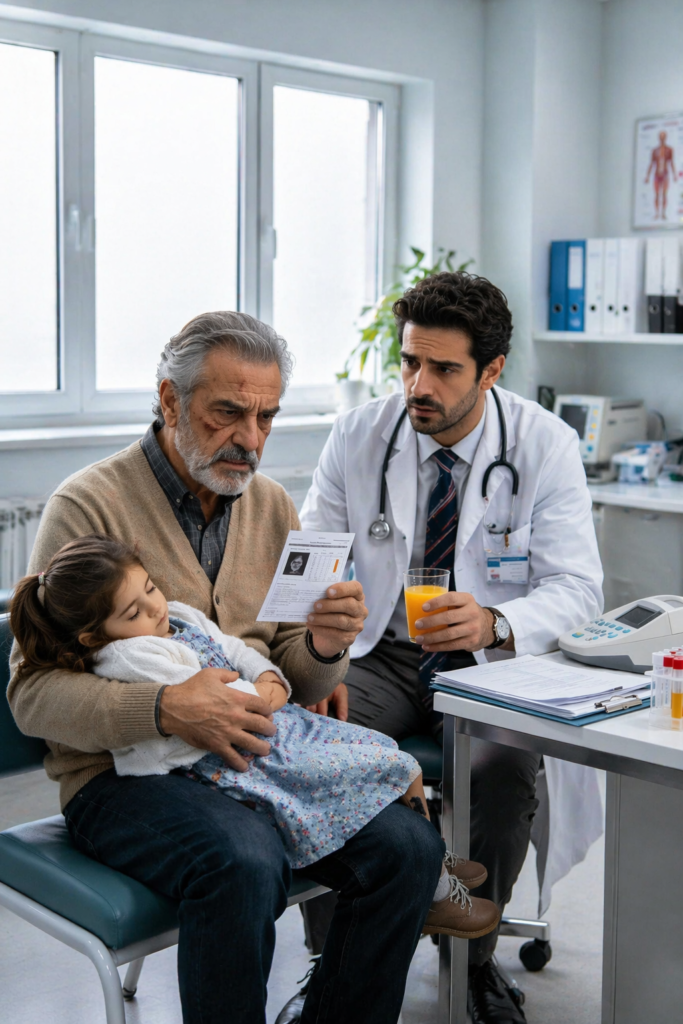
He loaded Sofía into his old truck and didn’t go for ice cream. He drove straight to a pediatric clinic, with the giraffe Lila cradled in the girl’s arms.
Hours later, the doctor came out with a sheet in his hand and a look no grandfather ever wants to see.
"Don Aurelio," he said, "this doesn't look accidental."
PART 2
Sofía was asleep on the examination table, with the giraffe Lila pressed against her chest, when Dr. Salinas placed the report on the desk.
Don Aurelio didn’t understand all the medical jargon, but he understood enough.
There were traces of an antihistamine at levels inconsistent with a single dose. The doctor used careful phrases, but no soft words could disguise what was happening.
"Does anyone prescribe this?" he asked.
"As far as I know, no."
"Then we need to keep her away from whoever is giving it to her."
Don Aurelio felt a cold rage. The kind of rage that no longer screams because it first wants proof.
"Is the girl in danger?"
The doctor looked toward the examination table.
"If she continues receiving it uncontrolled, yes. And by law, I have to report it."
"Do it," Don Aurelio replied. "But first, I need my son to open his eyes."
Daniel, Sofía’s father, was in Veracruz closing a contract for a materials company. He worked too much. He traveled too much. He believed that by paying tuition, a house, insurance, and vacations, he was fulfilling his duties.
He wasn’t a bad father, but he had become a father of video calls.
At 6:40 the next morning, Don Aurelio called him.
"Son, have you noticed anything odd about Sofía?"
There was silence on the other end.
"Patricia says she's throwing tantrums. That she sleeps a lot because she's growing. That she doesn't pay attention in school anymore."
Don Aurelio closed his eyes.
Growing. Tantrums. Lack of attention.
Comfortable words to avoid looking at the uncomfortable.
"I want her to stay with me for a few days," he said. "I feel bad about the birthday."
Daniel agreed quickly. He even sounded grateful.
"She’s going to love it, Dad. I’ll tell Paty."
An hour later, Daniel called back.
"Patricia says yes. That way she can rest a bit too."
Don Aurelio looked at Sofía sleeping on the couch, breathing peacefully for the first time in who knows how long.
"Perfect," he said, though inside, something was breaking.
That same day, he went to see Licenciada Mariela Ríos, a family lawyer known for not being impressed by last names or fancy houses.
Don Aurelio placed the medical report, a photo of the juice Sofía carried in her backpack, and a notebook where he had written down everything the girl had said on her desk.
Mariela read without interrupting. Then she took off her glasses.
"This isn’t a dispute between father-in-law and daughter-in-law. This could be child abuse."
"I know."
"Then you can’t act out of anger, Don Aurelio. You need to act with your head. If Daniel confronts Patricia without proof, she’ll cry, claim you hate her, and he will doubt."
"My son isn’t foolish."
"No, but he is a husband. And husbands sometimes want to believe before accepting they’re wrong."
The lawyer recommended a private investigator, Clara Montemayor, a former police officer with a dry voice and hawk-like eyes.
In 48 hours, Clara found what changed everything.
Patricia wasn’t just "tired" of her daughter.
For the past nine months, she had been seeing a man named Bruno Santillán, the owner of a used car agency in Angelópolis. They met at a boutique hotel downtown, almost always when Daniel was away on trips.
The dates coincided with the days Sofía had missed school due to "sleepiness," "tummy aches," or "bad moods."
Clara also legally obtained synchronized messages from a family tablet Daniel had bought for the house.
When Don Aurelio read the first conversation, he had to stand up from the table.
"I put a little in the juice and she fell fast."
"It was about time, love. That girl doesn’t let you live."
"When Daniel is gone, I finally feel like myself."
"Give her a little more and come over. It’s fine."
Don Aurelio didn't break the phone because Mariela took it away in time.
"This is saved," the lawyer said. "You don’t destroy what can save a child."
On Friday night, Daniel arrived at his father’s house believing they would talk about Sofía’s health.
He found the table set with noodle soup, breaded steaks, and lemonade. Sofía was in the room watching cartoons with her giraffe Lila, awake, restless, alive.
Daniel smiled when he saw her.
"You look better."
Don Aurelio didn’t respond.
He let his son eat. He let him tell him about the trip. He let him be, for one last time, a man who thought his house was still whole.
Then he placed four envelopes in front of him.
"Read them in order."
Daniel opened the first: the medical report.
His face changed.
He opened the second: school reports describing Sofía sleeping in class, confused, struggling to walk straight on some days.
He opened the third: pharmacy purchase records.
He opened the fourth: photos of Patricia with Bruno and copies of the messages.
Daniel didn’t scream.
That was worse.
He stared at the sheets as if someone had emptied the world in front of him.
"Did my daughter know?" he asked, his voice broken.
"She just knew her juice made her sleepy."
Daniel covered his mouth with his hand. His shoulders began to tremble, but no sound came out.
Don Aurelio recognized that cry.
It was the cry of a man who has just realized he was late.
"Give me the lawyer's number," Daniel said after several minutes.
Don Aurelio nodded.
In that moment, Daniel stopped appearing as a husband.
He appeared as a father.
The lawyer was clear: he shouldn’t rush to confront Patricia that night.
"If you go in shouting, she buys time. If you go in with measures, she loses ground."
Over the weekend, Daniel stayed at Don Aurelio’s house. He had breakfast with Sofía, opened a juice in front of her, and watched how the girl hesitated before drinking.
"Is it normal?" she asked.
Daniel almost broke down.
"Yes, my love. Here, we open everything in front of you."
Sofía took a small sip. Then she smiled.
"It tastes like real mango."
That phrase hurt him more than any insult.
On Monday, Daniel personally took Sofía to school. He walked her to the classroom door, adjusted her sweater, and kissed her forehead.
"Are you coming to pick me up?" she asked.
"Me or your grandpa. No one else."
The girl nodded, unaware that this promise was already a legal order in the making.
Then Daniel drove to Cholula.
Patricia was in the kitchen, impeccable, wearing sports clothes, drinking fancy coffee, with her phone beside her. The house smelled of vanilla. On the wall, the absurd phrase still read: "Love lives here."
"Aren't you going to work?" she asked.
Daniel placed his briefcase on the table.
"No."
Patricia noticed something in his face.
"What’s wrong?"
He placed the medical report in front of her.
Patricia read two lines and lost color.
"Dani, I can explain."
He said nothing.
That silence disarmed her. Patricia was used to talking over others, crying first, turning any complaint into an attack against her.
Daniel placed the school reports.
Then the purchases.
Then the messages.
Patricia tried to touch the pages.
"No," he said. "Read them from there."
She read.
"I put a little."
"That girl doesn’t let you live."
"Give her a little more and come over."
Her hands trembled.
"I didn’t want to hurt her," she whispered. "You were never there. I was alone. Sofía cried, screamed, followed me to the bathroom, asked me for things all day. I couldn’t take it anymore."
Daniel looked at her as if he were seeing a stranger wearing his wife’s face.
"She was seven."
"I’m a person too!" Patricia shouted. "Everyone expected me to be a perfect mom. Your dad always judging me. You always away. No one helped me."
Daniel took out the photos with Bruno.
Patricia fell silent.
"And he helped you, did he?" he asked.
She began to cry.
"It wasn't how you think."
"I don’t give a damn how it was for you."
"Bruno has nothing to do with Sofía."
Daniel pointed to the messages.
"He knew."
Patricia sat down, defeated, but her crying still held more fear than guilt.
"I just wanted a few hours to breathe."
Daniel took the keys.
"My daughter wasn’t a door you could close to escape."
"She’s my daughter too."
He took a deep breath.
"A mother doesn’t steal her daughter’s right to be awake."
Patricia tried to approach.
"Are you going to take her from me?"
Daniel stepped back.
"You let her go every time you put something in her glass."
She opened her mouth, but now she had nowhere to hide.
"From today on, you’re not going to school, you’re not going to my dad's house, and you’re not getting near Sofía without permission. Everything goes through the lawyer."
"Daniel, please…"
"You could have asked me for help. You could have screamed. You could have left. You could have left her with my dad, with my sister, with a nanny. You could have done a hundred things before drugging a little girl to sneak off to a hotel."
Patricia collapsed in a chair.
That same day, she tried to pick Sofía up from school. She didn’t get past the reception.
The principal already had instructions, provisional documents, and a list of authorized people.
"I’m her mother," Patricia said, raising her voice.
The principal looked at her without moving.
"And that’s why we’re waiting for the authorities."
Sofía saw nothing. Don Aurelio picked her up through a side exit. She came out happily, showing him a golden star in her notebook.
"I didn’t sleep in class today, grandpa."
Don Aurelio turned toward the street so she wouldn’t see him cry.
The following months weren’t like in the movies. There were no applause, no music, no scene where everything resolved suddenly.
There were offices, psychologists, interviews, stamps, hearings, and cold hallways.
Real justice doesn’t always barge in. Sometimes it comes carrying files.
Dr. Salinas testified. The school provided reports. The pharmacy confirmed repeated purchases. Clara presented the timeline: Daniel’s trips, meetings with Bruno, messages, and Sofía’s sleepiness.
Patricia’s lawyer tried to talk about emotional exhaustion.
"My client was overwhelmed," he said. "She had no support network."
The judge, a man with a low voice, reviewed the case and responded:
"Being overwhelmed does not authorize sedating a minor to maintain an extramarital relationship."
Patricia cried.
Daniel didn’t look at her.
Bruno was summoned. At first, he said he didn’t know anything. That he just heard Patricia was tired. That Sofía was "very demanding."
But when they showed him his own messages, his charm faded.
He provided conversations, schedules, and screenshots. Not for justice, but out of fear.
Patricia then discovered another cruel truth: the man for whom she had risked her daughter wouldn’t risk even a signature for her.
In 70 days, Daniel obtained full provisional custody. Patricia received supervised visits, mandatory therapy, and a criminal investigation for endangering a minor’s health.
The house in Cholula was sold.
Daniel didn’t want to live in a place where Sofía had learned to distrust a glass.
He bought a smaller apartment in La Paz, near the school and 12 minutes from Don Aurelio’s workshop. Sofía chose to paint her room lavender. Lila, the giraffe, had a shelf by the window.
The girl didn’t heal overnight.
For weeks, she wouldn’t drink anything unless she saw Daniel open it. Sometimes she would smell the glass. Sometimes she would push it away in fear.
Don Aurelio invented a routine.
Sofía chose the glass. Daniel opened the juice. Don Aurelio tasted it first. Then she drank.
Little by little, Sofía came back.
She ran again. She interrupted again. She sang badly in the living room again. She asked for two stories before bed again. She laughed so loudly that Daniel silently gave thanks.
Before, someone had called her unbearable.
Now he knew that intensity was life.
The first supervised visit happened six months later. Patricia arrived without makeup, thinner, with fidgety hands. Sofía entered holding Daniel’s hand, hugging Lila.
Patricia cried as soon as she saw her.
"My love…"
Sofía didn’t run.
She stood in front of her and asked what no adult dared to say so clearly.
"Did you put things in my juice?"
The social worker looked up.
Patricia had rehearsed a thousand phrases: that she was confused, that she was sick, that she made mistakes.
But in front of Sofía’s eyes, all of them sounded cowardly.
"Yes," she whispered. "And it was very wrong."
Sofía squeezed her giraffe.
"It scared me to sleep."
Patricia broke down.
"Forgive me. Forgive me, my girl."
Sofía looked at Daniel. He barely nodded, giving her permission to feel whatever she wanted.
The girl didn’t hug her mother.
She simply said:
"Now my dad opens my juices."
Daniel felt something inside him settle. Not because everything was okay. Not because there was forgiveness.
But because his daughter had voiced that she was now safe.
When they left, Don Aurelio was waiting outside with churros.
"How was it?" he asked.
Sofía thought for a moment.
"Sad."
The grandfather nodded.
"Sometimes sad can also be brave."
Years later, Daniel would still remember that phrase.
Because he learned that providing isn’t the same as seeing. That a pretty house doesn’t guarantee love. That no adult should ever call a child "intense" just because they need attention.
And Don Aurelio returned to the workshop quieter, but more attentive. He always said that engines warn before breaking, even with a tiny noise.
Families do too.
One night, almost a year later, Sofía fell asleep on the couch watching a movie. It was a normal, heavy sleep filled with popcorn, pajamas, and laughter.
Daniel carried her to bed. Don Aurelio followed him with Lila in hand.
"Look at her," the grandfather whispered. "That’s a happy girl’s dream."
Daniel tucked in the blanket. Sofía, half asleep, murmured:
"Dad…"
"I’m here."
"Tomorrow I want mango juice."
Daniel swallowed hard.
"Of course, my love."
"But you open it."
He kissed her forehead.
"Always."
Don Aurelio turned off the hallway light. Before leaving, he placed a hand on his son’s shoulder.
"You saw her in time."
Daniel shook his head slowly.
"No, Dad. You listened to her."
The grandfather didn’t reply. He just looked toward the room where a little girl slept soundly, with a stuffed giraffe watching over her dreams.
Because sometimes a family doesn’t fall apart when the truth appears.
It falls apart when everyone prefers not to see it.
And sometimes it is saved by something as small as a whisper… and by a grandfather who decides to believe a little girl.





