PART 1
—Alma was never sterile, Mauricio. Your family paid to make you believe that.
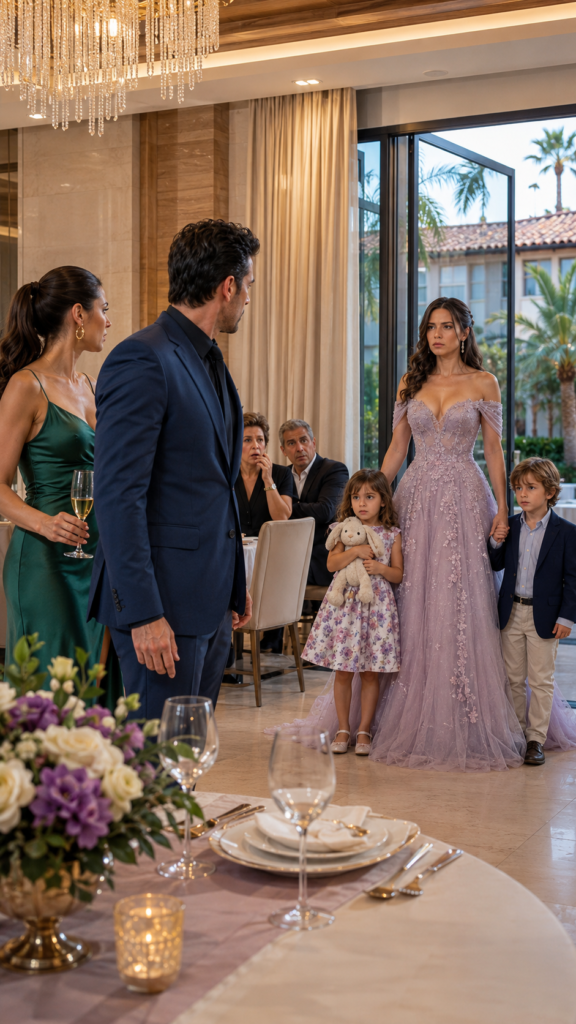
Verónica's voice was no louder than the murmur of the restaurant, but it was enough to leave Mauricio Alcázar gasping.
That night, the private dining room of a restaurant on Masaryk Street was filled with investors, politicians, and partners from his hospital chain. Mauricio had just toasted the opening of a new clinic when Verónica, his wife of four years, set her glass down and stared intently at the entrance.
Mauricio followed her gaze.
Alma Serrano had just walked in.
It had been six years since the divorce. She was no longer the young woman who cried after him while Rogelio Alcázar, his uncle and mentor, kept repeating that a woman “without a last name” could make up any illness to secure a fortune for herself.
Alma was dressed in black pants, a cream blouse, her hair pulled back. She didn’t look rich or defeated. She looked calm.
But she wasn’t alone.
To her right walked a boy with a axolotl backpack and Mauricio's serious frown. To her left, a girl clutched a rag doll, surveying the place with the same gray-green eyes that appeared in every portrait of the Alcázar family.
They both looked about five.
Twins.
Mauricio rose so quickly he knocked the table.
—Don’t go —Verónica murmured.
He didn’t hear her.
Alma saw him approach and held the children’s hands tightly.
—Alma…
—Don’t do this here.
The boy looked up.
—Mom, who is he?
Mauricio felt the question pierce through his chest.
—I’m Mauricio —he replied before she could.
Alma hardened her expression.
—Gael, take your sister.
Mauricio looked at the boy.
—Gael?
Then at the girl.
—And is she Abril?
Alma paled.
—Who told you their names?
—No one. I saw a photo years ago in a report that disappeared from my office.
Abril hid behind her mother.
Mauricio swallowed hard.
—Alma… are they my children?
The restaurant seemed to fall silent, although the music kept playing.
Alma didn’t answer immediately. Her eyes filled with a rage that was anything but recent.
—You lost the right to ask that question when you signed the divorce without reading my medical reports.
—I was told you had lied.
—And it suited you to believe it.
Verónica approached them, her face pale.
—Alma, please, the children don’t need to hear this.
Alma let out a dry laugh.
—How curious. When they were watched outside kindergarten, no one worried about what they might hear.
Mauricio turned to Verónica.
—What is she talking about?
She looked down.
Alma grabbed her bag and led the twins towards the exit.
Mauricio tried to stop her without touching her.
—I need to know the truth.
—The truth has been in front of you for six years. You just preferred your uncle's last name over my word.
Rain pounded against the windows as Alma left with the children.
Mauricio took a step to follow her, but Verónica grabbed his arm.
—If you go after them, Rogelio will know you’ve seen them.
Mauricio turned slowly.
—Does Rogelio know they exist?
Verónica began to tremble.
—He knows their names, their school, and the clause that activates when they turn five.
—What clause?
She looked at him with tears held back.
—The one that can take away control of the entire family.
At that moment, Mauricio's phone vibrated. It was a photograph taken from a black truck: Alma crossing the street in the rain with Gael and Abril.
Below was an unknown message:
“You're six years late. This time you won’t be able to save them.”
PART 2
Mauricio called Alma as he ran toward the exit.
She answered on the third attempt.
—Don’t call me again.
—A black truck is following you. Get into a place with people.
Alma was silent for barely a second.
—Then it didn’t start tonight.
Mauricio heard her speak to the children with a calm that felt too rehearsed.
—Gael, Abril, snail game. Stick close to Mom and don’t look back.
That phrase confirmed to him that Alma had already practiced that protocol.
He found her inside a pharmacy, with the twins clinging to her waist. Two bodyguards blocked the back entrance while the truck disappeared into traffic.
—We’re not going to any of your houses —she warned.
—That’s fine.
—Not to an Alcázar hotel either. And you won’t tell them who you are.
Mauricio looked at Gael, pretending to be brave, and Abril, clutching her wrist to keep from crying.
—That’s fine.
Alma called Teresa Montalvo, the lawyer who had been with her since the pregnancy. Teresa took them to a discreet house in San Miguel de Allende.
While the twins slept together on a couch, she laid several documents on the table.
Mauricio's grandfather had created a trust: if his only grandson had biological children, 38% of the family shares would pass to a protected fund when they turned five. Rogelio would lose the majority and could no longer move properties without authorization.
—They turned five last month —Alma said—. That’s why the trucks returned.
Mauricio felt nauseous.
—Returned?
—During the pregnancy, I changed houses twice. After the birth, three. A nurse warned me that two men tried to enter the nursery with fake credentials. I reported it, but the file disappeared.
—Why didn’t you ever look for me?
Teresa threw a yellowing folder in front of him.
There were 14 certified letters, emails, and meeting requests, all received by his office.
—I never saw this.
—Your secretary intercepted them —Alma said—. Then Rogelio called me. He swore he would fabricate an infidelity and take the children away if I tried to contact you again.
Mauricio remembered his uncle's warnings: Alma was ambitious, manipulative, capable of presenting someone else’s pregnancy to come back.
They hadn’t been warnings.
They had been part of the plan.
At 4:20, there was a knock at the door.
It was Verónica.
She arrived soaked, without makeup and with a USB drive hanging from her neck.
—She doesn’t come in —Alma said.
—I know who altered the tests —Verónica blurted—. And I know what they tried to do at the hospital.
The silence let her through.
Verónica explained that her brother worked in systems at the fertility clinic. Rogelio paid him to substitute results and delete backups.
—Since when do you know? —Mauricio asked.
—Since before our wedding.
Alma let out a bitter laugh.
—The perfect wife knew they had destroyed the previous one and decided to take advantage of the space.
—I didn’t know the children existed.
—But later, you did.
Verónica lowered her head.
—I found out when they were eight months old. Rogelio threatened to sink my brother. I was scared… and I also wanted to keep the house, the trips, the magazine covers. I convinced myself it wasn’t my business.
—My children became your business when you allowed them to be followed.
Teresa connected the USB drive.
There were transfers, photographs of files, and a folder named NURSERY.
In one audio, Rogelio's voice was heard:
“If Mauricio thinks she can’t give him descendants, he’ll get her out alone. We don’t need a scandal, just shame.”
In another, recorded weeks before, he said:
“The twins turned five. Prepare a contradictory genetic test. If the mother fights back, we’ll fabricate instability. A single woman always seems less credible than a respectable family.”
Alma closed her eyes.
For years, she believed she was exaggerating when she saw the same car outside her workshop or when a stranger photographed the children in the park.
She hadn’t been paranoid.
She had been in danger.
In the NURSERY folder appeared images from the hospital. Two men with fake badges roamed neonatology. A payment ordered to turn off the cameras for seven minutes.
—What were they going to do? —Mauricio asked.
Verónica didn’t answer.
Alma ran to the room and sat next to her children. Mauricio wanted to follow her, but she stopped him with a look.
—Don’t confuse your horror with the right to console me.
He lowered his head.
—You’re right.
At dawn, Teresa contacted a federal prosecutor. Benjamín Cruz, Mauricio’s lawyer, delivered business records without alerting the Alcázars.
The case took a turn when they located Mauricio’s former secretary, hiding in Hidalgo. He confessed that Rogelio paid him to intercept Alma’s letters and then forced him to disappear with a false accusation of theft.
Then came the truth that shattered Mauricio completely.
The original tests did not indicate infertility in Alma. They indicated that he had a temporary and treatable hormonal condition. Rogelio had switched the results to hurt his pride and make him blame his wife.
Mauricio stood frozen.
He had abandoned Alma saying he couldn’t live without children.
But the medical issue had been his.
—That’s what you didn’t want to hear —she said—. It was easier for you to believe I was broken.
He remembered their last argument. Alma had asked to repeat the tests; Mauricio, humiliated, responded that he wouldn’t endure an incomplete life and walked out.
—There’s no excuse sufficient.
—No.
—I failed you.
—Yes.
There were no screams. Alma’s serenity was more devastating.
In the following weeks, a nurse identified the men from the nursery, an accountant revealed ghost companies, and the prosecutor found a lawsuit prepared to accuse Alma of fraud.
Rogelio planned to present a false DNA test, declare Mauricio incapable, and remain as the administrator of the trust “in defense of the minors.”
He didn’t want to protect the family.
He wanted to keep the money.
At the hearing, he arrived in a gray suit, elegant cane, and respectable patriarch's smile.
—All this is revenge from a resentful woman —he declared.
Alma stood up. Behind her were Teresa and the nurse. Mauricio remained far away, as she had requested.
—For six years, they said my fear was hysteria and that my word was worth less because I didn’t have their last name. But Gael and Abril are not shares or votes. They are children. No child should look out the window to know if a truck has followed them again.
Rogelio tried to smile.
Then the audios sounded.
The transfers appeared.
The former secretary testified.
Verónica's brother explained the forgery.
And the smile disappeared.
Rogelio was arrested for fraud, threats, forgery of documents, and manipulation of medical information. His accounts were frozen, and the trust passed to independent administration.
Verónica collaborated in exchange for a reduction of charges for concealment. She lost her marriage, her position in the foundation, and the perfect life she had defended with silence.
Before leaving Mexico City, she requested to see Alma at a café in Juárez neighborhood.
—I don’t expect you to forgive me.
—Good.
Verónica left a folder with the names of two doctors willing to fabricate psychological evaluations.
—Are you doing this out of guilt or because you have nothing left to lose?
—For both.
Alma kept the folder.
—My children will not hear your name from my mouth. Not because I forgive you, but because I will not fill their childhood with people who chose to remain silent.
There was no hug.
Some apologies come too late to become reconciliations.
Six months later, Mauricio saw Gael and Abril twice a week at a supervised visitation center.
The children called him Mauricio.
He never corrected them.
He learned that Gael hated avocado, although he ate guacamole if no one told him what it was. He discovered that Abril could distinguish planets and got angry when someone confused a star with an airplane.
He also understood that his children’s lives hadn’t begun when he saw them in the restaurant.
One Sunday, at Parque México, Gael chased after some pigeons while Abril collected leaves for a school project. Alma stayed close, attentive.
Mauricio handed her an envelope. Inside was the ring she had returned after the divorce.
—I kept it because a part of me believed that I still owned something of you: your story, your forgiveness, the possibility of returning. I understand now that I don’t.
Alma closed the envelope.
—Regret doesn’t make you trustworthy.
—I know.
—Testifying against Rogelio doesn’t erase the fact that you chose not to listen to me.
—I know.
—And if one day they call you Dad, it will be because they decide to. Not because a judge, a test, or your last name forces them to.
Mauricio took a deep breath.
—I understand.
From the path, Gael shouted:
—Mauricio! Abril says the pigeons are having a meeting!
—It is a meeting! —she protested—. They’re deciding who gets the bread!
Alma let out a brief laugh.
Mauricio heard her as one looks from the outside at a house he himself set on fire.
He didn’t ask to return.
He didn’t ask for another chance.
He stayed at the right distance, understanding that some mistakes can’t be fixed with money, last names, or tears. Sometimes they can only be faced with years of humble presence.
And even so, no one is obliged to open the door that one has closed.





