PART 1
—If you’re not going to say who got you pregnant, get out of my house right now.
Don Roberto Mendoza’s voice crashed in the living room like thunder.
Camila was 19, palms icy, clutching a pregnancy test between her fingers. Outside, drizzle fell over the streets of La Paz, Puebla, where the neighbors learned everything before the family did.
Her mother, Doña Elvira, stood by the dining table, a rosary twisted in her hands. She wasn’t praying. She just stared at her daughter as if she had brought a curse.
Roberto remained standing, his gray shirt from the San Ángel Industrial plant stained with dust and grease. He’d worked there for 26 years. He was a dry, proud man, the kind who said that family name was worth more than any tear.
—Speak, Camila —he ordered—. Who was it?
She swallowed hard.
—I can’t say.
Doña Elvira let out a moan.
—Daughter, for God’s sake… Is he a married man? Did he threaten you? What happened?
—It’s not that, Mom.
—Then don’t give me that look —Roberto shouted—. In my house, we don’t hide a shame like this.
Camila felt the floor slipping away beneath her.
She longed to scream the truth. To say the father was Santiago Leal, a young environmental engineer who had come to the plant to check on supposed chemical leaks into the Atoyac River.
She wanted to say Santiago wasn’t a coward.
He was the only one brave enough to investigate what everyone else was keeping quiet.
But Santiago had vanished five days earlier.
And before he disappeared, he had given her a USB drive hidden inside a sweet bread bag.
—If something happens to me, keep this. And don’t trust anyone at the plant. Not even those you think you know.
Camila didn’t know if her father was involved. She didn’t know if they had tricked him. She didn’t know if Roberto knew more than he let on.
All she knew was that if she spoke, her baby could die before being born.
—Dad, one day you will understand —she whispered—. But today, don’t ask me for that.
Roberto slammed the table.
—You have one hour. Either you say the name, or you leave.
Camila looked at her mother.
She waited for her to stand up. To hug her. To remember she was her daughter, not a stranger.
But Doña Elvira lowered her gaze.
That silence hurt more than any insult.
Less than an hour later, Camila was on the sidewalk with an old suitcase, 480 pesos, and a thin jacket. From the window, her mother watched her, tears streaming down her face.
Camila waited.
She waited three minutes.
She waited until the light went out.
The door never opened.
That night she slept at the bus terminal, clutching her suitcase and resting a hand on her belly.
At dawn, she bought a ticket to Querétaro, where an old classmate found her a tiny room behind a diner.
There, she started from scratch.
She sold quesadillas, cleaned bathrooms, learned management in free courses, and cried silently without ever calling home again.
When her son was born, she named him Diego.
The boy grew serious, kind, and too much like Santiago. He asked why he had no grandparents, why his mom kept a green folder locked away, why she became sad every June 28.
Camila always answered:
—One day you will know, my love.
That day arrived when Diego turned ten.
In front of a simple chocolate cake, the boy said:
—Mom, I want to meet them even if they’re ashamed I exist.
Camila felt the past clawing at her chest.
Three days later, they boarded a bus to Puebla.
Camila carried a backpack, the green folder, and the USB drive wrapped in a napkin.
The house looked the same.
The same brown door.
The same dry bougainvillea.
The same step where she had been thrown out pregnant.
She knocked.
Roberto opened.
Upon seeing her, he went pale.
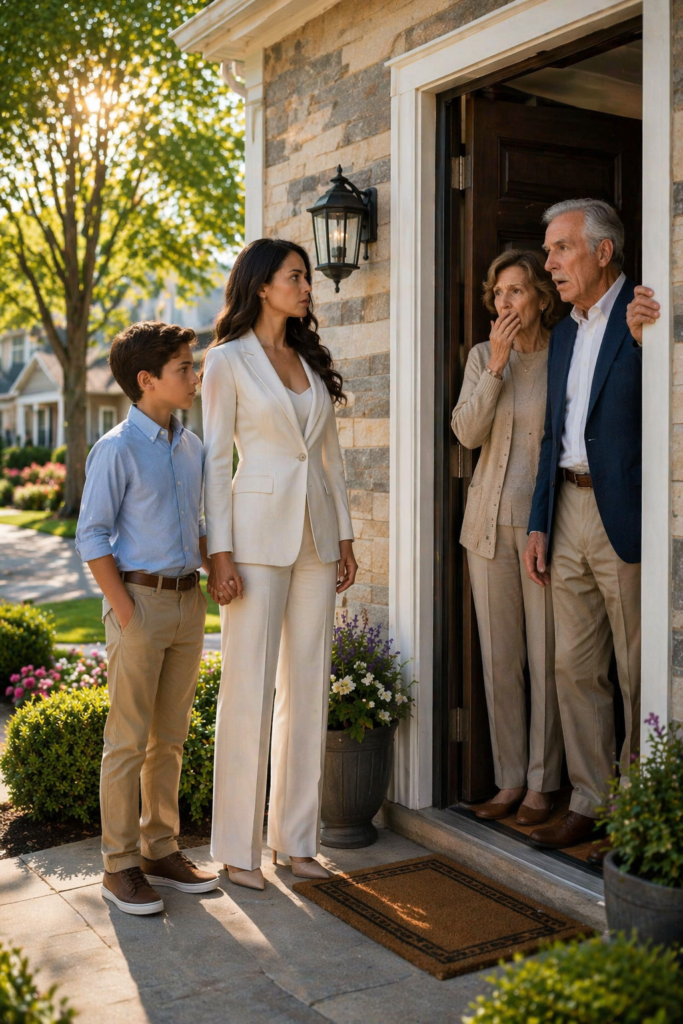
Doña Elvira appeared behind him. When she saw Diego, she covered her mouth.
Camila placed an old photograph on the table.
In it stood Santiago Leal, wearing a yellow helmet, smiling beside Roberto in front of Industrial San Ángel.
On the back of the photo, a phrase was written in shaky handwriting:
“Your dad tried to save us.”
Diego looked at the image, then at his mother.
—Mom… is that man my dad?
And Roberto understood that the girl he had thrown out ten years ago wasn’t carrying a shame.
She carried the truth he himself had helped bury.
PART 2
Camila knelt before Diego and took his hands.
—Yes, my love. His name was Santiago Leal. And yes, he was your dad.
The boy pressed the photograph against his chest.
—Did he know I was going to be born?
Camila closed her eyes, holding back tears.
—I didn’t get to tell him. He disappeared first.
Roberto slumped into a chair as if his legs had given out. His hard face, which had seemed like stone for years, shattered suddenly.
—Santiago Leal… —he murmured—. That boy never kept quiet.
Doña Elvira looked at him in horror.
—You knew him?
Roberto didn’t answer right away. He wiped his forehead, cold sweat trickling down.
—He came to the plant to check the spills. He said the river was poisoned. That there were sick children, women losing babies, workers with skin spots.
Camila pulled out the USB drive.
—He left this for me.
Roberto lifted his gaze, and his expression shifted.
He no longer seemed guilty.
He looked terrified.
—Don’t connect that here.
—Why not? —Camila asked.
Roberto opened his mouth but couldn’t speak.
Camila felt a chill.
—For ten years, I thought you kicked me out because you were a macho, because you were proud, because you wanted to protect your name. But now I’m looking at you, Dad. You know something.
Roberto began to cry.
It wasn’t a pretty or dignified cry. It was the cry of a man who had carried a rotting guilt for too long.
—I don’t know if I know… or if they made me believe otherwise.
Doña Elvira crossed herself.
—Roberto, don’t start with that.
But he couldn’t stop.
He recounted that ten years ago, Santiago came one night to seek him out. He carried documents, photos, and water samples. He asked for help to take boxes out of the plant before the owner, Don Julián Armenta, could make them disappear.
Industrial San Ángel was the most powerful company in the area. It provided jobs, handed out food packages, sponsored local festivals, and bought silence as easily as it dumped chemicals into the river.
Julián had friends in the city council, in hospitals, in law firms, and even in the state police.
—Santiago told me that if we didn’t speak up, people would keep dying —Roberto said—. I believed him.
Camila could barely breathe.
—And what happened?
Roberto lowered his head.
—I remember a warehouse. A white truck. A strong smell, like solvent. Then I woke up in my truck, near the river, with dried blood on my sleeve.
Doña Elvira let out a scream.
—Whose blood?
Roberto cried harder.
—It wasn’t mine.
Diego hid behind Camila.
—Did you kill my dad? —the boy asked, his voice so small it shattered everyone.
Roberto desperately shook his head.
—I don’t know, son. That’s the damned thing. I don’t know.
At that moment, the landline rang.
Everyone turned.
That phone had been almost dead for years.
It rang again.
Roberto answered in a trance.
His face went white.
—How did they know she came back? —he whispered.
He listened for a few seconds and hung up, trembling.
Camila hugged Diego.
—What did they say?
Roberto looked at Santiago’s photograph.
—They said there are dead people who shouldn’t return, not even in their children’s faces.
Camila shoved the USB drive into her bag.
—We’re leaving.
—Where to? —Doña Elvira asked.
—To someone who owes nothing to Julián Armenta.
That same afternoon, they went to Cholula, to the home of Renata Solís, an independent journalist who had been investigating environmental contamination for years.
Renata welcomed them with her laptop open and a face that screamed exhaustion.
—Camila, I managed to review part of the memory you sent me. There are videos, reports, and payments. But one folder is blocked.
On the screen appeared a name:
GREEN_DOOR.
Roberto paled.
—That’s not a name. It’s a place.
Camila looked at him.
—Where?
—An old warehouse behind the plant. They kept drums there when there were inspections.
Renata didn’t hesitate.
—Then let’s go.
Doña Elvira stayed with Diego, although the boy begged to accompany them.
—He’s my dad —he said—. I have a right too.
Camila stroked his hair.
—That’s why I need to come back alive, little one.
The warehouse was almost abandoned. The rusty gate creaked as Roberto pushed it open.
Inside, it smelled of dampness, metal, and fear.
An old guard recognized Roberto and lowered his gaze.
—I thought this would never come out, Don Beto.
—What thing? —Camila asked.
The man pointed down a hallway.
—Locker 118.
Roberto broke the lock with a rod. Inside was a yellow helmet, a torn shirt, old newspapers, and a toolbox with a false bottom.
Below, they found another USB drive.
Black.
No label.
Before they could leave, a calm voice stopped them.
—Look who it is. The prodigal daughter brought the cowardly dad.
Julián Armenta appeared at the end of the hallway in a dark coat and expensive shoes. Two big men flanked him.
Camila felt her blood run cold.
Roberto stepped in front of her.
—What did you do to Santiago?
Julián smiled.
—Santiago did a lot of damage to himself. He wanted to be a hero.
Renata held her cell phone close to her body. No one noticed she was streaming live.
Julián continued speaking, self-assured, like men who have spent years buying judges and patrols.
He said Santiago had discovered the spills.
He said he had photos of buried drums.
He said Roberto had helped him take documents out.
He said that’s why they drugged Roberto, stained his clothes with blood, and left him near the river to make him doubt himself for the rest of his life.
—Fear is cheaper than a bullet —Julián said.
Roberto broke down.
—Because of you, I threw my pregnant daughter out.
Julián looked at him without emotion.
—No, Roberto. You did that all on your own.
The phrase hit like a slap.
And no one could defend him.
Because it was true.
Julián had sown terror.
But Roberto chose to believe in his pride.
He chose to shout instead of listen.
He chose to shut the door while his pregnant daughter slept at a bus station.
Then sirens wailed.
Julián turned furious.
Renata lifted her cell phone.
—Two national media outlets, an environmental lawyer, and the Federal Prosecutor's Office heard that, Don Julián. The truth is, you bragged too much.
The two men tried to run, but agents poured in from both sides.
Julián shouted names, threats, and pending favors.
This time, no one obeyed him.
That night he was arrested.
But the truth still held its strongest blow.
At dawn, at Renata’s house, they connected the black USB drive to a computer without internet. Diego sat next to Camila, his eyes swollen, trying to look brave.
The drive asked for a password.
Roberto whispered:
—Green door.
The system opened.
Videos, maps, receipts, water analyses, names of doctors, police, and officials appeared. There were testimonies from sick families and photographs of waste buried near the river.
Then another folder appeared.
DIEGO.
Camila covered her mouth with her hands.
—It can't be…
Renata opened the file.
On the screen appeared Santiago.
He had a bruised face, a torn shirt, and a tired gaze. The date marked two days after his disappearance.
Diego stood up slowly.
—Mom…
Santiago looked into the camera as if he could see them from the past.
—Camila, if you’re watching this, forgive me for not coming back. Armenta already knows I have proof. If I survive, I’ll come looking for you. If not, I need you to know something.
Roberto began to tremble.
—Your dad didn’t betray me —Santiago continued—. Roberto tried to help me. They drugged him to break him. Don’t carry that hatred forever.
Roberto fell to his knees.
Doña Elvira cried, covering her face.
Camila didn’t know what to feel. She had waited ten years for an apology, but not for such a heavy truth.
The video continued.
—And if our child is born… because something in me feels he can exist… tell him it wasn’t a mistake. Tell him it was the reason I set everything in order.
Diego put a hand over his chest.
—Did he know about me?
Camila hugged him.
—He imagined you, my love. And that was enough for him to love you.
Then a message appeared on the screen:
FINAL ACCESS REQUIRES HEIR RECOGNITION.
Renata frowned.
—Heir?
The laptop camera turned on.
Diego took a step back.
—What do I do?
Camila took his hand.
—Just look at it.
A green line scanned his face.
The computer emitted a sound.
ACCESS GRANTED.
Santiago’s voice returned.
—Hello, Diego. If you’re seeing this, it means your mom was braver than all of us.
Doña Elvira bent over in tears.
Roberto looked at his grandson as if he had just seen a miracle.
The final folder contained legal copies, signed statements, and a trust created with a trusted notary. Everything was prepared to be handed over when Santiago’s son could claim it.
Diego wasn’t just the child the family called shame.
He was the key to unlocking the largest environmental corruption case Puebla had seen in years.
Months later, Industrial San Ángel was shut down.
Julián Armenta and several accomplices were prosecuted.
Dozens of families received medical attention and compensation.
Santiago’s remains were found near the river, in an area where the company had buried waste for years.
The funeral was small.
Camila brought white flowers.
Diego left a drawing on the grave: him, his mom, and a man wearing a yellow helmet, holding hands.
After the ceremony, Roberto approached Camila. He seemed older, smaller, less in control of himself.
—I don’t have the right to ask for your forgiveness.
Camila looked at him for a long time.
—No, Dad. You don’t.
Roberto lowered his head.
She took Diego’s hand.
—But he does have the right to decide if he wants to meet you.
Roberto looked at the boy, perhaps expecting a hug, a sweet word, an easy miracle.
Diego didn’t run to him.
He didn’t call him grandpa.
He just looked at him with Santiago’s serious eyes and said:
—Start by never closing a door again out of fear.
Roberto broke again.
Doña Elvira hugged Camila gently, knowing that one hug didn’t erase ten years, but it could be the first brick of something different.
Camila looked at Santiago’s grave, then at her son.
For the first time in ten years, the truth no longer chased her.
It held her.
Because a family doesn’t get destroyed just by a lie.
It gets destroyed every time someone decides to obey it.
And if it ever rises again, it’s not thanks to those who stayed silent.
It’s thanks to those who had the courage to return, look everyone in the eye, and say the phrase that shattered the entire house:
—The child you called shame was the one who saved us all.





