PART 1
Valeria always believed her younger sister was a freeloader.
For 4 years, Jimena lived in her apartment in the Narvarte neighborhood without paying rent, without contributing to utilities, without buying groceries, and without even washing the dishes she used.
Valeria was 39 years old, working at an accounting firm in Reforma, still paying off the mortgage on the apartment she had bought after years of sleepless nights.
Jimena was 35, and according to Valeria, she had a special talent for making everyone feel sorry for her.
First it had been the abusive landlord.
Then the toxic boss.
After that, the boyfriend who, according to her, had taken away her will to live.
One afternoon, she arrived with 2 suitcases and swollen eyes.
—Just give me a month, Vale. Two at most. I swear I’ll get back on my feet.
Valeria opened the door because she was her sister.
But those 2 months turned into 4 years.
Every night, Valeria came home exhausted, her feet burning and her head full of tasks. She found the kitchen dirty, the TV on, fast-food wrappers on the table, and Jimena lying on the couch with her phone face down.
—Didn’t you look for a job again?
—Yeah, I looked, but everyone pays a pittance.
—Well, we all start somewhere, Jimena.
—Oh, here we go again.
Valeria lent her money 3 times. She never paid it back.
One Thursday night, fed up, she pulled out a blue notebook where she had written down every single peso. Rent for the room she hadn’t been able to rent. Utility bills. Water. Gas. Groceries. Loans. Medicines that were supposedly for Jimena.
The total came to almost 300,000 pesos.
Valeria stared at the number as if it were a slap to the face.
The next day, she called a lawyer.
—I want to legally evict her from my house —she said—. And I also want to sue her for what she owes me.
The lawyer explained the process. Valeria didn’t hesitate.
The only thing that nagged at her was her mother, Doña Rosario.
Every time Valeria complained about Jimena, her mother interrupted her with a strange voice.
—Don’t be hard on your sister, dear.
Valeria believed it was favoritism. The typical mother who protected the younger daughter because “poor thing, she hasn’t had it easy.”
But there was something more.
There was also the pink pill organizer that had been sitting in the kitchen for months, next to the sugar bowl.
Valeria always thought it belonged to Jimena. She never asked.
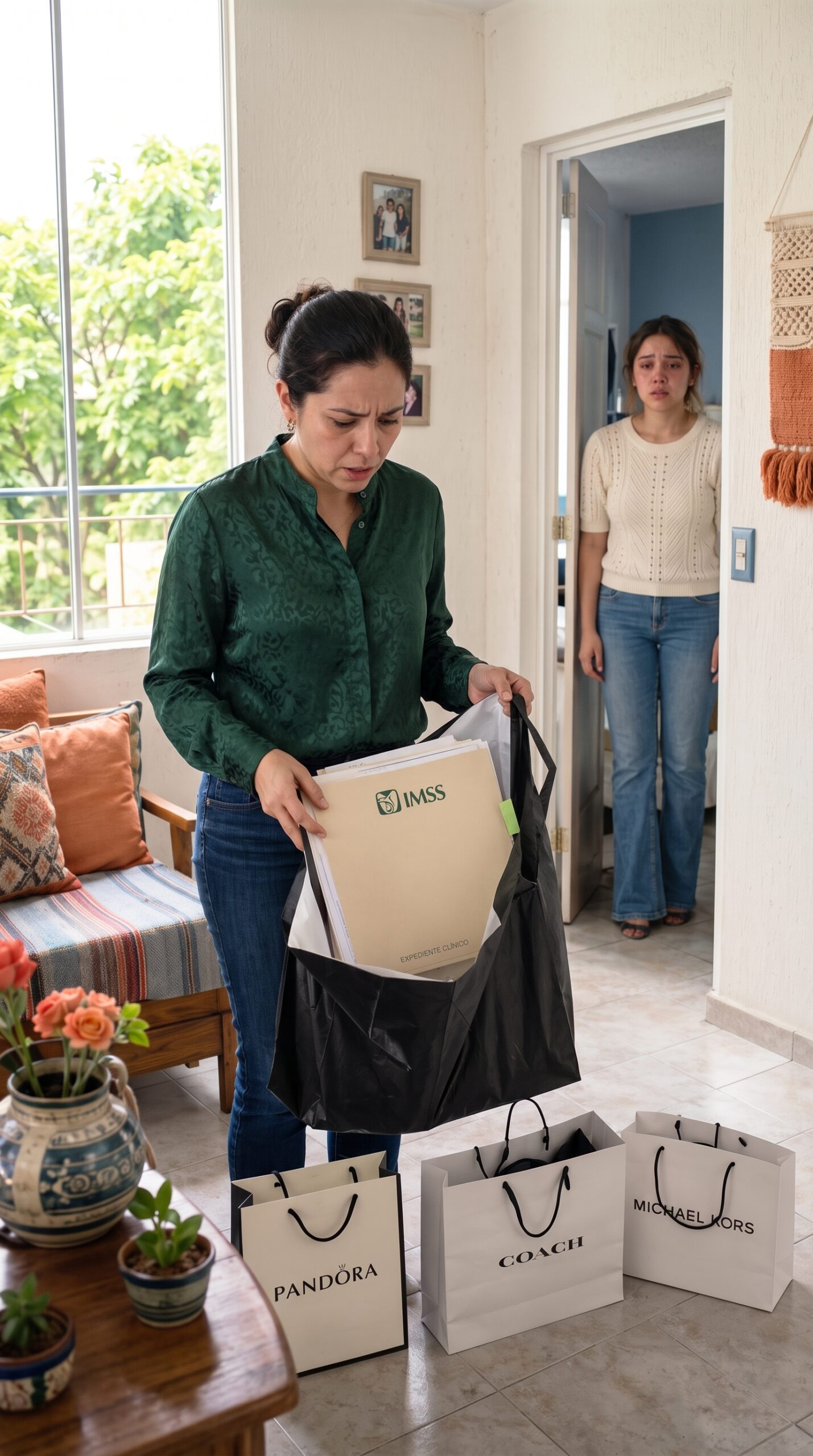
On Friday afternoon, Jimena arrived with 4 enormous bags from an upscale store in Polanco. She was sweaty, pale, but smiling in a strange way.
—What’s that? —Valeria asked.
—I got a little money.
—A little money? There’s money for designer clothes, but not to pay me back?
Jimena hugged the bags to her chest.
—Don’t start.
Valeria exploded.
On Saturday morning, she left the lawsuit on the table, right next to the coffee.
—It’s over, Jimena. Now you’re going to answer.
Jimena looked at the papers, then at her sister, and said nothing.
That ignited Valeria even more.
She went to the hallway, grabbed the bags, and ripped open the fourth one in anger, searching for a blouse, a dress, anything she could throw in her face to make her understand the shame.
But inside, there was no clothing.
There was a folder from the IMSS.
Valeria pulled it out slowly. Studies. Prescriptions. Appointments. Dates marked by hand.
And when she looked for the patient’s name, she felt the floor drop out from under her.
It didn’t say Jimena.
It said Rosario Hernández, her mother’s name.
PART 2
Valeria entered Jimena’s room without knocking.
Her sister was folding the new clothes on the bed, with a care that Valeria found cynical.
—What is this? —she asked, holding up the folder.
Jimena froze.
—Give me that.
—Why does an IMSS folder have mom’s name on it?
—It’s none of your business.
Valeria let out a dry laugh.
—How is it not my business? She’s my mom.
Jimena pressed her lips together. Her eyes were red, but she didn’t seem surprised. She seemed tired of the fact that this moment had arrived.
—Right now it’s my business, Valeria.
—Don’t come at me with nonsense. 4 years living here without doing anything, and now it turns out you’re hiding mom’s studies.
Jimena looked at the lawsuit on the bed. She picked it up with two fingers, as if it burned.
—Did you really do this?
—Yes. Because enough is enough. 4 years without working. 4 years hanging off me.
Then Jimena shouted something that shattered the air in the room.
—I didn’t get a job because someone had to take her to dialysis 3 times a week, and that someone wasn’t going to be you!
Valeria fell silent.
The word “dialysis” hit her chest, but her mind couldn’t connect it with the image of her mother preparing mole on Sundays, laughing softly, telling her not to push herself so hard.
—You’re lying —Valeria said, though her voice came out weak.
Jimena snatched the folder back.
—I wish it were a lie.
Valeria looked at the clothes on the bed. Elegant dresses, a fine blouse, new shoes, a cream-colored jacket with tags.
—And what’s this? You take her to dialysis and then go shopping in Polanco?
Jimena looked down.
She ran her hand over the dress, smoothing it with a tenderness Valeria couldn’t understand.
—The clothes aren’t mine.
—Then whose are they?
Jimena swallowed hard.
—They’re hers.
Valeria didn’t respond.
She imagined her mother tired, swollen, wanting to look beautiful one more time. She thought maybe she had been unjust. Maybe Doña Rosario just wanted to wear something nice for a meal, for a photo, to feel alive.
The shame began to burn her face.
She pulled out her cell phone and dialed her mother’s number. It rang once. It rang twice. It rang three times.
And then a phone rang inside Jimena’s room.
Valeria slowly lowered her phone.
Jimena answered from her own bed, crying silently.
—Don’t call that number anymore —she said in a broken voice—. I’ve had it for a month.
Valeria felt a chill.
—Why do you have mom’s phone?
Jimena sat on the edge of the bed. She no longer defended herself. No longer argued. She just looked like a woman who had been carrying a heavy stone on her back for too long.
—Because mom could hardly answer you without crying.
Valeria leaned against the door frame.
—Tell me everything.
—You don’t want to know everything.
—Jimena, tell me everything.
Her sister took a deep breath.
Doña Rosario had been sick with kidney disease for over a year. At first, it was swollen feet. Then fatigue. Then dizziness. Valeria had seen it during family meals, but always justified it.
“She’s getting old.”
“She must be tired.”
“It must be her blood pressure.”
Jimena was the one who took her to the IMSS the first time.
That day, Valeria was in an important meeting. A meeting she couldn’t even remember anymore.
Then came the tests, the transfers, the waits, the impossible prescriptions, the sleepless nights with fever, and the dialysis sessions on Mondays, Wednesdays, and Fridays.
4 hours connected to a machine.
4 hours with Jimena sitting in a plastic chair, holding her hand.
Those were the afternoons Valeria accused her.
—You went out again, didn’t you?
—Off again doing nothing.
—Seriously, Jimena, you’ve got no shame.
Jimena never replied because she came home exhausted. Not from partying. Not from hanging out with friends. From holding her mother while she trembled after each session.
Valeria looked down.
—Why didn’t you tell me?
Jimena let out a small, bitter laugh.
—Because she made me promise.
—Promise what?
—That you wouldn’t find out.
Valeria lifted her face, furious and hurt.
—She was my mom too!
—I know she was your mom too.
That “was” fell between them like a heavy stone.
Valeria noticed it.
—Why did you say “was”?
Jimena closed her eyes.
—Because the doctor said there isn’t much more to be done.
Valeria felt the room shrink around her.
—No.
—Yes.
—No, Jimena.
—Yes, Valeria. And mom didn’t want you to ruin your life trying to save something that was too far gone.
Valeria began to cry, but it was a silent cry, as if her body didn’t have permission to break.
—I would have paid for a private hospital.
—That’s why she didn’t tell you.
—I would have sold the car.
—That’s why she didn’t tell you.
—I would have brought mom here.
—That’s why she didn’t tell you.
Jimena wiped her face with her sleeve.
—She said: “Valeria has carried everyone since she was a child. I’m not going to let her carry my death too.”
Valeria couldn’t respond.
Her entire life, she had felt responsible. The one who never failed. The one who solved things. The one who paid. The one who didn’t ask for help because asking for help was for the weak.
And, without realizing it, she had confused Jimena’s silence with laziness.
That night, Valeria couldn’t sleep.
At 3 AM, she went to the kitchen and saw the pink pill organizer.
She opened it.
Each compartment held pills arranged with precision. Below was a label written in Jimena’s handwriting: “Mom. 7 AM, 2 PM, 9 PM.”
Valeria sat on the cold floor, the pill organizer in her hands.
For months, she had seen that object and thought: “This woman can’t even keep her things organized.”
But it wasn’t disarray. It was care. It wasn’t laziness. It was exhaustion. It wasn’t abuse. It was a clumsy and silent form of love.
At dawn, Valeria pulled out her blue notebook. She looked at the almost 300,000 pesos written down in anger.
Rent.
Utilities.
Water.
Food.
Loans.
There wasn’t a single line that said: “Mom.”
There wasn’t a single line that said: “Dialysis.”
There wasn’t a single line that said: “Jimena carried alone what the two of them should have carried together.”
On Sunday, Doña Rosario’s condition worsened.
Jimena drove to the hospital in a borrowed car from a neighbor because hers had been sold months before.
Valeria sat in the back, holding her mother’s hand.
—Forgive me, mommy —she whispered in her ear—. Forgive me for not seeing. Forgive me for being so busy being strong that I didn’t see you were fading away.
Doña Rosario didn’t open her eyes.
A doctor told them that she might still hear.
Valeria decided to believe him.
In the emergency room, Jimena signed papers with a calmness that didn’t seem human. She knew where each study was. She knew what medication was due. She knew which doctor had seen her. She knew what symptoms were new and which had been there before.
Valeria watched her sister as if she were seeing her for the first time.
The “freeloader” knew everything.
The “lazy one” had learned to care for a full-blown illness.
The “burden” had carried their mother alone.
Doña Rosario died on Monday afternoon, at the same hour she would have been due for another dialysis session.
Jimena didn’t scream.
She just sat there, staring at the white sheet, as if finally, someone had taken off a backpack, but along with it, they had ripped away half her soul.
Valeria wanted to hug her.
Jimena let her, but didn’t lift her arms.
At the funeral home, while they chose how to dress their mother, Valeria remembered the bags.
—The clothes from Polanco… —she murmured.
Jimena nodded.
—She asked me for something nice.
—To look good.
Jimena looked at her with dry eyes.
—So we could bury her in that.
Valeria felt the world twist again.
That phrase she hadn’t understood became clear.
“The clothes are hers. She’ll wear them.”
It wasn’t a whim. It wasn’t vanity. It wasn’t a celebratory purchase.
It was a farewell.
Doña Rosario had asked Jimena that when the time came, she not be buried in old clothes or a hospital gown.
She wanted to leave looking nice.
She wanted to wear something new.
She wanted her daughters to remember her beautiful, not consumed by illness.
Jimena had sold her car to pay for part of the medications, several transfers, studies that the insurance didn’t cover, and with what was left over, to buy her mother the last clothes of her life.
On Friday, after the last dialysis, she went to the store with trembling hands.
She came back with 4 bags.
When Valeria accused her of indulging herself, Jimena couldn’t tell her the truth.
She couldn’t stand in the living room and say:
“I went to buy the dress we’re going to bury our mother in.”
So she lied.
She said an ex had paid off an old debt.
That lie was what made Valeria call the lawyer.
That lie was what turned her pain into a lawsuit.
That lie, in the end, had been Jimena’s last attempt to protect her for one more day.
They buried Doña Rosario in the new dress, the cream jacket, and the shoes Valeria had judged without knowing.
She looked beautiful.
Valeria watched the tags the funeral home employee cut with small scissors. The same tags she had seen on the bed that had disgusted her.
That day she didn’t cry like a successful daughter.
She cried like a sister who had arrived too late.
After the burial, Valeria tore up the lawsuit in the kitchen. Not dramatically. She tore it up clumsily, with trembling hands, over the trash can.
Jimena watched from the doorway.
—You don’t have to do that —she said.
—I do.
—You don’t owe me anything.
Valeria looked up.
—I owe you 4 years.
Jimena shook her head.
—I don’t want to collect them.
—Well, I do want to pay them.
Since then, Jimena’s room remained occupied, but no longer as a refuge for a judged sister, but as a home for someone who deserved rest.
Valeria kept the fourth bag on top of the wardrobe.
Empty.
Sometimes she would take it down, put her hand to the bottom, and stay there for a few seconds, searching for something she knew wasn’t there.
She didn’t find clothes.
She didn’t find papers.
She found shame.
She found love.
She found the hardest truth of her life: sometimes one calls a burden the person who is silently holding everything up.
And when one finally opens their eyes, it may already be too late to ask for forgiveness from the one who deserved it the most.





