PART 1
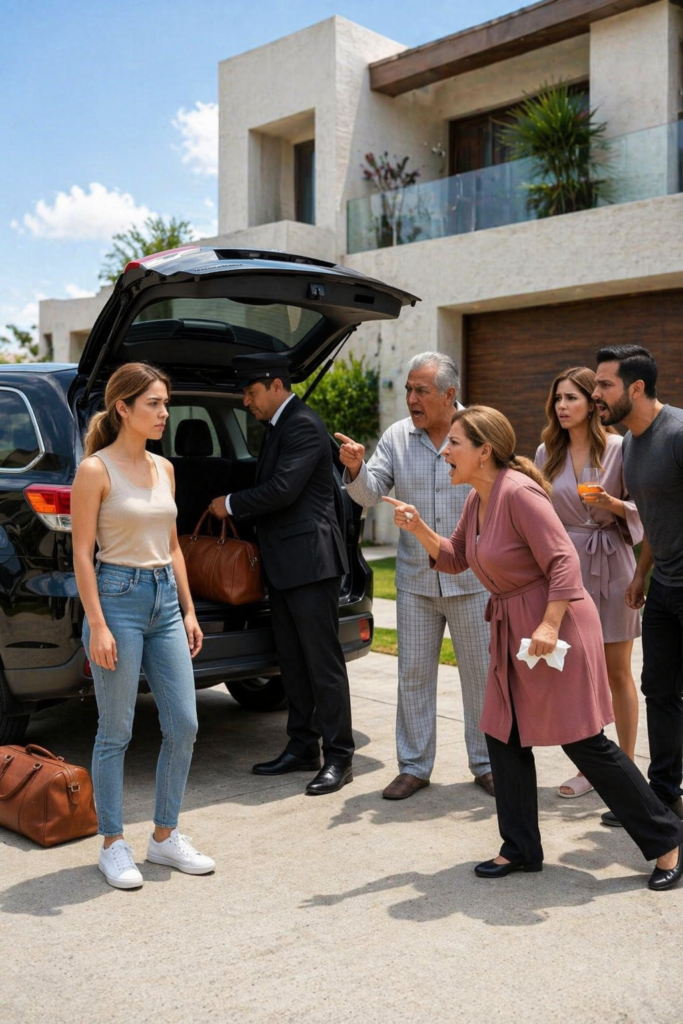
—You’re sleeping upstairs, in the service room. Your sister is coming with her husband, and we don’t want to disturb them.
Doña Patricia said this while adjusting the embroidered tablecloth on the dining table, as if she were announcing that the coffee was ready.
Valeria stood frozen at the entrance of the house, a backpack slung over her shoulder, an old suitcase, and exhaustion etched on her face. She had traveled from Querétaro to Guadalajara after three weeks of nearly no sleep, closing contracts, reviewing codes, and signing documents that still didn’t make sense in her mind.
But in that house in the Jardines Alcalde neighborhood, she was still “the weird girl with a computer.”
—Mom, my room is empty —Valeria said, trying to sound calm.
—It was your room —her father, Don Ernesto, corrected without taking his eyes off his cell phone—. Now we use it to store your sister’s things when she comes.
From the living room, Lorena let out a dry chuckle. She wore large earrings, had perfect nails, and was in a new blouse she surely bought with the credit card she flaunted like a medal.
—Oh, Vale, don’t exaggerate. It’s just one night. Besides, you always say you’re simple, right?
Next to her, Ramiro, her husband, adjusted his expensive watch and smiled with that look of a man who always believes he’s above everyone.
—There’s a breeze upstairs, right? It’ll even help you clear your head from being holed up with your internet games.
Valeria didn’t respond.
Because if she said anything, it would remind her of all the times he had entered her room “to borrow the charger,” “to check the modem,” or “to leave her a USB drive” she never asked for.
She would also remember that for fourteen months she had worked cooped up there, eating cold quesadillas, drinking reheated coffee, and listening to her family say it was time to get “a real job.”
To them, programming wasn’t work.
Developing a platform for refrigerated transport routes wasn’t work.
Sleeping four hours to build a system from scratch wasn’t work.
Working meant showing up in a pressed shirt, with a payroll receipt, a husband, kids, and pretty pictures on Facebook.
Lorena had that.
Valeria had dark circles, a laptop covered in stickers, and a bank account that no one in that house could have imagined.
—Don’t make drama, daughter —her mother murmured—. Your sister is tired from the trip. Her husband pays well when he goes out with us. We need to take care of them.
That phrase hurt more than the room.
Because Valeria understood they weren’t moving her because of a lack of space.
They were moving her because, to them, she was worth less.
She climbed the stairs without arguing. The service room was next to the water tanks, with a worn single bed, boxes of Christmas decorations, a broken bucket, and a small window that faced the street’s cables.
The tin roof creaked with the heat.
Below, laughter rose like knives.
Lorena was saying that Ramiro might open a tech consultancy. Doña Patricia proudly proclaimed that he knew how to make money. Don Ernesto asked if he needed “a smart girl” to help him with files.
Ramiro replied:
—Valeria is good at poking at the computer, but for serious business, you need a sharp edge.
Everyone laughed.
Valeria closed her eyes.
She didn’t cry.
She had cried enough when she lost her job at a startup in Monterrey and had to return to that house with a suitcase and the shame of feeling defeated.
But that night she was no longer defeated.
She was just waiting.
At 7:43 the next morning, she came down in the same clothes as the day before, her laptop clutched to her chest and her hair hastily pulled back.
Her mother was serving chilaquiles for Lorena and Ramiro.
No one had set a plate for Valeria.
Then, outside the house, a smooth brake sounded.
A shiny black Mercedes, with a chauffeur, stopped in front of the gate.
A suited man stepped out, checked a tablet, and rang the doorbell.
—Good morning. I’m looking for Engineer Valeria Montes Rivas.
Lorena’s fork fell onto her plate.
Ramiro went pale.
And Valeria, seeing the fear hidden in their eyes, understood that the humiliation of the attic was not the worst thing this family was about to discover.
PART 2
Doña Patricia opened the door with her hands still damp from the kitchen cloth.
—The engineer who? —she asked, as if the man had just uttered a curse.
The chauffeur, impeccably dressed, slightly bowed his head.
—Engineer Valeria Montes Rivas. I come on behalf of Grupo Cárdenas Logística. We have instructions to take you to the final signing and then to the corporate department assigned to you.
Don Ernesto appeared behind his wife, adjusting his glasses.
—You must be mistaken, young man. No engineer lives here.
Valeria stepped down the last stair.
—Yes, I do, Dad.
The silence was so heavy that even the sound of cars on the street seemed to fade away.
Lorena slowly stood up from the table.
—Final signing for what?
The chauffeur checked the tablet.
—For the acquisition of FríoRuta MX, a platform developed by Engineer Montes. Her presentation as the director of innovation for the new smart transport division is also scheduled.
Doña Patricia placed a hand on her chest.
Don Ernesto looked at her as if he suddenly didn’t recognize his own daughter.
Ramiro, on the other hand, wasn’t looking at her.
He was looking at the laptop.
He was looking at the backpack.
He was looking at the door.
Valeria noticed that detail and felt a strange chill in her back.
—FríoRuta MX? —Lorena whispered—. Was that what you were doing locked up?
—That was what you all called wasting time —Valeria replied.
She didn’t raise her voice. There was no need.
Ramiro tried to laugh it off.
—Well, don’t get all intense. It’s great that something worked out for you, Vale. Congratulations, seriously.
The word “seriously” sounded false, desperate.
Valeria looked at him calmly.
—Thanks, Ramiro.
He swallowed hard.
That gesture betrayed him more than any confession.
Valeria got into the Mercedes without saying goodbye. As the car moved along the avenue, she saw in the mirror how her parents remained frozen on the sidewalk, Lorena with her mouth agape and Ramiro talking very quickly, waving his hands as if he were already explaining something no one had asked him.
The corporate building was in Puerta de Hierro, with enormous glass windows, private security, and an elegant silence that made everything feel unreal.
Valeria had imagined that moment many times.
She thought she would feel victorious upon arrival.
But the first thing she felt was a deep sadness.
Because no one in her family had hugged her.
No one asked if she was happy.
No one said, “I’m sorry for sending you upstairs.”
They were only surprised that the daughter they had cornered turned out to be worth money.
At 10:30, she was greeted by Alonso Cárdenas, the group director. He was a serious man in his fifties, with a calm voice and very alert eyes.
—Valeria, before you sign the last part, there’s something you need to see —he said.
She sat down in front of a dark wood table.
Alonso slid a blue folder across.
—Five months ago, someone came to offer us a tool similar to yours.
Valeria felt her fingers tense.
—Similar how?
—Same maps. Same route logic. Even the same internal name in some files: Project Nopal.
That name wasn’t listed anywhere publicly.
It only appeared in her private folders.
—Who was it? —she asked, though a part of her already knew.
Alonso opened the folder and turned the first page.
There was a photo of Ramiro entering the corporate office, in a white shirt, black briefcase, and that salesman’s smile he used to convince everyone.
Beneath it were emails, proposals, screenshots, incomplete files, and a presentation titled: “FríoRuta: logistics solution developed by Ramiro Salcedo.”
Valeria stopped breathing for two seconds.
—It can’t be.
—He tried to sell us your work as his —Alonso said—. But the system was incomplete. There were broken modules, functions without keys, and encrypted parts. That made us suspicious.
Valeria remembered every visit from Ramiro to her room.
Every time he came in while she was in the bathroom.
Every time he asked to use her charger “because his wasn’t working.”
Every time she noticed her external hard drive moved two centimeters and thought she was being paranoid.
—He stole files from my computer —she murmured.
—That’s what we believe. But there’s more.
Alonso pressed a button, and a security video appeared on the screen.
It was Ramiro, in the hallway of the Montes’ house, entering Valeria’s room when everyone was supposedly at a family meal. He was wearing black gloves and carrying a USB drive.
Valeria froze.
—Where did that come from?
Alonso breathed slowly.
—Your neighbor, Doña Elvira, installed a camera because someone was stealing her plants. It captured part of the entry to your window. When she read on social media that Ramiro was going to open a tech consultancy, she remembered the video and contacted us. She said something didn’t add up.
Valeria covered her mouth.
The neighbor her mother called a gossip had seen more than her own family.
—Did my parents know? —she asked.
Alonso hesitated for a moment.
That hesitation broke her.
—Tell me the truth.
He pulled out another sheet.
It was a screenshot of messages between Ramiro and Don Ernesto.
Ramiro: “I need to get into Vale’s room. There are some files that could be useful to us all.”
Don Ernesto: “I don’t want problems.”
Ramiro: “When this takes off, I’ll buy them the vacation house. She doesn’t even know how to sell it.”
Don Ernesto: “Do it quickly. Patricia will keep her entertained downstairs.”
Valeria felt the floor drop away.
It wasn’t just Ramiro.
Her father had allowed it.
And perhaps her mother had too.
It wasn’t a stranger’s theft.
It was a handover.
They had sent her to sleep in the service room while they celebrated the thief at the table.
—Tonight there’s a presentation —Alonso said—. Your family has been invited.
Valeria lifted her gaze.
—I didn’t invite them.
—I know. I invited them because we need to publicly establish authorship. The group’s lawyer and a notary will also be present. You decide if you want to confront them or if you prefer we handle it without you.
Valeria looked at the papers.
For years she had wanted her parents to see her.
For them to one day say: “We were wrong.”
But she didn’t know if that was enough anymore.
Because one thing was not believing in her.
Another was opening the door to someone who tried to steal the life she built on her own.
That night, the terrace of the corporate building was filled with entrepreneurs, investors, and transport executives. There were warm lights, fine glasses, low music, and a view of Guadalajara spread out like a sea of lights.
Valeria arrived in a navy blue suit, simple makeup, and her hair down.
She didn’t seem like a daughter asking for permission.
She looked like a woman owning her own name.
Her parents arrived first. Doña Patricia wore a beige dress and had red eyes. Don Ernesto walked stiffly, with that old arrogance that broke in his jaw.
Lorena entered afterward, linked arm in arm with Ramiro.
She smiled nervously.
He didn’t.
Ramiro looked at Valeria, and his face changed. There he understood that it wasn’t a family dinner, nor an innocent celebration, nor an opportunity to ride on her success.
It was a trial without a court.
Alonso Cárdenas stepped up to the small podium and took the microphone.
—Good evening. Tonight, we officially present the integration of FríoRuta MX into our group. A platform created by a single Mexican developer, without external funding, without hidden partners, and with a technical capability that puts us three years ahead in the market.
There was applause.
Doña Patricia started to cry.
Lorena clapped slowly, confused, as if she still wanted to believe that everything was fine.
Alonso continued:
—It’s also important to clarify that, before this signing, there was an attempt to present this technology under false authorship.
Ramiro tightened his grip on the glass.
Lorena turned to him.
—What is he saying?
A lawyer distributed sealed folders among the main guests and left one in front of Lorena, one in front of Don Ernesto, and one in front of Ramiro.
Valeria didn’t need to open hers.
She already knew the contents.
Alonso projected on the screen the emails sent by Ramiro, the business proposal, the stolen files, and the access records.
Then the video from Doña Elvira’s camera appeared.
Ramiro entering through Valeria’s window.
The room filled with murmurs.
Lorena dropped her glass, and the wine spilled over the white tablecloth.
—Ramiro… tell me it’s not you.
He stood up.
—This is manipulated. Valeria has always been resentful. She surely set this up to humiliate me because I’ve progressed.
Valeria looked at him without blinking.
—Did I also manipulate your emails? Your calls to the corporate office? Your presentation with my internal name? The hard drive you sold in Tepatitlán?
Ramiro stood frozen.
Lorena opened the folder with trembling hands.
—Tepatitlán? What hard drive?
The lawyer intervened.
—A partial copy of the code was located in the hands of a third party. The seller was identified as Ramiro Salcedo. There is a formal complaint for intellectual property theft, attempted fraud, and unauthorized access.
Don Ernesto slammed the table.
—You can’t say that! It’s family!
Valeria slowly turned toward her father.
—Family? Was it also family when you opened the door to my room?
Silence fell like a stone.
Doña Patricia stopped crying.
Lorena looked at her father.
—What?
Don Ernesto paled.
—I didn’t know he was going to steal. I just thought he was going to check.
Valeria let out a sad laugh.
—Check what, Dad? My life? My work? The one thing you all said was worthless?
Doña Patricia covered her face.
—Ernesto, you said it was to help her…
Valeria felt the last piece click into place.
Her mother did know.
Maybe not all the details, but she knew Ramiro was going in.
And yet, the next day, she served chilaquiles to the thief while she didn’t even set a plate for her.
Lorena slowly stood up.
—Mom… did you let my husband into my sister’s room?
Doña Patricia cried harder.
—He told us he could sell that, that later Valeria would thank us because she had no contacts.
Ramiro tried to take Lorena’s hand.
—Honey, I did this for us. Your family was going to profit. Your dad wanted to pay debts. Your mom wanted to fix the house. I just saw an opportunity.
Lorena slapped him so hard that everyone froze.
—And in the meantime, you mocked her with me? Did you make me believe my sister was a failure so I wouldn’t suspect you were stealing from her?
Ramiro didn’t respond.
Because the truth was already naked.
Valeria felt something inside her, something tight for years, finally loosen.
It wasn’t happiness.
It was a kind of mourning.
She looked at her parents, at those two adults who had raised her with the idea that she should obey, stay silent, and be grateful for any scrap of a roof.
—Last night I was sent upstairs because Lorena was coming with her husband —she said—. I was taken from my room to give comfort to the man who tried to sell my work. And you didn’t just humiliate me. You helped him.
Don Ernesto lowered his head.
—Daughter, I’m sorry. I thought…
—No —Valeria interrupted—. You didn’t think of me.
Doña Patricia tried to come closer.
—Vale, please. We’re your parents.
—And I was your daughter even when you treated me like a burden.
That phrase broke Lorena.
She took off her wedding ring and placed it in front of Ramiro.
—I’ll file for divorce tomorrow. And if you really used my name for any of this, I’m coming after you too.
Ramiro tried to leave, but two security personnel stopped him at the door. Not with violence. Just with enough firmness to remind him that he could no longer walk through life believing himself untouchable.
The lawyer informed him that he had to stay to receive the notification.
Don Ernesto sank into his chair.
Doña Patricia cried as if she suddenly understood that she hadn’t lost a family night, but years of trust.
Alonso approached Valeria and spoke softly.
—The signing is ready. But you don’t have to do anything now.
Valeria looked at the city.
She thought of the hot attic room.
Of the old boxes.
Of the dying fan.
Of all the nights she asked herself if maybe her family was right and she was worth nothing.
Then she took the pen.
She signed.
The applause was discreet, respectful, almost solemn.
They weren’t the applause a family denied her.
They were from people who, without owing her affection, recognized her work.
Days later, Ramiro faced a formal complaint and lost the consultancy he had just been bragging about. Lorena filed for divorce, and for the first time, she sought out Valeria without emotional makeup.
She didn’t ask her to forget.
She only said:
—I’m sorry for laughing when I should have defended you.
Valeria didn’t hug her immediately.
But she didn’t close the door either.
With her parents, it was different.
Don Ernesto called 17 times in a week. Doña Patricia sent long messages, pictures of the clean room, crying audios, promises to change.
Valeria read everything.
She didn’t respond to all.
Because healing wasn’t about running back to the same place where they broke her.
Months later, she bought a small apartment in Providencia. It had plenty of light, plants in the window, and a spacious desk where no one could enter without knocking.
One afternoon, while arranging her laptop, she received a photo from her mother.
It was the empty attic room.
No boxes.
No old bed.
No buckets.
The message said:
“We finally understood you should never have slept there.”
Valeria looked at the photo for a long time.
Then she turned off her phone and continued working.
Because some humiliations can’t be erased with apologies.
And some families only discover how much a daughter was worth when they can no longer send her to the corner, take away her room, or decide what place she deserves in the world.





