PART 1
The first contraction doubled Mariana Ortega over while she was in the kitchen, trying to pour herself a glass of water.
The glass slipped from her hand and shattered against the floor as if announcing something terrible.
—Rodrigo... —she managed to say, clutching her belly—. Something’s not right.
Rodrigo Cárdenas didn’t even look up from his phone at first. He was in front of the dining room mirror, adjusting his navy blue jacket, his hair slicked back, and a pricey watch gleaming on his wrist.
That night was his mother Doña Patricia's 65th birthday.
And for Rodrigo, missing the family dinner in a Polanco banquet hall was nearly a mortal sin.
Mariana was 38 weeks pregnant. Just four days earlier, Dr. Valdez had warned them that her blood pressure was unstable and that if she felt severe pain, dizziness, or bleeding, they needed to rush to the hospital.
Rodrigo had nodded seriously in the office.
But now, as Mariana bent over the kitchen counter, cold sweat breaking out on her skin, he let out a sigh of annoyance.
—Come on, Mariana, don’t start.
She gritted her teeth. Another contraction hit, stronger, deeper, as if something inside her was tearing apart.
—I think the baby is coming... please, take me to the hospital.
Rodrigo grabbed the car keys.
—You always do this. As soon as my family needs something, you pull this drama.
Mariana looked at him, her eyes filled with fear.
—Your daughter needs you.
He paused at the door and let out a dry laugh.
—My mom only turns 65 once. You’ve been pregnant for 9 months. You can wait 2 hours.
And he left.
The door slammed, shaking the pictures in the hallway.
Mariana tried calling him 5 times. Rodrigo rejected every call. On the sixth, his phone sent her straight to voicemail.
Then she saw the blood.
At first, it was a small spot on the floor. Then another. The world began to tilt beneath her.
With trembling hands, she dialed 911 and crawled to the entrance, terrified that paramedics wouldn’t be able to get in if she fainted.
—My husband left... I’m alone... I’m pregnant... please, hurry —she begged.
The ambulance arrived minutes later.
Mariana would remember red lights on the ceiling, a voice telling her not to close her eyes, and words that froze her blood: “fetal distress,” “possible placental abruption,” “emergency cesarean.”
Then, everything went white.
Two days later, Rodrigo returned home smiling, a slice of cake in a golden box and his jacket still smelling of expensive perfume.
He expected to find a tired wife and a newborn baby.
But when he opened the door, he saw what was waiting for him in the living room… and fell to his knees, pale, as if he had just witnessed his own condemnation.
PART 2
In the middle of the living room, there were no balloons, no flowers, no decorated crib.
There was a closed suitcase, the broken glass from the kitchen still in a transparent bag, and a dark stain that someone had tried to clean up unsuccessfully near the hallway.
On the table lay Mariana’s phone, playing on repeat the last audio she had managed to record before passing out.
Rodrigo’s voice sounded clear, cruel, impossible to deny.
“My mom only turns 65 once. You’ve been pregnant for 9 months. You can wait 2 hours.”
Rodrigo felt his legs give way beneath him.
In front of him stood Renata, Mariana’s older sister, her eyes red from lack of sleep and a thick folder in her hands.
Beside her were a lawyer and two police officers.
—Where’s Mariana? —Rodrigo asked, trying to sound angry, but his voice came out broken—. Where’s my daughter?
Renata stepped toward him.
—Your daughter is alive by a miracle. So is Mariana.
Rodrigo swallowed hard.
He didn’t know that while he was toasting with premium tequila for Doña Patricia, Mariana was being cut open in an emergency operating room.
He didn’t know that Luna Sofía Cárdenas was born without crying.
He didn’t know that a nurse had placed a hand on Mariana’s shoulder and whispered, “They’re doing everything they can,” as she, numb from the chest down, looked at the surgical lights and begged God not to take her baby.
Rodrigo didn’t know because he never arrived.
Not that night.
Not the following morning.
Not even when the hospital called him as an emergency contact.
Later, Mariana learned that he had replied to a nurse:
—My wife exaggerates a lot. Call me when something really happens.
Something had happened.
Luna was taken to neonatal therapy with tiny tubes stuck to her face, so small she seemed to disappear inside the incubator.
Mariana lost too much blood. Her pressure dropped twice. For 16 hours, doctors monitored her as if she were a candle about to go out.
Renata arrived before dawn because she saw the missed calls.
She found the empty house, the broken glass, the trail of blood, and the door wide open.
It was she who ran to the hospital.
It was she who signed papers when Mariana could barely hold a pen.
It was she who stood in front of Luna’s incubator and cried silently, saying:
—We love you here, little one. Even if your dad is a coward.
When Mariana woke up on the second day, Renata was by her bedside with the phone in hand. Her face was pale with rage.
—Mariana... Rodrigo posted pictures.
Mariana blinked, confused from the medication.
—What pictures?
Renata showed her the screen.
There was Rodrigo, smiling, hugging Doña Patricia under golden balloons, a glass in hand, and the whole family around.
The text read:
“Family always comes first.”
Mariana didn’t scream.
Didn’t cry.
Didn’t break anything.
She just stared at the post until something inside her went dark forever.
It wasn’t hatred.
It was clarity.
In that moment, she understood she had been making excuses for the unforgivable for years.
Every time Rodrigo said she was exaggerated.
Every time Doña Patricia called her “delicate.”
Every time Mariana apologized just to avoid a fight.
Every time her pain was treated as an inconvenience.
But that time was no longer just about her.
It was about Luna, fighting for breath in a glass box because her father decided that his wife’s labor was less important than cutting a cake.
A nurse entered to check her vital signs and noticed her expression.
—Are you sure you feel safe going home with your husband?
The question was simple.
But it opened a door Mariana had been pretending was a wall for years.
That same afternoon, Renata called the lawyer Elena Robles, a family friend who worked on domestic violence cases.
When she heard the audio, saw the post, and read the medical report, Elena didn’t hesitate.
—This isn’t just emotional abandonment. There’s negligence, psychological violence, and a direct risk to mother and daughter.
Mariana, still weak, signed with trembling hands.
She didn’t sign out of revenge.
She signed for Luna.
She also asked for something else.
—I want him to understand what he did when I go back to that house.
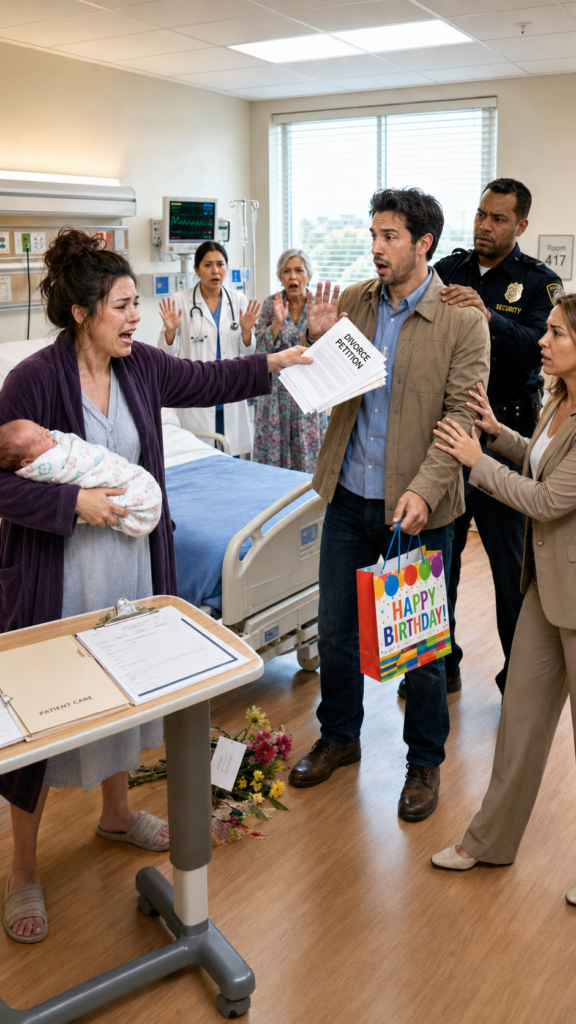
That’s why Rodrigo found the police in the living room.
That’s why he found the suitcase ready.
That’s why he found a temporary restraining order on the table.
And that’s why, when he tried to play the victim, Renata wouldn’t let him speak.
—Before you say something stupid, listen to this.
She pulled out another phone.
It was a video recorded in the hospital.
Mariana appeared pale, with deep dark circles under her eyes, connected to IV fluids. She could barely move. Beside her, behind glass, was Luna, with wires on her chest and a tiny bandage on her foot.
Mariana’s voice sounded low but firm.
—Rodrigo, when you left me in the kitchen, you didn’t just abandon me. You abandoned your daughter before you even met her. And that can’t be fixed with flowers, or apologies, or saying you were stressed.
Rodrigo covered his mouth.
—I didn’t know...
Renata exploded.
—Of course you knew, dude! You called 5 times. The hospital called you. The doctor had already warned you. What you didn’t know was that someone was going to gather evidence.
Rodrigo tried to move closer to the table, but one of the officers asked him to stay where he was.
—This is an exaggeration —he murmured, using the same phrase as always, but now without strength.
Then another phone rang.
It was Doña Patricia.
Rodrigo answered on speaker without thinking.
—Son, have you arrived? Tell Mariana not to be resentful. We all give birth and none of us died from it. Also, you looked great in the photos yesterday. The family saw that you were with me.
The room fell silent.
Lawyer Elena raised an eyebrow.
—Thank you, Mrs. Patricia. That was also recorded.
Rodrigo hung up abruptly.
His face changed completely.
It wasn’t guilt.
It was fear.
Fear that his coworkers would see him.
Fear that his family would stop applauding him.
Fear that the world would discover that Doña Patricia's good son was a terrible husband and a father who missed the birth of his daughter because he had a dinner to attend.
—Renata, please... let me talk to Mariana.
—No —she replied—. Mariana has talked to you for years. You never listened.
Rodrigo clenched his fists.
—She’s my daughter.
Renata stepped so close that he backed away.
—Your daughter is the baby who spent 2 days in neonatal therapy while you posted selfies with champagne. Don’t use the word “my” as if you had been there.
The lawyer handed him the documents.
Rodrigo read quickly. Separation. Protection measures. Request for provisional custody. Medical report. Copies of rejected calls. Testimony from the nurse. Screenshot of the post.
It was all there.
The worst came at the end.
A printed sheet with Dr. Valdez’s signature stated that had the ambulance taken any longer, the outcome could have been fatal for mother or baby.
Rodrigo sat on the floor.
The box with the cake fell from his hands. The frosting smeared against the tiles.
For the first time in years, he had no prepared phrase.
No Mariana asking for forgiveness.
No mother protecting him.
No control.
At the hospital, Mariana sat by Luna’s incubator when she received a message from Renata:
“He knows everything now.”
Mariana looked at her baby.
Luna remained small, fragile, her tiny fists clenched as if she were fighting against the world from the very first minute.
Dr. Valdez approached and smiled slightly.
—She’s improving. She’s strong, like her mom.
Mariana caressed the glass.
—I don’t want her to be strong because they hurt her —she whispered—. I want her to be free because someone protected her.
Hours later, Rodrigo arrived at the hospital but couldn’t get in.
The order was already active.
He stood at the entrance, calling, sending messages, writing long apologies that began with “sorry” and ended blaming stress, his mom, traffic, confusion.
Mariana read just one.
Then she blocked the number.
Doña Patricia appeared the next day, furious, with dark sunglasses and a designer bag, saying she wanted to meet “her granddaughter.”
Renata stopped her at reception.
—That girl isn’t a birthday prize, ma’am.
Doña Patricia threatened to sue, to call in favors, to “put Mariana in her place.”
But when lawyer Elena showed her that her comments were also documented, her voice dropped.
The woman who had always called the shots was left without a stage.
Weeks later, Luna was discharged from the hospital.
Mariana did not return to Rodrigo’s house.
She temporarily moved in with Renata in Coyoacán, in a small apartment full of plants, where no one called her dramatic for crying and no one mocked her exhaustion.
Rodrigo requested to see the baby.
The judge allowed supervised visits but made it clear that the abandonment during the emergency would be taken into account.
During the first visit, Rodrigo arrived with a huge teddy bear, flowers, and a remorseful face.
Luna slept in Mariana’s arms.
He looked at her as if until that moment he understood that that tiny life had almost been lost because of his selfishness.
—Mariana... I love you.
She didn’t raise her voice.
Didn’t put on a show.
Just looked at him with a calmness that hurt more than any insult.
—No, Rodrigo. You loved that I put up with everything. You loved that I kept quiet. You loved having a wife who made you look good. But love also meant answering the phone. Love meant taking me to the hospital. Love meant choosing your daughter when she needed you the most.
Rodrigo cried.
Mariana didn’t.
She had cried enough in the operating room.
Months later, when Luna turned 1 year old, Mariana posted a simple photo: her holding her daughter in a park, both smiling under the shade of a jacaranda.
The text read:
“Sometimes a family begins the day a woman stops protecting a marriage and starts protecting her daughter.”
The post filled with comments.
Some said she should have forgiven.
Others said no birthday justified abandoning a woman in labor.
But the question that repeated the most was the same:
How many times does a woman have to be on the edge of death for them to finally believe her?





