PART 1
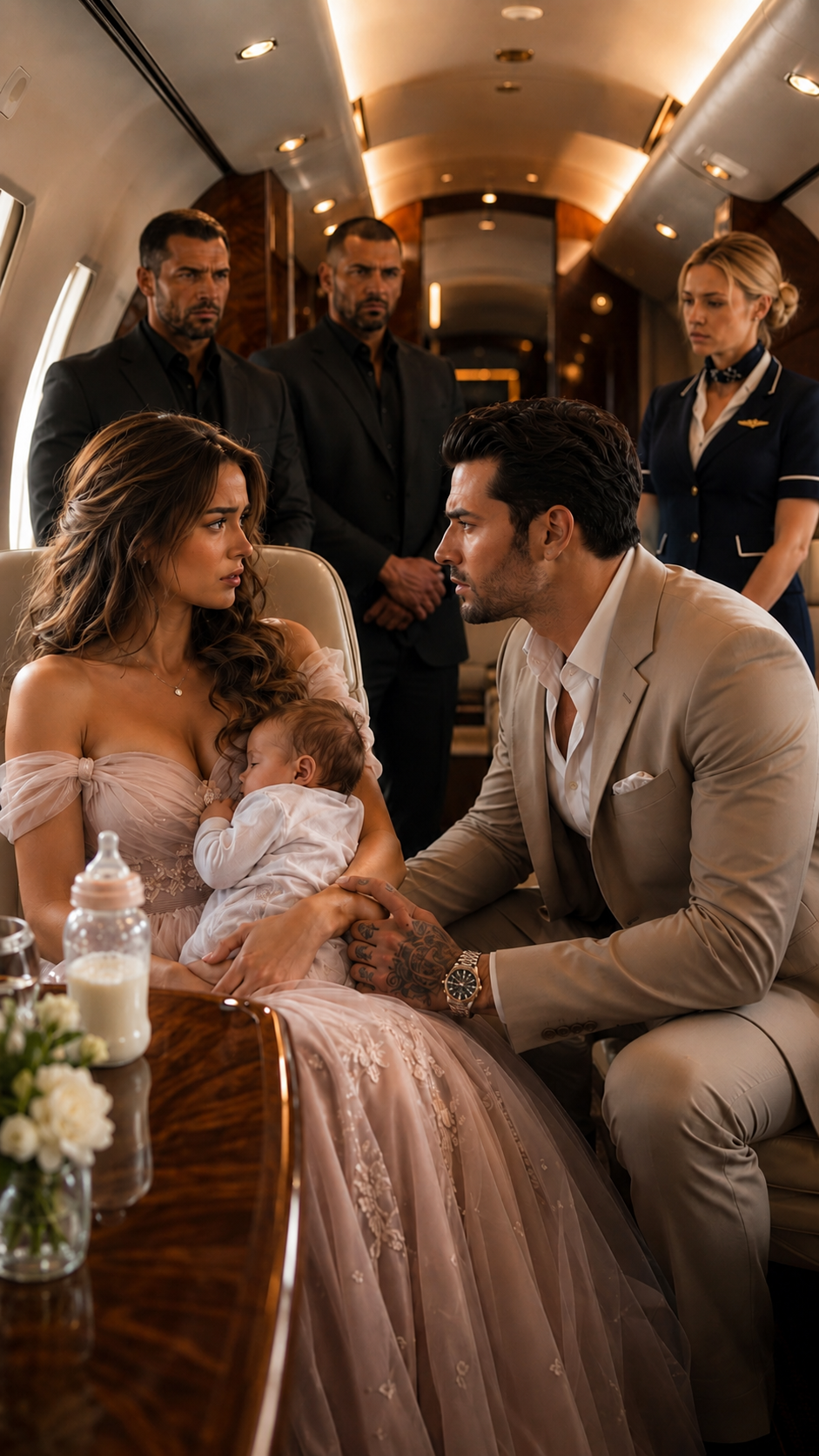
The baby's cries began when the private jet had been in the air for two hours over the Atlantic.
At first, it sounded strong, like any newborn discomforted. Then it grew weak, gasping, almost breathless.
Elena Ríos opened her eyes wide.
The flight was from Madrid to Mexico City. She had worked for nine years as a neonatal nurse in Puebla and knew how to tell a tantrum from a true emergency.
That little girl was running out of strength from hunger.
At the front of the plane was Joaquín Valdés, known in the papers as "El Zarco." Tall, dressed in a dark suit, he held a tiny baby in his tattooed arms.
In Mexico, his last name was enough to make businessmen, police, and politicians lower their voices. The four armed men scattered throughout the cabin confirmed he was no ordinary passenger.
Yet that night, the most feared man on the plane seemed defeated.
He brought a bottle to his daughter's mouth, but she turned her head, pressing her lips shut.
"We heated up another formula," murmured a flight attendant.
"She doesn't want it," Joaquín replied.
Elena tried to look away.
Three months before, her husband, Daniel, had died when his car went off a cliff on the Mexico-Puebla highway. Their twins, Emiliano and Mateo, were born prematurely that week and died from complications no doctor could stop.
She survived, at least physically.
She had accepted a consulting job in Spain to escape her home, the blue room, and the two cribs she couldn’t bring herself to dismantle.
The cruelest part was that her body continued to produce milk.
Every morning, the pain reminded her that she was still waiting for two children who would never return.
The baby let out a whimper so small that Elena felt something break inside her.
She stood up.
One of the bodyguards stepped forward, showing his weapon under his jacket.
Joaquín raised two fingers, and the man stopped.
"Your daughter is going into a feeding crisis," Elena said. "She could become dehydrated or lose consciousness."
"You know about babies?"
"I was a neonatal nurse."
Elena swallowed hard.
"I can feed her."
Joaquín took several seconds to comprehend.
Minutes later, behind a divider, Elena held the girl against her chest. The little one latched on desperately and stopped crying.
Elena closed her eyes.
She felt relief, pain, and a tenderness so brutal that tears began to fall.
For the first time since her children died, someone needed her.
Upon landing at a private hangar in Toluca, she handed the baby over, grabbed her suitcase, and walked toward the exit.
Joaquín blocked her way.
Behind him, the four bodyguards formed a line.
"You saved my daughter," he said.
"I’m glad she’s okay."
"You don’t understand."
He pulled out a transparent bag. Inside was the rejected bottle. Tiny white crystals floated at the bottom.
"Someone tried to poison her. And now those who did know that you kept her alive."
Elena looked at the open door of the plane, so close yet impossible to reach.
Then Joaquín spoke the words that turned her compassion into a condemnation:
"From this night on, you cannot go back home."
PART 2
Elena stepped back, clutching the strap of her bag.
"That’s kidnapping."
"Call it what you want," Joaquín replied. "If you leave this hangar alone, you won’t make it to the highway alive."
"Why would they know who I am?"
Joaquín pointed to a camera above the jet's door.
"The security feed was intercepted. They saw your face and know my daughter agreed to feed from you."
"I’m not anyone's property."
"I didn’t say you were."
"You just told me I can’t leave."
"Because there are two trucks outside waiting to confirm if the baby died."
One of the men showed a tablet. The screen displayed dark vehicles and several people watching the access.
Joaquín ordered the lights off and took Elena and the baby through a service door to an armored truck.
During the ride, the baby woke up crying and instinctively searched for Elena's breast.
"She needs to eat," she said.
Joaquín closed his eyes for a second, terrified by that dependency.
They arrived at a fortified estate in Valle de Bravo, with high walls, cameras, dogs, and armed men. Elena felt she had traded one prison for another, more elegant.
A pediatrician named Regina Salgado examined the baby, Lucía. She was dehydrated but stable.
Hours later, Regina analyzed the bottle.
"It contained a sedative mixed with an anticoagulant. In a five-week-old baby, it would have been fatal."
Joaquín slammed his hand on the table.
"Only six people knew what formula it had."
"Then one of them is inside here," Elena replied.
She remembered a bodyguard insisting on changing the bottle before the crying started. He was the only one who had avoided looking at Lucía when Elena fed her.
"The man with the scar," she said, "the one by the exit."
Joaquín called on the radio.
There was no answer.
Seconds later, gunshots rang out in the courtyard.
The bodyguard, nicknamed Chuy, tried to escape in a truck, but they captured him before he could cross the gate.
On his phone, they found messages directed to someone identified as "R."
"If the girl dies, the boss loses his head."
"Then we’ll go after the nurse."
Elena paled.
"Who is R?"
Joaquín didn’t answer.
That night, he ordered Lucía to sleep in Elena’s room, guarded by two women. He also returned her phone, but it had no signal.
"Tomorrow, she’ll call her mother from a secure line," he said.
"And what do I tell her? That I’m on vacation with a criminal?"
"Tell her the flight was delayed."
Elena slapped him.
The bodyguards raised their weapons, but Joaquín didn’t move.
"I lost my husband and my children," she said, "I won’t lose my freedom because you have enemies."
For the first time, the drug lord’s face cracked.
"I know who your husband was."
Elena stopped breathing.
Joaquín pulled out a photograph. Daniel was shown coming out of a restaurant in Polanco with Rafael Valdés, Joaquín’s older brother, and supposed real estate mogul.
"Daniel was investigating Rafael," he explained. "He discovered he was using a children’s foundation to launder money and transport minors with false documents."
"Daniel worked in insurance."
"That’s what he told you to protect you."
Joaquín laid out emails, photographs, and notes signed by Daniel. For eight months, he had been investigating accounts, names, and routes from Veracruz to the border.
He had also written that an informant from the Valdés family wanted to dismantle the network.
That informant was Joaquín.
"You were working with Daniel?"
"I gave him proof. We were going to report Rafael to the authorities and foreign journalists."
"Then you killed him when he stopped being useful."
Joaquín endured the accusation.
"The day of the accident, I sent two men to get him out of Puebla. They arrived late. The brakes on his car had been cut."
Elena gripped a chair.
For three months, she believed Daniel died due to rain and bad luck. Now she knew someone had chosen his death.
"Why didn’t you find me?"
"Rafael was watching the funeral. If I approached, you would have been next."
A cry erupted from the room.
As Elena fed Lucía, she understood the most horrifying part.
"Rafael tried to kill his own niece."
Joaquín nodded.
Lucía had inherited her mother Mariana’s properties, who died during childbirth. If the girl died and Joaquín fell, Rafael would control everything.
Regina reviewed Mariana’s file and found another irregularity: an unregistered nurse had administered a medication to which she was allergic.
The attack on the plane hadn’t been the first.
Rafael had been eliminating anyone who could stop him for weeks.
At dawn, Joaquín gathered his men.
"We’re going to turn him in."
"To the police?" one asked.
"To the prosecutor's office, with Daniel’s evidence, Chuy’s messages, and Mariana’s file."
Elena let out a bitter laugh.
"And you expect an unbought prosecutor to deliver justice?"
Joaquín turned on a screen. He had scheduled the simultaneous sending of everything to twelve journalists, three international organizations, and two consulates.
"I hope no one can bury it."
They needed a confession. Chuy agreed to call Rafael in exchange for protection for his family.
The conversation was recorded.
Rafael ordered to finish the job that afternoon and asked about "the meddlesome wet nurse from the plane."
Before hanging up, he said something that froze Elena:
"That woman should have died with her husband."
The phrase linked him to Daniel.
It also revealed that Elena was already a target before the flight. Feeding Lucía only confirmed that she remained alive and near Joaquín.
Hours later, federal agents surrounded a house in Lomas de Chapultepec. Rafael tried to escape through a tunnel, but his bodyguard abandoned him when the documents began circulating on social media and news outlets.
He was arrested along with seven collaborators.
The foundation was raided. Eighteen minors with false identities were located and placed under protection.
The truth about Daniel appeared in all the media.
To many, he was a hero.
To Elena, he was still the man who made coffee too sweet and spoke to their children before they were born.
Knowing the truth didn’t erase her pain.
It only gave a name to the guilty.
Three days later, Joaquín entered the room where Elena was cradling Lucía. He no longer wore a suit or had visible bodyguards.
"Rafael was linked to the process," he said. "You can leave."
"Now?"
"Now."
"You held me against my will, lied to me, and used me to keep your daughter alive."
Joaquín lowered his head.
"Yes."
"And what will you do?" Elena asked. "Will you continue living behind these walls as if turning in your brother would clean everything?"
Joaquín fell silent.
Then he placed another memory on the table. It contained information about his own companies, illegal payments, and names of officials who had protected him for years.
"I’m going to testify," he said. "Also about myself."
Elena watched him, distrustful.
"You could end up in prison."
"I know."
"Lucía could grow up without you."
"I’d rather she grow up knowing the truth than teach her that power is for escaping consequences."
It wasn’t redemption. No confession would bring back Daniel, Mariana, or the others harmed by the Valdés family.
But it was the first time Joaquín accepted to pay, instead of ordering someone else to pay for him.
"That doesn’t make you a good man," Elena warned.
"No. It only prevents me from continuing to be the same."
He handed over a folder with documents, money, and protection for her and her mother.
"You don’t have to see us again."
Elena looked at Lucía. The baby was now accepting expressed milk from a special bottle. She was no longer indispensable.
That should have relieved her.
Instead, she felt a familiar emptiness.
Joaquín extended his arms to receive his daughter, but Elena didn’t hand her over right away.
"I’m not staying for you."
"I know."
"Nor out of fear."
"I know."
"I’ll stay for thirty days, until Lucía is strong and has a trained caregiver. After that, I’ll decide what to do with my life."
Joaquín nodded without arguing.
For the first time, he respected a decision he hadn’t made.
During those four weeks, Elena helped Regina create a feeding protocol and taught Joaquín how to hold, bathe, and soothe his daughter without giving orders.
She also finally entered the room of her twins through a video call with her mother.
She asked them to donate the cribs, store the blankets, and keep two hospital bracelets.
She wasn’t forgetting Emiliano and Mateo.
She was accepting that loving Lucía didn’t betray them.
When the thirty days were up, Elena returned to Puebla.
Joaquín didn’t try to stop her.
Months later, she opened a clinic for premature babies funded with assets seized from Rafael’s foundation. She named it "Two Stars," for her children.
Lucía was her first honorary patient.
Joaquín visited her without visible bodyguards, though Elena knew he was never truly alone.
Between them, a perfect story didn’t emerge. There were wounds, distrust, and decisions impossible to justify.
But one night, Elena fed the child of a dangerous man and saved two lives.
The baby’s.
And her own.
Many continued to argue whether Joaquín protected her or kidnapped her, if an act of love could erase a threat, and if someone surrounded by so many shadows deserved another chance.
Elena never defended what he had done.
She only repeated that helping a hungry child didn’t make her weak.
It made her free to choose what kind of person she wanted to be.
Because some chains close with fear.
And others break when someone regains the right to say: "I stay" or "I go."





