PART 1
Seventeen minutes had barely passed since Marcela Salvatierra walked out of the family court in Mexico City when her cellphone started vibrating like someone was calling from a state of emergency.
She still held the blue folder from the divorce. Inside were the signatures, the official seals, and the end of ten years of marriage to Braulio Linares, a man who had lived too long as an entrepreneur without ever building anything for himself.
Marcela stopped by the curb, took a deep breath, and answered.
—What did you do with my card? —Priscila, her ex-sister-in-law, shouted—. I'm at Antara, at a boutique checkout, and the card was declined. Unlock it right now or I'll tell my mom.
Marcela closed her eyes.
For ten years, that phrase had functioned like a gun on the table: “I’ll tell my mom.” Doña Lourdes, the matriarch of the Linares family, always showed up afterward to demand, humiliate, and remind Marcela that she had entered the family “without a last name.”
—Priscila —Marcela said with an icy calm—, have you talked to your brother?
—He’s not answering. He’s probably busy with his business, not like you, who just plays at being a designer. But that doesn’t matter. I need to buy a cream that costs 12,000 pesos. Plus, today was my payday. Where’s my 50,000?
Marcela let out a dry laugh.
It wasn’t joy. It was old, accumulated weariness in her bones.
—There will be no payday. No card. Nothing.
—Oh, don’t start playing the martyr. You’re rich, Marcela. Your architecture studio makes millions. What’s 50,000 to you? A tip. My mom says you’re still family and that you owe us respect.
Marcela looked at the blue folder.
—Your brother and I have been divorced for 17 minutes.
On the other end, there was silence.
Then Priscila replied as if she had just been told it was going to rain.
—Well, that sucks, but that’s your problem. I still need my money.
Marcela felt something break, but not into pieces. More like an old door finally swinging open.
—You’re 26, Priscila. Get a job.
—A job? Don’t be ridiculous. My family doesn’t do those things. Besides, you should be grateful we let you into this house. You were just some orphan. We gave you status.
Some orphan.
The phrase hit her square in the chest.
Marcela was transported back to a night three years ago, to a public hospital with green walls, where her mother was dying on a gurney because there were no beds available. The surgery cost 350,000 pesos. Marcela had that money saved, but Braulio had emptied it that very morning for a supposed investment.
When she went to beg Doña Lourdes for help, she found her dining on ribeye with Braulio and Priscila.
—Don’t be stingy —Priscila had said between chews—. If your mom dies, well, it was her time.
Her mother died that morning.
Now, outside the courthouse, Marcela listened to the same woman demanding money for creams.
—It’s over —she said.
Priscila screamed, threatened to burn her on Instagram, and hung up. Minutes later, Marcela saw the story posted: a dramatic photo accusing her of abandoning the Linares family, of leaving Doña Lourdes without medicine, and of keeping a fortune that “Braulio had built.”
Marcela took a screenshot.
Then she opened another folder on her cellphone: “Evidence.”
And as a taxi stopped in front of her, she muttered:
—I hope they enjoy the scandal, because they still don’t know their fortune doesn’t exist.
PART 2
Marcela arrived at the office of Yasmín Duarte, her lawyer and best friend, in a glass tower on Reforma. The office smelled of strong coffee, freshly printed paper, and legal warfare.
Yasmín was already waiting for her with a screen lit up.
—I saw Priscila’s story —she said without greeting—. That girl just gifted herself a defamation lawsuit with a bow on top.
Marcela placed the blue folder on the desk.
—I don’t want to silence her yet. I want her to shout more. I want everyone to hear her before they know the truth.
Yasmín watched her carefully.
—You look different.
—I was called stingy.
Yasmín’s expression changed. She knew what that word meant. She knew about Marcela’s mother, the stolen money, that dinner where the Linares family feasted on meat paid for with the credit card of the woman begging for a life.
—Then yes —Yasmín said—. Patience is over.
She turned the screen.
There appeared a financial report filled with movements, transfers, and account names. Marcela sat down, though she already sensed that what she was about to see wouldn’t be a simple disaster.
—Braulio not only lost your money —Yasmín explained—. In the last two years, he burned nearly 4 million in sports betting, online casinos, and private loans.
Marcela clenched her jaw.
That hurt, but it didn’t surprise her.
—The strong part comes here —Yasmín continued—. When you closed the accounts and stopped paying for his whims, Braulio sought another source.
She opened another file.
—He emptied Doña Lourdes’s retirement fund. 2 million pesos. She thinks her money is still intact because he prints her false account statements every month.
Marcela froze.
Doña Lourdes was cruel, classist, unbearable. But she had dedicated her life to boasting that her son Braulio was a financial genius.
The genius had stolen her old age.
—And Priscila? —Marcela asked.
Yasmín let out a humorless laugh.
—Her trust fund is also empty. Braulio forged documents to release the money early. He took out 500,000 pesos and sent it to an account in his name.
Marcela remembered Priscila’s voice asking for 50,000 for creams.
She didn’t know.
She didn’t know she was spending on a financial corpse.
—There’s more —Yasmín said—. The house in Polanco is mortgaged.
Marcela looked up.
—That can’t be.
—To a lender named Eliseo. Braulio forged his mother’s signature. He owes 6 million plus interest. If he doesn’t pay this week, they lose the house.
Silence filled the office.
Marcela then understood that Braulio was not just a useless freeloader. He was a predator. He had used his wife, his mother, and his sister as an ATM machine, and still had the gall to let them all blame Marcela.
—Priscila summoned me tomorrow at the house —Marcela said—. She wants me to bring her allowance.
Yasmín raised an eyebrow.
—Are you going?
—Yes. But I’m not bringing money. I’m bringing them accounting.
That night, Yasmín got something more: a recording from Eliseo. In it, Braulio, drunk and desperate, admitted everything.
“My mom doesn’t know anything. I stole 2 million from her and she didn’t notice. I’ve already emptied my stupid sister’s trust fund. I just need Marcela to loosen up some money from the divorce.”
Marcela listened to the audio once.
She didn’t need more.
The next day, she arrived at the Linares mansion in Polanco at 7:05. She wore a pristine black suit and carried a leather briefcase. The house smelled of expensive flowers, old furniture wax, and lies.
Lupita, the domestic worker, greeted her.
—Mrs. Marcela —she whispered—, be careful. Aunts Carmen and Rosa came. Mrs. Lourdes is furious.
—Thank you, Lupita. Today it all ends.
In the dining room, the scene seemed set to humiliate her.
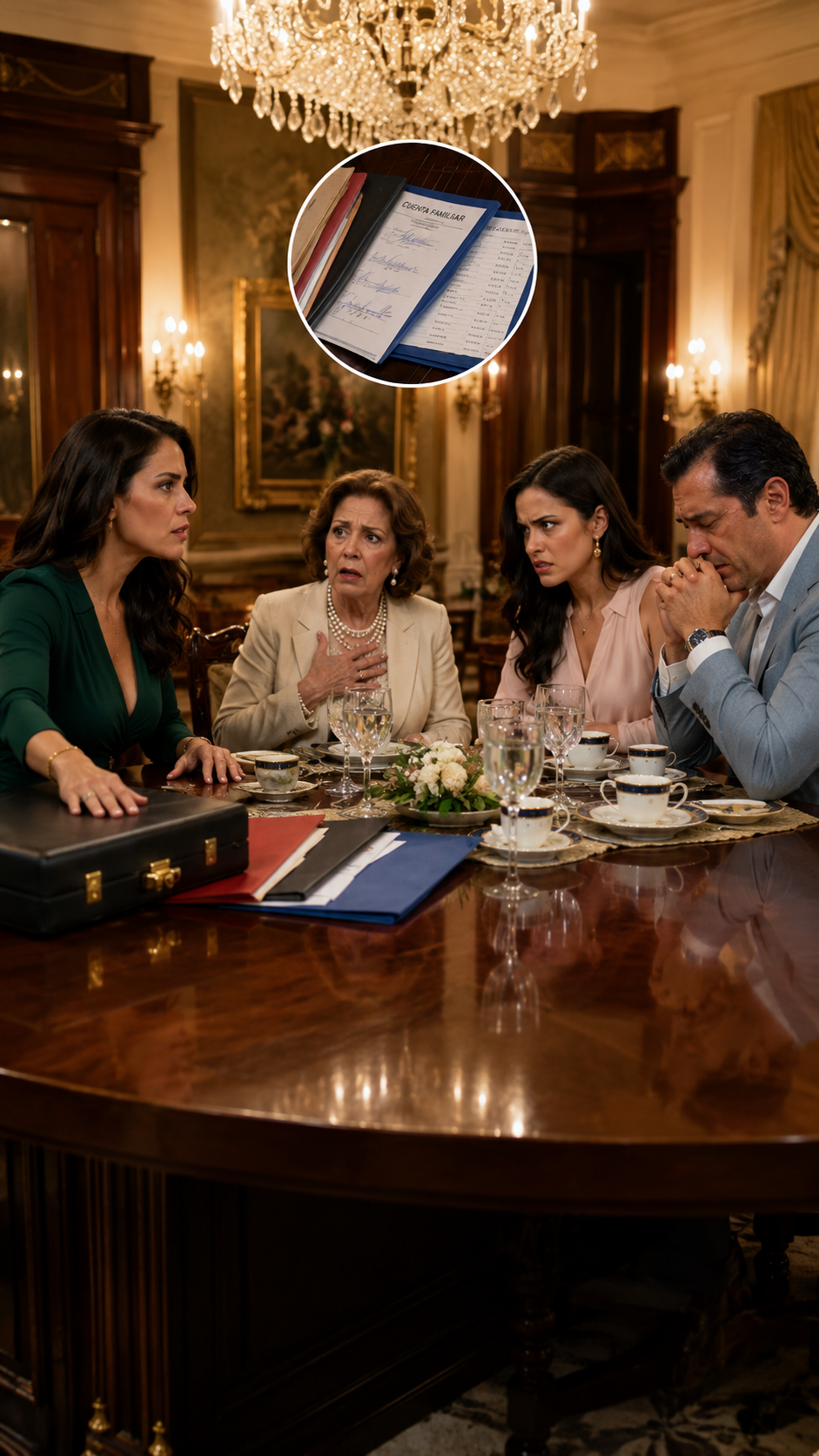
Doña Lourdes sat at the head, with her pearls and perfect hair. Priscila was checking her cellphone with a bored expression. Braulio drank whisky, pale and sweating. The aunts watched as if they had bought tickets to a show.
—You’re late —Doña Lourdes said—. Punctuality is learned at home, but of course, you grew up without one.
Marcela didn’t respond.
She sat down in front of her and placed the briefcase on the table.
—Did you bring the money? —Priscila asked—. Because you owe me at least 50,000 and a public apology.
—I brought something better —Marcela said.
She opened the briefcase.
She pulled out three folders: red, black, and blue.
The red one was for Priscila. The black one for Doña Lourdes. The blue one landed in front of Braulio.
—Priscila, open yours. Page 3.
—I asked for money, not homework —she huffed.
But she opened the folder.
Her face changed in seconds.
—What does zero balance mean?
Doña Lourdes straightened up.
—Zero balance of what?
—Of your trust fund —Marcela replied—. The one your grandfather left for you when you turned 30. It no longer exists.
Priscila looked at Braulio.
—Why does your signature appear here?
Braulio said nothing.
He just drank.
Doña Lourdes slammed the table.
—This is a trap. My son would never do such a thing.
Marcela turned to her.
—Then open your folder.
The woman did so with rigid hands. First with arrogance. Then with fear. Finally, with terror.
Withdrawals of 200,000. 300,000. 500,000.
Until reaching zero.
—No —she whispered—. My retirement fund, no. Braulio brings me statements every month.
—False statements —Marcela said—. Your son stole 2 million pesos.
The aunts stopped murmuring.
Priscila stood up, trembling.
—Braulio, tell her she’s lying.
Everyone looked at the man.
Braulio began to cry.
—I was going to recover it. I swear. It was just a bad streak.
Priscila screamed as if her skin had been torn off.
Doña Lourdes placed a hand on her chest.
—Did you steal from me?
—You don’t understand, mom —Braulio sobbed—. It was all to save the businesses.
Marcela stood up.
—There were no businesses. There were bets, debts, and lies.
Braulio pointed at her in rage.
—It’s your fault! If you had given me divorce money, I would have fixed it.
—Don’t you dare —Marcela said, her voice so firm that everyone fell silent—. My mother died because you stole my savings. And you all let her die while you feasted on meat and called me stingy. I’m not here to take revenge. I’m here to return your own truth.
Doña Lourdes, with black tears of makeup running down her cheeks, managed to stand.
—Get out of my house.
Marcela smiled sadly.
—That’s the last lie of the night. This is no longer your house.
Braulio dropped his glass.
Marcela pulled out a small speaker from the briefcase and connected her cellphone.
—No, Marcela —he begged—. Please.
She pressed play.
Braulio’s drunken voice filled the dining room.
“If my old lady finds out I mortgaged the house, she’ll kill me. I forged her signature, but the lender already has the papers. I just need Marcela to pay up.”
Doña Lourdes collapsed into her chair.
Priscila covered her mouth.
—The house is mortgaged for 6 million —Marcela said—. The deadline has passed. And the new owner is on the way.
As if fate had awaited her phrase, the doorbell rang.
Lupita entered pale.
—Ma’am… there are men outside. They bring lawyers and locksmiths. They say they’re here to take possession.
Marcela looked at her watch.
8:30.
—How punctual —she said—. That is something you learn in good families, right?
Chaos erupted.
Priscila launched herself at Braulio, hitting him in the chest, screaming that he had stolen her wedding, her future, her influencer life. Doña Lourdes repeated “my house” as if it were a prayer. Aunts Carmen and Rosa almost ran out, abandoning the ship with the same elegance they once used to spread gossip.
Braulio tried to approach Marcela.
—Help us. You have money. For what we lived for. For what you once felt.
Marcela looked at him one last time.
She no longer saw the husband she had loved. She saw the man who let her mother die for a bet.
—What I felt died in that hospital —she said—. And my money will no longer save those who left me alone.
She opened the door.
Eliseo entered with two men and a lawyer. He greeted Marcela with a slight bow, like someone recognizing another businessperson, and moved toward the dining room.
She stepped out into the night of Polanco.
Behind her were the screams, the accusations, the sobs.
Marcela walked to the curb, pulled out her cellphone, and blocked three numbers.
Braulio.
Priscila.
Doña Lourdes.
Six months later, Braulio was in prison for fraud, forgery, and theft. Marcela didn’t report him. His own mother did, trying to recover the house when it was already too late.
Doña Lourdes ended up renting a small room in a neighborhood she once despised. Priscila found work folding clothes in a mall store. The last time she saw Marcela, she looked down.
Marcela didn’t smile.
Nor did she feel pity.
She just kept walking.
Because sometimes justice doesn’t arrive with screams or blows. Sometimes it comes silently, inside a blue folder, when a woman learns that setting boundaries isn’t being stingy.
It’s surviving.
And the real question lingered for all who heard the story:
Was Marcela cruel for letting them fall, or did she simply stop paying the debts of a family that never knew how to love her?





