PART 1
—Mom, please... come for me. I need you.
Colonel Teresa Salgado heard her daughter Mariana's voice as if someone had squeezed her chest with both hands.
This was not the cry of a normal argument.
This was not a couple's spat.
This was fear.
Teresa was in a meeting inside the military zone in Querétaro when she received the call. She didn’t ask too many questions. She could only say:
—Don’t move. I’m on my way.
She hung up, grabbed the keys to her truck, and left still in uniform. The insignias on her chest glinted under the cold lights of the parking lot.
The whole way to San Gabriel Hospital in Juriquilla, Teresa drove with her jaw clenched.
Mariana was 27 years old. She had married Diego Arriaga a year ago, son of a family known for their construction companies, their upscale restaurants, and their smiling photos at social events.
From the outside, everyone said Mariana was lucky.
But Teresa had never fully swallowed that version.
She had noticed how Diego would “jokingly” check her phone.
She had seen how her mother-in-law, Ofelia, corrected her clothes, her weight, her way of speaking.
And she had heard too many times that phrase Mariana would say automatically:
—It’s fine, Mom. That’s just how they are.
When Teresa arrived at the emergency room, she didn’t ask for permission.
She walked in with a firm stride, showing her military ID, and asked for Mariana Salgado.
A young nurse led her to an observation room.
There was her daughter.
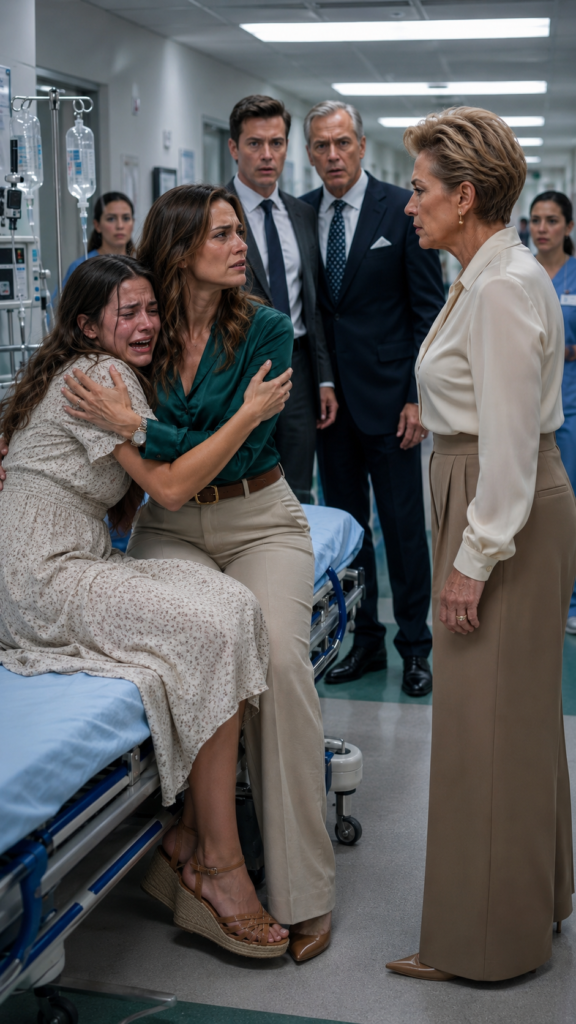
Sitting on a gurney, with smudged makeup, messy hair, and a ripped white party dress up to her thigh.
There were red marks on her left wrist.
But that wasn’t the worst.
The worst was her eyes.
Mariana looked toward the door as if she were waiting for someone to come in and finish breaking her.
Teresa approached slowly and took her hand.
—I’m here now, sweetheart.
Mariana wanted to speak but could barely let out a thread of voice.
—They hurt me, Mom... and they wanted me to say it was my fault.
Teresa felt something inside her turn to ice.
Before she could ask more, the door opened.
In walked Diego, immaculate in his navy blue blazer; Ofelia, his mother, with pearls around her neck; and Iván, Diego’s younger brother, smelling of expensive cologne and arrogance.
All three were far too calm.
As if they had come to claim a forgotten suitcase, not to see a woman trembling in a hospital bed.
Ofelia was the first to speak.
—Colonel Salgado, I’m sorry to have alarmed you. Mariana had a nervous breakdown during the family dinner. You know, she’s been very sensitive lately.
Mariana squeezed her mother’s hand tightly.
—It wasn’t that...
Diego sighed, exasperated.
—Honey, don’t start again. No one hurt you. You panicked, ran out, and fell. That’s all.
Teresa didn’t respond.
She looked him up and down, as one would look at a soldier who had just lied in formation.
Iván smirked.
—Look, ma’am, with all due respect, this is a private matter. Let’s not make a scene in the hospital.
Ofelia stepped closer.
—Besides, Mariana signed some documents before she got like this. We don’t want her to claim later that she wasn’t of sound mind.
Teresa turned slowly toward her daughter.
Mariana was pale.
—What documents?
Diego raised his hand, trying to control the conversation.
—Nothing serious. Just house matters. Normal stuff in a marriage.
Then the doctor entered with a folder.
She looked at Mariana, then at Teresa, and spoke carefully:
—Mrs. Mariana, the initial tests came back positive for a strong sedative. Did you take any medication tonight?
Mariana shook her head, crying.
And at that moment, Diego stopped smiling.
PART 2
The silence that fell in the room was so heavy that even the nurse stopped moving.
Ofelia blinked rapidly, as if calculating which lie to tell first.
—She must have taken something on her own —she said, adjusting her pearls—. Mariana is very dramatic. Ever since she joined this family, she exaggerates everything.
Teresa stood up.
She didn’t shout.
She didn’t make a scene.
She just stood in front of Ofelia with a calm so cold that the woman took half a step back without realizing.
—My daughter will not be called dramatic again.
Diego tried to approach Mariana.
—Honey, let’s go. No one here understands us. We can talk calmly at home.
Mariana recoiled.
That small movement confirmed everything for Teresa.
Her daughter wasn’t angry.
She was terrified.
The doctor closed the folder.
—By protocol, with this result, we must notify social services and register the possible non-consensual administration of medication.
Iván let out a nervous chuckle.
—Oh, doctor, don’t be ridiculous. We’re a serious family. My brother is a businessman, my mom knows half the city.
Teresa turned to him.
—And I know the difference between a fall and a concealed assault.
Diego’s face hardened.
—With all due respect, colonel, you don’t know what goes on in my marriage.
—I know enough —Teresa replied—. Especially when my daughter calls me saying: “come for me.”
Mariana took a deep breath. Her lips trembled.
—Mom... they took me to dinner at Ofelia's house. They said it was to celebrate our anniversary. I didn’t want to go, but Diego insisted.
Ofelia clicked her tongue.
—Here we go again.
Teresa didn’t take her gaze off Mariana.
—Go on.
Mariana swallowed hard.
She recounted how the dinner had been at the Arriaga residence, in a gated community. They had soft music, candles, wine glasses, and even white flowers, as if everything were perfect.
But as soon as the first toast ended, Ofelia laid a black folder on the table.
Inside were notarized documents.
A broad power of attorney.
A transfer of rights for the apartment Mariana had inherited from her grandmother.
And an authorization for Diego to manage an investment account that Teresa had opened for her daughter since she turned 18.
Mariana refused.
Diego told her that in a marriage, there shouldn’t be secrets.
Ofelia told her that a decent wife trusted her husband.
Iván mocked:
—Or what? Did your soldier mommy teach you not to obey?
Mariana wanted to leave.
Then Diego took the car keys from her.
Ofelia took her phone.
And someone, in the middle of another drink “to calm her down,” gave her something that started to cloud her vision.
Teresa listened without blinking.
Each word marked her face like a new scar.
—When I said I wouldn’t sign —Mariana continued—, Diego squeezed my wrist. Ofelia told me that if I didn’t sign, they would say I was unstable, that I had episodes, that I could ruin her son’s career.
Diego exploded.
—That’s a lie!
The doctor stepped toward the door.
—I’m calling security.
—Call them —Teresa said—. And also the police.
For the first time, Ofelia lost her composure.
—Police? For a family dispute? How low, colonel. You should know how to handle things with honor.
Teresa looked at her with disdain.
—Honor is not used to cover up crimes, ma’am.
Diego suddenly stepped forward.
—Mariana, tell her to leave. Tell her you’re confused.
Mariana looked down.
For one second, she seemed to revert to the woman who apologized for everything.
Then she lifted her face.
—No.
Diego froze.
—What did you say?
—I said no. I’m not going to obey you anymore.
Iván let out a curse.
The door opened, and two hospital guards entered. Behind them came a social worker and a municipal police officer.
Ofelia tried to regain her elegant tone.
—Officer, this is getting out of control. My daughter-in-law had a crisis. My son just wants to take her home.
The officer looked at Mariana.
—Ma’am, do you wish to leave with them?
Mariana shook her head.
—No. I want them to go. And I want to report.
Diego laughed, but his laughter no longer sounded confident.
—Report what? You have no proof.
Mariana closed her eyes.
Teresa felt her daughter gathering the last piece of strength she had left.
—I have proof.
Ofelia's eyes widened.
Mariana tremblingly reached under the pillow and pulled out a small silver brooch.
It looked like a dress ornament.
But Teresa recognized it instantly.
It was a tiny recorder she had given her three months earlier when Mariana confessed that sometimes conversations at Diego's house “got ugly.”
—I turned it on when I saw the folder —Mariana said.
Diego lunged to take it from her.
Teresa intervened so quickly that he crashed into her arm.
—Don’t you dare, jerk.
The word came out dry, low, dangerous.
The officer took the brooch as evidence, while the social worker asked that no one touch Mariana.
The doctor authorized that they listen to only a preliminary fragment to assess the urgency.
The recording started with the sound of glasses clinking.
Then Ofelia's voice, clear:
—Sign, Mariana. That apartment is useless to you if you don't know how to be a wife.
Then Diego:
—Don’t make me look like an idiot in front of my family.
Then Iván’s voice, laughing:
—Pour her more drops. That way she relaxes and signs quickly.
The whole room froze.
Ofelia turned pale.
Diego shot a death glare at his brother.
Iván swallowed hard.
—I was joking...
But the recording continued.
They heard Mariana say, “I want to leave.”
They heard Diego respond:
—You’re not leaving this house until you sign.
And then, the sharp thud of a chair.
Mariana’s heavy breathing.
The crying.
Ofelia's voice, cold as a knife:
—Tomorrow we’ll say she had an episode. No one will believe her against us.
Teresa felt the urge to break something.
But she didn’t.
Because justice, when done right, hurts more than a blow.
The officer called for backup.
Diego tried to call someone, but security told him to hand over the phone.
—This is abuse of authority —he said.
Teresa let out a minimal smile.
—No. This is the first time someone is setting a limit for you.
While they took Mariana’s initial statement, another piece of information came to light.
The doctor reported that the marks on her wrist matched strong pressure, not a fall. Additionally, the sedative found was not registered in any medication for Mariana.
Ofelia began to cry, but not from remorse.
She cried from rage.
—Are you going to destroy your husband over one rough night?
Mariana looked at her.
—It wasn’t one night. It was 12 months.
That’s when the entire wound opened.
Mariana recounted how Diego controlled her money, how Ofelia entered her house with a spare key, how Iván made comments about her body, how they told her that a “grateful” woman did not question the family that had “raised her status.”
Teresa clenched her fists.
She had seen signs.
Small ones.
A suddenly cut-off call.
A false smile at Christmas.
A long-sleeved blouse in the heat.
And like many strong mothers, she punished herself for not having arrived earlier.
But Mariana, as if reading the guilt on her face, said:
—Mom, I also hid it. I was ashamed.
Teresa leaned down and kissed her forehead.
—The shame is theirs, not yours.
At 2:17 AM, Diego Arriaga, Ofelia Arriaga, and Iván Arriaga were removed from the hospital by police officers to give their statements.
They did not exit handcuffed in front of cameras.
There were no soap opera-style screams.
But there was something worse for them.
There was record.
There was evidence.
There were names.
And there was a victim who was no longer alone.
The next morning, news spread through Querétaro like wildfire.
The Arriaga family tried to control the scandal. Their lawyer released a statement saying it was all “a domestic misunderstanding.” Ofelia sent messages to several friends claiming Mariana was “emotionally delicate.”
But the second surprise came that same day.
The notary who supposedly prepared the documents denied having summoned Mariana that night.
He said her signature had been forged.
And when they reviewed the papers, they found copies of identifications, bank statements, and a request to move 3,800,000 pesos to a company linked to Iván.
The story ceased to be merely family violence.
It became attempted dispossession, substance administration, deprivation of liberty, and forgery of documents.
Diego, who had always boasted of suits, watches, and connections, ended up sitting in front of the Public Ministry, sweating like a scolded child.
Ofelia demanded to speak to “someone of standing.”
No one arrived.
Iván was the first to crack.
He claimed the idea had been Ofelia’s. That Diego owed money for gambling. That they needed Mariana’s apartment to secure a loan.
And that the investment account seemed “wasted” on a woman who didn’t want to have children yet.
When Teresa heard that, she understood the true bottom line.
They didn’t want a daughter-in-law.
They wanted a safe with a white dress.
Mariana spent three days under observation and psychological support. She wouldn’t let Diego visit her. She also didn’t answer the 47 calls from unknown numbers that began to flood in.
On the fourth day, Teresa took her home.
Not to the marital home.
To her own house, where Mariana's room still had books, high school photos, and a blanket her grandmother had knitted.
That night, Mariana slept for 11 straight hours.
Teresa stayed awake in the living room, with a cup of cold coffee in her hands.
Not because she distrusted the security.
But because sometimes a mother needs to watch the silence to ensure that fear has not entered through the door.
Weeks later, Mariana filed for divorce.
She also requested protective measures.
The marital home was secured while they investigated the copies of documents Diego had stored in a safe.
The Arriaga construction company lost two important contracts when their partners learned that a criminal investigation was underway.
Ofelia stopped appearing at charity brunches.
Iván deleted his social media.
And Diego, the man who told Mariana that without him she was nobody, began to send pleading messages.
“Forgive me.”
“My mom pressured me.”
“I was a victim too.”
“I love you.”
Mariana read only one.
Then she blocked the number.
On the day of the first hearing, Diego arrived with a scruffy beard and a face of remorse. Ofelia wore black as if mourning her reputation.
Mariana entered holding her mother’s arm.
She wore no military uniform.
She wore no expensive jewelry.
She wore a simple blue dress and the look of someone who had cried enough to no longer ask for permission.
Diego tried to approach.
—Mariana, please. Let’s talk like spouses.
She stopped.
—The husband I thought I had died the night you took my keys.
He lowered his gaze.
Ofelia murmured:
—You’re destroying us.
Mariana looked directly at her.
—No, ma’am. You destroyed yourselves when you thought my fear was just a signature.
In the hearing, the full audios were played.
The medical analyses were reviewed.
The forged documents were shown.
And the statement of the nurse who found Mariana in the hospital parking lot, disoriented, repeating only one phrase:
—I don’t want to go back with them.
The judge granted the measures.
Diego could not approach Mariana.
Neither could Ofelia or Iván.
The criminal investigation would proceed.
As they exited, several reporters were outside, because in Mexico, a rich family falling from arrogance always becomes news.
Teresa tried to cover Mariana.
But her daughter stopped.
She looked at the cameras.
Took a deep breath.
Didn’t give morbid details.
Didn’t cry.
Just said:
—Sometimes danger doesn’t enter through the window. Sometimes it opens the door, says “my love,” and your in-laws call it tradition. If someone is living something like this, don’t stay silent.
That phrase was shared thousands of times.
Some people supported her.
Others said that “couple problems should be solved at home.”
And that’s where the debate began.
Because there are still those who believe a woman should endure to avoid breaking a family.
But Mariana had understood something that changed her life:
A family that needs your silence to stay clean is not a family.
It’s a prison with a pretty name.
Months later, she returned to San Gabriel Hospital, not as a patient, but as a volunteer in a program for women who arrived with fear and without words.
Teresa accompanied her on the first day.
Upon seeing her enter, the same nurse who had received her that night smiled.
—You look different.
Mariana touched the silver brooch she now kept in her bag, not as a weapon, but as a reminder.
—Not different —she replied—. Free.
Teresa watched her from the hallway.
The colonel who had faced high-risk zones, operations, and emergency dawns then understood that no medal weighed as heavily as witnessing her daughter reclaim her voice.
Because that night she hadn’t just pulled her from a hospital.
She had pulled her from a lie.
And although many continued to ask if it was worth destroying a marriage over “a family crisis,” Mariana had an answer that no longer trembled:
When a woman has to call her mother from urgent care to be saved from her husband, that marriage had already been destroyed long before.





