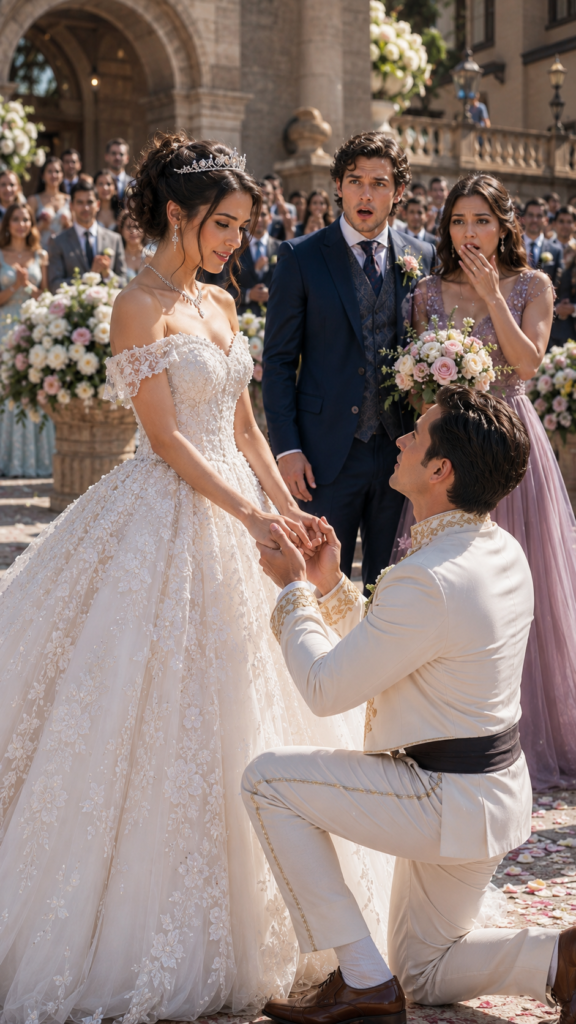
PART 1
Three hours after her sister's royal wedding began in a marble chapel across the ocean, Captain Mariana Salvatierra opened the door to her apartment in Veracruz and felt the air choke in her chest.
There were six royal guards on the street.
They weren’t Mexican police.
They weren’t sailors from the naval base.
They were palace guards, in immaculate uniforms, shiny boots, and faces so serious that even the neighbors stopped peering through their curtains.
Behind them, three black SUVs blocked half the street.
The tallest one stepped up and asked with respect:
—Captain Mariana Salvatierra?
She gripped the doorknob tightly.
—That’s me.
The guard bowed his head slightly.
—Your Majesty requests your presence immediately.
Mariana thought it was a cruel joke.
Her sister Valeria was getting married that day to Prince Adrián of Montclair, heir to an ancient European royal family. The wedding was to be broadcasted in several countries. In Mexico, entertainment shows had been talking for weeks about “the Mexican who conquered a palace.”
But Mariana wasn’t invited.
Valeria had erased her.
First, she said the guest list was limited. Then she claimed the protocol was complicated. After that, she stopped responding. And when Mariana asked if she could at least send flowers, Valeria replied with a cold message:
“Please don’t make this any harder. Your uniform doesn’t fit the image of my wedding.”
Your uniform.
As if years of service in the Mexican Navy were a stain.
Mariana had grown up with Valeria in Puebla, in a simple house near Amalucan. Their dad was a high school teacher. Their mom sold home-cooked meals to make ends meet. They had no luxuries, but they had something that, according to Mariana, was worth more: family.
As children, Valeria dreamed of dresses, mansions, and magazine covers. Mariana dreamed of the sea, discipline, and serving her country.
Valeria wanted to be admired.
Mariana wanted to be useful.
When Valeria moved to Mexico City to work organizing luxury events, she learned to smile with powerful people, to speak as if she had been born among crystal glasses, and to hide anything that smelled of the neighborhood, effort, or poverty.
Mariana joined the Navy.
Years later, Valeria called, crying with excitement: she was dating a European prince.
Mariana was genuinely happy for her.
Until her sister began treating her like a shame.
Six months before the wedding, Valeria summoned her to an upscale restaurant in Polanco. Between tiny plates and perfect candles, she said:
—I don’t think you should wear your uniform if you come.
Mariana frowned.
—Why not?
Valeria lowered her voice.
—Because it doesn’t fit the image.
The image.
That’s when Mariana realized her sister didn’t want family. She wanted a set piece.
Now, standing in front of those royal guards, Mariana understood nothing.
—I wasn’t invited—she said.
The guard replied without blinking:
—Precisely why we are here.
Mariana felt a punch in the stomach.
Twenty minutes later, she climbed into one of the SUVs wearing her formal Navy uniform, the very one Valeria had deemed “inconvenient.”
Before closing the door, the guard said something that left all the neighbors speechless:
—Your Majesty inquired about you this morning. And when no one could answer, he ordered an investigation.
PART 2
The private flight crossed the Atlantic while Mariana sat rigidly, hands on her knees.
No one gave her many details.
They only explained that the king had discovered an irregularity on the official guest list. Her name appeared as “absent due to active military deployment.” There was also a note supposedly signed by her, requesting not to be contacted because she disapproved of the wedding.
Mariana felt rage.
She had never written that.
When she arrived at the palace, the party was still going. There was music, cameras, white flowers, and hundreds of guests dressed as if they were in a movie.
Valeria was at the center of the ballroom, wearing a dress so perfect it seemed impossible to touch without ruining it.
Then she saw Mariana.
Her smile cracked.
Prince Adrián also saw her. But there was no rejection on his face. There was surprise. And then something deeper, almost painful.
The king rose from the main table.
The room fell silent.
—Captain Salvatierra—he said firmly—you should have been here from the beginning.
Valeria stepped forward.
—Your Majesty, there was a misunderstanding.
Adrián looked at her slowly.
—A misunderstanding?
Valeria tried to smile, but it wouldn’t come.
—I just wanted to avoid problems. Mariana doesn’t understand this world. I didn’t want her to feel uncomfortable.
Mariana watched her in silence.
She had faced storms at sea, rescue operations, and nights where fear swallowed any prayer. But nothing hurt as much as hearing her own sister disguise disdain as concern.
The king’s assistant opened a folder.
—Three months ago, the palace office received a notice indicating that Captain Salvatierra was on active duty. Then a second note arrived requesting that her absence not be mentioned publicly.
Adrián clenched his jaw.
—Valeria, did you send that?
She swallowed hard.
—I… I just wanted everything to go well.
A wave of murmurs swept through the ballroom.
The king didn’t raise his voice.
It wasn’t necessary.
—A wedding cannot be built on lies.
Valeria looked down. For the first time, she seemed small inside her enormous dress.
Mariana thought that this would end there.
But it didn’t.
The king turned to the guests.
—Many know my son as Prince Adrián. Few know that five years ago, he participated, under another identity, in a humanitarian mission in the Mediterranean.
Mariana felt her heart stop.
Mediterranean.
Night. Smoke. Screams. Water flooding a destroyed compartment.
She remembered a young officer trapped under metal, refusing to come out until the last child was evacuated.
She hadn’t known he was a prince.
To her, he had merely been a man about to die.
The king continued:
—Captain Salvatierra entered a declared unstable zone, rescued civilians, recovered a communications briefcase, and brought my son out alive just seconds before the ship sank.
The ballroom froze.
Adrián looked at Mariana with bright eyes.
—I never knew your full name—he said softly—I only remembered that a Mexican officer shouted at me: “Breathe, dude, then you can complain.”
A nervous laughter escaped among some guests.
Mariana couldn’t help but smile slightly.
But Valeria turned pale.
The woman she had hidden out of shame was the same one who had saved the life of the man she had just married.
The guests stood and applauded.
It wasn’t a light applause. It was heavy, long, uncomfortable. Each clap seemed to strike directly against Valeria’s lie.
Mariana didn’t enjoy watching it.
Because she was still her sister.
The same one who, as a child, braided her hair.
The same one who shared street tacos with her outside school.
The same one who once promised her: “No matter what happens, you and I together.”
But that sister had been lost among mirrors, cameras, and fear of not being enough.
After the applause, Adrián took the microphone.
—Today, I learned something in front of everyone—he said—. A title is worth nothing if it forces us to despise those who made us who we are.
Valeria stood up.
—I don’t despise her!
Her voice trembled.
—I just wanted this day to be perfect. Do you have any idea what it’s like to know everyone is waiting for a Mexican to mess up? To say I’m a wannabe, a climber, a loser in an expensive dress…
The silence became sharp.
Valeria turned to Mariana.
—And you… you always show up and everyone admires you without you having to try. Mom trusted you more. Dad talked about you as if you were a heroine. I spent my life trying to be someone, and you were that without trying.
Mariana felt something inside her break.
It wasn’t shame.
It was envy.
Valeria hadn’t hidden her because she was nothing. She had hidden her because she feared that, even at a royal wedding, Mariana would shine brighter.
—It was my day—Valeria whispered.
Mariana replied calmly:
—And it was. Until you decided to build it on a lie.
Then came the real twist.
An assistant rushed in and whispered in the king’s ear.
The monarch’s face hardened.
—Lady Camille left the palace through the front door twenty minutes ago.
Valeria raised her head.
—Camille?
Lady Camille was her etiquette advisor. An elegant, cold aristocrat, always close to Valeria during interviews and events. She had helped her with the guest list, the announcements, the dresses, the photos, everything.
The king looked at Valeria with a severity that froze the ballroom.
—Your desire for perfection made you useful to someone with more dangerous ambitions.
Adrián opened another folder.
Inside were copies of emails, private notes, and access records.
Camille hadn’t just fed Valeria’s insecurity. She had also forged documents using her office. She had insisted on keeping Mariana away because during that mission in the Mediterranean, the captain not only saved the prince.
She also recovered a briefcase containing evidence of a network selling naval information by exploiting humanitarian corridors.
That investigation ruined several powerful families.
Among them, Camille’s family.
Valeria covered her mouth with her hands.
—No… she was my friend.
The king replied:
—No. She was your manipulator.
The word fell like a stone.
But there was still worse to come.
The assistant handed Mariana a small envelope.
Her name was handwritten on it.
Mariana recognized that handwriting immediately.
It was from her dad.
But her dad had died eight months earlier.
With cold hands, she opened the envelope.
The letter read:
“Mariana, if this reaches you, it means your sister is closer to danger than she imagines. Valeria thinks she found a prince, but I believe someone found her first. Don’t let her erase you. Trust the king.”
Mariana stopped breathing.
Valeria let out a sob.
—Dad knew...
The king nodded.
—Your father wrote to us before he died. He suspected someone was isolating Valeria from her family. But the letter was intercepted by Camille.
Valeria fell to her knees.
The perfect dress crumpled against the marble floor.
For the first time, she didn’t look like a princess. She looked like a daughter who had understood too late that her dad had tried to protect her while she had been ashamed of everything he represented.
Adrián approached, but he didn’t lift her up.
—I don’t know if our marriage can survive this—he said—but I know it can’t start with a lie.
Valeria cried without running makeup, without pose, without cameras that could save her.
—Mariana… forgive me.
Mariana looked at her for a long time.
The rage was still there. The pain too.
But so was the memory of two Puebla girls sharing dreams on a hot rooftop, believing that life would never separate them.
—I don’t know if I can forgive you today—Mariana said—but I won’t let Camille finish destroying you.
That same night, the palace closed its doors. Camille was arrested at the airport before boarding a private flight. The forged documents were revealed. The press turned the perfect wedding into the royal scandal of the year.
Valeria lost the symbolic crown she had pursued so desperately.
But she gained something more painful: the truth.
Months later, she returned to Mexico without cameras, without borrowed jewels, and without advisors. She went to Puebla, to the cemetery where her dad was buried. Mariana accompanied her, but not like before. There was distance. Wounds. Silences that couldn’t be healed with an apology.
Valeria left flowers on the grave and murmured:
—I’m sorry for being ashamed of the only thing that really was mine.
Mariana said nothing.
She just stayed by her side.
Because sometimes justice doesn’t come as revenge. Sometimes it arrives by stripping someone of their disguise in front of the whole world.
And the question that burned on social media was the same one thousands commented on for days:
Did Valeria deserve to lose everything for erasing her sister… or was she also a victim of a world that taught her to hate her roots?





