PART 1
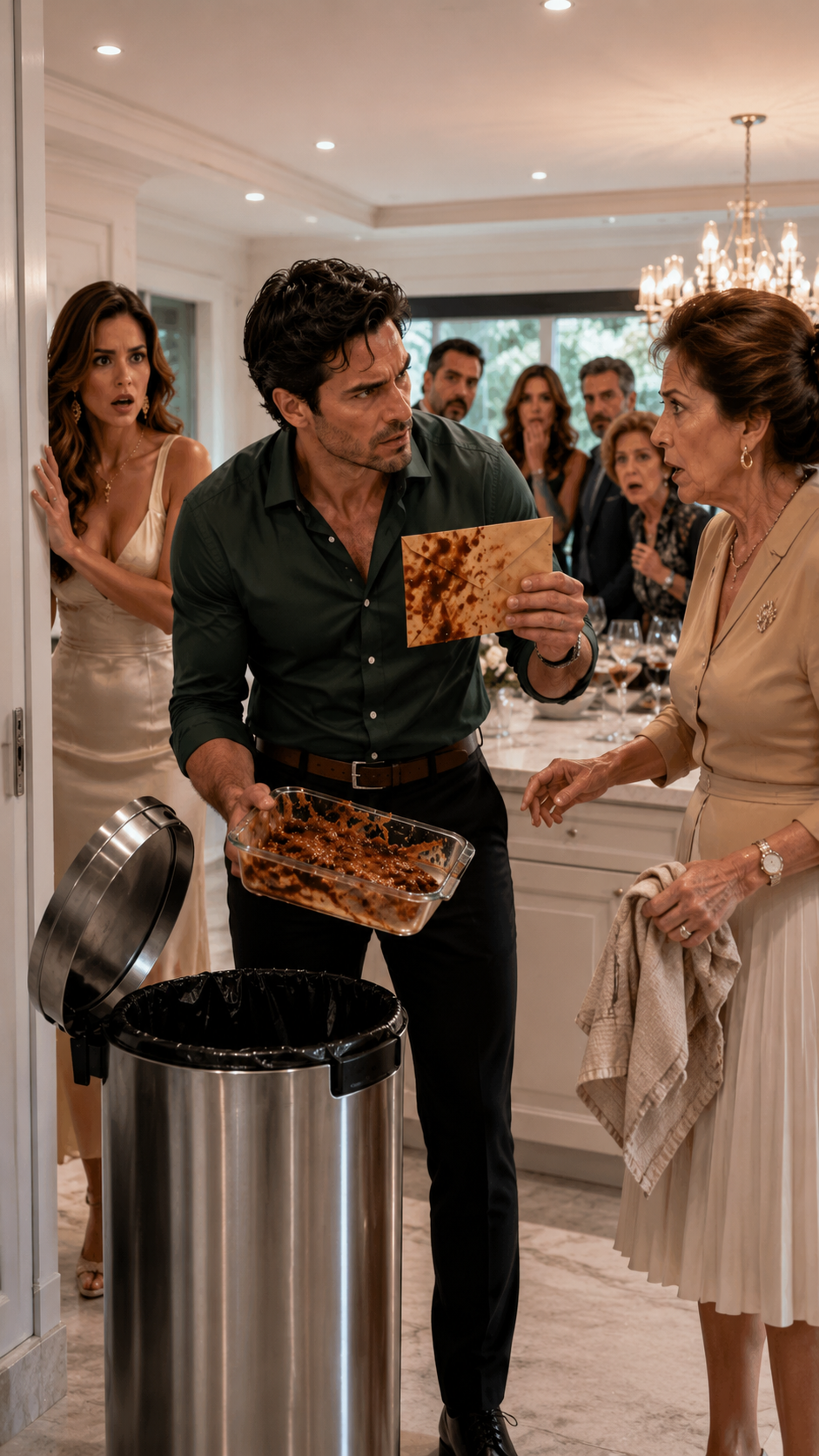
—Throw it in the trash. In this house, we serve nothing from a woman who still doesn't understand her place.
The casserole dish fell into the trash with a heavy sound, as if she were not just throwing away food, but seven years of swallowed silence.
Claudia Montes stood frozen at the kitchen entry, her hands still smelling of cinnamon, piloncillo, and butter. She had barely slept three hours to prepare that capirotada, the same dish her mother-in-law had asked her to bring because she couldn’t attend the family gathering.
Doña Elvira, her mother-in-law, slammed the lid of the trash can down with both hands.
She didn’t know Claudia was watching her.
But Sergio, her husband, did.
He stood next to the refrigerator, pale, a bag of soda still in his hand. For seven years, he had said the same thing: “Don’t mind her, that’s just my mom.” But that afternoon in the family house in the Narvarte neighborhood, his face was devoid of patience.
He was ashamed.
Claudia was 33 years old, worked as an administrative manager at a dental clinic in Tlalpan, and was the mother of Mateo, a six-year-old boy who adored his grandmother without yet understanding how a smile could hide poison.
Since marrying Sergio, Doña Elvira had treated her like an intruder.
On their first Christmas, she told her that her dress was “too office-like, nothing family-oriented.”
At Mateo’s baptism, she changed the centerpieces because, according to her, “Claudia had no taste.”
When Claudia bought her first used car, Doña Elvira declared in front of everyone: —It’s good you work, even if it’s just to help yourself with your little things.
Sergio would always clench his jaw.
But he never fully defended her.
Claudia learned to smile, to lower her voice, to not respond. Each family gathering was a test where she arrived with something prepared and left with her heart in knots.
That Sunday was the annual Salcedo family meal. Doña Elvira organized it like it was mandatory mass. She sent out a list for everyone to bring.
Claudia was assigned to bring charro beans.
But two days earlier, Doña Aurora, Doña Elvira’s older sister, had called from Pachuca.
—Honey, I can’t make it. I’m going to have heart tests. But I want you to bring my capirotada. It’s my mother’s recipe. Just don’t tell Elvira until it’s on the table.
Claudia hesitated.
—Why?
Doña Aurora sighed.
—Because if she knows you’re bringing it, she’ll want to humiliate you. And if she knows it’s mine, she’ll pretend it doesn’t exist.
The warning should have been enough.
But Claudia thought maybe, for once, the food would unite the family.
They arrived at the house at 2:15 PM. There were cousins in the yard, uncles talking politics, kids running with glasses of hibiscus water, and old music coming from a speaker.
Claudia placed the casserole dish on the counter.
Twenty minutes later, she heard Doña Elvira say: —Not even good for obeying. I asked for beans, and she brings dessert, as if she were trying to show off.
Sergio went to find her.
Claudia followed.
Then they saw Doña Elvira throw the entire capirotada into the trash, murmuring: —This is how she learns to respect my house.
Sergio reached in to retrieve the casserole.
And beneath the stained aluminum, there appeared a yellow envelope, taped with a strip, with Doña Elvira’s name written on the outside.
When Sergio opened it, he read the first line… and several family members left their plates unfinished.
PART 2
The silence in the kitchen was so profound that even the children stopped running down the hall.
Doña Elvira saw the envelope in Sergio’s hand, and her face changed completely. It wasn’t surprise. It was pure fear, the kind that cannot be disguised with authority.
—Give it to me —she ordered.
Sergio didn’t move.
Claudia noticed how her husband tightened his fingers around the paper. For years, she had watched that man falter, take one step forward and then retreat to avoid upsetting his mother.
But this time, he didn’t look away.
—What is this, Mom?
—Adult matters. Don’t make a scene.
Renata, Sergio’s younger sister, appeared at the door with a tray of glasses. Behind her peeked two cousins, an aunt, and the husband of a niece whom she didn’t even know well, but who smelled the drama from afar.
Doña Elvira tried to snatch the envelope from him.
Sergio raised his hand.
—No. If you could humiliate my wife in front of everyone, you can also listen to this in front of everyone.
Claudia felt a blow to her chest.
It wasn’t triumph.
It was exhaustion with witnesses.
Sergio pulled out a folded letter, three old photographs, and a yellowed notarized copy. The handwriting was Doña Aurora’s, firm yet trembling.
He read aloud:
“Elvira, if you’re reading this, it’s because you did exactly what I knew you would do. You threw Claudia’s capirotada away without tasting it, not because it was bad, but because it came from her. For years, I’ve watched you turn the family table into a courtroom where you decide who is worthy and who should bow their head.”
No one breathed.
Doña Elvira placed a hand over her chest.
—Aurora was always poisonous.
Renata spoke softly: —Mom, let him read.
Doña Elvira shot her a look.
—You shut up.
But Renata didn’t shut up.
And that, for the Salcedo family, was nearly an earthquake.
Sergio continued:
“You humiliated Claudia because you didn’t choose her. You humiliated Renata because she got divorced. You humiliated Javier’s wife until she stopped coming. You made your children confuse respect with fear. And the saddest part is that you forgot that you also came into this family with nothing, with a secret that Mom decided to keep to protect you.”
A murmur swept through the kitchen.
Doña Elvira took a step back.
—That has nothing to do with anything.
Sergio took the notarized copy. His brows furrowed.
He read silently for a few seconds, then looked up, confused, hurt.
—This house… wasn’t just yours.
The patio fell silent.
The Narvarte house was Doña Elvira’s pride. She always said “my house, my rules,” as if those walls had given her a crown. Every birthday, baptism, posada, and family meal happened there because no one dared to argue with her.
Javier, Sergio’s cousin, entered the kitchen.
—What do you mean it wasn’t hers?
Sergio returned to the document.
—It says here that Grandma Remedios left the property in the name of three children: Elvira, Aurora, and Tomás. Equal parts.
Renata dropped the tray on the counter. The glasses trembled.
—Mom… you always said Grandma left it to you because you took care of it.
Doña Elvira regained her hard voice, but it came out cracked.
—Because I took care of it. I stayed. I cleaned, cooked, took doctors. Where were the others?
From the dining room, an old voice answered: —Sending money, Elvira.
It was Don Tomás, the youngest brother, who rarely spoke at gatherings. He walked slowly, leaning on a cane, his eyes filled with ancient sadness.
—Aurora sent money every month from Pachuca. I paid for Mom’s operation in 2001. You did take care of her, yes, and nobody takes that from you. But you had no right to hide the papers.
Doña Elvira paled.
—You don’t understand.
—Of course I understand —Tomás said—. I stayed away for 15 years because every time I asked about my share, you said I was destroying the family.
Renata covered her mouth.
Javier looked at his wife, a woman who had sat in gatherings for years as an uncomfortable visitor.
Sergio kept reading the letter:
“I also know you used old signatures to process payments and rents for the shop below as if you were the only owner. I didn’t file a lawsuit because I didn’t want to see my nephews dragged into legal battles. But I will no longer allow you to use the house as a weapon against everyone.”
Claudia looked at Doña Elvira.
The woman who had called her exaggerated, sensitive, and ungrateful for years was standing in front of the trash can, her life’s secret stained with piloncillo.
—It wasn’t about the food —Claudia said calmly—. It was never about the food.
Doña Elvira turned to her with rage.
—You don’t get involved. This is family.
Sergio dropped the letter on the counter.
—Claudia is my family.
That phrase broke something.
Not in Claudia, but in everyone else.
Because for seven years, no one had said that out loud.
Renata approached her mother.
—You know what’s the worst? You taught us to leave people alone so you wouldn’t get angry.
Doña Elvira pressed her lips together.
—I just wanted to keep the family united.
—No, Mom —Renata said—. You wanted to keep it obedient.
Javier’s wife stepped forward. Her name was Laura, and she rarely voiced her opinion because, according to Doña Elvira, “she talked too much.”
—You told me I wasn’t a good mother because my son didn’t want to greet with a kiss. You told me Javier deserved a finer woman. And when I stopped coming, everyone said I was a spoiled brat.
Javier lowered his head.
—I’m sorry —he murmured.
Laura looked at him with wet eyes.
—Don’t tell me that here to look good. Tell me when I have to trust again.
The phrase fell like a stone.
Doña Elvira looked around. For the first time, her kitchen was not filled with allies. It was filled with people remembering.
Then Mateo appeared in the doorway with a ball in his hand.
—Mom, why did Grandma throw away your sweet bread?
Claudia felt her heart shrink.
She crouched down in front of him.
—Because sometimes adults make really bad mistakes when they want to control everything.
Mateo looked at his grandmother.
—But my mom made it with love.
No one moved.
Doña Elvira opened her mouth, but nothing came out.
The child wasn’t attacking her. That disarmed her more than any shout.
Sergio took Mateo’s hand.
—we’re leaving.
Doña Elvira reacted as if the ground had been pulled from under her.
—You’re leaving over a dessert?
Sergio let out a sad laugh.
—No. I’m leaving over seven years of my cowardice.
Claudia looked at him.
He continued, his voice breaking: —I'm leaving because I let my wife come in with fear to a house where she should have felt welcome. I’m leaving because my son just understood something I pretended not to see. And I’m leaving because being your son doesn’t obligate me to allow you to destroy my family.
Doña Elvira hardened her face.
—you’re going to regret this, Sergio.
—Maybe. But I regret more for having stayed silent.
Renata grabbed her bag.
—I’m leaving too.
—Renata, don’t be ridiculous.
—I’ve been ridiculous for many years, Mom. Not today.
Javier looked at Laura.
—we’re leaving too.
In less than 15 minutes, the annual Salcedo meal dissolved without shouting. That was the strongest part. No one threw plates. No one insulted. They simply stopped asking for permission.
An aunt picked up her bag.
A cousin turned off the music.
The children were called from the yard.
The table was left filled with served plates, open sauces, wrapped tortillas, and a pot of mole that no one touched. The house that had always seemed Doña Elvira’s throne began to look like an empty stage.
On the sidewalk, Claudia breathed in the cold November air.
Mateo asked if they could still have dessert.
Sergio picked him up.
—Let’s go for buñuelos, champ.
The boy smiled, not understanding that his dad had just broken an old chain.
Renata walked alongside Claudia to the car.
—I’m sorry —she said, crying—. I’m sorry for all the times I laughed to avoid defending you.
Claudia didn’t respond immediately.
Because forgiveness wasn’t a napkin quickly passed to clean the table.
—Today you spoke —she finally said—. That counts.
Renata hugged her carefully, as if she didn’t know if she had the right to.
Claudia hugged her back.
Not because everything was okay, but because something had begun to change.
That night, Sergio and Claudia put Mateo to bed after buying buñuelos at a stand near Ermita. The boy fell asleep with sugar on his fingers and the tranquility of someone who still believes adults always fix things.
In the kitchen, Sergio sat in front of Claudia.
His eyes were red.
—I’m sorry.
Claudia looked down.
—Don’t say it just because something big happened today.
—I say it because it happened for seven years and I made it small to avoid facing her.
She swallowed hard.
Sergio continued: —I’m sorry for every “that’s just my mom.” I’m sorry for every time I asked you to stay calm when what you needed was support. I’m sorry for letting you feel like a guest in a family where you put more love than many.
Claudia didn’t cry right away.
First, she remembered.
She remembered the dresses changed at the last minute to avoid comments. The meals prepared with anxiety. The forced smiles. The times she returned home feeling foolish for expecting respect.
—I also need to ask myself for forgiveness —she said.
Sergio frowned.
—Why?
—For getting used to disappearing so others would be comfortable.
There was no movie-like hug.
There was silence.
And in that silence, for the first time, no one pretended the wound was small.
The next day, Sergio called Doña Aurora. She answered from the hospital, her voice tired.
—Did you read the letter?
—Yes —he replied.
The woman sighed.
—Then Elvira threw away the capirotada.
Sergio closed his eyes.
—Why did she put the envelope in there?
—Because she knew your mom would never destroy anything bearing my name in public. But she would destroy anything that belonged to Claudia. She needed everyone to see who she was when she thought no one important was watching her.
Sergio fell silent.
Doña Aurora added: —I’m sorry for using Claudia in that. But also tell her that thanks to her, a door that had been closed for decades has opened.
Weeks later, a lawyer reviewed the documents. Doña Elvira had been collecting rent from a small shop under the house for years without sharing anything with her brothers. She didn’t go to jail. No one wanted to go that far.
But she had to sign a legal agreement.
The house ceased to be just “hers.”
Family gatherings were no longer held there.
The first one was in a park in Coyoacán. Everyone brought something. No one made a mandatory list. No one corrected how to serve. No one asked permission to exist.
Doña Elvira didn’t come.
She didn’t come to the second one either.
By the third, she arrived with a bag of sweet bread and a thinner face. She sat far away, serious, with her hands resting on her lap.
Mateo was the first to approach.
He offered her half a buñuelo.
—Grandma, we don’t throw away food here.
The entire family stood still.
Doña Elvira took the piece with trembling fingers.
Her eyes filled with tears.
—No —she barely said—. Not here.
It wasn’t a complete apology.
Claudia knew that.
She didn’t run to hug her. She didn’t say “it’s over.” She didn’t pretend that seven years could be erased with two words and a piece of sweet bread.
But she also didn’t feel fear.
And that was already a victory.
Over time, Sergio learned to say “no” without writing speeches. Renata started therapy. Javier and Laura took months to piece together what cowardice had broken. Doña Aurora reclaimed her legal share of the house, and Don Tomás returned to sit at meetings without feeling like a thief of his own story.
Claudia continued to prepare capirotada every November.
But she no longer took it to where she wasn’t respected.
She placed it on her own table, in her small apartment, with borrowed chairs, mismatched plates, and people who came without fear.
Sometimes Doña Elvira went.
Sometimes she didn’t.
The difference was that Claudia no longer measured her worth by the approval of a woman who confused love with control.
Because there are families where humiliation is disguised as tradition.
And there are days when food thrown in the trash ends up nourishing something much more important: the dignity of all who finally dared to rise from the table.





