PART 1
—If that guy crosses that door again, Mom, I can’t be responsible for what happens.
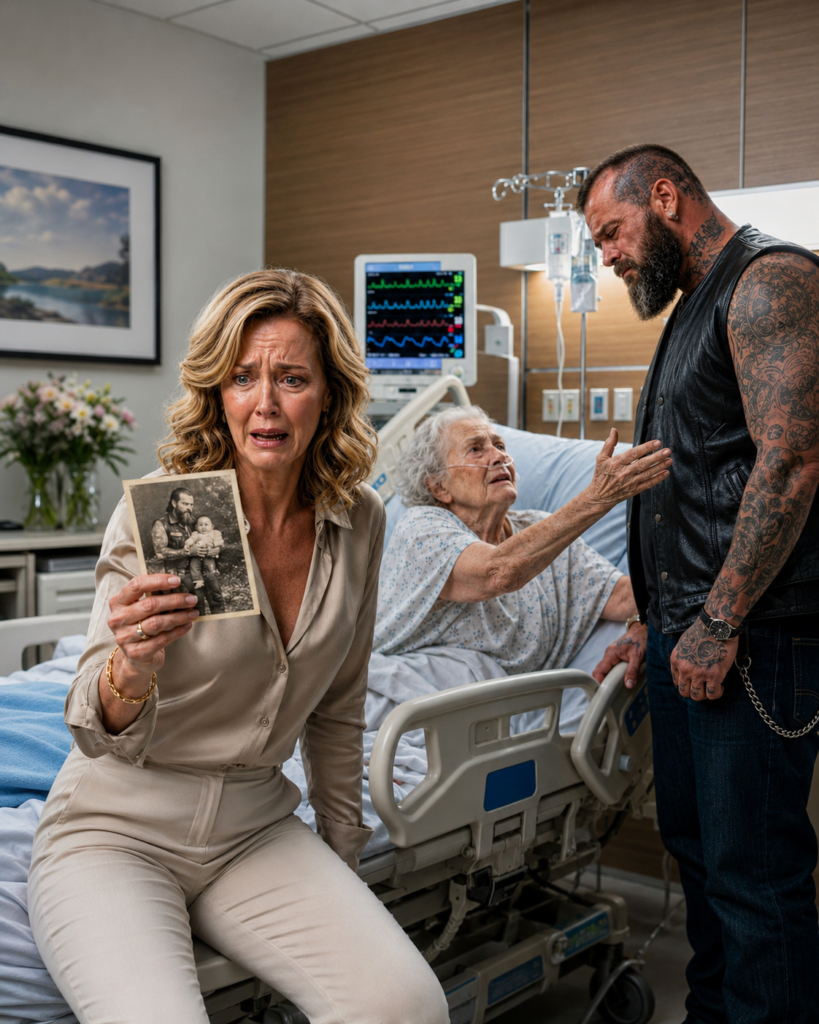
Lucía said it with a voice broken by rage, standing in the middle of the living room of that old house in the Narvarte neighborhood, unaware that by that very night she would find herself sitting on the hospital floor, clutching an old photo to her chest, realizing that her family had been incomplete for sixty years.
For twelve years, her life had revolved around Doña Elena, her 81-year-old mother.
The house always smelled of ointment, reheated coffee, and clean sheets. In the main room, there was a hospital bed, a table full of pills, adult diapers, gauze, a thermometer, hand cream, and a little Virgin of Guadalupe on the nightstand.
Lucía worked at an insurance office in Roma. She left before dawn, returned exhausted on the Metro, and still stopped by the market for papaya, whole grain bread, electrolyte solution, chicken, and the medicines that seemed to cost more each month.
Lidia, the caregiver, had been coming into that house at 7 in the morning for twelve years.
She wasn’t family, but almost. She knew just how to adjust Doña Elena’s pillow, when her hip hurt, when she pretended to sleep to avoid talking, and when she needed someone to play old boleros on her cell phone.
That’s why Lucía didn’t understand anything when Lidia called her crying on a Tuesday in June.
—Lucía, come right now. Your mom fired me.
—What do you mean she fired you? Did she fall? Did she say something strange?
—She told me she didn’t need me anymore. That someone else would take care of her.
Lucía left her computer open, grabbed her bag, and walked out without explaining anything.
—Someone who?
Lidia breathed as if afraid to say it.
—A man. Big guy. All tattooed. He came on a motorcycle, wearing a leather vest, black boots... and your mom let him in like she’d been waiting for him for years.
Lucía’s blood ran cold.
Her mother had been acting strange for weeks. She asked to be left alone with her cell phone. She combed her hair before 5 PM. She asked if the street was quiet. Once, she even asked for perfume.
—Perfume to lie down, Mom?
Doña Elena replied with a sad smile:
—To remind me that I’m still a woman, daughter.
Lucía thought it was nostalgia. Old age. Loneliness.
But upon entering the house and finding the door unlocked, rage surged up to her throat.
—Mom!
The living room was silent. Too silent.
She walked quickly down the hallway and opened the door to the main room.
There he was.
A huge man, graying beard, arms covered in tattoos and a black vest, sat next to Doña Elena’s bed, blowing on a spoonful of broth before feeding her with absurd care for someone with such a rough appearance.
Doña Elena smiled.
Not just any smile.
She smiled as if that stranger had returned something she had buried her whole life.
Lucía felt a surge of jealousy, fear, and disgust.
—Who the hell are you?
The man looked up. His eyes were calm, but there was pain in them.
—My name is Ramiro.
—I don’t care what your name is. I want to know what you’re doing in my mother’s house.
Doña Elena set the spoon down on the napkin.
—He stays, Lucía.
—Are you listening to yourself? You fired Lidia, who took care of you for twelve years, to let in a biker we don’t even know.
—I know him.
Lucía froze.
—From where?
Doña Elena clutched the blanket between her thin fingers.
—I can’t tell you yet.
Ramiro stood up slowly.
—It’s better if I leave you to talk.
—No—Doña Elena said, with a strength Lucía hadn’t heard in years—. You’re not going.
Lucía felt something break inside her.
—If that man comes into this house, I stop being your daughter.
Doña Elena looked at her with tear-filled eyes.
—Don’t say that, honey. You don’t know what you’re saying.
But Lucía wasn’t listening anymore.
She was staring at Ramiro’s hand resting on the nightstand.
On one of his fingers was an old silver ring. The same one her mother had kept in a little red velvet box and never allowed anyone to touch.
Then Doña Elena took the biker’s hand, pressed it against her chest, and whispered a word that left Lucía breathless:
—Son…
PART 2
The word fell in the room like a broken plate.
Lucía felt the floor shift beneath her. She looked at her mother, then at Ramiro, then back at her mother, waiting for a logical explanation, a bad joke, anything but that word slipping from Doña Elena’s mouth with such tenderness.
—What did you say?—Lucía asked.
Doña Elena closed her eyes.
—Honey, please…
—No. Don’t say “please.” You just called a stranger your son.
Ramiro looked down. With those dusty boots, tattoos up to his neck, and strong arms, he seemed capable of intimidating anyone. But at that moment, he looked like a scolded child in a house where he didn’t know if he had the right to sit.
—I didn’t come to take anything away—he said.
Lucía let out a bitter laugh.
—What a relief, right? Because you already took out Lidia, you already entered my house, and now my mom is holding your hand like you’re family.
Doña Elena struggled to breathe.
—Lucía, don’t talk to him like that.
—And how do you want me to talk to him? Like a friend? Should I serve him coffee too?
—Enough.
Her mother’s voice came out weak but firm.
Lucía fell silent, more from surprise than obedience.
In twelve years, she had watched Doña Elena become small, fragile, dependent. She had bathed her, dressed her, fed her, carried her to the bathroom, accompanied her to appointments, comforted her during feverish nights. She had missed boyfriends, vacations, birthdays, even job opportunities because no one else could take care of her.
And now her mother was facing her over a man who had just appeared.
That hurt more than any insult.
Ramiro walked toward the door.
—Doña Elena, I’m going to the patio. I’ll leave the water here.
—Don’t go far—she whispered.
Lucía noticed the tremor in that phrase. It wasn’t a whim. It was fear of losing him.
When Ramiro left, Lucía sat beside the bed.
—Tell me the truth.
Doña Elena looked away toward the window.
—There are truths that come too late and still hurt.
—Mom, don’t give me novel phrases. Who is he?
The old woman swallowed.
—Someone I searched for in silence for many years.
Lucía felt a chill.
—Did you know him before Dad?
Doña Elena didn’t answer.
That silence was worse.
In the following days, the house became a battlefield without screams.
Ramiro arrived early on his black motorcycle. He prepared oatmeal with cinnamon, checked medications, arranged blankets, washed dishes, fixed a leak in the bathroom, and even trimmed the dry bougainvillea in the patio.
Doña Elena ate better with him. She laughed when he told her road stories. She slept peacefully if he was nearby reading old car magazines.
Lucía hated him for it.
Not because he did anything wrong, but because he did it well.
One night, while searching for gauze in the guest room, Lucía found Ramiro's vest hanging on a chair. From one pocket, a black notebook peeked out.
She knew she shouldn’t touch it.
She took it anyway.
Inside were dates, names, addresses, copies of documents, notes written in heavy handwriting.
“Santa Clara Clinic, Puebla, 1966.”
“Biological mother: Elena Márquez.”
“Age at delivery: 19.”
Lucía stopped breathing.
She kept flipping through the pages with frozen hands.
There was an old photograph, creased at the corners. A very young girl lay in a hospital bed, hair stuck to her forehead, with a baby wrapped in a white blanket in her arms.
You couldn’t see her whole face.
But you could see her hand.
A thin hand with a dark mole next to the thumb.
Lucía recognized that mole from childhood.
It was her mother’s hand.
Before she could scream, she heard a thud in the main room.
She ran.
Doña Elena was convulsing on the bed, her eyes lost and her mouth trembling.
—Mom!
Ramiro appeared barefoot, pale, desperate. He held her with a delicacy that didn’t match his size.
—Hold on, Mommy. Hold on, please. Don’t leave me now.
Lucía froze.
Mommy.
It wasn’t a Mexican term of endearment. It wasn’t customary. It wasn’t a way of speaking.
It was the truth breaking out in the midst of fear.
In the emergency room of the General Hospital, Lucía walked for nearly two hours with the folded photo in her bag.
Ramiro sat at the end of the hallway, leaning forward, his tattooed hands clasped as if praying. His eyes were red.
When the doctor told them that Doña Elena was stable but delicate, Lucía didn’t feel relieved. She felt a lifetime of lies crashing down on her.
She approached Ramiro.
—Now you’re going to talk.
He lifted his head.
—She asked me not to say anything.
—My mother could have died a while ago. I don’t care what she asked. Who are you?
Ramiro took a deep breath. He pulled another copy of a document from his wallet.
—My name is Ramiro Salcedo Márquez. I’m 60 years old. I grew up in Toluca with a couple who adopted me. My adoptive mother died a year ago, and before she died, she told me that I wasn’t born of her.
Lucía squeezed the photo.
—No.
—I searched for my papers. Then I looked for old records. After that, an organization helped me. That’s how I found Elena Márquez’s name. At first, I thought she would be dead.
His voice broke.
—When I heard her voice on the phone, I knew I had found her. I can’t explain it. She said “hello,” and I was left speechless.
Lucía felt her legs give out.
—Did my mom have a child before me?
Ramiro nodded.
—They forced her to give me up. She was 19. Her father was one of those old men, first surname and then heart. They took her to Puebla, locked her in a clinic, and told her that if she returned with the baby, they would throw her out. She held me for just a few minutes.
Lucía felt nauseous.
Her whole life, she thought she knew every pain of her mother’s. Every wrinkle, every fear, every memory. But she didn’t know any of that.
—And why didn’t she tell me?
Ramiro wiped his tears with the back of his hand.
—Because she was afraid of hurting you. She told me you gave her twelve years of your life. That you took care of her when everyone else looked away. She was afraid you would think I came to claim a place I didn’t earn.
Lucía let out a broken laugh.
—Well, I thought so.
—I know.
—I thought you were a freeloader. That you wanted money. That you were manipulating her.
—I don’t want anything from her.
Ramiro opened the notebook and showed her a page.
There were several questions written down.
“Did you think of me every Mother’s Day?”
“Did you give me a name even if it was just in your head?”
“Did you cry when I turned 15, 30, 50?”
“Do I have your laugh?”
Lucía could no longer hold his gaze.
She covered her mouth and cried soundlessly.
Because she understood that this tattooed man, whom she had judged by his appearance, hadn’t come to destroy her home.
He had come searching for the piece of mother that was taken from him before he learned to walk.
When Doña Elena woke up, Lucía entered the room alone.
The old woman was pale, with oxygen in her nose and sunken eyes.
—You know now—she whispered.
Lucía sat beside her.
—Why did you hide it from me?
Doña Elena closed her eyes, and a tear rolled down to her ear.
—Because I was ashamed. Then afraid. Then it was too late.
—I was your daughter.
—That’s why. You looked at me like I was strong, even when I was sick. How could I tell you that before being your mom, I was a scared girl who had a child ripped from her arms?
Lucía took her hand.
—I thought you were replacing me.
Doña Elena cried.
—Never, my girl. You were my daily life. My home. My care. My company. Ramiro was my wound. A wound that never healed.
Ramiro was still outside, looking through the glass door as if waiting for permission to exist.
Lucía stood up, opened the door, and looked at him.
For weeks, she had seen a threat where there was pain. She had seen danger where there was blood. She had seen competition where there was only a broken family trying to come together late.
—Come in—she said.
Ramiro didn’t move.
—Are you sure?
Lucía took a deep breath.
—My mom likes you to take her left hand. The right one hurts more.
He covered his mouth with his fingers, trying not to break down. Then he stepped inside.
Doña Elena reached out her hand toward him and Lucía.
The three of them cried in silence.
It wasn’t a pretty movie ending. It was awkward, painful, filled with questions that no one could answer. Lucía had to apologize to Lidia, and Lidia, after being quite angry, returned with a bag of sweet bread and told Ramiro:
—If you’re going to stay, learn where the towels are, because no one comes here as a decoration.
Doña Elena let out a laugh that ended in a cough.
From then on, the house changed.
Ramiro didn’t replace Lucía. Lidia wasn’t erased. Doña Elena didn’t stop being the same difficult, proud, and tender mother. But the truth stopped rotting beneath the blankets.
One Sunday, Ramiro brought his two daughters and three grandchildren. The kids ran around the patio while Lucía prepared coffee. Doña Elena watched them from her chair, her eyes shining.
—I spent so many years thinking my family was over—she said.
Lucía knelt beside her.
—It’s not over, Mom. It was just hidden.
Doña Elena died seven months later, in the early morning, without scandal, with Lucía holding one hand and Ramiro the other.
At the wake, an aunt murmured that such things shouldn’t be told.
Lucía stood up in front of everyone.
—My mother had two children. She raised me with her hands. She mourned Ramiro with her soul. And no one here has the right to call shame what was pain.
The room fell silent.
Ramiro cried without hiding his face.
And Lucía understood, too late but at last, that taking care of a mother doesn’t mean owning all her secrets. Loving also means accepting that there were wounds before you.
Because sometimes the person who arrives on a motorcycle, tattooed and looking like trouble, isn’t there to steal a place.
They’re there to fill the void that a family pretended not to see for sixty years.





