PART 1
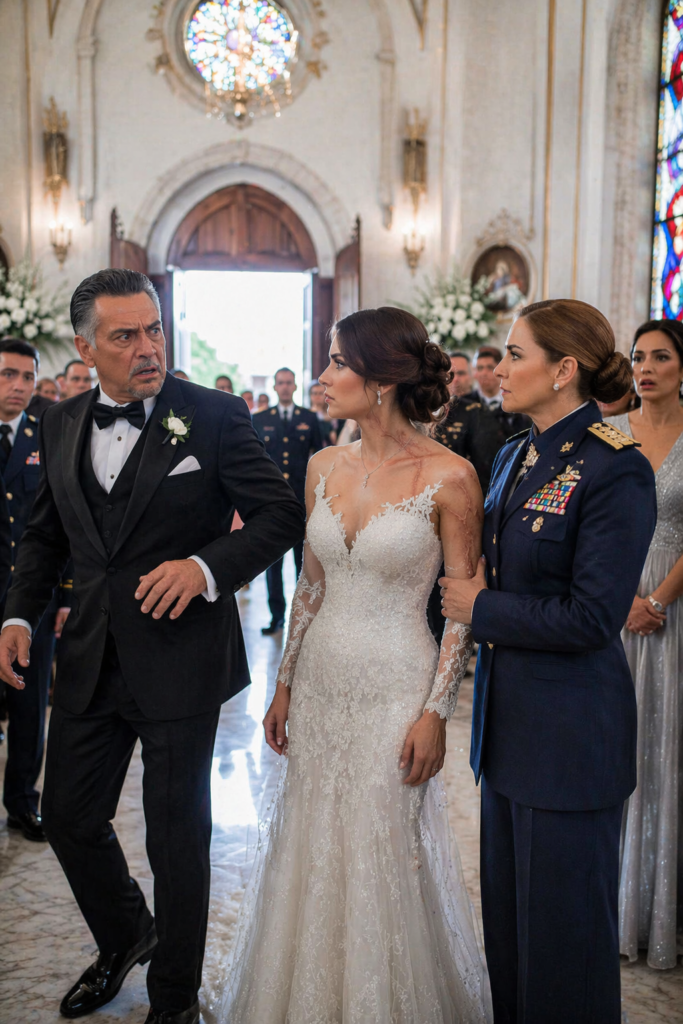
Three minutes before the wedding march, Rogelio Aranda looked at his daughter's neck and froze.
The scar ran from her left ear, crossed part of her shoulder, and disappeared beneath the lace of her white dress. It wasn’t grotesque. It wasn’t shameful. It was the mark of a woman who had survived fire.
But to him, it felt like a stain on the family reputation.
—I won’t give you away at the altar like this—he whispered, careful that none of the guests heard him—. A marked bride ruins every photograph.
Lucía Aranda didn’t lower her gaze.
At 29, she was a Lieutenant Commander in the Mexican Navy and had spent seven months learning how to move her left arm again after an explosion at sea, off the coast of Oaxaca.
She had felt her skin burn.
She had heard screams in a compartment filled with smoke.
She had dragged two injured sailors to the deck when everyone thought no one would survive.
But her father saw none of that.
He only saw a scar.
Rogelio adjusted the pearl gray jacket he had commissioned in Polanco and turned to face the chapel filled with businessmen, politicians, family from Monterrey, and naval commanders.
—Do you know who’s sitting there?—he murmured—. Important people. People who will talk. I won’t be seen as the father of a woman who looks like a warning sign.
Lucía took a deep breath.
Her younger sister, Jimena, stood behind him in a golden dress with a smile that didn’t reach her eyes.
—Dad isn’t saying it out of malice—she intervened—. He just wants to protect the image. I told you to wear the high-neck dress. You would have looked more... elegant.
—This is my dress—Lucía replied.
—Then cancel—Jimena said—. Or at least put the veil over it.
Esteban, the groom, appeared at the side door, dressed in a sleek black charro outfit, his jaw clenched tight.
—What’s going on?
Lucía raised a hand to stop him.
—Nothing worth ruining today.
Rogelio let out a dry laugh.
—Don’t act dignified. Without me, you’ll walk down that aisle alone. And when everyone asks why, they’ll know that even your own father had a bit of shame.
Lucía felt something break inside her, but she didn’t cry.
She had already cried too much in hospital beds, with bandages stuck to her skin and the scent of medicine.
At that moment, the main doors of the chapel swung open.
All the officers present stood up.
The murmur died abruptly.
Admiral Sofía Beltrán, Secretary of the Navy, entered, clad in a pristine white uniform, her medals shining under the stained glass light, and a presence that made even the politicians straighten their backs.
Rogelio paled.
For two years, he had tried to get close to her because his construction company was looking for million-dollar contracts for ports and shipyards.
The admiral walked straight toward Lucía.
She looked at the scar.
Then she looked at Rogelio as if she had just found a crack in a ship.
—Mr. Aranda—she said in a frosty voice—, perhaps you are ashamed of your daughter’s marks.
Then she offered her arm to Lucía.
—But the Navy knows exactly how each one was earned.
The chapel erupted in applause.
Lucía took her arm.
Rogelio stood frozen, humiliated in front of everyone.
When they reached the altar, the admiral leaned in and whispered:
—The file arrived complete this morning.
Lucía smiled like a bride.
—Is it enough?
—It’s enough to sink whoever manufactured that tragedy.
In the back, Rogelio understood that the admiral hadn’t just come to a wedding.
She had come for him.
PART 2
The ceremony continued as if nothing had happened, but the air inside the chapel was no longer the same.
Esteban took Lucía’s hands with a tenderness that hurt. He knew her sleepless nights, her therapies, her anxiety attacks when the smell of gasoline closed her throat.
He also understood that this wedding wasn’t just a wedding.
It was the day Lucía had decided to stop hiding.
The priest spoke of love, patience, and loyalty. Some aunts cried. Jimena pretended to admire the flowers. Rogelio, in the last row, checked his phone every twenty seconds.
When the priest said he could kiss the bride, Esteban did so gently, as if he were also kissing every broken part of her story.
The guests applauded.
Lucía smiled for the photos.
She hugged her mother.
She greeted her Navy colleagues.
But she never stopped noticing her father.
Rogelio no longer looked like the powerful man who silenced everyone at family meals. He was sweating. He took off and put on his glasses. He looked at Admiral Beltrán with a mix of fear and rage.
The reception was at a hacienda near Tepoztlán, with bougainvillea, soft mariachi music, and tables decorated with talavera.
Everything seemed beautiful.
But beneath that beauty lay a bomb waiting to explode.
For years, Rogelio Aranda had built his name with the company Aranda Maritime Infrastructure. He sold parts, thermal coatings, and metal structures for vessels and docks.
On television, he spoke of patriotism.
At dinners, he said Mexico needed businessmen “with guts.”
But at home, he humiliated his wife for not having an opinion, compared his daughters, and repeated that a woman had to look impeccable to be worth something.
Lucía had grown up trying to earn his approval.
When she joined the Navy, he said it was a waste of time.
When she was promoted, he said someone must have helped her.
When she almost died, he didn’t arrive at the hospital until two days later because, according to him, he had an important meeting in Santa Fe.
But the worst happened one month after Lucía returned home to recover.
One early morning, she went down to the library looking for pain medication.
The door was ajar.
Rogelio was on the phone.
—The certificates are already signed—he was saying—. No one is going to check those plates. By the time they fail, the blame will be on the vessel's maintenance.
Lucía froze.
The voice on the other end asked something she didn’t catch.
Rogelio replied:
—If there’s another accident, then there will be another report. That’s how this country works, buddy. No one loses a contract over three dead.
Lucía felt nausea.
Because she knew those plates.
The patrol ARM Centinela, where the explosion had occurred, carried materials from a subsidiary of Aranda Maritime Infrastructure.
That night, she began investigating quietly.
With her arm still bandaged, she reviewed folders, invoices, and printed emails that her father kept locked away.
She found payments to retired inspectors.
Phantom companies in Querétaro.
Altered technical reports.
Purchased signatures.
And finally, she found the document that robbed her of sleep for weeks.
The thermal plate installed in the engine room of the ARM Centinela had failed at a much lower temperature than required.
The original test said “rejected.”
The version delivered to the Navy said “approved.”
At the bottom was Rogelio Aranda's signature.
Her father.
The man who had just refused to walk with her because of her scars.
He was part of the reason those scars existed.
Lucía didn’t confront him.
She didn’t shout.
She didn’t break anything.
She did something harder.
She gathered evidence.
She copied files.
She recorded calls.
She handed everything over to a naval internal investigation unit.
For eight months, she pretended to be busy with the wedding.
While Rogelio talked about floral arrangements and important last names, she was helping to build a case for corruption, fraud, falsification of documents, and damage to strategic assets.
At the reception, Rogelio decided to approach the admiral.
He held a champagne glass and wore the smile of someone who still believes he can buy any silence.
—Admiral Beltrán—he said—. What an honor to see you here. I must say that my daughter has always been intense, but today she surprised us all.
The admiral stared at him without blinking.
—I wasn’t surprised.
—Well, you know how young people are. Sometimes they dramatize.
—Do they dramatize when they enter a burning room to pull fellow sailors out alive?
Rogelio clenched the glass.
—I didn’t mean that.
—Or do they dramatize when they report that someone sold defective materials to the Navy?
The mariachi stopped playing.
Not because someone asked them to.
But because everyone felt the impact of the words.
Jimena stood frozen with a glass in her hand.
Lucía’s mother, Marta, covered her mouth.
Esteban stood beside his wife.
Rogelio feigned a laugh.
—I don’t know what you’re talking about.
The admiral pulled a dark blue folder from the hands of an officer.
—Of course you know.
On a table, she laid out photographs, certificates, bank statements, and copies of contracts.
Rogelio looked at the papers as if they were snakes.
—That doesn’t prove anything.
—The originals are secured.
—They are private documents.
—They are falsified documents used in public contracts.
—This is disrespectful.
The admiral took a step toward him.
—Disrespect was calling your daughter a “marked woman” for surviving the consequences of your ambition.
Rogelio turned to Lucía.
Her face no longer bore shame.
It was filled with hatred.
—Did you do this?
Lucía held his gaze.
—Yes.
—I’m your father.
—And yet you sold parts that could kill sailors.
—I gave you a life!
—You gave me fear, Dad. Not a life.
The silence hurt more than a scream.
Lucía breathed with difficulty but didn’t back down.
—You taught me that Mom had to stay quiet to avoid inconveniencing you. You taught me that Jimena and I had to compete for your attention. You taught me that the last name mattered more than the truth.
Her eyes shone, but her voice did not break.
—The Navy taught me something else. It taught me that if someone puts lives at risk, they must be stopped. Even if their last name is yours.
Rogelio slammed the table.
—you betrayed your family!
—No—Lucía replied—. I betrayed your business. I’m saving my family from continuing to pretend.
At that moment, two federal agents entered the hall.
One showed an identification card.
—Rogelio Aranda Méndez, you need to come with us.
The guests began to murmur.
Several partners moved away.
A congressman who had moments earlier been patting him on the back pretended to take a call.
Rogelio sought support from his wife.
Marta cried silently.
—Marta, tell them something.
She lifted her gaze.
For the first time in many years, she didn’t seem afraid.
—Is it true?
Rogelio clenched his jaw.
—This isn’t the time.
—Is it true?—she repeated.
He didn’t answer.
And that lack of response was worse than a confession.
Then Jimena let out a sob.
—I destroyed a box.
Everyone turned to her.
Rogelio’s eyes widened.
—Shut up.
Jimena shook her head, trembling.
—Dad asked me to burn papers at the house in Cuernavaca. He told me they were old invoices, that they could cause him problems with the tax office. I didn’t know they were related to accidents.
Lucía looked at her with a mix of pain and surprise.
Jimena wiped her tears.
—I also told Lucía to cover up her scars because I wanted to look good for you. Because my whole life I thought if I was the pretty daughter, the obedient daughter, the perfect daughter, one day you’d love me more.
Rogelio tried to advance toward her, but an agent stopped him.
—Jimena, you don’t know what you’re saying.
—I do know—she replied—. I’m saying you used us all as decoration.
Marta broke into tears.
That phrase pierced through the entire wedding.
Because everyone understood that the scandal was not only legal.
It was familial.
It was a whole house held up by silence.
Rogelio lost strength all at once.
He looked like he had aged twenty years in five minutes.
The impeccable businessman was gone.
Only a cornered man remained, with a crooked tie and trembling hands.
The agents asked him to walk.
But before leaving, he looked at Lucía.
—Did it hurt a lot?
The question was so unexpected that no one breathed.
Lucía understood immediately what he meant.
Not the arrest.
Not the shame.
But the explosion.
She touched, without thinking, the scar on her neck.
—Yes.
Rogelio swallowed hard.
—Were you scared?
—Very.
—Did you think you were going to die?
Lucía closed her eyes for a moment.
She remembered the black smoke.
The hot metal.
The screams.
The weight of a comrade on her injured shoulder.
—Yes.
Rogelio lowered his head.
For the first time, his voice didn’t sound powerful.
—I should have been there when you returned.
Lucía didn’t respond.
—I should have hugged you.
Marta was crying with her hands on her chest.
Jimena too.
Rogelio raised his tear-filled eyes.
—I should have told you that you were still my daughter. That you were still beautiful.
Lucía felt her chest break.
Not because she forgave everything.
But because she had waited too long for those words.
Esteban took her hand, without squeezing it.
She stepped closer to her father.
The agents tensed, but the admiral merely raised her hand to allow it.
Lucía stopped in front of Rogelio.
—I can’t save you from what you did.
He nodded.
—I know.
—I can’t erase the names of those who died because of your ambition.
—I know.
—And I’m not going to lie for you.
Rogelio cried silently.
—I know that too.
Lucía took a deep breath.
Then she hugged him.
It was a brief hug.
Shattered.
Painful.
But real.
As they separated, she said softly:
—It’s never too late to repent. But it can be too late to repair everything.
Rogelio closed his eyes as if that phrase weighed more than the handcuffs.
The agents escorted him toward the exit.
Before crossing the door, he looked back one last time.
—Lucía...
She looked at him.
—Thank you for being braver than me.
Then he disappeared.
No one applauded at first.
It wasn’t necessary.
The silence was louder.
Admiral Beltrán raised her glass.
—To Lieutenant Lucía Aranda—she said—. Because there are wounds that do not shame. There are wounds that prove who had the courage to keep living.
Then Lucía’s colleagues began to applaud.
Then her mother.
Then Jimena.
Then everyone.
Esteban kissed his wife’s forehead.
Lucía looked at the flowers, the lights, the stunned faces, and the empty space where her father should have been from the beginning.
She didn’t feel triumph.
She felt peace.
Because she understood that some families break when the truth comes out.
But others finally stop rotting in silence.
That night, Lucía didn’t cover her scar for any photo.
She showed it in full.
And when someone asked her if she wasn’t ashamed that everyone saw it, she smiled.
—It’s not shameful to survive.
What was shameful was having lived for years believing that a woman had to hide her wounds to deserve love.





