PART 1
"If my son walks through that door and doesn’t smell hot food, I swear you’ll finally understand who’s in charge here," Socorro said, gripping the handle of the frying pan.
Valeria didn’t respond.
Her hands trembled, her blouse clung to her body from the heat of the kitchen, and her heart was knotted tight. The rice was just finishing. The chicken still sat in the pot. The dining table was still bare of napkins.
For Socorro, that was an offense.
For Valeria, it was just another day trying not to provoke a war.
The house, in an upscale neighborhood of Puebla, looked perfect from the outside. Trimmed garden, stone fountain, luxury truck in the driveway. But inside, it smelled of fear, of orders disguised as tradition and silences that weighed more than the expensive furniture.
Socorro had been living there for 8 months.
She had arrived "while recovering from stress," with 4 suitcases, 2 plaster saints, and the habit of meddling in everything. She rummaged through the pantry, criticized Valeria’s clothes, dictated what was cooked, and called her son, Andrés, whenever something displeased her.
"Your wife is too mouthy," she would say.
And Andrés always believed her.
Valeria had been a project manager before getting married. She earned well, handled contracts, traveled for work, and had her own life. But Andrés convinced her to give it all up "to start a family." First, he asked for her credit cards to "manage expenses." Then he checked her phone. After that, he started telling everyone that Valeria was dramatic, nervous, kind of unstable.
Socorro was just there to complete the cage.
That afternoon, Andrés sent a text: "I’ll be home by 8. I want dinner without drama."
It was 8:17.
Socorro looked at the wall clock as if she had just discovered a crime.
"Seventeen minutes late," she murmured. "You can’t even serve properly."
Valeria took a deep breath.
"Ms. Socorro, I’ve asked you not to speak to me like that. This is my house."
The mother-in-law let out a dry laugh.
"Your house? Oh, sweet girl. This house belongs to my son. You’re here because he puts up with you."
Valeria turned off the stove.
"No. This house is in my name. And tomorrow, you’re leaving."
Silence fell heavily.
Socorro stood still, her eyes fixed on Valeria. Then she grabbed the frying pan where the oil was still bubbling.
"Don’t threaten me in my son’s house."
Valeria barely managed to take a step back.
The oil fell on her.
First came the hot slap across her shoulder, chest, and part of her back. Then came the scream, a broken sound that ricocheted off the tiles. Valeria collapsed to the floor, her skin burning as if her entire body had split open.
Socorro didn’t drop the pan.
"So you’ll learn," she said, breathing heavily. "A mother-in-law deserves respect."
Andrés walked in almost at the same moment.
He held his jacket in one hand and his phone still pressed to his ear. He saw Valeria writhing on the floor. He saw his mother with the pan. He saw the oil spreading under the table.
He didn’t run to his wife.
First, he closed the door.
"Mom… what did you do?"
"What you didn’t have the guts to do," Socorro replied. "Put her in her place."
Valeria tried to call for an ambulance, but she could barely move her lips.
Andrés crouched down, touched her face, and brought the phone closer to her.
"Unlock it," Socorro ordered.
"She’s too burned," he said.
"Then hurry up, idiot. Before she wakes up completely."
Valeria, between pain and dizziness, saw how Andrés aimed the phone at her face. Then she heard a phrase that froze her more than the oil.
"We need to delete the messages and say she spilled the soup."
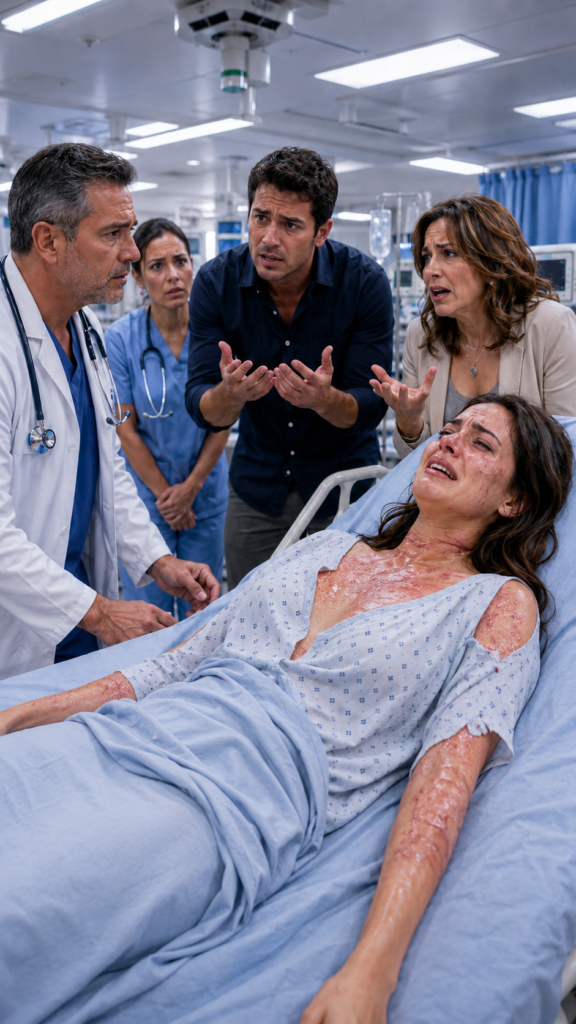
When she opened her eyes, she was in a hospital.
The smell of disinfectant scraped her throat. She had bandages, tubes, and a deep pain that seemed to breathe within her skin.
Behind a curtain, Andrés spoke in a sad voice.
"Doctor, my wife has always been clumsy. She got nervous, pulled the pot wrong, and burned herself. My mom tried to help her."
Socorro sobbed.
"Poor thing. She’s been so agitated lately."
Valeria closed her eyes.
Then a doctor approached her bed and spoke almost into her ear.
"Valeria, don’t move. I’m Dr. Renata Ibarra. These burns don’t look accidental. And the police are already downstairs."
Valeria felt her soul return to her body.
Renata was her cousin.
The only person who knew about the safe, the audios, the copies of contracts, and the hidden camera in the kitchen.
The doctor opened the curtain and looked at Andrés.
"Before the agents arrive," she said, "I want you to explain why the video shows your mother throwing boiling oil at her."
Andrés turned pale.
Socorro stopped crying.
And the door to the room began to open.
PART 2
Two agents from the Prosecutor's Office entered with a calm that made more noise than any scream.
Andrés stood up immediately, adjusting his jacket as if he could still appear to be a concerned husband. Socorro gripped the rosary she had in her apron pocket and lowered her gaze, ready to act like a victim.
"This is a misunderstanding," Andrés said. "My wife has episodes. My mom and I have been trying to help her for months."
Dr. Renata didn’t blink.
"Help her by burning her?"
"Doctor, don’t let yourself be manipulated," Socorro interjected. "Valeria has always wanted to separate us. Since she arrived in this family, she just seeks to turn my son against me."
From the bed, Valeria opened her eyes.
It hurt to breathe. It hurt to exist. But hearing that lie ignited a strange, cold strength within her, harder than fear.
"The green folder," she murmured.
Andrés turned toward her.
"Shut up, Vale. You’re sedated."
One of the agents stepped forward.
"I’m Commander Raúl Medina. Mrs. Valeria Ortega, do you authorize the release of the documents mentioned in your medical directive?"
Valeria barely moved her fingers.
Renata pulled out a sealed envelope from a drawer. Inside was a statement signed six weeks earlier. Valeria detailed threats, economic control, blows disguised as accidents, and Andrés' attempt to take her house and shares of her construction company.
She also authorized her cousin to call the Prosecutor's Office if she arrived at the hospital unconscious or with suspicious injuries.
Andrés looked at her with hatred.
"Fucking old woman. You set a trap for me."
Valeria swallowed hard.
"No. I let you keep being you."
The first recording was reviewed that same night.
In a hospital room, in front of the commander, a prosecutor, and two experts, the video from the kitchen filled a screen.
There was Socorro counting the minutes of delay.
There was Valeria saying the house was hers.
There was Andrés entering earlier than he had said, hiding in the hallway, listening to the argument without intervening.
The image showed the frying pan rising.
Showed the oil falling.
Showed Valeria collapsing.
Then Socorro's voice was heard, clear, venomous:
"So you’ll learn."
Andrés closed his eyes.
But the worst came next.
The camera kept recording as he rummaged through Valeria’s phone. It was heard when he said:
"If we manage to declare her incapable, the power of attorney goes into effect today."
Socorro asked:
"And the house?"
"Also. She signed everything."
"I didn’t sign anything," Valeria whispered from her bed, though no one needed to hear it to know it.
Because that was the second part of the green folder.
Valeria had discovered three months earlier that Andrés was attempting to forge documents to take control of Constructora Ortega, the company her father had left her. She had found altered sheets, scanned signatures, and a notary from Cholula who charged to "fix wills."
Andrés thought she didn’t understand business.
What an idiot.
For years, he had called her "dramatic" so that no one would believe her. But Valeria had managed projects, multi-million-dollar budgets, and public contracts before getting married. She knew how to read traps in small print. She knew how to follow money. She knew how to keep evidence.
And she kept it all.
Bank statements.
Emails.
Audios.
Photos of bruises.
Messages where Socorro told Andrés: "This woman can be tamed or removed."
Commander Medina listened without changing expression.
Then he ordered the arrest of Socorro for severe injuries and attempted femicide. Andrés was arrested for domestic violence, evidence manipulation, forgery, and attempted property fraud.
When they put the handcuffs on him, Socorro lost her victim act.
"Ungrateful!" she screamed toward the bed. "My son made you a lady!"
Valeria didn’t raise her voice.
"Your son made me scars. I was a lady long before I met him."
But Andrés still had cards to play.
Within 24 hours, his lawyer submitted a request to declare Valeria mentally incapable. He attached reports from a private psychiatrist claiming she suffered from paranoid delusions, pathological jealousy, and aggressive episodes.
They also leaked the story to local gossip sites.
"The drama of the businesswoman who filmed her family."
"Millionaire wife accuses her mother-in-law after a domestic accident."
"Victim or manipulator?"
People began to weigh in without knowing. Some said that no mother-in-law would do such a thing. Others swore Valeria must have provoked everything. On Facebook, strangers debated as if her pain were a daytime soap.
Andrés counted on that.
He thought the noise could cover the truth.
He didn’t know Valeria had already submitted another copy.
The twist came with the notary.
The man appeared at the Prosecutor's Office with his own lawyer and a frightened expression he couldn’t hide. He delivered messages, receipts, and recordings. He said Andrés had pressured him to prepare a fake power of attorney and that Socorro had offered family jewels as payment.
But the notary also confessed something that changed the case.
"Andrés didn’t want a divorce," he declared. "He wanted to institutionalize her. He said that a living but incapacitated wife was more useful than an ex-wife fighting in court."
The prosecutor requested to check the private clinic mentioned.
There they found a room reserved in Valeria's name, paid in advance by Andrés. The file stated: "Admission for psychotic crisis induced by domestic stress."
The admission date was the day after the attack.
Renata cried when she read it.
Valeria didn’t.
She had cried too much in closed bathrooms, in sleepless nights without witnesses, in dinners where she had to smile even when Socorro squeezed her arm under the table.
Now she just wanted everything to come to light.
The trial began 9 months later.
Valeria arrived in a beige blazer, hair tied up, and visible scars on her neck. She didn’t cover them. She walked slowly, still in pain, but she walked forward.
Andrés entered in an expensive suit, hard gaze, and a arrogance that didn’t suit him anymore.
Socorro arrived dressed in black, with a light veil and an expression of a suffering mother for the cameras.
It didn’t last long.
The prosecutor played the video.
The entire room heard Valeria’s scream.
Then she presented the expert testimonies: the pattern of burns didn’t match an accidental fall. The oil had been thrown from above and to the side. There were previous injuries documented as "slips," "door hits," and "falls due to anxiety."
Then came the money.
Diverted accounts.
Fake invoices.
Payments to the psychiatrist.
An apartment in Querétaro purchased for Jimena, Andrés' mistress, with Valeria’s company funds.
Jimena testified on the fourth day.
She didn’t cry for love. She cried for fear.
"Andrés told me Valeria was sick," she confessed. "That they would soon institutionalize her. He said that afterward he would have control of everything and that we would go to Spain. His mom said Valeria was a burden."
Socorro crossed herself, indignant.
But the moment that broke everything came when Andrés' lawyer questioned Valeria.
"Mrs. Ortega," he said in a soft voice, "you set up cameras, gathered documents, prepared a medical directive, and spoke with the Prosecutor's Office before the incident. Isn’t it true that you planned to destroy my client?"
Valeria looked at Andrés.
She remembered when he took away the keys "because she drove nervously." She remembered when Socorro threw her clothes in the trash because "a decent wife doesn’t dress like that." She remembered the first time Andrés told her: "No one will believe you, Vale. Everyone knows you’re unwell."
Then she replied:
"I wasn’t planning to destroy him. I was planning that, if one day they tried to destroy me, someone might believe me."
The room fell silent.
The prosecutor showed the final document.
It wasn’t a waiver of rights, as Andrés thought.
It was a protection clause signed by him two years earlier, in Valeria's family trust. It stated that any attempt at violence, fraud, medical coercion, or forgery by the spouse would automatically expel him from all management, benefits, and access to property.
Andrés had signed as a witness without reading.
The man who wanted to keep everything had signed his own ruin.
Socorro tried to save herself by blaming him.
"He told me to scare her!" she shouted from the stand. "He said that if Valeria continued to feel like she owned the house, we could never control her!"
Andrés stood up furiously.
"Shut up, Mom!"
And there, before everyone, the perfect family they bragged about shattered.
Mother and son accused each other like strangers. She said he planned the institutionalization. He said she threw the oil out of hatred. Both told the truth only when it no longer served them to lie.
The verdict came weeks later.
Socorro received 16 years in prison for attempted femicide and domestic violence. Andrés received 25 years for fraud, forgery, domestic violence, attempted illegal confinement, and obstruction of justice.
The psychiatrist lost his license and was prosecuted.
The notary accepted responsibility.
The company returned entirely to Valeria’s hands.
When they took Andrés out in handcuffs, he looked at her with rage.
"You ruined my life."
Valeria touched the scar that crossed her shoulder.
"No, Andrés. I just left the camera on."
A year later, Valeria returned to the hospital where they almost made her out to be crazy.
Renata was waiting for her with coffee and a tired smile.
Valeria carried a green folder under her arm.
With part of the recovered money, she created a support network for women whose injuries were disguised as domestic accidents. They paid for lawyers, expert testimonies, shelters, therapy, and digital boxes to keep safe evidence.
The first woman she attended had a burn on her leg.
Her husband said she tripped over the stove.
She sat in front of Valeria with trembling hands.
"They’re going to say I'm crazy," she whispered.
Valeria opened the green folder.
"Probably."
The woman lowered her gaze.
"He has money. He has family. Everyone believes him."
Valeria showed her scars, unashamed.
"That’s what they want you to think. But the truth also gathers witnesses. It also leaves marks. It also learns to speak."
Outside, the light streamed clean through the hospital windows.
Valeria understood then that peace wasn’t an elegant house or dinner served on time.
Peace was a door that Andrés would never cross again.
It was a voice that no longer asked for permission.
It was her clean name.
It was her body marked, yes, but hers.
And every time someone asked about her scars, Valeria answered the same:
"They are proof that I survived the fire they thought would silence me."





