PART 1
Santiago Armenta's mansion in Lomas de Chapultepec gleamed like those houses in magazines, yet inside it felt colder than a hospital at midnight.
At 28, he owned buildings bearing his name, land across half the country, and more money than most could fathom.
But no one was waiting for him at dinner.
No one asked if he had slept well.
No one laughed in those marble hallways where even footsteps seemed to ask for permission.
Santiago had learned to distrust everyone.
His father had repeated to him since childhood:
—People come near for their own interests, son. Pretend to be asleep, and you’ll see who takes off their mask.
And he believed it.
He believed it so much that he turned his life into a constant test.
Employees, partners, girlfriends, friends… all were watched, measured, suspected.
Until Mariana Delgado arrived.
At 32, she came from Iztapalapa and worked as if each rag, each glass, and every corner mattered like life or death.
She didn’t talk excessively.
She didn’t ask for favors.
She wasn’t impressed by the chandeliers or the cars in the driveway.
She simply arrived, cleaned, organized, and left with a dignity that made Santiago uncomfortable.
One rainy morning, Mariana entered through the service door holding a little girl by the hand.
The small one wore a yellow raincoat, had messy curls, and clutched a stuffed rabbit under her arm.
Mariana paled as soon as she saw Santiago.
—Mr. Armenta, I’m sorry. The lady who watches her canceled on me. I had no one to leave her with. If you want, I’ll leave and make up for the day.
The girl raised her hand.
—Hello.
Santiago looked at her, unsure of what to do.
—What’s your name?
—Valentina —she replied—. And this is Pancho. He’s brave, but he faints when someone hugs him too tightly.
Mariana closed her eyes, embarrassed.
Santiago should have said no.
A child in his house meant noise, stains, accidents, chaos.
But something in that tiny voice broke protocol.
—You can stay in the small living room —he said—. No stairs. No offices. And always under supervision.
Mariana let out a breath as if a stone had been lifted from her chest.
—Thank you, sir.
Valentina smiled.
—Thank you, Mr. Castle.
That day, for the first time in years, the mansion didn’t sound empty.
Afterwards, Valentina appeared whenever Mariana’s life became unmanageable.
An afternoon without a babysitter.
An unexpected school meeting.
An emergency.
She would sit at a low table, drawing with crayons and talking to Pancho as if the rabbit understood all the secrets of the world.
Santiago pretended to work nearby.
But he listened.
He listened to her out-of-tune songs.
Her giggles.
Her absurd questions.
And little by little, that childish noise began to feel like the only thing that wasn’t dangerous.
On a gray Friday, rain battered the windows.
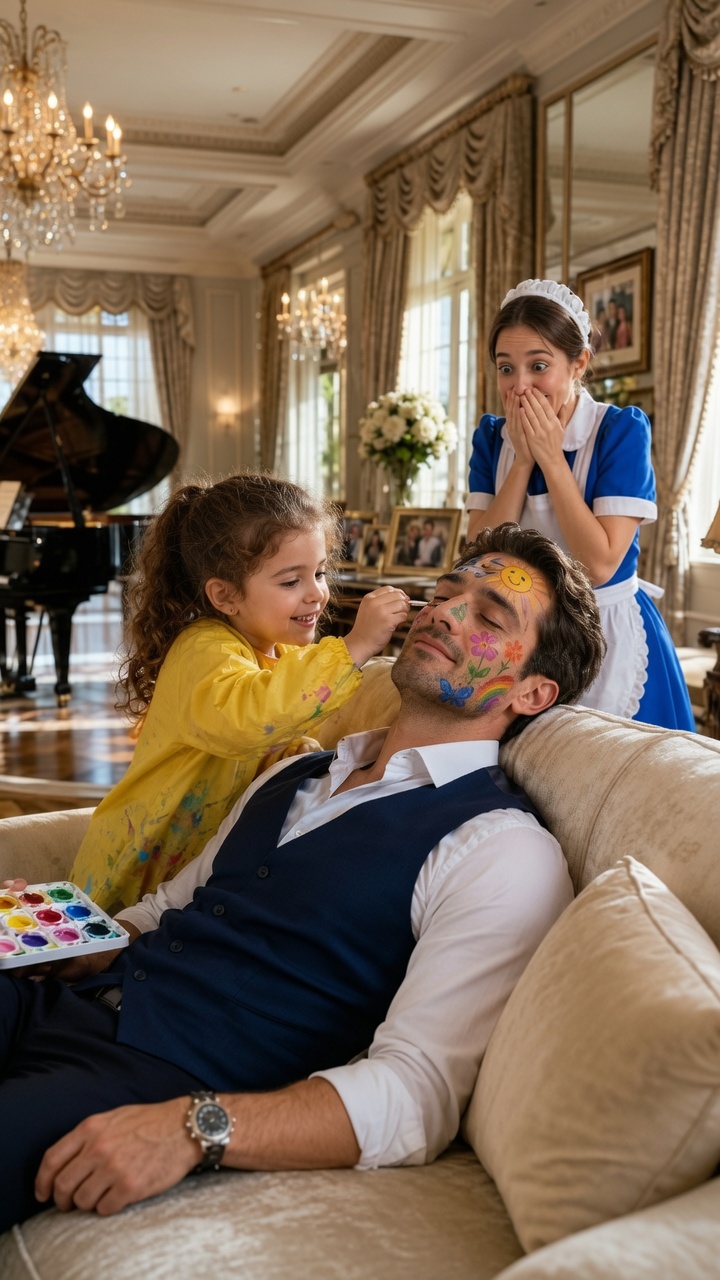
Mariana was setting the dining room for a dinner with investors, and Valentina was painting watercolors on plastic.
Santiago entered with his laptop and claimed there was better light.
A lie.
He just wanted to be close to that rare peace.
He leaned back on the couch.
Closed his eyes.
He wasn’t asleep.
He wanted to test the girl.
He wanted to see what she would do when she thought no one was watching.
Minutes later, he heard soft footsteps.
Then a breath nearby.
Then the brush of a paintbrush on his skin.
He didn’t move.
Then Mariana entered and let out a choked scream.
—Valentina! What did you do?
Santiago opened his eyes.
The girl stood before him with a brush in hand.
On her cheek was a yellow sun.
On her forehead, a blue butterfly.
And across her nose, a crooked rainbow.
Mariana was trembling.
—Sir, I… I swear, I’ll pay for the cleaning, I…
Valentina interrupted her with a calm that froze the room.
—I wasn’t asleep, Mommy. I was sad.
Santiago felt a blow to his chest.
The girl dipped the brush in water again.
—And sad people shouldn’t be scolded. They should be painted nicely so they don’t break.
Mariana fell silent.
Santiago didn’t know whether to laugh, cry, or run away.
But then Valentina lifted her hand toward his face again and said something that left everyone breathless:
—Also, my grandmother says he lost his baby too.
PART 2
The brush hung suspended in the air.
The rain kept falling outside, but inside the room, everything dimmed.
Mariana opened her eyes as if Valentina had just broken down a door she should never have touched.
—Valentina, be quiet —she said in a whisper.
It wasn’t a loud reprimand.
It was fear.
Pure fear.
Santiago sat up slowly on the couch, still with his face painted, still ridiculous, still with a blue butterfly crossing his forehead.
But he no longer cared.
—What did you say? —he asked.
Valentina hugged Pancho against her chest.
—That you lost your baby too.
Mariana stepped forward.
—Mr. Armenta, please. She’s just a little girl. She repeats things. She doesn’t know what she’s saying.
Santiago looked at her.
For the first time, he didn’t see his housekeeper.
He saw a terrified woman.
—Who told her that? —he asked.
Valentina pointed to her mother without malice.
—My grandmother. But my mom cries when she hears it.
Mariana’s face lost color.
—Valentina, go to the kitchen with Rosa.
—No —Santiago said.
His voice came out harsher than he intended.
The girl shrank back.
Santiago lowered his tone.
—I’m sorry. I didn’t mean to scare you.
Valentina moved closer to Mariana and tugged at her skirt.
Mariana looked trapped between protecting her daughter and escaping a truth she had buried for years.
Santiago stood up.
—Mariana, what is she talking about?
She didn’t answer.
He pressed on.
—What does your mother know about me?
Mariana swallowed hard.
—Nothing.
—Don’t lie to me.
That phrase echoed in the room like thunder.
Valentina began to cry softly.
And it was that cry, not the lie, that finally broke Santiago.
He crouched in front of the girl.
—Don’t cry, little one. You didn’t do anything wrong.
Valentina looked at him with her huge eyes.
—Then why does my mom look like her stomach hurts?
Mariana covered her mouth.
Santiago stood up slowly.
—I need you to explain to me right now.
Mariana breathed as if preparing to receive a blow.
—Four years ago, I worked for a woman named Renata Salcedo.
Santiago felt that name open an old wound inside him.
Renata.
His ex-girlfriend.
The only woman he had ever loved without contracts, without suspicion, without absurd proof.
The woman who disappeared from his life after telling him she had lost the baby they were expecting.
The woman who sent him a cold, almost cruel message:
“There’s nothing that binds us anymore. Don’t look for me.”
Santiago searched for her for months.
She changed her number, her city, her life.
Or so he was told.
Then, his father assured him that Renata only wanted money.
He told him she had faked the pregnancy.
Showed him receipts, messages, papers.
And Santiago, broken and proud, chose to believe him.
—Don’t say that name in my house —he said, though his voice trembled.
Mariana looked down.
—I took care of Mrs. Esperanza, Renata’s mother. She was sick. I would come and go from that house. I heard things I shouldn’t.
Santiago clenched his jaw.
—What things?
Mariana looked at Valentina.
—Sweetheart, go with Rosa.
—I don’t want to.
—Go, please.
The girl hesitated, then approached Santiago and touched his painted hand.
—Don’t take off the sun. It looks good on you.
Then she left with Pancho dragging his ears across the floor.
When the door closed, Mariana broke down.
—Renata didn’t lose the baby.
Santiago didn’t move.
He didn’t blink.
The silence was so heavy that it seemed to crush the furniture.
—Repeat that —he asked.
—Renata didn’t lose the baby —Mariana said, already crying—. Your father forced her to leave.
Santiago let out a dry laugh, devoid of humor.
—My father died two years ago. Don’t drag him into this to justify a rumor.
—It’s not a rumor.
—Then what is it?
Mariana took out her cellphone with trembling hands.
She searched through old photos.
Showed him a blurry image of a young woman exiting a clinic in Puebla.
Renata.
Thinner.
Pale.
With a pregnancy belly that was impossible to deny.
Santiago felt the floor disappear beneath him.
—Where did you take that?
—Mrs. Esperanza asked me to keep evidence. She was scared. She said if something happened to her, someone had to tell you the truth.
Santiago grabbed the cellphone.
His fingers trembled.
—What truth?
Mariana wiped her tears with her sleeve.
—Your father offered Renata money to disappear. She didn’t accept. Then he threatened her with destroying her family. He told her you were going to take the baby away from her, that with your last name and your lawyers, she wouldn’t stand a chance.
Santiago shook his head.
—No.
—Yes.
—No.
—Santiago, yes.
It was the first time Mariana called him by his name.
And that hurt more.
She continued:
—Renata left because she was scared. Not because she didn’t love you.
Santiago walked to the window.
In the dark glass, he saw his absurd reflection: yellow sun, blue butterfly, crooked rainbow.
He looked like a man dressed up in happiness.
—Did she have the baby? —he asked, almost voiceless.
Mariana didn’t respond quickly.
And that delay was an answer.
Santiago turned back.
—Where is my child?
Mariana closed her eyes.
—It wasn’t a son. It was a daughter.
Santiago’s chest sank.
Daughter.
The word fell inside him like a bell.
A daughter.
Four years of life.
Four years of birthdays.
Four years of first words, first falls, first fevers.
Four years that someone had stolen from him.
—Where is she? —he repeated.
Mariana cried harder.
—I don’t know.
—What do you mean you don’t know?
—Renata died three years ago.
Santiago took a step back.
—No.
—It was a car accident near Querétaro. She was with the girl, but the girl survived. Renata’s family hid her. Mrs. Esperanza tried to contact you, but your father blocked everything. Changed phone numbers. Paid people. Made it seem like Renata never existed.
Santiago brought his hands to his head.
The paint smudged on his fingers.
Suddenly, too many things clicked into place.
The calls that never came.
The emails that bounced back.
His father’s lawyers talking about reputation.
The documents signed in haste.
The hatred sown against the only person who might have just been trying to survive.
—Why didn’t you tell me before? —he asked.
Mariana lifted her face.
And there appeared another guilt.
A darker one.
—Because I needed the job.
Santiago looked at her as if he didn’t understand.
—What?
—My mother was the one who told me everything when Mrs. Esperanza died. She told me to find a way to get to you, to work here, to see if you were like your father or if there was still something human in you.
Santiago felt nauseous.
—Did you come into my house for that?
—Yes.
The word was clean.
Brutal.
—Did you spy on me?
—At first, yes.
Santiago clenched his fists.
The old him would have called security.
Would have fired Mariana.
Would have made sure no one in Mexico would ever hire her again.
But Valentina had said: “Sad people shouldn’t be scolded.”
And that phrase stopped him.
—And the girl? —he asked.
Mariana paled.
—No.
Santiago took a step toward her.
—Mariana.
—No.
—Tell me the truth.
She shook her head, crying as if each tear were ripping off skin.
—Don’t take her away from me.
Santiago stopped breathing.
The whole house seemed to tilt.
—What are you saying?
Mariana fell into the chair.
—Valentina isn’t my blood daughter.
Santiago didn’t hear anything after that.
The world faded away.
The rain.
The mansion.
The expensive paintings.
The marble.
Everything.
Only the name of the girl remained.
Valentina.
The girl in the yellow raincoat.
The one who talked to a fainting rabbit.
The one who painted a sun for him because she saw he was sad.
Mariana kept talking between sobs.
—After the accident, Renata died in the hospital. The girl was left with an aunt, but that woman wanted to send her to an orphanage because she said she was a burden. My mother worked nearby, recognized the Salcedo surname, and called me. I… I couldn’t leave her there.
Santiago’s eyes filled with tears.
—Is Valentina my daughter?
Mariana nodded.
—Yes.
That word destroyed him.
Not with rage.
With delayed love.
With guilt.
With four years of absence crashing down on him.
Santiago walked toward the door, but Mariana stopped him.
—Please, don’t tell her abruptly. She thinks I’m her mother. I’ve raised her since she was months old. I’ve cared for her with everything I am. I didn’t steal her from you. I swear to God I didn’t steal her.
Santiago stood still.
He wanted to hate her.
He wanted to blame her.
It was easier.
But he couldn’t.
Because in that house, the only person who hadn’t used Valentina as proof, threat, or inheritance was Mariana.
She had lifted her in the nights.
She had taken her to the doctor.
She had bought her shoes when she barely made enough for rent.
She had taught her to say thank you, to share, to paint suns on sad faces.
—Why did you come then? —Santiago asked—. To ask me for money?
Mariana raised her gaze, offended to her core.
—I came because my mother died six months ago and left me a box with letters from Esperanza. It said that Valentina had the right to know who her father was. But when I saw you… you were cold, distrustful, hard. I was afraid you would treat her like a surname, not like a little girl.
Santiago lowered his head.
Because it was true.
If Mariana had come on the first day with the whole story, he would have asked for DNA before hugging her.
Would have called lawyers before looking Valentina in the eyes.
Would have turned his own daughter into a file.
—I pretended to sleep today to test her —he confessed.
Mariana looked at him.
—What?
—I thought maybe she would break something. Steal something. I don’t know. I wanted to confirm that I shouldn’t get attached.
Mariana let out a bitter laugh.
—Seriously, what a sad life you have, sir.
Santiago didn’t defend himself.
For the first time, he couldn’t.
The door opened just slightly.
Valentina peeked her head in.
—Are you guys not fighting anymore?
The two fell silent.
The girl crept in slowly, clutching Pancho to her chest.
She looked at Santiago.
—Your sun is melting.
He crouched down in front of her.
Never in his life had he felt such fear.
Not in million-dollar meetings.
Not in threats from partners.
Not when he buried his father, believing he was burying all his mistakes.
—Valentina —he said with a broken voice—, can I hug you?
The girl looked at Mariana, asking for permission.
Mariana cried silently and nodded.
Valentina approached.
Santiago hugged her carefully, as if she were made of glass, as if the whole world could fit in those tiny arms.
The girl smelled like watercolor, cheap peach shampoo, and cookies.
He closed his eyes.
And cried.
He cried for Renata.
For the daughter he never saw born.
For his father’s lies.
For having confused distrust with intelligence.
Valentina touched his face.
—Don’t cry, Mr. Castle.
Santiago let out a broken sound.
—I’m not Mr. Castle.
The girl scrunched her nose.
—Then who?
He looked at Mariana.
Mariana covered her mouth, trembling.
Santiago understood that the truth couldn’t drop like a bomb on a four-year-old.
It had to come like the morning light: little by little.
—I’m someone who loves you very much —he said—. And who arrived late.
Valentina thought for a moment.
—Like when my mom is late for the bus?
Santiago smiled through tears.
—Yes. But much, much later.
The girl wiped a tear away with her finger and smeared yellow paint on him.
—Then hurry up.
That phrase broke him completely.
The next day, Santiago didn’t call security.
He called lawyers, yes, but not to attack Mariana.
He called them to open the truth.
Requested medical records, reports, accident letters from Esperanza.
He also asked for a DNA test, not to decide whether he wanted Valentina, but to legally protect her from the vultures who would appear when they learned she was an Armenta heir.
The result arrived twelve days later.
99.99%.
Santiago Armenta was Valentina’s biological father.
That same day, Mariana tried to leave.
She left her uniform folded, a letter in the kitchen, and a small backpack.
Santiago found her at the entrance with Valentina asleep in her arms.
—Where are you going?
Mariana couldn’t look at him.
—to prevent a judge from tearing my girl away from me.
—Our girl —he said.
Mariana raised her face.
—Don’t play with me.
—I’m not playing.
—You have money. I have nothing.
Santiago looked at Valentina sleeping.
—You have four years that I could never buy.
Mariana cried.
—I’m scared.
—I am too.
They stood in silence under the enormous ceiling of the entrance.
For the first time, that mansion didn’t seem like a palace.
It seemed like a place waiting to become a home.
Months later, the story exploded in the Armenta family.
Uncles, cousins, and partners were outraged.
They said Mariana was an opportunist.
That Valentina could be a trap.
That a housekeeper shouldn’t live in the same house as the owner.
One of Santiago’s aunts even dared to say during a meal:
—That girl needs a family education, not neighborhood lessons.
Mariana stood up, pale.
But before she could say anything, Valentina left her water glass and asked:
—Is family the people who care or the people who show off?
The table fell silent.
Santiago looked at his aunt.
—In this house, family is who cares. And anyone who doesn’t understand that knows where the door is.
No one spoke of it again.
In time, Valentina learned the truth.
Not in a day.
Not with shouts.
Not as a scandal.
She learned that Mariana was her heart mom.
That Renata was her birth mom.
And that Santiago was her father, a clumsy, late father full of mistakes, but willing to learn even how to style curls without making her look like a messy corn cob.
In the small living room, there was still a blue paint stain on the couch.
The decorators insisted on changing it.
Santiago never wanted to.
Because that’s where it all began.
There, a man who believed money bought loyalty discovered that a four-year-old girl could see more than all his advisors.
There, an employee accused of being self-serving proved that love doesn’t always come from blood, but is tested in the early mornings, in sacrifices, and in staying when no one applauds.
And there, with his face covered in paint, Santiago understood the truth that hurt him most to accept:
Sometimes they don’t steal an inheritance from you.
Sometimes they steal the opportunity to love.
And when you finally recover it, it’s not enough to be right.
You need the courage to repair what others broke in your name.





