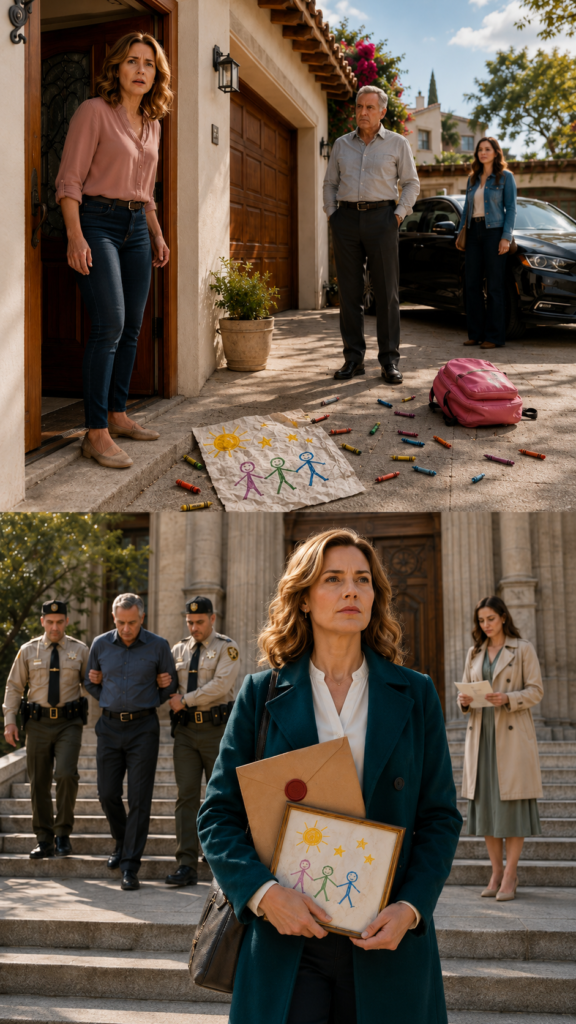
PART 1
Laura thought that one weekend at her parents' house couldn't destroy so much.
At 32 years old, living in Querétaro with her 4-year-old daughter Camila, she had spent nearly a year avoiding the family home in the Álamos neighborhood. Not because she didn’t love her mother, but because she knew too well the temperament of Don Efraín, her father.
Doña Rosa, her mom, had called her on a Friday afternoon.
"Your dad has been calmer, daughter. He’s asking about Cami. Just give him a chance."
Laura closed her eyes. That phrase, "give him a chance," had been the invisible chain of her entire childhood.
When Don Efraín shouted, you had to give him a chance.
When he threw dishes, it was because he was tired.
When he humiliated everyone at the table, it was just "his way."
When Laura cried, Doña Rosa told her not to be dramatic.
But Camila shouldn’t have to inherit that fear.
Still, Laura packed a little pink backpack, one unicorn pajamas, crayons, two storybooks, and drove to the house where she had learned to stay silent.
The first day was odd, but calm.
Don Efraín hardly spoke. He watched Camila from his armchair as if measuring how much noise she made, how much space she took up, how much he could bear.
Camila, innocent, tried to win him over.
She made him a drawing of a purple house, three clouds, and a giant sun.
"Look, grandpa, this is your house," she said excitedly.
Don Efraín glanced at the paper for barely one second.
"It’s all crooked."
Camila’s smile faded.
Brenda, Laura’s younger sister, sat at the dining table, staring at her phone.
"Don’t spoil her," she murmured. "Then kids think everything they do deserves applause."
Laura felt an ancient blow to her chest but said nothing.
That night, Camila lay down next to her in the room where Laura had slept as a child.
"Does my grandpa not want my drawings?"
Laura stroked her hair.
"Some adults forget how to look at beautiful things."
"I can teach him."
Something inside Laura broke.
"No, my love. Kids shouldn’t have to teach adults to be good."
The next morning, during breakfast, Camila accidentally knocked over a glass of orange juice.
Don Efraín slammed the table so hard that the spoons jumped.
"Watch it!"
Camila froze. She didn’t cry. She didn’t speak. She simply shrugged as if she wanted to disappear.
Laura recognized that posture. She had used it herself for years.
"It was an accident," she said.
"Accidents happen when you’re not paying attention," he replied.
In the afternoon, Brenda was loading boxes into her car. Doña Rosa asked for help in the kitchen. Camila went out to the patio with her crayons and sat near the garage.
Then the scream pierced through the house.
Laura dropped a plate in the sink and ran.
As she opened the side door, she saw her father with his hand buried in Camila’s hair, dragging her across the floor towards the big trash bin.
Brenda stood by, keys in hand.
Watching.
Not moving.
Not saying anything.
PART 2
Laura felt the world split in two.
Camila screamed with a desperation that didn’t seem to come from a child but from something broken. Her knees scraped against the hot cement. Her crayons were scattered across the garage, broken like colorful little bones.
"Dad, let her go!" Laura screamed.
Don Efraín didn’t even look up.
"She was in the way."
As if that explained everything.
As if a 4-year-old girl deserved to be yanked by the hair for sitting down to draw near a parked car.
Then he yanked her up, still holding her tightly, and tossed her into the green trash bin by the gate.
The bin shook.
Camila fell onto a black bag and began to cry even louder.
Don Efraín let out a dry laugh.
"Useless things go to the trash."
That phrase killed the last excuse Laura had left.
She ran, opened the bin, and pulled her daughter out. Camila clung to her neck with trembling hands.
"Mommy, my grandpa hurt me."
Doña Rosa came out to the patio, hand on her chest.
"Laura, your dad just wanted—"
"No," she cut her off, with a calmness that was frightening. "Don’t you dare finish that sentence."
Brenda scoffed.
"Oh, come on. You’re exaggerating."
Laura glared at her.
"My daughter is bleeding."
"Well, she was in the middle—" Brenda retorted.
Laura walked to her car. She secured Camila in her car seat, her hands shaking so much that it took her three tries to buckle the seatbelt.
Don Efraín stood by the bin, red with rage.
"If you leave like this, don’t come back."
Laura shut the car door.
"Perfect."
At the emergency room, the nurse saw Camila and immediately called in the doctor.
Laura was about to tell the old lie.
"She fell."
"It was an accident."
"My dad got upset."
"That’s just how he is."
But she looked at Camila’s scraped knees, the bruise on her arm, and the clump of hair tangled with dirt.
"My father assaulted her," she said.
The office fell silent.
The doctor documented everything: injuries on both knees, swelling on the scalp, pain in the ribs, marks on the arm.
Camila didn’t let go of her mom’s hand.
"Did I do something wrong?" she asked softly.
Laura squatted in front of her.
"No, my love. Nothing. Adults can’t hurt children just because they’re angry."
That night, in her apartment, Laura made three calls.
The first was to a lawyer.
The second, to the Public Ministry.
The third, to Diego, her ex-husband and Camila’s dad.
Diego arrived in less than 20 minutes.
When he saw his daughter sleeping with bandaged knees, he froze.
"Who did this to her?"
"My dad."
Diego clenched his jaw.
"Tell me you’ve reported it."
"They’re on their way."
For the first time since the divorce, there were no accusations between them. No past. No pride.
Just Camila.
Just what had been done to her.
Someone knocked on the door with desperation.
Laura thought it was the police.
It was Doña Rosa.
She came in disheveled, without a purse, as if she had run out in a hurry.
"Let me in, daughter."
"No."
"The neighbors can see me."
Laura almost laughed, but out of anger.
Her mother was more afraid of shame than of her granddaughter’s pain.
"Then speak softly."
Doña Rosa looked inside and saw Diego.
"This is a family matter."
Diego stepped forward.
"Camila is my family."
Doña Rosa started explaining that Don Efraín "lost his patience," that "he got scared because Brenda was going to move the car," that "the bin was nearly empty."
Laura listened with nausea.
"He yanked her by the hair."
"I didn’t know it hurt her that much."
"She was screaming."
"Your dad gets nervous."
"He laughed."
Doña Rosa lowered her gaze.
"You know how he is."
That was the phrase that changed everything.
You know how he is.
Yes. Laura knew. And knowing that, she would never allow him to come near her daughter again.
She shut the door.
When two police officers and a worker from the Child Protection Agency arrived, Laura handed over the medical records, photographs, and the messages Brenda had already started sending.
"You’re crazy."
"Dad saved Camila from being run over by my car."
"You always want to play the victim."
"You’re going to destroy the family."
Diego read the messages and looked at Laura.
"Was the car running?"
"No."
"Was Brenda driving?"
"No. She had the keys in her hand."
"Then they’re lying."
Laura swallowed hard.
"Yes."
The family lie came together quickly, as if they had rehearsed it all their lives.
Don Efraín declared he only "moved" Camila. Brenda said the girl was behind the car. Doña Rosa insisted it had all been "a misunderstanding."
But there was one detail none of them expected.
A security camera from the neighbor across the street recorded part of the garage.
It had no audio, but showed enough.
Camila was sitting to the side, not behind the car. Brenda was outside the vehicle. The car was off. Don Efraín walked toward the girl, yanked her by the hair, and dragged her several meters.
When Laura watched the video in her lawyer's office, she felt breathless.
Not because she doubted what she had seen.
But because finally, there was evidence that her family couldn’t twist with pretty words.
The protective measures hearing was three days later.
The judge ordered that Don Efraín could not come near Camila, her school, Laura’s apartment, or Diego’s. He also prohibited any contact through third parties.
Doña Rosa cried in the hallway.
"Your dad could go to jail."
Laura looked at her without hatred, but without fear.
"Camila is 4 years old."
"He is your father."
"She is my daughter."
Brenda walked past them without greeting.
But before entering to testify, she approached Laura and whispered:
"You don’t know what he did for us."
Laura looked at her with sadness.
"Yes, I do. He taught us to be afraid. And you’re still paying for it with silence."
For weeks, the case grew.
Camila’s specialized interview was conducted in a room decorated with drawings of trees and animals. Laura couldn’t enter; she only watched from another room with Diego.
The interviewer asked Camila what it meant to tell the truth.
Camila answered:
"To say what happened, even if someone gets mad."
Laura had to cover her mouth to avoid crying.
Afterward, the girl told everything in simple words.
That her grandfather got angry.
That he yanked her by the hair.
That she screamed.
That he put her in the trash.
That her aunt Brenda did nothing.
That her mom took her out.
When she finished, Camila ran to Laura.
"Did I do well?"
Laura hugged her tightly.
"You told the truth. That’s always good."
The Public Ministry pressed charges for injuries and domestic violence against a minor. Don Efraín rejected any agreement because he didn’t want to accept blame.
"I was correcting her," he said in front of his lawyer. "Now it turns out that kids run the show."
That phrase made it into the record.
And it also made it to the hearing.
On the day of the trial, Don Efraín appeared in a white shirt, dark blazer, and perfectly combed hair. He looked like a respectable man, one of those who greet the guard, pay their property taxes, and help carry water jugs.
That was the most dangerous part.
That cruelty, when dressed well, always finds someone to defend it.
Laura testified to what she saw.
The defense tried to portray her as unstable due to her divorce, resentful of her childhood, and exaggerated over "a minor incident."
"Do you hate your father?" the lawyer asked.
Laura breathed deeply.
"I was afraid of him for many years."
"That wasn’t my question."
"Then yes. I also resented him."
"And do you want to see him punished?"
"I want my daughter to be safe."
Then the doctor, the police, and the child specialist testified.
But the moment that turned everything around was Brenda.
She entered wearing a navy blue dress, her face serious and hands clenched.
At first, she repeated the family version.
That Camila was near the car.
That Don Efraín tried to prevent an accident.
That everything happened quickly.
That the bin was there.
That it wasn’t such a big deal.
The prosecutor showed her the video.
"Miss Brenda, was the car running?"
"No."
"Were you inside the car?"
"No."
"Was Camila behind the vehicle?"
Brenda fell silent.
"Was she behind the vehicle?" the prosecutor repeated.
"She was nearby."
"The question is if she was behind."
Brenda looked at her father.
Don Efraín was watching her with that same hard gaze Laura had known since childhood.
Brenda swallowed hard.
"No."
Doña Rosa covered her mouth.
The prosecutor continued.
"Did your father yank Camila by the hair?"
Brenda started to cry.
"Yes."
"Did the girl scream?"
"Yes."
"Did he let her go when she screamed?"
Brenda shook her head.
"No."
"Did he laugh?"
The silence was horrifying.
Brenda looked at her mom. Doña Rosa barely moved her head, as if asking her to stop.
But for the first time, Brenda did not obey.
"Yes," she said. "He laughed."
Don Efraín slammed his hand on the table.
"Shut up!"
The judge ordered silence.
Brenda cried louder.
"He always did that to us. He always said it was for our own good. And we believed him because if we didn’t, it would be worse for us."
The room froze.
It wasn’t a perfect confession. It didn’t fix anything. It didn’t erase that Brenda had watched while Camila suffered.
But the truth had come from the mouth of the one who had tried the hardest to hide it.
The judge found Don Efraín guilty.
He was sentenced to prison with conditional benefits, mandatory therapy, periodic signing, and an absolute prohibition on approaching Camila. The protection order was extended.
When the police escorted him away, Don Efraín looked at Laura.
"You ruined me."
Laura felt fear rise in her throat.
But this time, she didn’t shrink.
"No. I just stopped protecting you from what you did."
Doña Rosa left with him.
For months, she wrote letters saying that Laura had destroyed the family. That her father was suffering from sadness. That Brenda had been marked by the trial. That one day Camila would understand.
Laura kept some letters, not to reply, but to remember.
Forgiveness didn’t mean opening the door.
Blood didn’t force a girl to be handed over.
Surviving wasn’t proof that no harm had been done.
Brenda also wrote one letter.
It said that when she saw Camila on the floor, she froze. That she hated Laura because Laura moved. That she had obeyed Don Efraín for years because he paid for her education, helped her find work, and then charged her for every favor as if it were an eternal debt.
In the end, it said:
"Tell Camila I’m sorry. She didn’t deserve that. Neither did you."
Laura read the letter twice.
Then she put it away.
She didn’t respond.
An apology could be sincere and still not be enough.
Camila started child therapy. For weeks, she didn’t want to go near any trash bins. If she saw a large one on the street, she hid behind Laura.
She also stopped drawing people.
She only drew houses with blue walls, closed doors, and three figures inside: her, her mom, and her dad.
Diego and Laura didn’t become a couple again. That wasn’t the story.
But they learned to be better parents. They stopped arguing in front of Camila. They stopped using silence as punishment. Diego learned to speak more softly. Laura learned that a disagreement wasn’t a threat.
Six months later, on Camila’s 5th birthday, they had a small party in a park.
There were balloons, chocolate cake, and a purple crown that Camila refused to take off even to jump.
At the end of the afternoon, the girl gave Laura a drawing.
It was a woman pulling a girl out of a green bin. Above it was a giant sun and many yellow stars.
"What’s it called?" the therapist asked.
Camila smiled.
"My mom came for me."
Laura had to step back a few paces to cry.
She didn’t cry just for what her father had done.
She cried because her daughter didn’t only remember the fear.
She also remembered that someone came.
Don Efraín had taught Laura that love was enduring.
Doña Rosa had taught her that peace was silence.
Brenda had learned that standing next to power was safer than confronting it.
But the day Camila screamed from a trash bin, Laura rejected all those lessons.
She took her daughter in her arms, left that house, and never returned.
And sometimes, breaking a family isn’t destroying it.
Sometimes it’s preventing another girl from growing up believing that fear is also called love.





