PART 1
Mariana had three weeks left until her due date, but that afternoon, her body decided it couldn't wait any longer.
The first contraction doubled her over the kitchen table.
The second made her drop the glass of water.
The third brought her to her knees, one hand pressed tightly against her enormous belly, where her two daughters moved as if they understood that something was horribly wrong.
—Rodrigo… please… —she managed to say, her voice breaking—. Take me to the hospital.
Rodrigo appeared in the doorway, keys in hand, pale and nervous, but frozen in place.
They lived in a spacious house in Coyoacán, one that his family flaunted like a trophy. But for Mariana, since the moment they married, that house had felt less like a home and more like a territory ruled by Doña Elvira, her mother-in-law.
Doña Elvira didn’t ask for favors.
She issued orders.
And that day was no different.
Just as Rodrigo was helping Mariana to her feet, his mother stepped into the hallway, wearing dark glasses, a designer handbag, and a perfume so strong it seemed to fill the entire house.
Behind her came Paulina, Rodrigo’s sister, fixing her hair as if she were preparing for a runway.
—Where do you think you’re going? —Doña Elvira asked, looking at Mariana as if she were throwing a tantrum.
—To the hospital —Rodrigo said, swallowing hard—. Mariana is in pain.
Doña Elvira let out a dry laugh.
—Oh, please. All women give birth. It’s not that serious. First, you’re taking us to Antara. Your sister needs to change a dress, and I have an appointment at the boutique.
Mariana lifted her face, sweating, her lips trembling.
—I can’t wait… the doctor said if the pain started getting strong, I needed to go immediately. They’re twins, Rodrigo. Please.
Rodrigo’s father, Don Ernesto, appeared from the living room with a folded newspaper under his arm.
—Don’t exaggerate, girl. A couple of hours won’t kill anyone.
Mariana stared at him in disbelief.
Another contraction shot through her.
This time, she screamed.
Rodrigo took a step toward her, but his mother clicked her tongue.
—You’re not going to leave me hanging for some drama, are you? Seriously, Rodrigo, it’s like you don’t even know who your mother is anymore.
That phrase always destroyed him.
Mariana had seen it many times: his jaw tensed, his eyes confused, the scared little boy hiding inside the adult man.
But she never thought she’d see it in the most important moment of her life.
Rodrigo took a breath.
Then he looked away.
—Just hold on a bit —he said—. I’ll be back quickly.
Mariana felt the floor drop away beneath her.
—No… Rodrigo, don’t leave me. I’m begging you.
He opened the door.
—Don’t move from here until I return —he ordered, his voice harsh, a tone he didn’t even recognize.
Doña Elvira smiled as if she had won.
Paulina didn’t even look back.
The four of them left.
The door closed.
And Mariana was left alone, sprawled on the cold floor, blood beginning to stain her dress, and a phone just out of reach.
When Rodrigo returned hours later with bags of clothes and iced coffee in hand, he didn’t find an obedient wife waiting in silence.
He found the living room destroyed, red stains in the hallway, and a letter on the table that made his legs buckle.
PART 2
The first bag fell from Rodrigo’s hands.
Then another.
The coffee spilled onto the floor, mixing with the dark footprints that led from the kitchen to the living room.
—Mariana? —he shouted.
No one answered.
The house, which had always been filled with Doña Elvira’s commanding voice, was now so silent that even the hum of the refrigerator seemed like a scream.
Rodrigo ran to the bedroom.
Empty.
To the bathroom.
Empty.
To the patio.
Nothing.
Paulina stood frozen by the door, clutching her purchases as if they were a shield.
Doña Elvira took off her glasses, more annoyed than scared.
—She probably called her mom to make us look bad.
But Don Ernesto said nothing.
He was staring at the carpet.
There was blood.
Too much blood.
On the dining table was a white envelope with Rodrigo’s name written in shaky handwriting.
He opened it with trembling fingers.
The first line read:
“Doctors informed me that 30 more minutes of delay could have killed our daughters and me.”
Rodrigo stopped breathing.
He kept reading.
Mariana wasn’t insulting him.
She wasn’t begging.
She wasn’t asking for explanations.
She was just stating the facts.
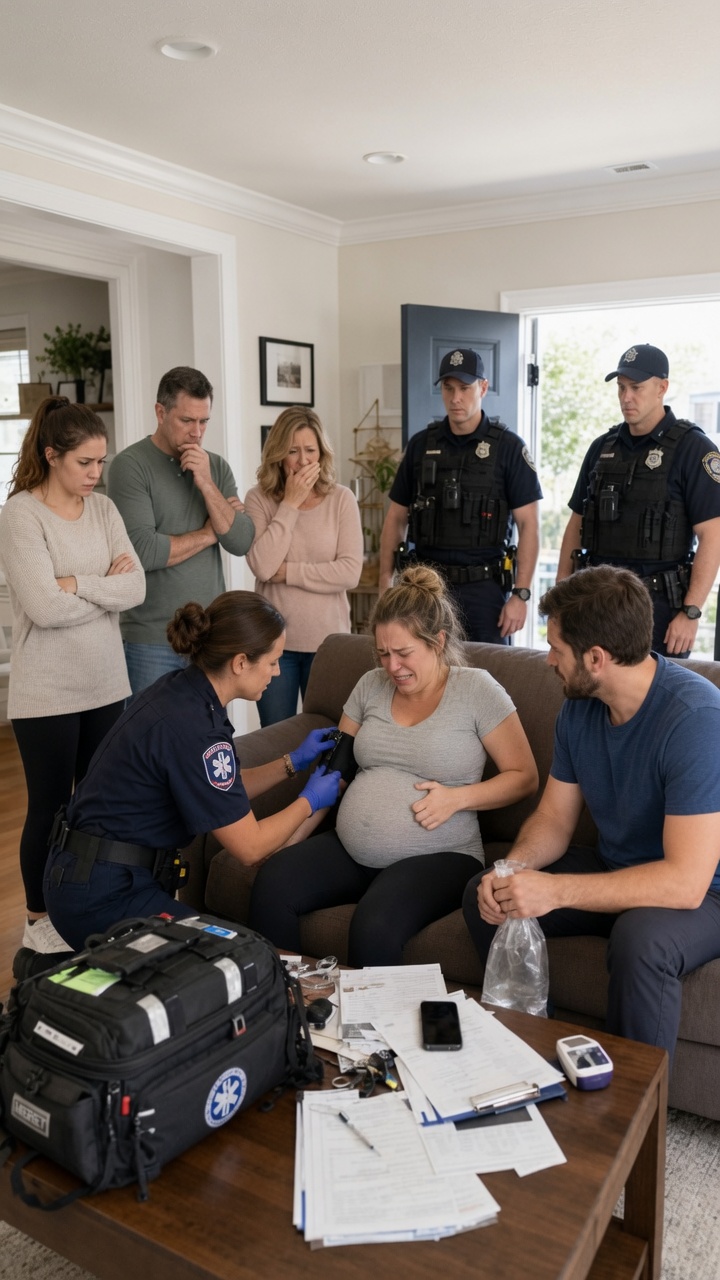
The ambulance had arrived because she managed to drag herself to the phone and call 911.
The paramedics found her nearly unconscious, bleeding, with dangerously low blood pressure and signs of fetal distress.
She was rushed to Hospital Ángeles, where they performed an emergency C-section.
The girls were born small.
Very small.
But alive.
Rodrigo reached the end of the letter, and his knees hit the floor.
“Today your daughters were born. You weren’t there because you chose to take your mother shopping. From this moment on, any communication will be through my lawyer.”
Rodrigo’s phone rang just then.
He answered with shaking hands.
—Is this Mr. Rodrigo Salcedo? —a serious voice asked.
—Yes…
—This is Attorney Adrián Treviño. I represent your wife, Mariana. You are informed that the hospital has been instructed to prevent any unauthorized attempts to enter the neonatal area.
—I want to see her —Rodrigo said, breaking down—. I need to see my daughters.
—That will need to be resolved by a family judge. You should also know that the DIF and the Public Ministry have been notified for possible abandonment during a medical emergency.
Doña Elvira approached furiously.
—Tell her not to be ridiculous! Those girls are our family!
The lawyer heard her.
—Precisely because of that, ma’am, authorities want to know why that family left a high-risk pregnant woman alone and bleeding on the floor.
Rodrigo closed his eyes.
The lawyer continued:
—Tomorrow you will receive formal notification. And I recommend you not approach the hospital.
The call ended.
For the first time in his life, Rodrigo didn’t look to his mother for permission.
He looked at her as if he was seeing her for the first time.
—You said it wasn’t serious —he whispered.
Doña Elvira lifted her chin.
—And it wasn’t. The girls are alive, aren’t they? See? All that fuss for nothing.
That “for nothing” felt like a slap to the face.
Rodrigo stood up slowly.
—They could have died.
—But they didn’t die.
Paulina looked down.
Don Ernesto sat down, aged all at once.
The next morning, two Public Ministry agents and a DIF worker knocked on the door.
Doña Elvira tried to act indignant.
—This is an exaggeration. My daughter-in-law has always been dramatic.
The worker opened a folder.
—We have the paramedics’ report, photographs of the residence, the recording of the 911 call, and the medical report from the gynecologist.
Then she looked at Rodrigo.
—Your wife had a written indication: “DO NOT DELAY TRANSPORTATION UNDER ANY CIRCUMSTANCES.” Did you know about this document?
Rodrigo swallowed hard.
—Yes.
—And you left anyway?
He looked at his mother.
For a second, Doña Elvira waited for her son to protect her, as always.
But this time, Rodrigo answered:
—Yes. I left.
Doña Elvira let out a scream.
—Because I asked him to! I didn’t know it would get this bad!
The agent stared at her without blinking.
—Ma’am, you were not obligated to care for your son’s wife. He was.
Rodrigo bowed his head.
That statement broke something inside him.
Meanwhile, Mariana was in the hospital, sitting next to the nursery, watching her daughters through the glass.
They were named Lucía and Renata.
Lucía was the most restless, moving her fingers as if she wanted to grasp the world.
Renata hardly cried, but when she opened her eyes, it seemed she was looking directly into her mother’s soul.
Mariana’s body was stitched, tired, and sore.
But her gaze was steady.
Her mom, Teresa, had arrived from Puebla as soon as she got the call. She didn’t scream, didn’t make a show. She just hugged Mariana and said:
—Daughter, this time you’re not going back to that house.
Mariana didn’t respond.
She signed.
She signed the divorce petition.
She signed the provisional custody.
She signed the protection measures.
And when the lawyer asked if she was sure, she looked at her daughters connected to monitors and replied:
—I’m more sure than ever.
But the hardest blow came three days later.
A nurse sought out Mariana with a strange look.
—There’s something you need to know.
She explained that when the paramedics entered the house, one had a body camera due to internal security protocol.
The recording showed Mariana opening the door, almost unable to stand.
It showed the blood.
It showed her voice, barely a thread, saying:
—My husband left… please save my babies.
Mariana didn’t want to watch the full video.
She didn’t need to.
But her lawyer did.
And so did the judge.
On the day of the family hearing, Rodrigo arrived without his mother.
That surprised everyone.
Doña Elvira had tried to enter but was prohibited from approaching Mariana and the girls. She stayed outside, shouting that they were humiliating her, that they were stealing her granddaughters, that in Mexico, family matters were settled at home.
But that was precisely the problem.
For years, everything had been “settled at home.”
Every slight.
Every insult disguised as advice.
Every decision where Mariana was the last to know.
Doña Elvira had chosen the wedding menu.
She had chosen the color of the girls’ room.
She had decided which visits were “allowed.”
And Rodrigo, with his eternal “don’t listen to her, that’s just my mom,” had allowed everything to grow like mold on the walls.
Until the mold brought the whole house down.
In the courtroom, the judge reviewed the documents.
The medical report stated that the delay worsened the situation.
The 911 call recorded the exact minutes.
The camera showed the abandonment.
Rodrigo didn’t deny anything.
When it was his turn to speak, he stood up.
His beard was unkempt, his eyes hollow, and a shame he couldn’t hide.
—I’m not going to justify myself —he said—. Because there’s no way. My wife asked me for help, and I chose to obey my mother. My daughters were born without me because I was a coward.
Mariana didn’t cry.
She had already cried too much.
Rodrigo turned toward her.
—I’m not asking for forgiveness for you to come back. I know that’s not going to happen. I just want them to know someday that I do love them.
Mariana held his gaze.
—Love that arrives late doesn’t warm an emergency room, Rodrigo.
He lowered his head.
The judge granted provisional full custody to Mariana, supervised visits for Rodrigo, and a permanent order barring Doña Elvira from coming near the girls.
Doña Elvira exploded outside.
—Mariana will pay for this! Those girls are Salcedo!
Teresa, Mariana’s mother, came out of the courthouse carrying a diaper bag.
She stopped in front of her.
—No, ma’am. Those girls are not a surname. They are two lives. And you almost lost them for going dress shopping.
The people waiting in the hallway stared.
Someone recorded it.
The video went viral on Facebook that same night.
Thousands of comments divided.
Some said Mariana did right.
Others questioned whether a woman should separate the girls from their father for “a mistake.”
But those who had seen the photos from the living room, the medical report, and the letter knew it wasn’t a mistake.
It was a choice.
Months later, Mariana rented a small house in Querétaro, close to her mom.
It wasn’t big.
It didn’t have expensive furniture.
It didn’t have a mother-in-law commenting from the kitchen.
But it had peace.
Lucía and Renata grew up among soft blankets, lullabies, and afternoons in the yard.
Rodrigo completed his supervised visits.
He never brought Doña Elvira again.
In fact, he stopped living with his parents.
One day, during a visit, he handed Mariana a sealed letter.
—It’s not for you —he said—. It’s for them, when they’re older. I’m not asking for anything.
Mariana put it away.
Not because she forgave him.
But because one day her daughters would have questions.
And they deserved a complete truth, not a comfortable lie.
Justice doesn’t always come as prison, screams, or revenge.
Sometimes it arrives as a closed door.
As a mother who decides not to return.
As two girls growing up in a house where no one has to beg to be chosen.
And every time Mariana saw Lucía and Renata sleeping, she remembered that terrible afternoon not as the day her husband abandoned her.
But as the day she stopped abandoning herself.





