PART 1
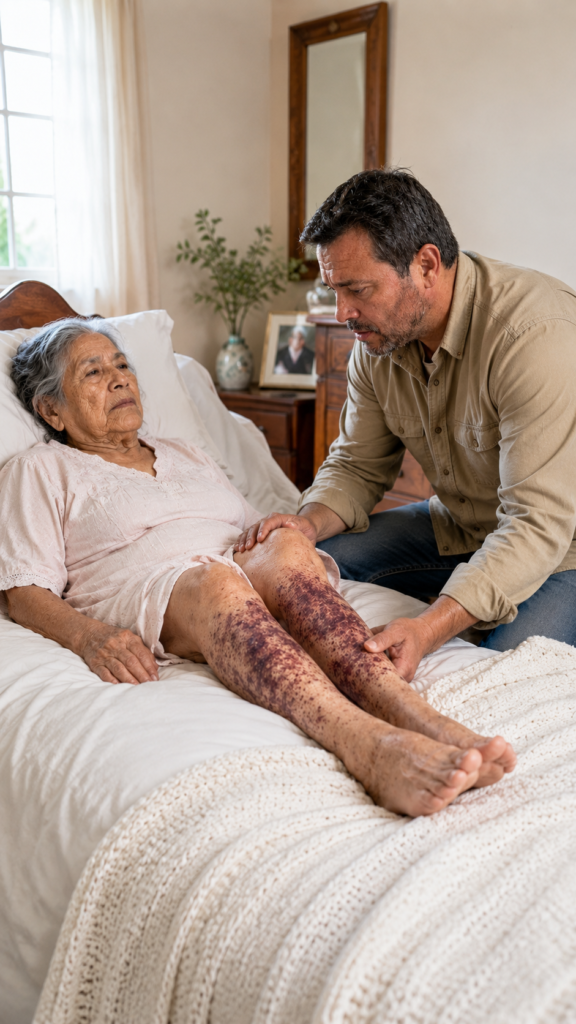
Doña Amparo was locked away in the room on the second floor, while her daughter-in-law, immaculate and perfumed, told the neighbors that the poor woman was 'losing her mind.'
The house stood in a quiet neighborhood of Tlalpan, adorned with bougainvillea over the gate, clay pots at the entrance, and a Virgin of Guadalupe gazing from the foyer.
Everything seemed normal.
Until Julián Mendoza returned from the barracks.
He arrived with dusty boots, a military backpack slung over his shoulder, and the tired face of someone who had spent months away from home. He had imagined this return countless times: his mother’s coffee, his wife Karla’s embrace, the smell of sweet bread on the table.
But as soon as he stepped out of the taxi, he heard a voice that froze his blood.
—Julián! Don’t leave me locked up here!
The scream came from above.
Karla appeared at the door almost instantly. She wore a beige dress, golden earrings, and a smile that was too perfect.
—My love… what a surprise. You didn’t say you were coming home today.
Julián looked at her without embracing her.
—Why is my mom screaming?
Karla sighed, as if burdened by a heavy sorrow.
—She’s at it again. I told you she’s not well. She gets confused, becomes aggressive, makes things up. Yesterday, she tried to go out in her nightgown.
Doña Meche, the neighbor, stood by the gate with a sympathetic look.
—Poor doña Amparo. She was such a refined lady.
Julián raised his gaze to the window. The curtain moved slightly. She didn’t seem like a confused woman. She seemed like someone begging for help.
—And that’s why you locked her up? —he asked.
Karla lowered her voice.
—For her safety, Julián. You don’t understand what it’s been like for me to care for her alone.
He didn’t argue. In the barracks, he had learned that when someone lies, it’s best to let them talk.
He entered the house, left his backpack in the living room, and feigned exhaustion.
—I’m going to take a shower.
Karla smiled, relieved.
But Julián didn’t go to the bathroom.
He went straight to his wife’s vanity. He knew where she kept what she didn’t want anyone to touch: a small wooden box with necklaces, receipts, and keys.
There it was.
A small key wrapped in a white handkerchief.
He ascended the stairs quietly. When he opened the door to the room, he felt his chest crack.
Doña Amparo was sitting on the floor. The bed had no sheets. On the nightstand, there was a glass of lukewarm water and a plate with one dry tortilla. His mother wore the same purple blouse she had on during their last video call five days ago.
She had bruises on her wrists.
—Mom...
Doña Amparo lifted her face. Her eyes were not lost. They were furious.
—I’m not crazy, son.
Julián knelt in front of her.
—I know.
She swallowed hard.
—Karla took my phone, hid my medicine, and told everyone that I see things. When I tried to call your uncle, she yanked my arm and locked me in here.
Before Julián could respond, footsteps echoed in the hallway.
Doña Amparo changed her expression in an instant. She opened her mouth, her gaze went vacant, and she began to sway as if she didn’t understand anything.
—Not yet —she barely whispered—. She’s watching me.
Julián understood.
He closed the door from the outside, hating himself with each click of the lock.
Karla appeared at the end of the hallway.
—Is everything okay?
He held her gaze.
—Yes. I just wanted to see her.
That night, Karla served soup, wine, and a complete lie on the table.
She talked about dementia, private clinics, doctors, and a document that Julián needed to sign 'for his mother’s sake.'
—It’s just a power of attorney —she said—. To manage her accounts and sell the old house in Coyoacán before it’s too late.
Julián looked at the papers.
He said nothing.
But at 12:17 AM, when Karla was already asleep, he opened his laptop and found transfers of 92,000 pesos from doña Amparo’s account, emails with a real estate agent named Darío Salvatierra, and a nearly finalized contract to sell the family home.
Then he went back to his mother’s room.
—Tomorrow, I need you to act confused in front of her.
Doña Amparo looked at her marked wrists.
Then she smiled with a calmness that was frightening.
—Tell me, son… how crazy do you want me to look?
PART 2
The next morning, doña Amparo came down to the kitchen wearing a clean robe that Julián had passed her before dawn. She walked slowly, dragging her feet, staring at the walls as if she didn’t recognize her own house.
Karla was preparing capsule coffee, too calm for a woman who claimed to be shattered from caring for a sick elderly woman.
—Does the bus to Xochimilco stop here? —doña Amparo asked, pointing at the refrigerator.
Karla looked at Julián with a weary expression.
—See? This is every day. Honestly, love, I can’t take it anymore.
Doña Amparo picked up the sugar bowl and dropped it on the floor.
The crash startled everyone.
Karla reacted quickly. Too quickly. She squeezed the woman’s wrist so hard that the skin turned white.
—Stop your little theatrics —she whispered in her ear—. Today your show ends.
Julián glanced down at his plate.
Under the table, his cell phone was recording.
—Karla, chill —he said—. Remember she’s sick.
She let out a dry laugh.
—Finally, you’re getting it.
After breakfast, Karla placed a folder on the table. There was an appointment at 10:00 AM the next day with Dr. Marcela Rivas, a mental capacity specialist. If doña Amparo was declared incompetent, Julián would sign guardianship papers, and Karla could manage her assets.
—The Coyoacán house sells fast —she said—. With that, we can put her in a nice care facility. One with a garden and nurses.
—That house belonged to my dad —Julián replied.
—And now it’s a problem —Karla said without thinking.
That’s when her mask fell.
It wasn’t care.
It was money.
That afternoon, Julián moved as if he were still on a military investigation. He called an old comrade who now worked in the Prosecutor’s Office. He requested to review transfers, bank access, and suspicious emails.
What he found was worse than he had imagined.
Doña Amparo’s bank statements had been redirected to Karla’s personal email. The old woman’s signature appeared scanned on three documents. There was a promise of sale below the real value of the house. And the buyer was a company linked to Darío Salvatierra.
A locksmith certified that the lock on the room had been modified to open only from the outside.
A military doctor photographed doña Amparo’s bruises and wrote a clear report: the marks did not appear from falling, but from violent restraint.
But the turning point came when doña Amparo recalled something.
—Check your dad’s bookshelf —she told Julián—. The bottom one, where he kept old cables.
Julián found a small camera hidden inside an old smoke detector. His father had installed it years ago when there was a robbery on the street, and no one had remembered it since.
Karla had erased the new cameras in the house.
But not this one.
The video left him breathless.
Karla dragging doña Amparo down the hallway. Karla taking away her phone. Karla locking her up. Karla practicing in front of the mirror with a trembling voice:
—My mother-in-law can no longer distinguish reality.
Then another scene appeared.
Darío Salvatierra was in the kitchen, kissing Karla.
—Once she’s deemed incompetent, the house will sell cheap and clean —he said.
—Julián will sign —Karla replied—. He’s military. He follows orders.
That phrase burned him more than anything.
That night, during dinner, Karla drank wine and spoke as if she had already won.
—Your mom has always hated me —she said—. Now she’s just a pity.
—Maybe she’ll recover —Julián replied.
—From dementia? Don’t be naive.
—I meant her wrists.
A heavy silence fell.
Karla set the glass down on the table.
—Be careful with what you’re implying.
Julián looked at her calmly.
—I just want to understand.
She leaned in, her eyes hard.
—No one will believe an old woman locked away before they believe me. I’ve told everyone she screams, lies, falls, and forgets. Tomorrow, a doctor will put it in writing.
Julián raised his glass.
—Then let’s toast to tomorrow.
Karla clinked her glass, unaware that she had just condemned herself.
The next day, Karla dressed as if she were going to a TV audition: white blazer, red lips, perfect hair, and a folder full of lies tucked under her arm.
Doña Amparo sat in the back seat, looking at the jacarandas along the avenue. She wasn’t crying. She wasn’t trembling. She seemed like a woman who had decided to reclaim her name.
In Dr. Marcela Rivas’s office, Karla handed over her documents first.
—Doctor, we really are worried. My mother-in-law invents things, becomes violent, and no longer recognizes reality properly.
The doctor nodded.
Julián waited one minute.
Then he placed another folder on the desk.
—Before we begin, you need to see this.
The doctor opened the folder. Her expression changed as she reviewed the photos, the locksmith’s report, the transfers, the emails, the medical report, and the memory card with videos.
Without raising her voice, she asked to close the door.
—The evaluation will be thorough —she said—. But not just for doña Amparo.
Karla frowned.
—What does that mean?
—It means that no one here is going to speak over anyone else.
For 45 minutes, doña Amparo answered everything accurately. She stated her full name, her address, the date, her medications, the bank where she had her account, the deed number for the Coyoacán house, and even the name of the notary who assisted her when her husband died.
Then she recounted every instance of being locked away.
Every threat.
Every day without a phone.
Every plate of cold food.
Karla stood up abruptly.
—She practiced! Julián manipulated her!
The doctor looked directly at her.
—Mrs. Karla, why was a lucid adult locked in a room whose lock opened only from the outside?
—It was for her safety.
—And why did she have bruises consistent with struggle?
Karla turned to Julián.
—Tell them the truth. I’m your wife.
Julián placed his cell phone on the desk and hit play.
Karla’s voice filled the room.
—No one will believe an old woman locked away before they believe me.
Karla turned pale.
Then came the recording of Darío talking about selling the house below its value. After that, the video played: Karla dragging doña Amparo down the hallway, taking away her phone, and locking the door.
Karla attempted to snatch the phone away.
But the side door opened.
Two Prosecutor’s agents entered.
—Karla Villaseñor, you are under arrest for probable abuse of an elderly person, illegal deprivation of liberty, forgery, and attempted property fraud.
—This is a trap! —she screamed as they placed the handcuffs on her.
Doña Amparo stood up.
—No, Karla. The trap was my door.
Karla looked at Julián with hatred.
—You slept with me! You owed me loyalty!
He didn’t look away.
—I owed my mother protection.
At that moment, Karla broke down. She began blaming Darío, the stress, the money, the house, the made-up illness, and even doña Amparo for 'provoking her.' Everything was recorded.
That same day, Darío was arrested while trying to move the promise of sale at a notary in Roma.
Dr. Marcela signed a decisive report: doña Amparo was fully lucid and needed psychological support for trauma, not a facility against her will.
The judge froze the accounts touched by Karla, nullified the forged documents, and issued protective measures.
The neighbors who had whispered before looked down when they saw doña Amparo return to her home.
Doña Meche cried on the sidewalk.
—I’m so sorry, Amparito. I believed her.
Doña Amparo took her time to respond.
She looked at the gate, the bougainvillea, the window of the room where she had screamed so many times without anyone coming up.
—Sometimes people prefer a well-dressed lie over a desperate scream.
Months later, Karla accepted her guilt when she understood there was no longer any story she could invent. She lost her marriage, money, her perfect image, and the freedom she had robbed from another.
Darío received a harsher sentence when it was discovered he had used the same scheme against two more families.
Julián’s divorce took less than 20 minutes.
Doña Amparo ordered the lock of the room to be removed. She painted the walls light blue, placed an armchair by the window, and left a new phone on the nightstand, always charged.
The house began to smell like coffee and sweet bread again.
One afternoon, before returning to service, Julián found his mother preparing lemon pie.
—So, are you still confused, Mom?
Doña Amparo let out a soft laugh.
—Very much so, son. I forget why I was ever afraid of her.
In the hallway, a new camera was installed.
But this time it wasn’t watching a prison.
This time it was guarding peace.
And the question lingered among all the neighbors: how many elderly people are still screaming behind a door while their family prefers to believe the one who appears more elegant?





